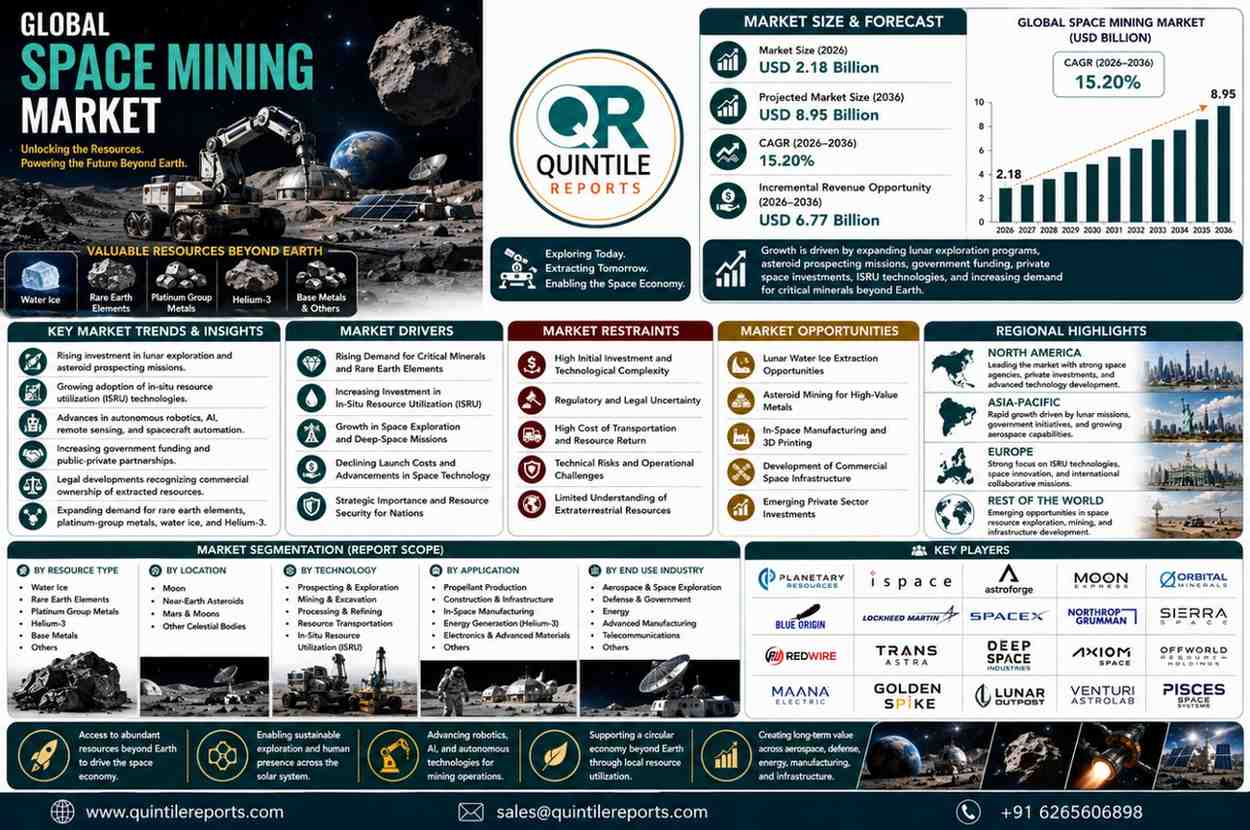
The global Space Mining Market was valued at USD 2.18 billion in 2026 and is projected to reach USD 8.95 billion by 2036, expanding at a CAGR of 15.20% during the forecast period. Space mining is rapidly evolving from a conceptual vision into a strategic component of the global space economy, driven by increasing investments in lunar exploration, asteroid missions, and in-situ resource utilization (ISRU). The extraction of water ice, rare earth elements, platinum-group metals, Helium-3, and other valuable resources from the Moon and near-Earth asteroids has the potential to transform future space exploration by reducing dependence on Earth-based supplies while enabling sustainable lunar habitats, deep-space missions, and commercial space infrastructure.
Growing collaboration between national space agencies and private aerospace companies is accelerating the commercialization of space resource utilization. Advances in autonomous robotics, artificial intelligence, remote sensing, spacecraft propulsion, additive manufacturing, and precision navigation are making extraterrestrial resource exploration increasingly feasible. Government initiatives such as NASA's Artemis Program, China's lunar exploration roadmap, ESA's ISRU programs, and Japan's asteroid exploration missions are strengthening long-term market prospects. As legal frameworks governing commercial space resources continue to mature and launch costs decline, the market is expected to witness substantial investment across aerospace, defense, energy, advanced manufacturing, and space infrastructure sectors.
Growth is driven by expanding lunar exploration programs, asteroid prospecting missions, government funding, private space investments, ISRU technologies, and increasing demand for critical minerals beyond Earth.
Rising Demand for Critical Minerals and Rare Earth Elements
Growing global demand for rare earth elements, platinum-group metals, and other critical minerals used in electronics, clean energy systems, aerospace, and defense technologies is a major driver of the Space Mining Market. Near-Earth asteroids and lunar regolith are believed to contain abundant deposits of these strategic resources, offering a potential long-term alternative to Earth's finite mineral reserves. As governments seek to secure critical raw material supply chains, extraterrestrial resource extraction is gaining significant strategic importance.
Increasing Investment in In-Situ Resource Utilization (ISRU)
Space agencies and commercial aerospace companies are investing heavily in in-situ resource utilization (ISRU) technologies to reduce dependence on Earth-based supplies. Extracting water ice from the Moon or asteroids for conversion into hydrogen and oxygen-based rocket propellants can significantly reduce mission costs while supporting lunar bases, deep-space exploration, and long-duration human spaceflight. ISRU is increasingly recognized as a foundational technology for sustainable space infrastructure.
Advancements in Autonomous Robotics and Artificial Intelligence
Rapid progress in autonomous robotics, artificial intelligence, machine vision, remote sensing, and precision navigation is improving the technical feasibility of extraterrestrial mining operations. These technologies enable robotic prospecting, excavation, material processing, and autonomous decision-making in harsh space environments while minimizing human intervention, operational risk, and mission costs. Continued innovation in space robotics is expected to accelerate commercialization of future mining missions.
Growing Government Support and National Space Programs
Governments across the United States, China, Japan, Europe, and other spacefaring nations are prioritizing space resource utilization within their long-term exploration strategies. National lunar exploration programs, public-private partnerships, increased research funding, and investments in advanced spacecraft technologies are strengthening the commercial outlook for space mining while reinforcing geopolitical competitiveness in the emerging space economy.
Supportive Regulatory Frameworks Encouraging Commercial Investment
Progressive legislation recognizing commercial ownership of extracted space resources has significantly improved investor confidence. Legal frameworks such as the U.S. Commercial Space Launch Competitiveness Act and Luxembourg's Space Resources Law have established important precedents for commercial resource utilization, encouraging private companies to invest in mining technologies, lunar infrastructure, and asteroid exploration projects.
Significant Technological Complexity
Despite rapid technological progress, space mining remains one of the most technically challenging industries. Developing reliable excavation equipment, resource processing systems, autonomous operations, and transportation technologies capable of functioning under microgravity, extreme temperatures, radiation exposure, and harsh extraterrestrial environments continues to require extensive research, testing, and engineering innovation.
High Mission Costs and Long Commercialization Timelines
Space mining projects require exceptionally high capital investment across spacecraft development, launch services, mission operations, robotics, and resource processing technologies. The long timeline required to achieve commercial returns, coupled with significant technological and operational risks, continues to limit private investment and represents a major barrier to market expansion.
Regulatory and Legal Uncertainty
Although several countries have established national legislation supporting commercial space resource utilization, there is currently no universally accepted international legal framework governing extraterrestrial mining activities. Uncertainty surrounding the interpretation of international agreements such as the Outer Space Treaty creates legal and geopolitical challenges related to resource ownership, sovereignty, and commercial rights, potentially delaying future investment decisions.
Expansion of Permanent Lunar Infrastructure and Space Stations
The development of permanent lunar habitats, orbital space stations, and deep-space logistics infrastructure is creating substantial opportunities for commercial space mining and long-term resource utilization.
Commercial Asteroid Mining for High-Value Metals
Growing interest in extracting platinum-group metals, rare earth elements, and other valuable minerals from near-Earth asteroids is opening new commercial opportunities for future mining missions.
Growing Demand for Space-Based Fuel Production Using Extracted Water Ice
The utilization of lunar and asteroid water ice to produce hydrogen and oxygen propellants is expected to support sustainable space transportation, reduce launch costs, and enable long-duration exploration missions.
Development of Sustainable Off-Earth Manufacturing Ecosystems
Advancements in extraterrestrial resource processing and additive manufacturing are supporting the creation of sustainable off-Earth industrial ecosystems capable of producing construction materials, components, and infrastructure in space.
Increasing Participation from Private Aerospace Companies and Venture Capital Investors
Rising private investment, venture capital funding, and public-private partnerships are accelerating innovation, technology commercialization, and the long-term development of the global Space Mining Market.
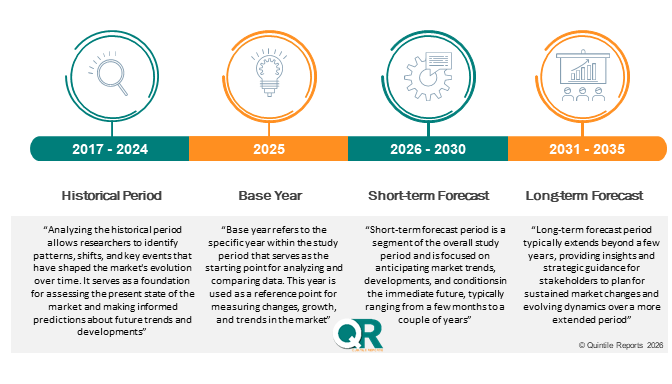
North America leads the market through NASA programs, private sector innovation, and supportive commercial space legislation.
Europe is strengthening its position through ESA-led ISRU programs, sustainability initiatives, and regulatory development.
Asia-Pacific is rapidly advancing with major lunar and asteroid exploration programs led by China and Japan.
Latin America is gradually expanding international collaboration and space research capabilities.
Middle East & Africa is emerging through growing investments in national space programs, particularly in the UAE.
North America dominates the global Space Mining Market through strong government funding, advanced aerospace capabilities, and an active commercial space ecosystem. NASA's Artemis Program, Commercial Lunar Payload Services (CLPS), and increasing private-sector participation continue to accelerate ISRU research and lunar resource exploration. The region also benefits from supportive legislation that encourages commercial ownership of extracted space resources.
Europe is strengthening its market position through coordinated initiatives led by the European Space Agency (ESA), regulatory advancements, and investments in sustainable lunar exploration technologies. Luxembourg's pioneering space resource legislation and growing collaboration between research institutions and private companies continue to stimulate innovation.
Asia-Pacific represents the fastest-growing regional market, driven by ambitious lunar exploration programs in China and Japan. China's lunar missions, asteroid exploration initiatives, and long-term plans for permanent lunar infrastructure, together with Japan's successful Hayabusa missions and expanding commercial space sector, continue to strengthen regional competitiveness. India is also increasing investments in lunar exploration and future ISRU capabilities.
Latin America is gradually expanding its role through international partnerships, research collaborations, and growing investment in national space capabilities.
The Middle East & Africa is emerging as a promising future market, supported by the UAE's long-term space exploration strategy and increasing regional investment in advanced space technologies.
The United States remains the global leader in space mining through strong collaboration between NASA, commercial aerospace companies, and private investors. Programs such as Artemis and CLPS are advancing lunar resource utilization, while companies including AstroForge and Off-World are developing technologies for asteroid and lunar mining. Supportive legislation and continued government investment position the U.S. at the forefront of commercial space resource development.
Germany plays a vital role in Europe's space mining ecosystem through ESA collaboration, robotics research, automation technologies, and advanced materials science. Strong investment in lunar technologies and ISRU research positions Germany as a leading contributor to future European resource utilization missions.
Japan has established global leadership in asteroid exploration through JAXA's Hayabusa missions and continued investment in lunar infrastructure. Public-private collaboration, including the activities of iSpace Inc., is supporting the commercialization of lunar resource utilization and future asteroid mining technologies.
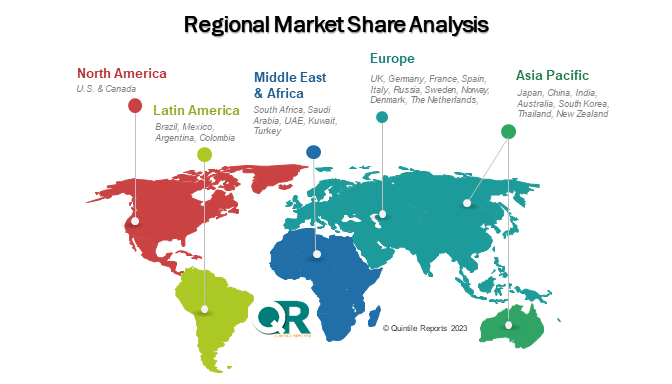
The global Space Mining Market is characterized by intense competition driven by technological innovation, government support, regulatory frameworks, and long-term investment in space exploration capabilities. Unlike traditional mining industries, competition is centered on the ability to develop advanced autonomous systems, in-situ resource utilization (ISRU) technologies, robotic mining platforms, spacecraft engineering, and extraterrestrial resource processing solutions. National space agencies and private aerospace companies are increasingly collaborating to accelerate the commercialization of lunar and asteroid resource extraction while reducing mission costs and technological risks.
The United States currently maintains the strongest competitive position due to its well-established space infrastructure, supportive legal environment, and vibrant commercial space ecosystem. Government initiatives led by NASA, including the Artemis Program and Commercial Lunar Payload Services (CLPS), combined with significant private sector participation, continue to drive innovation in lunar exploration, asteroid prospecting, and ISRU technologies. Companies developing autonomous mining robots, spacecraft, resource processing systems, and deep-space logistics platforms are strengthening the country's first-mover advantage in commercial space resource utilization.
Europe and Japan remain major innovation hubs through close collaboration between government agencies, research institutions, and private aerospace companies. The European Space Agency (ESA) continues to advance sustainable lunar exploration, robotics, and resource utilization technologies, while Luxembourg's progressive space resource legislation has established one of the world's most favorable regulatory environments for commercial investment. Japan has reinforced its technological leadership through successful asteroid exploration missions and continued investment in lunar infrastructure, positioning its aerospace industry as a key contributor to future commercial space mining operations.
China is rapidly expanding its competitive position through ambitious national space programs, lunar exploration missions, and long-term plans for permanent lunar infrastructure and extraterrestrial resource utilization. At the same time, emerging space nations including India, the United Arab Emirates, and South Korea are increasing investments in lunar exploration, advanced robotics, satellite technologies, and deep-space research, further intensifying global competition. Companies and agencies capable of integrating artificial intelligence, autonomous robotics, advanced remote sensing, precision navigation, and sustainable space technologies are expected to secure significant long-term competitive advantages as commercial space mining transitions from exploration to operational deployment.
The regulatory environment is becoming an increasingly important competitive differentiator. Countries that have established legal recognition of commercial ownership over extracted space resources, together with strong government funding, public-private partnerships, and advanced launch capabilities, are attracting greater private investment and accelerating technology commercialization. As international cooperation expands and the global space economy continues to mature, strategic alliances, intellectual property development, and scalable space infrastructure will remain central to competitive success.
Key market participants include Moon Express, iSpace Inc., Asteroid Mining Corporation, Off-World Inc., Trans Astronautica Corporation, Planetary Resources (ConsenSys), Deep Space Industries (Bradford Space), AstroForge, Shackleton Energy Company, SpaceFab.US, Karman+, NASA, ESA, JAXA, CNSA, Roscosmos, and other emerging commercial space technology companies and government space agencies.
Recent developments highlight the accelerating pace of investment and technological advancement within the global Space Mining Market. In May 2025, China National Space Administration successfully launched the Tianwen-2 asteroid sample-return mission aboard a Long March 3B launch vehicle from Xichang Satellite Launch Center. The mission targets the near-Earth asteroid Kamoʻoalewa (2016 HO3) with the objective of returning samples to Earth by 2027. Beyond advancing planetary science, the mission is expected to provide valuable geological data supporting future asteroid resource exploration, commercial mining feasibility, and planetary defense capabilities.
In August 2024, AstroForge announced its third asteroid mining mission, Vestri, scheduled for launch aboard Intuitive Machines' IM-3 lunar mission. The approximately 200 kg spacecraft is designed to rendezvous with a metallic near-Earth asteroid, representing one of the first privately funded missions targeting direct asteroid resource exploration beyond the Earth-Moon system. The mission marks a significant milestone in the commercialization of space mining and demonstrates growing confidence in private-sector participation within the emerging extraterrestrial resource economy.
| Report Scope | Details |
| Report Version | 2026 |
| Growth Rate | CAGR of 12.21 % from 2026 to 2036 |
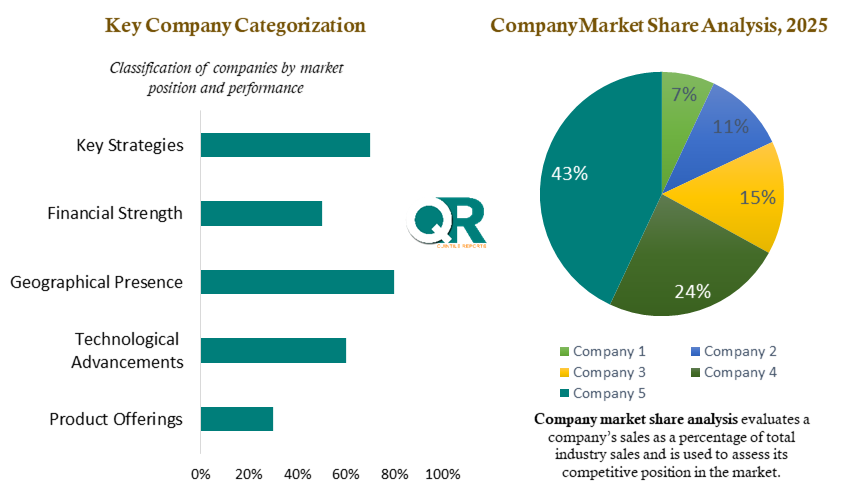
| Base Year | 2025 |
| Actual Estimates / Historical Data | 2017 - 2024 |
| Forecast Period | 2026 - 2036 |
| Quantitative Units | Revenue in USD million/billion & CAGR from 2026 to 2036 |
| Country Scope | North America (U.S., Canada), Europe (UK, Germany, France, Italy, Spain, Russia, Sweden, Denmark, Norway, Rest of Europe), Asia Pacific (Japan, China, India, Australia, South Korea, Thailand, Rest of Asia Pacific), Latin America (Brazil, Mexico, Argentina, Colombia, Rest of Latin America), Middle East & Africa (South Africa, Saudi Arabia, UAE, Kuwait, Rest of Middle East & Africa). |
| The Segment Covered by Phase |
|
| The Segment Covered by Resource Type |
|
| Companies Covered |
|
| Report Coverage | Revenue forecast, company share, competitive landscape, growth factors, technology trends, and regional analysis |
| Free Customization Scope (Equivalent to 5 Analyst Working Days) | If you require additional insights beyond the current scope, our analysts can customize the report to meet your specific business needs. |
This report combines extensive primary research with aerospace experts, space technology companies, research institutions, policymakers, and industry participants, alongside comprehensive secondary research from government space agencies, scientific publications, aerospace organizations, technical journals, and commercial industry databases. The study evaluates technology readiness, investment trends, regulatory developments, mission pipelines, competitive strategies, and commercialization opportunities across the global Space Mining Market. Every market estimate is validated through data triangulation, expert consultation, and advanced forecasting models, providing stakeholders with reliable and actionable market intelligence.
The research methodology integrates extensive primary interviews with executives from aerospace companies, space technology developers, government agencies, robotics specialists, and research organizations with detailed secondary research covering scientific publications, mission reports, regulatory frameworks, company filings, patent databases, and international space agency documentation. Market sizing was conducted using bottom-up and top-down methodologies, evaluating investments, mission activity, technology adoption, commercialization potential, and regional funding trends. Forecast models incorporate developments in lunar exploration, asteroid missions, reusable launch systems, AI-enabled mining technologies, ISRU adoption, government policies, and private investment activity. All findings undergo rigorous data triangulation and expert validation to ensure analytical accuracy and forecast reliability.

This report has been prepared by a team of experienced aerospace industry analysts, space technology researchers, advanced robotics specialists, and emerging technology consultants with expertise in commercial space exploration, satellite systems, planetary science, autonomous robotics, and extraterrestrial resource utilization. Leveraging a rigorous research framework that combines primary interviews, scientific analysis, market intelligence, and expert validation, the team delivers comprehensive insights into technology innovation, regulatory developments, competitive strategies, investment trends, and long-term opportunities shaping the global Space Mining Market.
Table 1 List of Abbreviation and Acronyms
Table 2 List of Sources
Table 3 North America Iron Ore Market, by Segment Analysis, (USD Million) 2017-2036
Table 4 North America Iron Ore Market, by Region, (USD Million) 2017-2036
Table 5 U.S. Iron Ore Market, by Segment Analysis, (USD Million) 2017-2036
Table 6 Canada Iron Ore Market, by Segment Analysis, (USD Million) 2017-2036
Table 7 Europe Iron Ore Market, by Segment Analysis, (USD Million) 2017-2036
Table 8 Europe Iron Ore Market, by Region, (USD Million) 2017-2036
Table 9 Germany Iron Ore Market, by Segment Analysis, (USD Million) 2017-2036
Table 10 U.K. Iron Ore Market, by Segment Analysis, (USD Million) 2017-2036
Table 11 France Iron Ore Market, by Segment Analysis, (USD Million) 2017-2036
Table 12 Italy Iron Ore Market, by Segment Analysis, (USD Million) 2017-2036
Table 13 Spain Iron Ore Market, by Segment Analysis, (USD Million) 2017-2036
Table 14 Sweden Iron Ore Market, by Segment Analysis, (USD Million) 2017-2036
Table 15 Denmark Iron Ore Market, by Segment Analysis, (USD Million) 2017-2036
Table 16 Norway Iron Ore Market, by Segment Analysis, (USD Million) 2017-2036
Table 17 The Netherlands Iron Ore Market, by Segment Analysis, (USD Million) 2017-2036
Table 18 Russia Iron Ore Market, by Segment Analysis, (USD Million) 2017-2036
Table 19 Asia Pacific Global Market, by Segment Analysis, (USD Million) 2017-2036
Table 20 Asia Pacific Iron Ore Market, by Region, (USD Million) 2017-2036
Table 21 China Iron Ore Market, by Segment Analysis, (USD Million) 2017-2036
Table 22 Japan Iron Ore Market, by Segment Analysis, (USD Million) 2017-2036
Table 23 India Iron Ore Market, by Segment Analysis, (USD Million) 2017-2036
Table 24 Australia Iron Ore Market, by Segment Analysis, (USD Million) 2017-2036
Table 25 South Korea Iron Ore Market, by Segment Analysis, (USD Million) 2017-2036
Table 26 Thailand Iron Ore Market, by Segment Analysis, (USD Million) 2017-2036
Table 27 Latin America Iron Ore Market, by Segment Analysis, (USD Million) 2017-2036
Table 28 Latin America Iron Ore Market, by Region, (USD Million) 2017-2036
Table 29 Brazil Iron Ore Market, by Segment Analysis, (USD Million) 2017-2036
Table 30 Mexico Iron Ore Market, by Segment Analysis, (USD Million) 2017-2036
Table 31 Argentina Iron Ore Market, by Segment Analysis, (USD Million) 2017-2036
Table 32 Middle East and Africa Iron Ore Market, by Segment Analysis, (USD Million) 2017-2036
Table 33 Middle East and Africa Iron Ore Market, by Region, (USD Million) 2017-2036
Table 34 South Africa Iron Ore Market, by Segment Analysis, (USD Million) 2017-2036
Table 35 Saudi Arabia Iron Ore Market, by Segment Analysis, (USD Million) 2017-2036
Table 36 UAE Iron Ore Market, by Segment Analysis, (USD Million) 2017-2036
Table 37 Kuwait Iron Ore Market, by Segment Analysis, (USD Million) 2017-2036
Table 38 Turkey Iron Ore Market, by Segment Analysis, (USD Million) 2017-2036
Fig.1 Market Research Process
Fig.2 Market Research Approaches
Fig.3 Global Iron Ore Market: Market Scenario
Fig.4 Global Iron Ore Market Competitive Outlook
Fig.5 Global Iron Ore Market Driver Analysis
Fig.6 Global Iron Ore Market Restraint Analysis
Fig.7 Global Iron Ore Market Opportunity Analysis
Fig.8 Global Iron Ore Market Trends Analysis
Fig.9 Global Iron Ore Market: Segment Analysis (Based on the Scope)
Fig.10 Global Iron Ore Market: Regional Analysis
Fig.11 Global Market Shares and Leading Market Players
Fig.12 North America Market Share and Leading Players
Fig.13 Europe Market Share and Leading Players
Fig.14 Asia Pacific Market Share and Leading Players
Fig.15 Latin America Market Share and Leading Players
Fig.16 Middle East & Africa Market Share and Leading Players
Fig.17 North America, by Country
Fig.18 North America
Fig.19 North America Market Estimates and Forecast, 2017-2036
Fig.20 U.S.
Fig.21 Canada
Fig.22 Europe
Fig.23 Europe Market Estimates and Forecast, 2017-2036
Fig.24 U.K.
Fig.25 Germany
Fig.26 France
Fig.27 Italy
Fig.28 Spain
Fig.29 Sweden
Fig.30 Denmark
Fig.31 Norway
Fig.32 The Netherlands
Fig.33 Russia
Fig.34 Asia Pacific
Fig.35 Asia Pacific Market Estimates and Forecast, 2017-2036
Fig.36 China
Fig.37 Japan
Fig.38 India
Fig.39 Australia
Fig.40 South Korea
Fig.41 Thailand
Fig.42 Latin America
Fig.43 Latin America Market Estimates and Forecast, 2017-2036
Fig.44 Brazil
Fig.45 Mexico
Fig.46 Argentina
Fig.47 Colombia
Fig.48 Middle East and Africa
Fig.49 Middle East and Africa Market Estimates and Forecast, 2017-2036
Fig.50 Saudi Arabia
Fig.51 South Africa
Fig.52 UAE
Fig.53 Kuwait
Fig.54 Turkey
Table 1 List of Abbreviation and Acronyms
Table 2 List of Sources
Table 3 North America Iron Ore Market, by Segment Analysis, (USD Million) 2017-2036
Table 4 North America Iron Ore Market, by Region, (USD Million) 2017-2036
Table 5 U.S. Iron Ore Market, by Segment Analysis, (USD Million) 2017-2036
Table 6 Canada Iron Ore Market, by Segment Analysis, (USD Million) 2017-2036
Table 7 Europe Iron Ore Market, by Segment Analysis, (USD Million) 2017-2036
Table 8 Europe Iron Ore Market, by Region, (USD Million) 2017-2036
Table 9 Germany Iron Ore Market, by Segment Analysis, (USD Million) 2017-2036
Table 10 U.K. Iron Ore Market, by Segment Analysis, (USD Million) 2017-2036
Table 11 France Iron Ore Market, by Segment Analysis, (USD Million) 2017-2036
Table 12 Italy Iron Ore Market, by Segment Analysis, (USD Million) 2017-2036
Table 13 Spain Iron Ore Market, by Segment Analysis, (USD Million) 2017-2036
Table 14 Sweden Iron Ore Market, by Segment Analysis, (USD Million) 2017-2036
Table 15 Denmark Iron Ore Market, by Segment Analysis, (USD Million) 2017-2036
Table 16 Norway Iron Ore Market, by Segment Analysis, (USD Million) 2017-2036
Table 17 The Netherlands Iron Ore Market, by Segment Analysis, (USD Million) 2017-2036
Table 18 Russia Iron Ore Market, by Segment Analysis, (USD Million) 2017-2036
Table 19 Asia Pacific Global Market, by Segment Analysis, (USD Million) 2017-2036
Table 20 Asia Pacific Iron Ore Market, by Region, (USD Million) 2017-2036
Table 21 China Iron Ore Market, by Segment Analysis, (USD Million) 2017-2036
Table 22 Japan Iron Ore Market, by Segment Analysis, (USD Million) 2017-2036
Table 23 India Iron Ore Market, by Segment Analysis, (USD Million) 2017-2036
Table 24 Australia Iron Ore Market, by Segment Analysis, (USD Million) 2017-2036
Table 25 South Korea Iron Ore Market, by Segment Analysis, (USD Million) 2017-2036
Table 26 Thailand Iron Ore Market, by Segment Analysis, (USD Million) 2017-2036
Table 27 Latin America Iron Ore Market, by Segment Analysis, (USD Million) 2017-2036
Table 28 Latin America Iron Ore Market, by Region, (USD Million) 2017-2036
Table 29 Brazil Iron Ore Market, by Segment Analysis, (USD Million) 2017-2036
Table 30 Mexico Iron Ore Market, by Segment Analysis, (USD Million) 2017-2036
Table 31 Argentina Iron Ore Market, by Segment Analysis, (USD Million) 2017-2036
Table 32 Middle East and Africa Iron Ore Market, by Segment Analysis, (USD Million) 2017-2036
Table 33 Middle East and Africa Iron Ore Market, by Region, (USD Million) 2017-2036
Table 34 South Africa Iron Ore Market, by Segment Analysis, (USD Million) 2017-2036
Table 35 Saudi Arabia Iron Ore Market, by Segment Analysis, (USD Million) 2017-2036
Table 36 UAE Iron Ore Market, by Segment Analysis, (USD Million) 2017-2036
Table 37 Kuwait Iron Ore Market, by Segment Analysis, (USD Million) 2017-2036
Table 38 Turkey Iron Ore Market, by Segment Analysis, (USD Million) 2017-2036
Fig.1 Market Research Process
Fig.2 Market Research Approaches
Fig.3 Global Iron Ore Market: Market Scenario
Fig.4 Global Iron Ore Market Competitive Outlook
Fig.5 Global Iron Ore Market Driver Analysis
Fig.6 Global Iron Ore Market Restraint Analysis
Fig.7 Global Iron Ore Market Opportunity Analysis
Fig.8 Global Iron Ore Market Trends Analysis
Fig.9 Global Iron Ore Market: Segment Analysis (Based on the Scope)
Fig.10 Global Iron Ore Market: Regional Analysis
Fig.11 Global Market Shares and Leading Market Players
Fig.12 North America Market Share and Leading Players
Fig.13 Europe Market Share and Leading Players
Fig.14 Asia Pacific Market Share and Leading Players
Fig.15 Latin America Market Share and Leading Players
Fig.16 Middle East & Africa Market Share and Leading Players
Fig.17 North America, by Country
Fig.18 North America
Fig.19 North America Market Estimates and Forecast, 2017-2036
Fig.20 U.S.
Fig.21 Canada
Fig.22 Europe
Fig.23 Europe Market Estimates and Forecast, 2017-2036
Fig.24 U.K.
Fig.25 Germany
Fig.26 France
Fig.27 Italy
Fig.28 Spain
Fig.29 Sweden
Fig.30 Denmark
Fig.31 Norway
Fig.32 The Netherlands
Fig.33 Russia
Fig.34 Asia Pacific
Fig.35 Asia Pacific Market Estimates and Forecast, 2017-2036
Fig.36 China
Fig.37 Japan
Fig.38 India
Fig.39 Australia
Fig.40 South Korea
Fig.41 Thailand
Fig.42 Latin America
Fig.43 Latin America Market Estimates and Forecast, 2017-2036
Fig.44 Brazil
Fig.45 Mexico
Fig.46 Argentina
Fig.47 Colombia
Fig.48 Middle East and Africa
Fig.49 Middle East and Africa Market Estimates and Forecast, 2017-2036
Fig.50 Saudi Arabia
Fig.51 South Africa
Fig.52 UAE
Fig.53 Kuwait
Fig.54 Turkey
Space mining refers to the exploration and extraction of valuable resources such as water ice, rare earth elements, platinum-group metals, and Helium-3 from the Moon, asteroids, and other celestial bodies for scientific and commercial use.
ISRU is the process of collecting and using locally available resources in space instead of transporting materials from Earth. It enables the production of fuel, water, oxygen, and construction materials for long-duration space missions.
Water ice can be converted into hydrogen and oxygen, which are used as rocket propellants and life-support resources, making it essential for sustainable lunar bases and deep-space exploration.
Potential resources include water ice, platinum-group metals, rare earth elements, nickel, cobalt, iron, Helium-3, and other strategic minerals found on the Moon and near-Earth asteroids.
The United States, China, Japan, and several European countries are leading the market through government space programs, private aerospace investments, and advanced lunar and asteroid exploration missions.
Key technologies include autonomous robotics, artificial intelligence, remote sensing, precision navigation, spacecraft propulsion, additive manufacturing, and advanced in-situ resource utilization systems.
Major challenges include high mission costs, technological complexity, long commercialization timelines, harsh space environments, and evolving international legal and regulatory frameworks.
The global Space Mining Market is expected to grow at a CAGR of 15.20% between 2026 and 2036.
The global Space Mining Market was valued at USD 2.18 billion in 2026 and is projected to reach USD 8.95 billion by 2036, expanding at a CAGR of 15.20% during the forecast period. Space mining is rapidly evolving from a conceptual vision into a strategic component of the global space economy, driven by increasing investments in lunar exploration, asteroid missions, and in-situ resource utilization (ISRU). The extraction of water ice, rare earth elements, platinum-group metals, Helium-3, and other valuable resources from the Moon and near-Earth asteroids has the potential to transform future space exploration by reducing dependence on Earth-based supplies while enabling sustainable lunar habitats, deep-space missions, and commercial space infrastructure.
Growing collaboration between national space agencies and private aerospace companies is accelerating the commercialization of space resource utilization. Advances in autonomous robotics, artificial intelligence, remote sensing, spacecraft propulsion, additive manufacturing, and precision navigation are making extraterrestrial resource exploration increasingly feasible. Government initiatives such as NASA's Artemis Program, China's lunar exploration roadmap, ESA's ISRU programs, and Japan's asteroid exploration missions are strengthening long-term market prospects. As legal frameworks governing commercial space resources continue to mature and launch costs decline, the market is expected to witness substantial investment across aerospace, defense, energy, advanced manufacturing, and space infrastructure sectors.
Growth is driven by expanding lunar exploration programs, asteroid prospecting missions, government funding, private space investments, ISRU technologies, and increasing demand for critical minerals beyond Earth.
Rising Demand for Critical Minerals and Rare Earth Elements
Growing global demand for rare earth elements, platinum-group metals, and other critical minerals used in electronics, clean energy systems, aerospace, and defense technologies is a major driver of the Space Mining Market. Near-Earth asteroids and lunar regolith are believed to contain abundant deposits of these strategic resources, offering a potential long-term alternative to Earth's finite mineral reserves. As governments seek to secure critical raw material supply chains, extraterrestrial resource extraction is gaining significant strategic importance.
Increasing Investment in In-Situ Resource Utilization (ISRU)
Space agencies and commercial aerospace companies are investing heavily in in-situ resource utilization (ISRU) technologies to reduce dependence on Earth-based supplies. Extracting water ice from the Moon or asteroids for conversion into hydrogen and oxygen-based rocket propellants can significantly reduce mission costs while supporting lunar bases, deep-space exploration, and long-duration human spaceflight. ISRU is increasingly recognized as a foundational technology for sustainable space infrastructure.
Advancements in Autonomous Robotics and Artificial Intelligence
Rapid progress in autonomous robotics, artificial intelligence, machine vision, remote sensing, and precision navigation is improving the technical feasibility of extraterrestrial mining operations. These technologies enable robotic prospecting, excavation, material processing, and autonomous decision-making in harsh space environments while minimizing human intervention, operational risk, and mission costs. Continued innovation in space robotics is expected to accelerate commercialization of future mining missions.
Growing Government Support and National Space Programs
Governments across the United States, China, Japan, Europe, and other spacefaring nations are prioritizing space resource utilization within their long-term exploration strategies. National lunar exploration programs, public-private partnerships, increased research funding, and investments in advanced spacecraft technologies are strengthening the commercial outlook for space mining while reinforcing geopolitical competitiveness in the emerging space economy.
Supportive Regulatory Frameworks Encouraging Commercial Investment
Progressive legislation recognizing commercial ownership of extracted space resources has significantly improved investor confidence. Legal frameworks such as the U.S. Commercial Space Launch Competitiveness Act and Luxembourg's Space Resources Law have established important precedents for commercial resource utilization, encouraging private companies to invest in mining technologies, lunar infrastructure, and asteroid exploration projects.
Significant Technological Complexity
Despite rapid technological progress, space mining remains one of the most technically challenging industries. Developing reliable excavation equipment, resource processing systems, autonomous operations, and transportation technologies capable of functioning under microgravity, extreme temperatures, radiation exposure, and harsh extraterrestrial environments continues to require extensive research, testing, and engineering innovation.
High Mission Costs and Long Commercialization Timelines
Space mining projects require exceptionally high capital investment across spacecraft development, launch services, mission operations, robotics, and resource processing technologies. The long timeline required to achieve commercial returns, coupled with significant technological and operational risks, continues to limit private investment and represents a major barrier to market expansion.
Regulatory and Legal Uncertainty
Although several countries have established national legislation supporting commercial space resource utilization, there is currently no universally accepted international legal framework governing extraterrestrial mining activities. Uncertainty surrounding the interpretation of international agreements such as the Outer Space Treaty creates legal and geopolitical challenges related to resource ownership, sovereignty, and commercial rights, potentially delaying future investment decisions.
Expansion of Permanent Lunar Infrastructure and Space Stations
The development of permanent lunar habitats, orbital space stations, and deep-space logistics infrastructure is creating substantial opportunities for commercial space mining and long-term resource utilization.
Commercial Asteroid Mining for High-Value Metals
Growing interest in extracting platinum-group metals, rare earth elements, and other valuable minerals from near-Earth asteroids is opening new commercial opportunities for future mining missions.
Growing Demand for Space-Based Fuel Production Using Extracted Water Ice
The utilization of lunar and asteroid water ice to produce hydrogen and oxygen propellants is expected to support sustainable space transportation, reduce launch costs, and enable long-duration exploration missions.
Development of Sustainable Off-Earth Manufacturing Ecosystems
Advancements in extraterrestrial resource processing and additive manufacturing are supporting the creation of sustainable off-Earth industrial ecosystems capable of producing construction materials, components, and infrastructure in space.
Increasing Participation from Private Aerospace Companies and Venture Capital Investors
Rising private investment, venture capital funding, and public-private partnerships are accelerating innovation, technology commercialization, and the long-term development of the global Space Mining Market.
North America leads the market through NASA programs, private sector innovation, and supportive commercial space legislation.
Europe is strengthening its position through ESA-led ISRU programs, sustainability initiatives, and regulatory development.
Asia-Pacific is rapidly advancing with major lunar and asteroid exploration programs led by China and Japan.
Latin America is gradually expanding international collaboration and space research capabilities.
Middle East & Africa is emerging through growing investments in national space programs, particularly in the UAE.
North America dominates the global Space Mining Market through strong government funding, advanced aerospace capabilities, and an active commercial space ecosystem. NASA's Artemis Program, Commercial Lunar Payload Services (CLPS), and increasing private-sector participation continue to accelerate ISRU research and lunar resource exploration. The region also benefits from supportive legislation that encourages commercial ownership of extracted space resources.
Europe is strengthening its market position through coordinated initiatives led by the European Space Agency (ESA), regulatory advancements, and investments in sustainable lunar exploration technologies. Luxembourg's pioneering space resource legislation and growing collaboration between research institutions and private companies continue to stimulate innovation.
Asia-Pacific represents the fastest-growing regional market, driven by ambitious lunar exploration programs in China and Japan. China's lunar missions, asteroid exploration initiatives, and long-term plans for permanent lunar infrastructure, together with Japan's successful Hayabusa missions and expanding commercial space sector, continue to strengthen regional competitiveness. India is also increasing investments in lunar exploration and future ISRU capabilities.
Latin America is gradually expanding its role through international partnerships, research collaborations, and growing investment in national space capabilities.
The Middle East & Africa is emerging as a promising future market, supported by the UAE's long-term space exploration strategy and increasing regional investment in advanced space technologies.
The United States remains the global leader in space mining through strong collaboration between NASA, commercial aerospace companies, and private investors. Programs such as Artemis and CLPS are advancing lunar resource utilization, while companies including AstroForge and Off-World are developing technologies for asteroid and lunar mining. Supportive legislation and continued government investment position the U.S. at the forefront of commercial space resource development.
Germany plays a vital role in Europe's space mining ecosystem through ESA collaboration, robotics research, automation technologies, and advanced materials science. Strong investment in lunar technologies and ISRU research positions Germany as a leading contributor to future European resource utilization missions.
Japan has established global leadership in asteroid exploration through JAXA's Hayabusa missions and continued investment in lunar infrastructure. Public-private collaboration, including the activities of iSpace Inc., is supporting the commercialization of lunar resource utilization and future asteroid mining technologies.
The global Space Mining Market is characterized by intense competition driven by technological innovation, government support, regulatory frameworks, and long-term investment in space exploration capabilities. Unlike traditional mining industries, competition is centered on the ability to develop advanced autonomous systems, in-situ resource utilization (ISRU) technologies, robotic mining platforms, spacecraft engineering, and extraterrestrial resource processing solutions. National space agencies and private aerospace companies are increasingly collaborating to accelerate the commercialization of lunar and asteroid resource extraction while reducing mission costs and technological risks.
The United States currently maintains the strongest competitive position due to its well-established space infrastructure, supportive legal environment, and vibrant commercial space ecosystem. Government initiatives led by NASA, including the Artemis Program and Commercial Lunar Payload Services (CLPS), combined with significant private sector participation, continue to drive innovation in lunar exploration, asteroid prospecting, and ISRU technologies. Companies developing autonomous mining robots, spacecraft, resource processing systems, and deep-space logistics platforms are strengthening the country's first-mover advantage in commercial space resource utilization.
Europe and Japan remain major innovation hubs through close collaboration between government agencies, research institutions, and private aerospace companies. The European Space Agency (ESA) continues to advance sustainable lunar exploration, robotics, and resource utilization technologies, while Luxembourg's progressive space resource legislation has established one of the world's most favorable regulatory environments for commercial investment. Japan has reinforced its technological leadership through successful asteroid exploration missions and continued investment in lunar infrastructure, positioning its aerospace industry as a key contributor to future commercial space mining operations.
China is rapidly expanding its competitive position through ambitious national space programs, lunar exploration missions, and long-term plans for permanent lunar infrastructure and extraterrestrial resource utilization. At the same time, emerging space nations including India, the United Arab Emirates, and South Korea are increasing investments in lunar exploration, advanced robotics, satellite technologies, and deep-space research, further intensifying global competition. Companies and agencies capable of integrating artificial intelligence, autonomous robotics, advanced remote sensing, precision navigation, and sustainable space technologies are expected to secure significant long-term competitive advantages as commercial space mining transitions from exploration to operational deployment.
The regulatory environment is becoming an increasingly important competitive differentiator. Countries that have established legal recognition of commercial ownership over extracted space resources, together with strong government funding, public-private partnerships, and advanced launch capabilities, are attracting greater private investment and accelerating technology commercialization. As international cooperation expands and the global space economy continues to mature, strategic alliances, intellectual property development, and scalable space infrastructure will remain central to competitive success.
Key market participants include Moon Express, iSpace Inc., Asteroid Mining Corporation, Off-World Inc., Trans Astronautica Corporation, Planetary Resources (ConsenSys), Deep Space Industries (Bradford Space), AstroForge, Shackleton Energy Company, SpaceFab.US, Karman+, NASA, ESA, JAXA, CNSA, Roscosmos, and other emerging commercial space technology companies and government space agencies.
Recent developments highlight the accelerating pace of investment and technological advancement within the global Space Mining Market. In May 2025, China National Space Administration successfully launched the Tianwen-2 asteroid sample-return mission aboard a Long March 3B launch vehicle from Xichang Satellite Launch Center. The mission targets the near-Earth asteroid Kamoʻoalewa (2016 HO3) with the objective of returning samples to Earth by 2027. Beyond advancing planetary science, the mission is expected to provide valuable geological data supporting future asteroid resource exploration, commercial mining feasibility, and planetary defense capabilities.
In August 2024, AstroForge announced its third asteroid mining mission, Vestri, scheduled for launch aboard Intuitive Machines' IM-3 lunar mission. The approximately 200 kg spacecraft is designed to rendezvous with a metallic near-Earth asteroid, representing one of the first privately funded missions targeting direct asteroid resource exploration beyond the Earth-Moon system. The mission marks a significant milestone in the commercialization of space mining and demonstrates growing confidence in private-sector participation within the emerging extraterrestrial resource economy.
| Report Scope | Details |
| Report Version | 2026 |
| Growth Rate | CAGR of 12.21 % from 2026 to 2036 |
| Base Year | 2025 |
| Actual Estimates / Historical Data | 2017 - 2024 |
| Forecast Period | 2026 - 2036 |
| Quantitative Units | Revenue in USD million/billion & CAGR from 2026 to 2036 |
| Country Scope | North America (U.S., Canada), Europe (UK, Germany, France, Italy, Spain, Russia, Sweden, Denmark, Norway, Rest of Europe), Asia Pacific (Japan, China, India, Australia, South Korea, Thailand, Rest of Asia Pacific), Latin America (Brazil, Mexico, Argentina, Colombia, Rest of Latin America), Middle East & Africa (South Africa, Saudi Arabia, UAE, Kuwait, Rest of Middle East & Africa). |
| The Segment Covered by Phase |
|
| The Segment Covered by Resource Type |
|
| Companies Covered |
|
| Report Coverage | Revenue forecast, company share, competitive landscape, growth factors, technology trends, and regional analysis |
| Free Customization Scope (Equivalent to 5 Analyst Working Days) | If you require additional insights beyond the current scope, our analysts can customize the report to meet your specific business needs. |
This report combines extensive primary research with aerospace experts, space technology companies, research institutions, policymakers, and industry participants, alongside comprehensive secondary research from government space agencies, scientific publications, aerospace organizations, technical journals, and commercial industry databases. The study evaluates technology readiness, investment trends, regulatory developments, mission pipelines, competitive strategies, and commercialization opportunities across the global Space Mining Market. Every market estimate is validated through data triangulation, expert consultation, and advanced forecasting models, providing stakeholders with reliable and actionable market intelligence.
The research methodology integrates extensive primary interviews with executives from aerospace companies, space technology developers, government agencies, robotics specialists, and research organizations with detailed secondary research covering scientific publications, mission reports, regulatory frameworks, company filings, patent databases, and international space agency documentation. Market sizing was conducted using bottom-up and top-down methodologies, evaluating investments, mission activity, technology adoption, commercialization potential, and regional funding trends. Forecast models incorporate developments in lunar exploration, asteroid missions, reusable launch systems, AI-enabled mining technologies, ISRU adoption, government policies, and private investment activity. All findings undergo rigorous data triangulation and expert validation to ensure analytical accuracy and forecast reliability.
This report has been prepared by a team of experienced aerospace industry analysts, space technology researchers, advanced robotics specialists, and emerging technology consultants with expertise in commercial space exploration, satellite systems, planetary science, autonomous robotics, and extraterrestrial resource utilization. Leveraging a rigorous research framework that combines primary interviews, scientific analysis, market intelligence, and expert validation, the team delivers comprehensive insights into technology innovation, regulatory developments, competitive strategies, investment trends, and long-term opportunities shaping the global Space Mining Market.
Table 1 List of Abbreviation and Acronyms
Table 2 List of Sources
Table 3 North America Iron Ore Market, by Segment Analysis, (USD Million) 2017-2036
Table 4 North America Iron Ore Market, by Region, (USD Million) 2017-2036
Table 5 U.S. Iron Ore Market, by Segment Analysis, (USD Million) 2017-2036
Table 6 Canada Iron Ore Market, by Segment Analysis, (USD Million) 2017-2036
Table 7 Europe Iron Ore Market, by Segment Analysis, (USD Million) 2017-2036
Table 8 Europe Iron Ore Market, by Region, (USD Million) 2017-2036
Table 9 Germany Iron Ore Market, by Segment Analysis, (USD Million) 2017-2036
Table 10 U.K. Iron Ore Market, by Segment Analysis, (USD Million) 2017-2036
Table 11 France Iron Ore Market, by Segment Analysis, (USD Million) 2017-2036
Table 12 Italy Iron Ore Market, by Segment Analysis, (USD Million) 2017-2036
Table 13 Spain Iron Ore Market, by Segment Analysis, (USD Million) 2017-2036
Table 14 Sweden Iron Ore Market, by Segment Analysis, (USD Million) 2017-2036
Table 15 Denmark Iron Ore Market, by Segment Analysis, (USD Million) 2017-2036
Table 16 Norway Iron Ore Market, by Segment Analysis, (USD Million) 2017-2036
Table 17 The Netherlands Iron Ore Market, by Segment Analysis, (USD Million) 2017-2036
Table 18 Russia Iron Ore Market, by Segment Analysis, (USD Million) 2017-2036
Table 19 Asia Pacific Global Market, by Segment Analysis, (USD Million) 2017-2036
Table 20 Asia Pacific Iron Ore Market, by Region, (USD Million) 2017-2036
Table 21 China Iron Ore Market, by Segment Analysis, (USD Million) 2017-2036
Table 22 Japan Iron Ore Market, by Segment Analysis, (USD Million) 2017-2036
Table 23 India Iron Ore Market, by Segment Analysis, (USD Million) 2017-2036
Table 24 Australia Iron Ore Market, by Segment Analysis, (USD Million) 2017-2036
Table 25 South Korea Iron Ore Market, by Segment Analysis, (USD Million) 2017-2036
Table 26 Thailand Iron Ore Market, by Segment Analysis, (USD Million) 2017-2036
Table 27 Latin America Iron Ore Market, by Segment Analysis, (USD Million) 2017-2036
Table 28 Latin America Iron Ore Market, by Region, (USD Million) 2017-2036
Table 29 Brazil Iron Ore Market, by Segment Analysis, (USD Million) 2017-2036
Table 30 Mexico Iron Ore Market, by Segment Analysis, (USD Million) 2017-2036
Table 31 Argentina Iron Ore Market, by Segment Analysis, (USD Million) 2017-2036
Table 32 Middle East and Africa Iron Ore Market, by Segment Analysis, (USD Million) 2017-2036
Table 33 Middle East and Africa Iron Ore Market, by Region, (USD Million) 2017-2036
Table 34 South Africa Iron Ore Market, by Segment Analysis, (USD Million) 2017-2036
Table 35 Saudi Arabia Iron Ore Market, by Segment Analysis, (USD Million) 2017-2036
Table 36 UAE Iron Ore Market, by Segment Analysis, (USD Million) 2017-2036
Table 37 Kuwait Iron Ore Market, by Segment Analysis, (USD Million) 2017-2036
Table 38 Turkey Iron Ore Market, by Segment Analysis, (USD Million) 2017-2036
Fig.1 Market Research Process
Fig.2 Market Research Approaches
Fig.3 Global Iron Ore Market: Market Scenario
Fig.4 Global Iron Ore Market Competitive Outlook
Fig.5 Global Iron Ore Market Driver Analysis
Fig.6 Global Iron Ore Market Restraint Analysis
Fig.7 Global Iron Ore Market Opportunity Analysis
Fig.8 Global Iron Ore Market Trends Analysis
Fig.9 Global Iron Ore Market: Segment Analysis (Based on the Scope)
Fig.10 Global Iron Ore Market: Regional Analysis
Fig.11 Global Market Shares and Leading Market Players
Fig.12 North America Market Share and Leading Players
Fig.13 Europe Market Share and Leading Players
Fig.14 Asia Pacific Market Share and Leading Players
Fig.15 Latin America Market Share and Leading Players
Fig.16 Middle East & Africa Market Share and Leading Players
Fig.17 North America, by Country
Fig.18 North America
Fig.19 North America Market Estimates and Forecast, 2017-2036
Fig.20 U.S.
Fig.21 Canada
Fig.22 Europe
Fig.23 Europe Market Estimates and Forecast, 2017-2036
Fig.24 U.K.
Fig.25 Germany
Fig.26 France
Fig.27 Italy
Fig.28 Spain
Fig.29 Sweden
Fig.30 Denmark
Fig.31 Norway
Fig.32 The Netherlands
Fig.33 Russia
Fig.34 Asia Pacific
Fig.35 Asia Pacific Market Estimates and Forecast, 2017-2036
Fig.36 China
Fig.37 Japan
Fig.38 India
Fig.39 Australia
Fig.40 South Korea
Fig.41 Thailand
Fig.42 Latin America
Fig.43 Latin America Market Estimates and Forecast, 2017-2036
Fig.44 Brazil
Fig.45 Mexico
Fig.46 Argentina
Fig.47 Colombia
Fig.48 Middle East and Africa
Fig.49 Middle East and Africa Market Estimates and Forecast, 2017-2036
Fig.50 Saudi Arabia
Fig.51 South Africa
Fig.52 UAE
Fig.53 Kuwait
Fig.54 Turkey
Table 1 List of Abbreviation and Acronyms
Table 2 List of Sources
Table 3 North America Iron Ore Market, by Segment Analysis, (USD Million) 2017-2036
Table 4 North America Iron Ore Market, by Region, (USD Million) 2017-2036
Table 5 U.S. Iron Ore Market, by Segment Analysis, (USD Million) 2017-2036
Table 6 Canada Iron Ore Market, by Segment Analysis, (USD Million) 2017-2036
Table 7 Europe Iron Ore Market, by Segment Analysis, (USD Million) 2017-2036
Table 8 Europe Iron Ore Market, by Region, (USD Million) 2017-2036
Table 9 Germany Iron Ore Market, by Segment Analysis, (USD Million) 2017-2036
Table 10 U.K. Iron Ore Market, by Segment Analysis, (USD Million) 2017-2036
Table 11 France Iron Ore Market, by Segment Analysis, (USD Million) 2017-2036
Table 12 Italy Iron Ore Market, by Segment Analysis, (USD Million) 2017-2036
Table 13 Spain Iron Ore Market, by Segment Analysis, (USD Million) 2017-2036
Table 14 Sweden Iron Ore Market, by Segment Analysis, (USD Million) 2017-2036
Table 15 Denmark Iron Ore Market, by Segment Analysis, (USD Million) 2017-2036
Table 16 Norway Iron Ore Market, by Segment Analysis, (USD Million) 2017-2036
Table 17 The Netherlands Iron Ore Market, by Segment Analysis, (USD Million) 2017-2036
Table 18 Russia Iron Ore Market, by Segment Analysis, (USD Million) 2017-2036
Table 19 Asia Pacific Global Market, by Segment Analysis, (USD Million) 2017-2036
Table 20 Asia Pacific Iron Ore Market, by Region, (USD Million) 2017-2036
Table 21 China Iron Ore Market, by Segment Analysis, (USD Million) 2017-2036
Table 22 Japan Iron Ore Market, by Segment Analysis, (USD Million) 2017-2036
Table 23 India Iron Ore Market, by Segment Analysis, (USD Million) 2017-2036
Table 24 Australia Iron Ore Market, by Segment Analysis, (USD Million) 2017-2036
Table 25 South Korea Iron Ore Market, by Segment Analysis, (USD Million) 2017-2036
Table 26 Thailand Iron Ore Market, by Segment Analysis, (USD Million) 2017-2036
Table 27 Latin America Iron Ore Market, by Segment Analysis, (USD Million) 2017-2036
Table 28 Latin America Iron Ore Market, by Region, (USD Million) 2017-2036
Table 29 Brazil Iron Ore Market, by Segment Analysis, (USD Million) 2017-2036
Table 30 Mexico Iron Ore Market, by Segment Analysis, (USD Million) 2017-2036
Table 31 Argentina Iron Ore Market, by Segment Analysis, (USD Million) 2017-2036
Table 32 Middle East and Africa Iron Ore Market, by Segment Analysis, (USD Million) 2017-2036
Table 33 Middle East and Africa Iron Ore Market, by Region, (USD Million) 2017-2036
Table 34 South Africa Iron Ore Market, by Segment Analysis, (USD Million) 2017-2036
Table 35 Saudi Arabia Iron Ore Market, by Segment Analysis, (USD Million) 2017-2036
Table 36 UAE Iron Ore Market, by Segment Analysis, (USD Million) 2017-2036
Table 37 Kuwait Iron Ore Market, by Segment Analysis, (USD Million) 2017-2036
Table 38 Turkey Iron Ore Market, by Segment Analysis, (USD Million) 2017-2036
Fig.1 Market Research Process
Fig.2 Market Research Approaches
Fig.3 Global Iron Ore Market: Market Scenario
Fig.4 Global Iron Ore Market Competitive Outlook
Fig.5 Global Iron Ore Market Driver Analysis
Fig.6 Global Iron Ore Market Restraint Analysis
Fig.7 Global Iron Ore Market Opportunity Analysis
Fig.8 Global Iron Ore Market Trends Analysis
Fig.9 Global Iron Ore Market: Segment Analysis (Based on the Scope)
Fig.10 Global Iron Ore Market: Regional Analysis
Fig.11 Global Market Shares and Leading Market Players
Fig.12 North America Market Share and Leading Players
Fig.13 Europe Market Share and Leading Players
Fig.14 Asia Pacific Market Share and Leading Players
Fig.15 Latin America Market Share and Leading Players
Fig.16 Middle East & Africa Market Share and Leading Players
Fig.17 North America, by Country
Fig.18 North America
Fig.19 North America Market Estimates and Forecast, 2017-2036
Fig.20 U.S.
Fig.21 Canada
Fig.22 Europe
Fig.23 Europe Market Estimates and Forecast, 2017-2036
Fig.24 U.K.
Fig.25 Germany
Fig.26 France
Fig.27 Italy
Fig.28 Spain
Fig.29 Sweden
Fig.30 Denmark
Fig.31 Norway
Fig.32 The Netherlands
Fig.33 Russia
Fig.34 Asia Pacific
Fig.35 Asia Pacific Market Estimates and Forecast, 2017-2036
Fig.36 China
Fig.37 Japan
Fig.38 India
Fig.39 Australia
Fig.40 South Korea
Fig.41 Thailand
Fig.42 Latin America
Fig.43 Latin America Market Estimates and Forecast, 2017-2036
Fig.44 Brazil
Fig.45 Mexico
Fig.46 Argentina
Fig.47 Colombia
Fig.48 Middle East and Africa
Fig.49 Middle East and Africa Market Estimates and Forecast, 2017-2036
Fig.50 Saudi Arabia
Fig.51 South Africa
Fig.52 UAE
Fig.53 Kuwait
Fig.54 Turkey

A license granted to one user. Rules or conditions might be applied for e.g. the use of electric files (PDFs) or printings, depending on product.
A license granted to multiple users.
A license granted to a single business site/establishment.
A license granted to all employees within organisation access to the product.
Immediate / Within 24-48 hours - Working days
Online Payments with PayPal and CCavenue
You can order a report by picking any of the payment methods which is bank wire or online payment through any Debit/Credit card or PayPal.
Hard Copy
Aramid Fiber Market Overview The global Aramid Fiber Market was valued at USD 4.98 billion in 2026 a
Read MoreConcrete Market Overview The global concrete market forms the backbone of modern construction, provi
Read MoreSilicon Carbide Market Overview The global Silicon Carbide (SiC) Market was valued at USD 7.52 billi
Read More