The global concrete market forms the backbone of modern construction, providing one of the most widely used building materials across residential, commercial, industrial, and infrastructure projects. Concrete, produced by combining cement, aggregates, water, and specialized admixtures, is valued for its exceptional strength, durability, versatility, and cost-effectiveness. It is extensively used in foundations, bridges, highways, tunnels, dams, airports, commercial buildings, and urban infrastructure, making it indispensable to economic development and urban expansion.
Beyond conventional concrete, the industry has evolved significantly with the introduction of advanced formulations such as ready-mix concrete, precast concrete, self-compacting concrete, ultra-high-performance concrete (UHPC), fibre-reinforced concrete, lightweight concrete, and specialty mixes designed for demanding construction environments. These innovations are helping contractors improve construction efficiency, reduce project timelines, and enhance structural performance.
Sustainability is rapidly becoming a defining trend across the concrete industry. Manufacturers are increasingly incorporating supplementary cementitious materials (SCMs) such as fly ash, ground granulated blast furnace slag (GGBFS), silica fume, and recycled aggregates to reduce clinker consumption and lower greenhouse gas emissions. At the same time, technologies including carbon capture, utilization and storage (CCUS), digital mix optimization, AI-driven quality control, 3D concrete printing, and IoT-enabled monitoring systems are reshaping production processes and supporting the industry's transition toward low-carbon construction.
Growing investments in transportation infrastructure, affordable housing, smart cities, renewable energy projects, and commercial real estate continue to strengthen global demand for concrete. Supported by technological innovation, circular economy initiatives, and stricter environmental regulations, the market is expected to maintain steady long-term growth throughout the forecast period.
According to Quintile Reports' analysts, infrastructure modernization, rapid urbanization, and increasing investments in sustainable construction will continue to support long-term growth in the Concrete Market. Emerging technologies such as AI-driven batching systems, carbon capture, and 3D concrete printing are expected to transform production efficiency and reduce lifecycle emissions, creating new opportunities for manufacturers worldwide.
Large-scale investments in transportation, utilities, and public infrastructure remain the primary growth engine for the global concrete market. Governments across North America, Europe, Asia Pacific, and the Middle East continue to allocate substantial funding toward highways, rail networks, airports, ports, bridges, tunnels, dams, and smart city developments. These projects require durable, high-strength construction materials capable of supporting long operational lifecycles, making concrete an essential component of modern infrastructure.
Economic stimulus programs, urban renewal initiatives, and public-private partnerships are further accelerating infrastructure construction worldwide. As countries continue upgrading ageing infrastructure while expanding new transportation and energy networks, demand for ready-mix, precast, and high-performance concrete is expected to remain strong.
Rapid urban population growth is creating sustained demand for residential housing, commercial complexes, healthcare facilities, educational institutions, and industrial buildings. Emerging economies, particularly across Asia Pacific, Africa, and Latin America, continue to witness large-scale migration toward urban centres, driving significant investments in new construction projects.
Countries such as China and India remain among the world's largest consumers of concrete due to continuous residential development, metro rail expansion, industrial parks, and mixed-use commercial projects. Rising disposable incomes and government-supported affordable housing initiatives are also contributing to increased concrete consumption across both developed and developing markets.
Environmental sustainability has become a strategic priority for governments, developers, and construction companies worldwide. Since cement manufacturing contributes significantly to global carbon emissions, the industry is increasingly investing in low-carbon concrete solutions that minimize environmental impact without compromising structural performance.
Manufacturers are expanding the use of supplementary cementitious materials, recycled aggregates, carbon capture technologies, and alternative binders to reduce clinker content and improve production efficiency. The growing adoption of green building certifications such as LEED, BREEAM, and similar sustainability frameworks is further encouraging the use of environmentally responsible concrete across commercial and infrastructure projects.
Continuous technological innovation is transforming concrete production and application across the construction industry. Emerging technologies including 3D concrete printing, ultra-high-performance concrete (UHPC), fibre-reinforced concrete, AI-assisted mix optimization, automated batching systems, and IoT-enabled quality monitoring are improving construction speed, material efficiency, and long-term structural performance.
Digitalization is also enabling real-time quality control, predictive maintenance, and optimized resource utilization, allowing contractors to reduce waste while improving project delivery timelines. These technological advancements are expected to create new opportunities for manufacturers while enhancing the competitiveness of modern concrete solutions.
As infrastructure projects become increasingly complex, demand is rising for specialized concrete formulations capable of delivering enhanced strength, durability, corrosion resistance, and environmental performance. High-rise buildings, marine infrastructure, industrial facilities, and transportation networks require advanced concrete solutions that can withstand extreme weather conditions, seismic activity, and heavy operational loads.
Manufacturers are responding by introducing customized high-performance mixes that offer improved workability, faster curing, longer service life, and reduced maintenance costs. This growing emphasis on performance-driven construction materials is expected to support sustained market expansion throughout the forecast period.
Despite its indispensable role in global construction, the concrete industry faces several operational, environmental, and economic challenges that could influence market growth. Rising production costs, increasingly stringent environmental regulations, supply chain disruptions, and the need to transition toward low-carbon manufacturing are prompting producers to rethink conventional production processes. At the same time, labor shortages and technological adoption barriers continue to affect manufacturing efficiency and project execution across several regions.
One of the most significant challenges facing the concrete market is the environmental impact associated with cement production. Cement manufacturing remains one of the largest industrial sources of carbon dioxide (CO₂) emissions globally, leading governments to introduce stricter emissions standards, carbon pricing mechanisms, and sustainability regulations.
To comply with these evolving requirements, manufacturers are investing in carbon capture, utilization and storage (CCUS), energy-efficient kilns, alternative fuels, and low-carbon cement technologies. While these initiatives contribute to long-term sustainability goals, they also require substantial capital investments, increasing production costs and extending the return on investment for many manufacturers.
Concrete production relies heavily on essential raw materials such as cement, aggregates, sand, gravel, and chemical admixtures, while manufacturing operations consume significant amounts of electricity and thermal energy. Fluctuations in the prices of raw materials, transportation, fuel, and electricity continue to create uncertainty throughout the supply chain.
Geopolitical tensions, inflationary pressures, and disruptions in global logistics have further intensified procurement challenges, making cost management increasingly difficult for producers and construction companies. As a result, project budgets, delivery schedules, and profit margins remain vulnerable to changing market conditions.
The growing adoption of advanced manufacturing technologies and sustainable concrete formulations has increased demand for skilled professionals capable of operating automated batching systems, digital quality control platforms, and modern production facilities. However, many regions continue to face shortages of experienced plant operators, quality engineers, technicians, and construction specialists.
Limited availability of skilled labor can reduce production efficiency, increase operational risks, and create inconsistencies in product quality. Ongoing workforce development, technical training, and digital upskilling will be essential to support the industry's technological transformation.
The industry's shift toward greener production methods requires manufacturers to modernize existing facilities, integrate supplementary cementitious materials (SCMs), deploy carbon capture technologies, and adopt digital production systems. These upgrades often involve substantial capital expenditure, equipment replacement, process redesign, and workforce training.
While larger multinational companies possess the financial resources to accelerate sustainability initiatives, smaller regional manufacturers may face challenges in implementing similar investments. This disparity could temporarily slow the widespread adoption of low-carbon concrete technologies across certain markets.
Asia Pacific remains the largest and fastest-growing regional market, supported by rapid urbanization, industrialization, and unprecedented infrastructure investment across China, India, Japan, Southeast Asia, and other emerging economies. Massive government spending on highways, metro rail systems, airports, ports, industrial corridors, and affordable housing continues to generate strong demand for ready-mix, precast, and high-performance concrete.
The region also benefits from a well-established manufacturing base, abundant raw material availability, and increasing adoption of advanced construction technologies, including precast systems, self-healing concrete, corrosion-resistant formulations, and digital construction management platforms. Continued urban expansion and public infrastructure development are expected to maintain Asia Pacific's market leadership throughout the forecast period.
North America's concrete market is experiencing steady growth, supported by infrastructure modernization initiatives, residential development, and commercial construction projects across the United States and Canada. Government investments in transportation infrastructure, bridge rehabilitation, airports, water systems, and renewable energy facilities continue to create long-term demand for advanced concrete solutions.
Manufacturers are increasingly incorporating supplementary cementitious materials, recycled aggregates, automated batching technologies, and low-carbon concrete formulations to meet evolving sustainability objectives. Growing adoption of Building Information Modeling (BIM), AI-assisted quality control, and mobile ready-mix operations is further improving production efficiency and project execution.
Europe continues to lead the global transition toward environmentally sustainable concrete production. Strong regulatory frameworks, ambitious climate targets, and circular economy initiatives are encouraging manufacturers to reduce carbon emissions through innovative cement formulations, recycled construction materials, and energy-efficient manufacturing processes.
Countries including Germany, the United Kingdom, France, and the Netherlands are actively expanding the use of fibre-reinforced concrete, lightweight concrete, insulated concrete systems, and modular precast construction. Investments in carbon capture technologies, alternative binders, and recycled aggregates continue to strengthen the region's position as a leader in sustainable construction materials.
The Latin American concrete market is witnessing gradual expansion, supported by public infrastructure development, urban housing initiatives, and commercial construction activities across Brazil, Mexico, Chile, and other developing economies. Increasing investments in transportation networks, flood control systems, industrial facilities, and affordable housing continue to stimulate regional demand.
Manufacturers are focusing on cost-effective, climate-resilient concrete solutions while expanding ready-mix operations, on-site testing services, and modular precast systems to improve construction efficiency and reduce project timelines.
The Middle East and Africa continue to offer significant growth opportunities for the concrete market, driven by large-scale infrastructure projects, smart city developments, commercial real estate, and industrial expansion. Countries across the Gulf Cooperation Council (GCC), together with South Africa and other emerging economies, are investing heavily in transportation infrastructure, tourism developments, energy facilities, and urban modernization.
Demand for high-strength, heat-resistant, and rapid-setting concrete formulations is increasing to meet the region's challenging climatic conditions. Suppliers are also expanding mobile batching plants, prefabricated concrete systems, and advanced admixture technologies to improve operational efficiency and support large-scale construction projects.
The United States remains one of the world's largest concrete markets, supported by sustained investments in transportation infrastructure, commercial construction, residential development, and urban renewal projects. Federal funding initiatives, including highway modernization, bridge rehabilitation, airport expansion, and public infrastructure upgrades, continue to generate significant demand for ready-mix and precast concrete solutions.
Sustainability is becoming a defining characteristic of the U.S. concrete industry. Contractors and manufacturers are increasingly incorporating recycled concrete aggregates (RCA), supplementary cementitious materials (SCMs) such as fly ash and slag, and low-carbon concrete formulations to reduce embodied carbon while improving resource efficiency. These materials not only support circular economy initiatives but also help projects comply with green building standards such as LEED.
Technological innovation is also reshaping the market. Ready-mix producers are investing in AI-driven mix optimization, automated batching systems, digital quality control, and smart admixture technologies to improve consistency, reduce waste, and enhance productivity. As demand for environmentally responsible construction materials continues to grow, the United States is expected to remain a key contributor to innovation and sustainable concrete production.
Germany continues to lead Europe's concrete market through its strong commitment to sustainable construction, energy-efficient manufacturing, and circular economy principles. The country's ambitious climate policies and carbon reduction targets are encouraging widespread adoption of low-carbon cement, recycled aggregates, and environmentally friendly concrete technologies across residential, commercial, and infrastructure projects.
Manufacturers are increasingly utilizing alternative clinker materials, limestone-calcined clay cement (LC3), recycled construction waste, and carbon capture technologies to reduce emissions while maintaining product performance. Infrastructure modernization programs across regions such as Bavaria, North Rhine-Westphalia, and Saxony are further supporting demand for advanced concrete solutions capable of meeting stringent environmental and structural standards.
Leading companies including Heidelberg Materials, Holcim, and MC-Bauchemie continue to invest in carbon-neutral production technologies, energy-efficient manufacturing facilities, and innovative concrete formulations. These investments reinforce Germany's position as one of the global leaders in sustainable construction materials and green infrastructure development.
Japan's concrete market continues to benefit from extensive investments in urban infrastructure renewal, seismic resilience, and transportation modernization. As much of the country's post-war infrastructure approaches the end of its operational lifespan, government agencies are prioritizing the rehabilitation and replacement of bridges, tunnels, highways, ports, and public buildings.
Strict earthquake-resistant construction standards have accelerated demand for high-performance concrete, ultra-high-performance concrete (UHPC), fibre-reinforced concrete, and precast structural components that offer superior durability and structural integrity. Off-site prefabrication methods are also gaining popularity, helping contractors reduce construction timelines and minimize disruption within densely populated urban areas.
Environmental sustainability remains another important growth driver. Japanese manufacturers are expanding the use of recycled aggregates, industrial by-products, and low-carbon cement technologies while improving manufacturing efficiency through energy-saving kilns and digital production systems. These initiatives are helping the country balance infrastructure resilience with long-term environmental objectives.
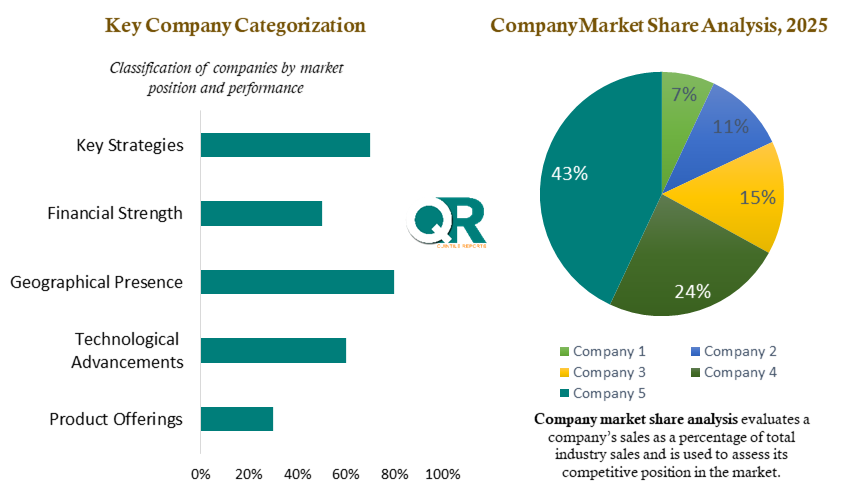
The global concrete market is characterized by intense competition, with leading manufacturers focusing on sustainability, technological innovation, operational efficiency, and product differentiation to strengthen their market positions. Companies are expanding production capacity while investing heavily in low-carbon concrete technologies, advanced manufacturing processes, and digital construction solutions to address evolving customer requirements and increasingly stringent environmental regulations.
A major competitive trend is the development of sustainable concrete solutions incorporating supplementary cementitious materials (SCMs), recycled aggregates, geopolymer technologies, and carbon capture, utilization and storage (CCUS). These innovations enable manufacturers to reduce lifecycle carbon emissions while meeting growing demand for environmentally responsible construction materials.
Another important area of competition involves high-performance concrete technologies. Companies are introducing ultra-high-performance concrete (UHPC), fibre-reinforced concrete, self-healing concrete, self-compacting concrete, and smart concrete capable of improving structural durability, reducing maintenance costs, and extending infrastructure service life.
Digital transformation is also reshaping the competitive landscape. Manufacturers are increasingly integrating Building Information Modeling (BIM), artificial intelligence, Internet of Things (IoT)-enabled monitoring systems, automated batching plants, and predictive quality control technologies to improve operational efficiency, optimize material consumption, and enhance project execution.
Growing adoption of precast construction, modular building systems, and 3D concrete printing is creating new opportunities for companies capable of delivering customized, factory-produced structural components that reduce labor requirements and accelerate construction schedules.
In June 2025, Holcim announced a USD 100 million investment to modernize its Ste. Genevieve cement plant in Missouri, transforming it into the largest single-site cement production facility in North America. The investment is expected to increase production capacity by approximately 10%, reduce CO₂ emissions per ton of cement by up to 20%, and significantly expand production of the company's ECOPact low-carbon concrete solutions. The initiative reflects Holcim's long-term commitment to decarbonizing cement manufacturing and supporting sustainable infrastructure development.
In April 2025, Holcim completed the acquisition of PRB Group, a leading French manufacturer specializing in building envelope systems, façade coatings, insulation products, and exterior finishing solutions. The acquisition expands Holcim's sustainable construction portfolio and strengthens its presence in energy-efficient building materials, complementing its global concrete and cement business while supporting demand for integrated green building solutions.
In May 2024, Heidelberg Materials officially commenced construction of the world's first industrial-scale Carbon Capture and Storage (CCS) facility at its cement plant in Brevik, Norway. The project is designed to capture approximately 400,000 metric tons of CO₂ annually, representing one of the most significant milestones in the decarbonization of the global cement and concrete industry. The initiative demonstrates the industry's growing commitment to achieving net-zero emissions through large-scale deployment of carbon capture technologies.
| Report Scope | Details |
| Report Version | 2026 |
| Growth Rate | CAGR of 4.31 % from 2026 to 2036 |
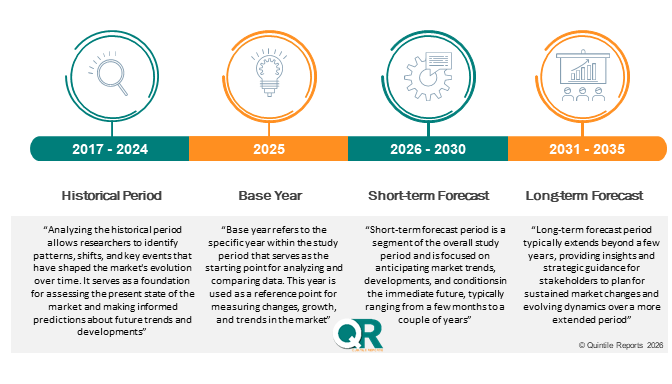
| Base Year | 2025 |
| Actual Estimates / Historical Data | 2017 - 2024 |
| Forecast Period | 2026 - 2036 |
| Quantitative Units | Revenue in USD million/billion & CAGR from 2026 to 2036 |
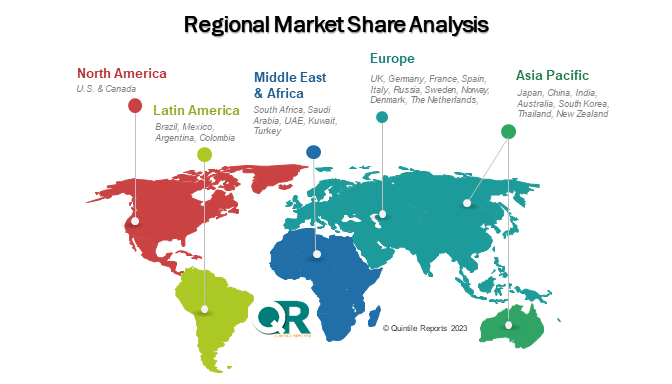
| Country Scope | North America (U.S., Canada), Europe (UK, Germany, France, Italy, Spain, Russia, Sweden, Denmark, Norway, Rest of Europe), Asia Pacific (Japan, China, India, Australia, South Korea, Thailand, Rest of Asia Pacific), Latin America (Brazil, Mexico, Argentina, Colombia, Rest of Latin America), Middle East & Africa (South Africa, Saudi Arabia, UAE, Kuwait, Rest of Middle East & Africa). |
| The Segment Covered by Type |
|
| The Segment Covered by Application |
|
| Companies Covered |
|
| Report Coverage | Revenue forecast, company share, competitive landscape, growth factors, technology trends, and regional analysis |
| Free Customization Scope (Equivalent to 5 Analyst Working Days) | If you require additional insights beyond the current scope, our analysts can customize the report to meet your specific business needs. |
Organizations across the globe rely on our research because we combine deep industry expertise with rigorous analytical methodologies to deliver reliable market intelligence.
The Global Concrete Market Report (2026 - 2036) has been developed using a comprehensive research framework that combines primary research, secondary intelligence, quantitative analysis, and expert validation. This structured approach ensures that every market estimate, forecast, and strategic insight is accurate, reliable, and aligned with current industry developments.
Primary research forms the foundation of this study and includes direct interactions with key stakeholders across the concrete value chain. Our analysts conducted interviews and consultations with:
These interactions provided valuable insights into market trends, pricing dynamics, technological advancements, customer demand, competitive strategies, and future industry outlook.
To complement primary findings, extensive secondary research was carried out using credible public and proprietary information sources, including:
This multi-source approach helped validate market data and identify emerging industry trends.
Market estimates were developed using a combination of top-down and bottom-up methodologies. Historical market performance, production volumes, infrastructure investments, construction activity, macroeconomic indicators, pricing trends, and regional demand patterns were analyzed to determine the current market size and forecast future growth.
Advanced statistical models and data triangulation techniques were applied to verify findings and ensure consistency across different market segments and geographic regions.
The competitive landscape was evaluated by analyzing:
This analysis provides a comprehensive understanding of the competitive environment and strategic positioning of leading market participants.
The market forecast is based on several key assumptions, including:
Every report undergoes multiple stages of quality review, including data verification, expert validation, statistical analysis, and editorial assessment. This rigorous process ensures the research delivers objective, accurate, and actionable insights that support strategic business decision-making.

Quintile Reports is a global market research and consulting firm specializing in syndicated market research, customized industry analysis, competitive intelligence, and strategic business consulting. Our team of experienced analysts delivers comprehensive research across diverse industries, helping organizations identify growth opportunities, evaluate market trends, and make informed business decisions.
Our research combines extensive primary interviews, secondary intelligence, statistical modeling, and expert validation to provide accurate, objective, and actionable market insights. Every report is developed using a structured research methodology and undergoes multiple levels of quality assurance to ensure reliability, transparency, and analytical excellence.
Serving manufacturers, investors, consultants, government agencies, financial institutions, and corporate decision-makers worldwide, Quintile Reports is committed to delivering market intelligence that supports sustainable business growth, strategic planning, and long-term competitive advantage.
Table 1 List of Abbreviation and Acronyms
Table 2 List of Sources
Table 3 North America Concrete Market, by Segment Analysis, (USD Million) 2017-2036
Table 4 North America Concrete Market, by Region, (USD Million) 2017-2036
Table 5 U.S. Concrete Market, by Segment Analysis, (USD Million) 2017-2036
Table 6 Canada Concrete Market, by Segment Analysis, (USD Million) 2017-2036
Table 7 Europe Concrete Market, by Segment Analysis, (USD Million) 2017-2036
Table 8 Europe Concrete Market, by Region, (USD Million) 2017-2036
Table 9 Germany Concrete Market, by Segment Analysis, (USD Million) 2017-2036
Table 10 U.K. Concrete Market, by Segment Analysis, (USD Million) 2017-2036
Table 11 France Concrete Market, by Segment Analysis, (USD Million) 2017-2036
Table 12 Italy Concrete Market, by Segment Analysis, (USD Million) 2017-2036
Table 13 Spain Concrete Market, by Segment Analysis, (USD Million) 2017-2036
Table 14 Sweden Concrete Market, by Segment Analysis, (USD Million) 2017-2036
Table 15 Denmark Concrete Market, by Segment Analysis, (USD Million) 2017-2036
Table 16 Norway Concrete Market, by Segment Analysis, (USD Million) 2017-2036
Table 17 The Netherlands Concrete Market, by Segment Analysis, (USD Million) 2017-2036
Table 18 Russia Concrete Market, by Segment Analysis, (USD Million) 2017-2036
Table 19 Asia Pacific Global Market, by Segment Analysis, (USD Million) 2017-2036
Table 20 Asia Pacific Concrete Market, by Region, (USD Million) 2017-2036
Table 21 China Concrete Market, by Segment Analysis, (USD Million) 2017-2036
Table 22 Japan Concrete Market, by Segment Analysis, (USD Million) 2017-2036
Table 23 India Concrete Market, by Segment Analysis, (USD Million) 2017-2036
Table 24 Australia Concrete Market, by Segment Analysis, (USD Million) 2017-2036
Table 25 South Korea Concrete Market, by Segment Analysis, (USD Million) 2017-2036
Table 26 Thailand Concrete Market, by Segment Analysis, (USD Million) 2017-2036
Table 27 Latin America Concrete Market, by Segment Analysis, (USD Million) 2017-2036
Table 28 Latin America Concrete Market, by Region, (USD Million) 2017-2036
Table 29 Brazil Concrete Market, by Segment Analysis, (USD Million) 2017-2036
Table 30 Mexico Concrete Market, by Segment Analysis, (USD Million) 2017-2036
Table 31 Argentina Concrete Market, by Segment Analysis, (USD Million) 2017-2036
Table 32 Middle East and Africa Concrete Market, by Segment Analysis, (USD Million) 2017-2036
Table 33 Middle East and Africa Concrete Market, by Region, (USD Million) 2017-2036
Table 34 South Africa Concrete Market, by Segment Analysis, (USD Million) 2017-2036
Table 35 Saudi Arabia Concrete Market, by Segment Analysis, (USD Million) 2017-2036
Table 36 UAE Concrete Market, by Segment Analysis, (USD Million) 2017-2036
Table 37 Kuwait Concrete Market, by Segment Analysis, (USD Million) 2017-2036
Table 38 Turkey Concrete Market, by Segment Analysis, (USD Million) 2017-2036
Fig.1 Market Research Process
Fig.2 Market Research Approaches
Fig.3 Global Concrete Market: Market Scenario
Fig.4 Global Concrete Market Competitive Outlook
Fig.5 Global Concrete Market Driver Analysis
Fig.6 Global Concrete Market Restraint Analysis
Fig.7 Global Concrete Market Opportunity Analysis
Fig.8 Global Concrete Market Trends Analysis
Fig.9 Global Concrete Market: Segment Analysis (Based on the Scope)
Fig.10 Global Concrete Market: Regional Analysis
Fig.11 Global Market Shares and Leading Market Players
Fig.12 North America Market Share and Leading Players
Fig.13 Europe Market Share and Leading Players
Fig.14 Asia Pacific Market Share and Leading Players
Fig.15 Latin America Market Share and Leading Players
Fig.16 Middle East & Africa Market Share and Leading Players
Fig.17 North America, by Country
Fig.18 North America
Fig.19 North America Market Estimates and Forecast, 2017-2036
Fig.20 U.S.
Fig.21 Canada
Fig.22 Europe
Fig.23 Europe Market Estimates and Forecast, 2017-2036
Fig.24 U.K.
Fig.25 Germany
Fig.26 France
Fig.27 Italy
Fig.28 Spain
Fig.29 Sweden
Fig.30 Denmark
Fig.31 Norway
Fig.32 The Netherlands
Fig.33 Russia
Fig.34 Asia Pacific
Fig.35 Asia Pacific Market Estimates and Forecast, 2017-2036
Fig.36 China
Fig.37 Japan
Fig.38 India
Fig.39 Australia
Fig.40 South Korea
Fig.41 Thailand
Fig.42 Latin America
Fig.43 Latin America Market Estimates and Forecast, 2017-2036
Fig.44 Brazil
Fig.45 Mexico
Fig.46 Argentina
Fig.47 Colombia
Fig.48 Middle East and Africa
Fig.49 Middle East and Africa Market Estimates and Forecast, 2017-2036
Fig.50 Saudi Arabia
Fig.51 South Africa
Fig.52 UAE
Fig.53 Kuwait
Fig.54 Turkey
Table 1 List of Abbreviation and Acronyms
Table 2 List of Sources
Table 3 North America Concrete Market, by Segment Analysis, (USD Million) 2017-2036
Table 4 North America Concrete Market, by Region, (USD Million) 2017-2036
Table 5 U.S. Concrete Market, by Segment Analysis, (USD Million) 2017-2036
Table 6 Canada Concrete Market, by Segment Analysis, (USD Million) 2017-2036
Table 7 Europe Concrete Market, by Segment Analysis, (USD Million) 2017-2036
Table 8 Europe Concrete Market, by Region, (USD Million) 2017-2036
Table 9 Germany Concrete Market, by Segment Analysis, (USD Million) 2017-2036
Table 10 U.K. Concrete Market, by Segment Analysis, (USD Million) 2017-2036
Table 11 France Concrete Market, by Segment Analysis, (USD Million) 2017-2036
Table 12 Italy Concrete Market, by Segment Analysis, (USD Million) 2017-2036
Table 13 Spain Concrete Market, by Segment Analysis, (USD Million) 2017-2036
Table 14 Sweden Concrete Market, by Segment Analysis, (USD Million) 2017-2036
Table 15 Denmark Concrete Market, by Segment Analysis, (USD Million) 2017-2036
Table 16 Norway Concrete Market, by Segment Analysis, (USD Million) 2017-2036
Table 17 The Netherlands Concrete Market, by Segment Analysis, (USD Million) 2017-2036
Table 18 Russia Concrete Market, by Segment Analysis, (USD Million) 2017-2036
Table 19 Asia Pacific Global Market, by Segment Analysis, (USD Million) 2017-2036
Table 20 Asia Pacific Concrete Market, by Region, (USD Million) 2017-2036
Table 21 China Concrete Market, by Segment Analysis, (USD Million) 2017-2036
Table 22 Japan Concrete Market, by Segment Analysis, (USD Million) 2017-2036
Table 23 India Concrete Market, by Segment Analysis, (USD Million) 2017-2036
Table 24 Australia Concrete Market, by Segment Analysis, (USD Million) 2017-2036
Table 25 South Korea Concrete Market, by Segment Analysis, (USD Million) 2017-2036
Table 26 Thailand Concrete Market, by Segment Analysis, (USD Million) 2017-2036
Table 27 Latin America Concrete Market, by Segment Analysis, (USD Million) 2017-2036
Table 28 Latin America Concrete Market, by Region, (USD Million) 2017-2036
Table 29 Brazil Concrete Market, by Segment Analysis, (USD Million) 2017-2036
Table 30 Mexico Concrete Market, by Segment Analysis, (USD Million) 2017-2036
Table 31 Argentina Concrete Market, by Segment Analysis, (USD Million) 2017-2036
Table 32 Middle East and Africa Concrete Market, by Segment Analysis, (USD Million) 2017-2036
Table 33 Middle East and Africa Concrete Market, by Region, (USD Million) 2017-2036
Table 34 South Africa Concrete Market, by Segment Analysis, (USD Million) 2017-2036
Table 35 Saudi Arabia Concrete Market, by Segment Analysis, (USD Million) 2017-2036
Table 36 UAE Concrete Market, by Segment Analysis, (USD Million) 2017-2036
Table 37 Kuwait Concrete Market, by Segment Analysis, (USD Million) 2017-2036
Table 38 Turkey Concrete Market, by Segment Analysis, (USD Million) 2017-2036
Fig.1 Market Research Process
Fig.2 Market Research Approaches
Fig.3 Global Concrete Market: Market Scenario
Fig.4 Global Concrete Market Competitive Outlook
Fig.5 Global Concrete Market Driver Analysis
Fig.6 Global Concrete Market Restraint Analysis
Fig.7 Global Concrete Market Opportunity Analysis
Fig.8 Global Concrete Market Trends Analysis
Fig.9 Global Concrete Market: Segment Analysis (Based on the Scope)
Fig.10 Global Concrete Market: Regional Analysis
Fig.11 Global Market Shares and Leading Market Players
Fig.12 North America Market Share and Leading Players
Fig.13 Europe Market Share and Leading Players
Fig.14 Asia Pacific Market Share and Leading Players
Fig.15 Latin America Market Share and Leading Players
Fig.16 Middle East & Africa Market Share and Leading Players
Fig.17 North America, by Country
Fig.18 North America
Fig.19 North America Market Estimates and Forecast, 2017-2036
Fig.20 U.S.
Fig.21 Canada
Fig.22 Europe
Fig.23 Europe Market Estimates and Forecast, 2017-2036
Fig.24 U.K.
Fig.25 Germany
Fig.26 France
Fig.27 Italy
Fig.28 Spain
Fig.29 Sweden
Fig.30 Denmark
Fig.31 Norway
Fig.32 The Netherlands
Fig.33 Russia
Fig.34 Asia Pacific
Fig.35 Asia Pacific Market Estimates and Forecast, 2017-2036
Fig.36 China
Fig.37 Japan
Fig.38 India
Fig.39 Australia
Fig.40 South Korea
Fig.41 Thailand
Fig.42 Latin America
Fig.43 Latin America Market Estimates and Forecast, 2017-2036
Fig.44 Brazil
Fig.45 Mexico
Fig.46 Argentina
Fig.47 Colombia
Fig.48 Middle East and Africa
Fig.49 Middle East and Africa Market Estimates and Forecast, 2017-2036
Fig.50 Saudi Arabia
Fig.51 South Africa
Fig.52 UAE
Fig.53 Kuwait
Fig.54 Turkey
The market is expected to grow at a Compound Annual Growth Rate (CAGR) of 8.81% during the forecast period from 2026 to 2036.
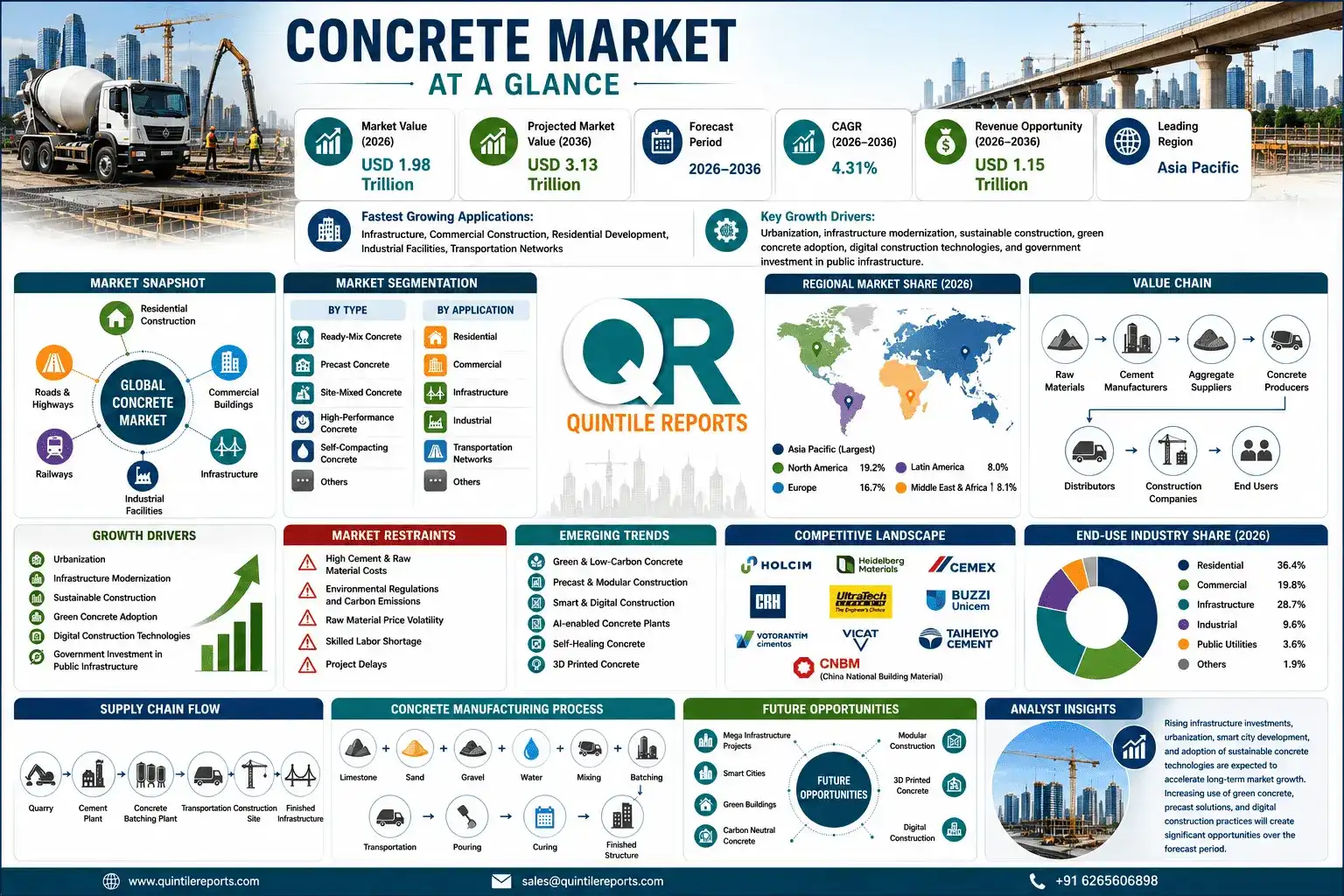
The global Concrete Market was valued at USD 1.98 trillion in 2026 and is projected to reach USD 3.13 trillion by 2036, driven by increasing investments in infrastructure development, urbanization, residential construction, and sustainable building materials.
The Concrete Market is expected to grow at a Compound Annual Growth Rate (CAGR) of 4.31% during the forecast period from 2026 to 2036, supported by rising demand for high-performance concrete, smart city projects, and green construction initiatives.
Asia Pacific dominates the global Concrete Market owing to rapid urbanization, large-scale infrastructure projects, expanding residential and commercial construction, and strong government investments in transportation networks across countries such as China, India, and Japan.
The Infrastructure segment accounts for the largest share of the Concrete Market, driven by extensive investments in highways, bridges, tunnels, railways, airports, ports, dams, and smart city developments. Residential and commercial construction also contribute significantly to market demand.
Major companies operating in the Concrete Market include Holcim Group, HeidelbergCement AG, Cemex S.A.B. de C.V., CRH plc, China National Building Material (CNBM), Anhui Conch Cement, UltraTech Cement Ltd., Votorantim Cimentos, Sika AG, Buzzi Unicem, ACC Ltd., Vicat Group, Eagle Materials, Knife River, Summit Materials, Quikrete Holdings, Martin Marietta Materials, and Vulcan Materials.
The market is primarily driven by rapid urbanization, increasing infrastructure modernization, government investments in public construction, rising demand for sustainable and low-carbon concrete, growing adoption of ready-mix and precast concrete, and technological advancements such as AI-enabled batching systems, IoT-based quality monitoring, and 3D concrete printing.
Major challenges include stringent environmental regulations on carbon emissions, volatility in raw material and energy prices, high capital investment required for sustainable manufacturing, supply chain disruptions, and shortages of skilled labor for advanced concrete production technologies.
Key trends influencing the Concrete Market include the adoption of green and low-carbon concrete, increased use of supplementary cementitious materials (SCMs), carbon capture, utilization and storage (CCUS), AI-driven quality control, digital construction technologies, Building Information Modeling (BIM), 3D concrete printing, modular construction, and circular economy initiatives aimed at reducing environmental impact.
The global concrete market forms the backbone of modern construction, providing one of the most widely used building materials across residential, commercial, industrial, and infrastructure projects. Concrete, produced by combining cement, aggregates, water, and specialized admixtures, is valued for its exceptional strength, durability, versatility, and cost-effectiveness. It is extensively used in foundations, bridges, highways, tunnels, dams, airports, commercial buildings, and urban infrastructure, making it indispensable to economic development and urban expansion.
Beyond conventional concrete, the industry has evolved significantly with the introduction of advanced formulations such as ready-mix concrete, precast concrete, self-compacting concrete, ultra-high-performance concrete (UHPC), fibre-reinforced concrete, lightweight concrete, and specialty mixes designed for demanding construction environments. These innovations are helping contractors improve construction efficiency, reduce project timelines, and enhance structural performance.
Sustainability is rapidly becoming a defining trend across the concrete industry. Manufacturers are increasingly incorporating supplementary cementitious materials (SCMs) such as fly ash, ground granulated blast furnace slag (GGBFS), silica fume, and recycled aggregates to reduce clinker consumption and lower greenhouse gas emissions. At the same time, technologies including carbon capture, utilization and storage (CCUS), digital mix optimization, AI-driven quality control, 3D concrete printing, and IoT-enabled monitoring systems are reshaping production processes and supporting the industry's transition toward low-carbon construction.
Growing investments in transportation infrastructure, affordable housing, smart cities, renewable energy projects, and commercial real estate continue to strengthen global demand for concrete. Supported by technological innovation, circular economy initiatives, and stricter environmental regulations, the market is expected to maintain steady long-term growth throughout the forecast period.
According to Quintile Reports' analysts, infrastructure modernization, rapid urbanization, and increasing investments in sustainable construction will continue to support long-term growth in the Concrete Market. Emerging technologies such as AI-driven batching systems, carbon capture, and 3D concrete printing are expected to transform production efficiency and reduce lifecycle emissions, creating new opportunities for manufacturers worldwide.
Large-scale investments in transportation, utilities, and public infrastructure remain the primary growth engine for the global concrete market. Governments across North America, Europe, Asia Pacific, and the Middle East continue to allocate substantial funding toward highways, rail networks, airports, ports, bridges, tunnels, dams, and smart city developments. These projects require durable, high-strength construction materials capable of supporting long operational lifecycles, making concrete an essential component of modern infrastructure.
Economic stimulus programs, urban renewal initiatives, and public-private partnerships are further accelerating infrastructure construction worldwide. As countries continue upgrading ageing infrastructure while expanding new transportation and energy networks, demand for ready-mix, precast, and high-performance concrete is expected to remain strong.
Rapid urban population growth is creating sustained demand for residential housing, commercial complexes, healthcare facilities, educational institutions, and industrial buildings. Emerging economies, particularly across Asia Pacific, Africa, and Latin America, continue to witness large-scale migration toward urban centres, driving significant investments in new construction projects.
Countries such as China and India remain among the world's largest consumers of concrete due to continuous residential development, metro rail expansion, industrial parks, and mixed-use commercial projects. Rising disposable incomes and government-supported affordable housing initiatives are also contributing to increased concrete consumption across both developed and developing markets.
Environmental sustainability has become a strategic priority for governments, developers, and construction companies worldwide. Since cement manufacturing contributes significantly to global carbon emissions, the industry is increasingly investing in low-carbon concrete solutions that minimize environmental impact without compromising structural performance.
Manufacturers are expanding the use of supplementary cementitious materials, recycled aggregates, carbon capture technologies, and alternative binders to reduce clinker content and improve production efficiency. The growing adoption of green building certifications such as LEED, BREEAM, and similar sustainability frameworks is further encouraging the use of environmentally responsible concrete across commercial and infrastructure projects.
Continuous technological innovation is transforming concrete production and application across the construction industry. Emerging technologies including 3D concrete printing, ultra-high-performance concrete (UHPC), fibre-reinforced concrete, AI-assisted mix optimization, automated batching systems, and IoT-enabled quality monitoring are improving construction speed, material efficiency, and long-term structural performance.
Digitalization is also enabling real-time quality control, predictive maintenance, and optimized resource utilization, allowing contractors to reduce waste while improving project delivery timelines. These technological advancements are expected to create new opportunities for manufacturers while enhancing the competitiveness of modern concrete solutions.
As infrastructure projects become increasingly complex, demand is rising for specialized concrete formulations capable of delivering enhanced strength, durability, corrosion resistance, and environmental performance. High-rise buildings, marine infrastructure, industrial facilities, and transportation networks require advanced concrete solutions that can withstand extreme weather conditions, seismic activity, and heavy operational loads.
Manufacturers are responding by introducing customized high-performance mixes that offer improved workability, faster curing, longer service life, and reduced maintenance costs. This growing emphasis on performance-driven construction materials is expected to support sustained market expansion throughout the forecast period.
Despite its indispensable role in global construction, the concrete industry faces several operational, environmental, and economic challenges that could influence market growth. Rising production costs, increasingly stringent environmental regulations, supply chain disruptions, and the need to transition toward low-carbon manufacturing are prompting producers to rethink conventional production processes. At the same time, labor shortages and technological adoption barriers continue to affect manufacturing efficiency and project execution across several regions.
One of the most significant challenges facing the concrete market is the environmental impact associated with cement production. Cement manufacturing remains one of the largest industrial sources of carbon dioxide (CO₂) emissions globally, leading governments to introduce stricter emissions standards, carbon pricing mechanisms, and sustainability regulations.
To comply with these evolving requirements, manufacturers are investing in carbon capture, utilization and storage (CCUS), energy-efficient kilns, alternative fuels, and low-carbon cement technologies. While these initiatives contribute to long-term sustainability goals, they also require substantial capital investments, increasing production costs and extending the return on investment for many manufacturers.
Concrete production relies heavily on essential raw materials such as cement, aggregates, sand, gravel, and chemical admixtures, while manufacturing operations consume significant amounts of electricity and thermal energy. Fluctuations in the prices of raw materials, transportation, fuel, and electricity continue to create uncertainty throughout the supply chain.
Geopolitical tensions, inflationary pressures, and disruptions in global logistics have further intensified procurement challenges, making cost management increasingly difficult for producers and construction companies. As a result, project budgets, delivery schedules, and profit margins remain vulnerable to changing market conditions.
The growing adoption of advanced manufacturing technologies and sustainable concrete formulations has increased demand for skilled professionals capable of operating automated batching systems, digital quality control platforms, and modern production facilities. However, many regions continue to face shortages of experienced plant operators, quality engineers, technicians, and construction specialists.
Limited availability of skilled labor can reduce production efficiency, increase operational risks, and create inconsistencies in product quality. Ongoing workforce development, technical training, and digital upskilling will be essential to support the industry's technological transformation.
The industry's shift toward greener production methods requires manufacturers to modernize existing facilities, integrate supplementary cementitious materials (SCMs), deploy carbon capture technologies, and adopt digital production systems. These upgrades often involve substantial capital expenditure, equipment replacement, process redesign, and workforce training.
While larger multinational companies possess the financial resources to accelerate sustainability initiatives, smaller regional manufacturers may face challenges in implementing similar investments. This disparity could temporarily slow the widespread adoption of low-carbon concrete technologies across certain markets.
Asia Pacific remains the largest and fastest-growing regional market, supported by rapid urbanization, industrialization, and unprecedented infrastructure investment across China, India, Japan, Southeast Asia, and other emerging economies. Massive government spending on highways, metro rail systems, airports, ports, industrial corridors, and affordable housing continues to generate strong demand for ready-mix, precast, and high-performance concrete.
The region also benefits from a well-established manufacturing base, abundant raw material availability, and increasing adoption of advanced construction technologies, including precast systems, self-healing concrete, corrosion-resistant formulations, and digital construction management platforms. Continued urban expansion and public infrastructure development are expected to maintain Asia Pacific's market leadership throughout the forecast period.
North America's concrete market is experiencing steady growth, supported by infrastructure modernization initiatives, residential development, and commercial construction projects across the United States and Canada. Government investments in transportation infrastructure, bridge rehabilitation, airports, water systems, and renewable energy facilities continue to create long-term demand for advanced concrete solutions.
Manufacturers are increasingly incorporating supplementary cementitious materials, recycled aggregates, automated batching technologies, and low-carbon concrete formulations to meet evolving sustainability objectives. Growing adoption of Building Information Modeling (BIM), AI-assisted quality control, and mobile ready-mix operations is further improving production efficiency and project execution.
Europe continues to lead the global transition toward environmentally sustainable concrete production. Strong regulatory frameworks, ambitious climate targets, and circular economy initiatives are encouraging manufacturers to reduce carbon emissions through innovative cement formulations, recycled construction materials, and energy-efficient manufacturing processes.
Countries including Germany, the United Kingdom, France, and the Netherlands are actively expanding the use of fibre-reinforced concrete, lightweight concrete, insulated concrete systems, and modular precast construction. Investments in carbon capture technologies, alternative binders, and recycled aggregates continue to strengthen the region's position as a leader in sustainable construction materials.
The Latin American concrete market is witnessing gradual expansion, supported by public infrastructure development, urban housing initiatives, and commercial construction activities across Brazil, Mexico, Chile, and other developing economies. Increasing investments in transportation networks, flood control systems, industrial facilities, and affordable housing continue to stimulate regional demand.
Manufacturers are focusing on cost-effective, climate-resilient concrete solutions while expanding ready-mix operations, on-site testing services, and modular precast systems to improve construction efficiency and reduce project timelines.
The Middle East and Africa continue to offer significant growth opportunities for the concrete market, driven by large-scale infrastructure projects, smart city developments, commercial real estate, and industrial expansion. Countries across the Gulf Cooperation Council (GCC), together with South Africa and other emerging economies, are investing heavily in transportation infrastructure, tourism developments, energy facilities, and urban modernization.
Demand for high-strength, heat-resistant, and rapid-setting concrete formulations is increasing to meet the region's challenging climatic conditions. Suppliers are also expanding mobile batching plants, prefabricated concrete systems, and advanced admixture technologies to improve operational efficiency and support large-scale construction projects.
The United States remains one of the world's largest concrete markets, supported by sustained investments in transportation infrastructure, commercial construction, residential development, and urban renewal projects. Federal funding initiatives, including highway modernization, bridge rehabilitation, airport expansion, and public infrastructure upgrades, continue to generate significant demand for ready-mix and precast concrete solutions.
Sustainability is becoming a defining characteristic of the U.S. concrete industry. Contractors and manufacturers are increasingly incorporating recycled concrete aggregates (RCA), supplementary cementitious materials (SCMs) such as fly ash and slag, and low-carbon concrete formulations to reduce embodied carbon while improving resource efficiency. These materials not only support circular economy initiatives but also help projects comply with green building standards such as LEED.
Technological innovation is also reshaping the market. Ready-mix producers are investing in AI-driven mix optimization, automated batching systems, digital quality control, and smart admixture technologies to improve consistency, reduce waste, and enhance productivity. As demand for environmentally responsible construction materials continues to grow, the United States is expected to remain a key contributor to innovation and sustainable concrete production.
Germany continues to lead Europe's concrete market through its strong commitment to sustainable construction, energy-efficient manufacturing, and circular economy principles. The country's ambitious climate policies and carbon reduction targets are encouraging widespread adoption of low-carbon cement, recycled aggregates, and environmentally friendly concrete technologies across residential, commercial, and infrastructure projects.
Manufacturers are increasingly utilizing alternative clinker materials, limestone-calcined clay cement (LC3), recycled construction waste, and carbon capture technologies to reduce emissions while maintaining product performance. Infrastructure modernization programs across regions such as Bavaria, North Rhine-Westphalia, and Saxony are further supporting demand for advanced concrete solutions capable of meeting stringent environmental and structural standards.
Leading companies including Heidelberg Materials, Holcim, and MC-Bauchemie continue to invest in carbon-neutral production technologies, energy-efficient manufacturing facilities, and innovative concrete formulations. These investments reinforce Germany's position as one of the global leaders in sustainable construction materials and green infrastructure development.
Japan's concrete market continues to benefit from extensive investments in urban infrastructure renewal, seismic resilience, and transportation modernization. As much of the country's post-war infrastructure approaches the end of its operational lifespan, government agencies are prioritizing the rehabilitation and replacement of bridges, tunnels, highways, ports, and public buildings.
Strict earthquake-resistant construction standards have accelerated demand for high-performance concrete, ultra-high-performance concrete (UHPC), fibre-reinforced concrete, and precast structural components that offer superior durability and structural integrity. Off-site prefabrication methods are also gaining popularity, helping contractors reduce construction timelines and minimize disruption within densely populated urban areas.
Environmental sustainability remains another important growth driver. Japanese manufacturers are expanding the use of recycled aggregates, industrial by-products, and low-carbon cement technologies while improving manufacturing efficiency through energy-saving kilns and digital production systems. These initiatives are helping the country balance infrastructure resilience with long-term environmental objectives.
The global concrete market is characterized by intense competition, with leading manufacturers focusing on sustainability, technological innovation, operational efficiency, and product differentiation to strengthen their market positions. Companies are expanding production capacity while investing heavily in low-carbon concrete technologies, advanced manufacturing processes, and digital construction solutions to address evolving customer requirements and increasingly stringent environmental regulations.
A major competitive trend is the development of sustainable concrete solutions incorporating supplementary cementitious materials (SCMs), recycled aggregates, geopolymer technologies, and carbon capture, utilization and storage (CCUS). These innovations enable manufacturers to reduce lifecycle carbon emissions while meeting growing demand for environmentally responsible construction materials.
Another important area of competition involves high-performance concrete technologies. Companies are introducing ultra-high-performance concrete (UHPC), fibre-reinforced concrete, self-healing concrete, self-compacting concrete, and smart concrete capable of improving structural durability, reducing maintenance costs, and extending infrastructure service life.
Digital transformation is also reshaping the competitive landscape. Manufacturers are increasingly integrating Building Information Modeling (BIM), artificial intelligence, Internet of Things (IoT)-enabled monitoring systems, automated batching plants, and predictive quality control technologies to improve operational efficiency, optimize material consumption, and enhance project execution.
Growing adoption of precast construction, modular building systems, and 3D concrete printing is creating new opportunities for companies capable of delivering customized, factory-produced structural components that reduce labor requirements and accelerate construction schedules.
In June 2025, Holcim announced a USD 100 million investment to modernize its Ste. Genevieve cement plant in Missouri, transforming it into the largest single-site cement production facility in North America. The investment is expected to increase production capacity by approximately 10%, reduce CO₂ emissions per ton of cement by up to 20%, and significantly expand production of the company's ECOPact low-carbon concrete solutions. The initiative reflects Holcim's long-term commitment to decarbonizing cement manufacturing and supporting sustainable infrastructure development.
In April 2025, Holcim completed the acquisition of PRB Group, a leading French manufacturer specializing in building envelope systems, façade coatings, insulation products, and exterior finishing solutions. The acquisition expands Holcim's sustainable construction portfolio and strengthens its presence in energy-efficient building materials, complementing its global concrete and cement business while supporting demand for integrated green building solutions.
In May 2024, Heidelberg Materials officially commenced construction of the world's first industrial-scale Carbon Capture and Storage (CCS) facility at its cement plant in Brevik, Norway. The project is designed to capture approximately 400,000 metric tons of CO₂ annually, representing one of the most significant milestones in the decarbonization of the global cement and concrete industry. The initiative demonstrates the industry's growing commitment to achieving net-zero emissions through large-scale deployment of carbon capture technologies.
| Report Scope | Details |
| Report Version | 2026 |
| Growth Rate | CAGR of 4.31 % from 2026 to 2036 |
| Base Year | 2025 |
| Actual Estimates / Historical Data | 2017 - 2024 |
| Forecast Period | 2026 - 2036 |
| Quantitative Units | Revenue in USD million/billion & CAGR from 2026 to 2036 |
| Country Scope | North America (U.S., Canada), Europe (UK, Germany, France, Italy, Spain, Russia, Sweden, Denmark, Norway, Rest of Europe), Asia Pacific (Japan, China, India, Australia, South Korea, Thailand, Rest of Asia Pacific), Latin America (Brazil, Mexico, Argentina, Colombia, Rest of Latin America), Middle East & Africa (South Africa, Saudi Arabia, UAE, Kuwait, Rest of Middle East & Africa). |
| The Segment Covered by Type |
|
| The Segment Covered by Application |
|
| Companies Covered |
|
| Report Coverage | Revenue forecast, company share, competitive landscape, growth factors, technology trends, and regional analysis |
| Free Customization Scope (Equivalent to 5 Analyst Working Days) | If you require additional insights beyond the current scope, our analysts can customize the report to meet your specific business needs. |
Organizations across the globe rely on our research because we combine deep industry expertise with rigorous analytical methodologies to deliver reliable market intelligence.
The Global Concrete Market Report (2026 - 2036) has been developed using a comprehensive research framework that combines primary research, secondary intelligence, quantitative analysis, and expert validation. This structured approach ensures that every market estimate, forecast, and strategic insight is accurate, reliable, and aligned with current industry developments.
Primary research forms the foundation of this study and includes direct interactions with key stakeholders across the concrete value chain. Our analysts conducted interviews and consultations with:
These interactions provided valuable insights into market trends, pricing dynamics, technological advancements, customer demand, competitive strategies, and future industry outlook.
To complement primary findings, extensive secondary research was carried out using credible public and proprietary information sources, including:
This multi-source approach helped validate market data and identify emerging industry trends.
Market estimates were developed using a combination of top-down and bottom-up methodologies. Historical market performance, production volumes, infrastructure investments, construction activity, macroeconomic indicators, pricing trends, and regional demand patterns were analyzed to determine the current market size and forecast future growth.
Advanced statistical models and data triangulation techniques were applied to verify findings and ensure consistency across different market segments and geographic regions.
The competitive landscape was evaluated by analyzing:
This analysis provides a comprehensive understanding of the competitive environment and strategic positioning of leading market participants.
The market forecast is based on several key assumptions, including:
Every report undergoes multiple stages of quality review, including data verification, expert validation, statistical analysis, and editorial assessment. This rigorous process ensures the research delivers objective, accurate, and actionable insights that support strategic business decision-making.
Quintile Reports is a global market research and consulting firm specializing in syndicated market research, customized industry analysis, competitive intelligence, and strategic business consulting. Our team of experienced analysts delivers comprehensive research across diverse industries, helping organizations identify growth opportunities, evaluate market trends, and make informed business decisions.
Our research combines extensive primary interviews, secondary intelligence, statistical modeling, and expert validation to provide accurate, objective, and actionable market insights. Every report is developed using a structured research methodology and undergoes multiple levels of quality assurance to ensure reliability, transparency, and analytical excellence.
Serving manufacturers, investors, consultants, government agencies, financial institutions, and corporate decision-makers worldwide, Quintile Reports is committed to delivering market intelligence that supports sustainable business growth, strategic planning, and long-term competitive advantage.
Table 1 List of Abbreviation and Acronyms
Table 2 List of Sources
Table 3 North America Concrete Market, by Segment Analysis, (USD Million) 2017-2036
Table 4 North America Concrete Market, by Region, (USD Million) 2017-2036
Table 5 U.S. Concrete Market, by Segment Analysis, (USD Million) 2017-2036
Table 6 Canada Concrete Market, by Segment Analysis, (USD Million) 2017-2036
Table 7 Europe Concrete Market, by Segment Analysis, (USD Million) 2017-2036
Table 8 Europe Concrete Market, by Region, (USD Million) 2017-2036
Table 9 Germany Concrete Market, by Segment Analysis, (USD Million) 2017-2036
Table 10 U.K. Concrete Market, by Segment Analysis, (USD Million) 2017-2036
Table 11 France Concrete Market, by Segment Analysis, (USD Million) 2017-2036
Table 12 Italy Concrete Market, by Segment Analysis, (USD Million) 2017-2036
Table 13 Spain Concrete Market, by Segment Analysis, (USD Million) 2017-2036
Table 14 Sweden Concrete Market, by Segment Analysis, (USD Million) 2017-2036
Table 15 Denmark Concrete Market, by Segment Analysis, (USD Million) 2017-2036
Table 16 Norway Concrete Market, by Segment Analysis, (USD Million) 2017-2036
Table 17 The Netherlands Concrete Market, by Segment Analysis, (USD Million) 2017-2036
Table 18 Russia Concrete Market, by Segment Analysis, (USD Million) 2017-2036
Table 19 Asia Pacific Global Market, by Segment Analysis, (USD Million) 2017-2036
Table 20 Asia Pacific Concrete Market, by Region, (USD Million) 2017-2036
Table 21 China Concrete Market, by Segment Analysis, (USD Million) 2017-2036
Table 22 Japan Concrete Market, by Segment Analysis, (USD Million) 2017-2036
Table 23 India Concrete Market, by Segment Analysis, (USD Million) 2017-2036
Table 24 Australia Concrete Market, by Segment Analysis, (USD Million) 2017-2036
Table 25 South Korea Concrete Market, by Segment Analysis, (USD Million) 2017-2036
Table 26 Thailand Concrete Market, by Segment Analysis, (USD Million) 2017-2036
Table 27 Latin America Concrete Market, by Segment Analysis, (USD Million) 2017-2036
Table 28 Latin America Concrete Market, by Region, (USD Million) 2017-2036
Table 29 Brazil Concrete Market, by Segment Analysis, (USD Million) 2017-2036
Table 30 Mexico Concrete Market, by Segment Analysis, (USD Million) 2017-2036
Table 31 Argentina Concrete Market, by Segment Analysis, (USD Million) 2017-2036
Table 32 Middle East and Africa Concrete Market, by Segment Analysis, (USD Million) 2017-2036
Table 33 Middle East and Africa Concrete Market, by Region, (USD Million) 2017-2036
Table 34 South Africa Concrete Market, by Segment Analysis, (USD Million) 2017-2036
Table 35 Saudi Arabia Concrete Market, by Segment Analysis, (USD Million) 2017-2036
Table 36 UAE Concrete Market, by Segment Analysis, (USD Million) 2017-2036
Table 37 Kuwait Concrete Market, by Segment Analysis, (USD Million) 2017-2036
Table 38 Turkey Concrete Market, by Segment Analysis, (USD Million) 2017-2036
Fig.1 Market Research Process
Fig.2 Market Research Approaches
Fig.3 Global Concrete Market: Market Scenario
Fig.4 Global Concrete Market Competitive Outlook
Fig.5 Global Concrete Market Driver Analysis
Fig.6 Global Concrete Market Restraint Analysis
Fig.7 Global Concrete Market Opportunity Analysis
Fig.8 Global Concrete Market Trends Analysis
Fig.9 Global Concrete Market: Segment Analysis (Based on the Scope)
Fig.10 Global Concrete Market: Regional Analysis
Fig.11 Global Market Shares and Leading Market Players
Fig.12 North America Market Share and Leading Players
Fig.13 Europe Market Share and Leading Players
Fig.14 Asia Pacific Market Share and Leading Players
Fig.15 Latin America Market Share and Leading Players
Fig.16 Middle East & Africa Market Share and Leading Players
Fig.17 North America, by Country
Fig.18 North America
Fig.19 North America Market Estimates and Forecast, 2017-2036
Fig.20 U.S.
Fig.21 Canada
Fig.22 Europe
Fig.23 Europe Market Estimates and Forecast, 2017-2036
Fig.24 U.K.
Fig.25 Germany
Fig.26 France
Fig.27 Italy
Fig.28 Spain
Fig.29 Sweden
Fig.30 Denmark
Fig.31 Norway
Fig.32 The Netherlands
Fig.33 Russia
Fig.34 Asia Pacific
Fig.35 Asia Pacific Market Estimates and Forecast, 2017-2036
Fig.36 China
Fig.37 Japan
Fig.38 India
Fig.39 Australia
Fig.40 South Korea
Fig.41 Thailand
Fig.42 Latin America
Fig.43 Latin America Market Estimates and Forecast, 2017-2036
Fig.44 Brazil
Fig.45 Mexico
Fig.46 Argentina
Fig.47 Colombia
Fig.48 Middle East and Africa
Fig.49 Middle East and Africa Market Estimates and Forecast, 2017-2036
Fig.50 Saudi Arabia
Fig.51 South Africa
Fig.52 UAE
Fig.53 Kuwait
Fig.54 Turkey
Table 1 List of Abbreviation and Acronyms
Table 2 List of Sources
Table 3 North America Concrete Market, by Segment Analysis, (USD Million) 2017-2036
Table 4 North America Concrete Market, by Region, (USD Million) 2017-2036
Table 5 U.S. Concrete Market, by Segment Analysis, (USD Million) 2017-2036
Table 6 Canada Concrete Market, by Segment Analysis, (USD Million) 2017-2036
Table 7 Europe Concrete Market, by Segment Analysis, (USD Million) 2017-2036
Table 8 Europe Concrete Market, by Region, (USD Million) 2017-2036
Table 9 Germany Concrete Market, by Segment Analysis, (USD Million) 2017-2036
Table 10 U.K. Concrete Market, by Segment Analysis, (USD Million) 2017-2036
Table 11 France Concrete Market, by Segment Analysis, (USD Million) 2017-2036
Table 12 Italy Concrete Market, by Segment Analysis, (USD Million) 2017-2036
Table 13 Spain Concrete Market, by Segment Analysis, (USD Million) 2017-2036
Table 14 Sweden Concrete Market, by Segment Analysis, (USD Million) 2017-2036
Table 15 Denmark Concrete Market, by Segment Analysis, (USD Million) 2017-2036
Table 16 Norway Concrete Market, by Segment Analysis, (USD Million) 2017-2036
Table 17 The Netherlands Concrete Market, by Segment Analysis, (USD Million) 2017-2036
Table 18 Russia Concrete Market, by Segment Analysis, (USD Million) 2017-2036
Table 19 Asia Pacific Global Market, by Segment Analysis, (USD Million) 2017-2036
Table 20 Asia Pacific Concrete Market, by Region, (USD Million) 2017-2036
Table 21 China Concrete Market, by Segment Analysis, (USD Million) 2017-2036
Table 22 Japan Concrete Market, by Segment Analysis, (USD Million) 2017-2036
Table 23 India Concrete Market, by Segment Analysis, (USD Million) 2017-2036
Table 24 Australia Concrete Market, by Segment Analysis, (USD Million) 2017-2036
Table 25 South Korea Concrete Market, by Segment Analysis, (USD Million) 2017-2036
Table 26 Thailand Concrete Market, by Segment Analysis, (USD Million) 2017-2036
Table 27 Latin America Concrete Market, by Segment Analysis, (USD Million) 2017-2036
Table 28 Latin America Concrete Market, by Region, (USD Million) 2017-2036
Table 29 Brazil Concrete Market, by Segment Analysis, (USD Million) 2017-2036
Table 30 Mexico Concrete Market, by Segment Analysis, (USD Million) 2017-2036
Table 31 Argentina Concrete Market, by Segment Analysis, (USD Million) 2017-2036
Table 32 Middle East and Africa Concrete Market, by Segment Analysis, (USD Million) 2017-2036
Table 33 Middle East and Africa Concrete Market, by Region, (USD Million) 2017-2036
Table 34 South Africa Concrete Market, by Segment Analysis, (USD Million) 2017-2036
Table 35 Saudi Arabia Concrete Market, by Segment Analysis, (USD Million) 2017-2036
Table 36 UAE Concrete Market, by Segment Analysis, (USD Million) 2017-2036
Table 37 Kuwait Concrete Market, by Segment Analysis, (USD Million) 2017-2036
Table 38 Turkey Concrete Market, by Segment Analysis, (USD Million) 2017-2036
Fig.1 Market Research Process
Fig.2 Market Research Approaches
Fig.3 Global Concrete Market: Market Scenario
Fig.4 Global Concrete Market Competitive Outlook
Fig.5 Global Concrete Market Driver Analysis
Fig.6 Global Concrete Market Restraint Analysis
Fig.7 Global Concrete Market Opportunity Analysis
Fig.8 Global Concrete Market Trends Analysis
Fig.9 Global Concrete Market: Segment Analysis (Based on the Scope)
Fig.10 Global Concrete Market: Regional Analysis
Fig.11 Global Market Shares and Leading Market Players
Fig.12 North America Market Share and Leading Players
Fig.13 Europe Market Share and Leading Players
Fig.14 Asia Pacific Market Share and Leading Players
Fig.15 Latin America Market Share and Leading Players
Fig.16 Middle East & Africa Market Share and Leading Players
Fig.17 North America, by Country
Fig.18 North America
Fig.19 North America Market Estimates and Forecast, 2017-2036
Fig.20 U.S.
Fig.21 Canada
Fig.22 Europe
Fig.23 Europe Market Estimates and Forecast, 2017-2036
Fig.24 U.K.
Fig.25 Germany
Fig.26 France
Fig.27 Italy
Fig.28 Spain
Fig.29 Sweden
Fig.30 Denmark
Fig.31 Norway
Fig.32 The Netherlands
Fig.33 Russia
Fig.34 Asia Pacific
Fig.35 Asia Pacific Market Estimates and Forecast, 2017-2036
Fig.36 China
Fig.37 Japan
Fig.38 India
Fig.39 Australia
Fig.40 South Korea
Fig.41 Thailand
Fig.42 Latin America
Fig.43 Latin America Market Estimates and Forecast, 2017-2036
Fig.44 Brazil
Fig.45 Mexico
Fig.46 Argentina
Fig.47 Colombia
Fig.48 Middle East and Africa
Fig.49 Middle East and Africa Market Estimates and Forecast, 2017-2036
Fig.50 Saudi Arabia
Fig.51 South Africa
Fig.52 UAE
Fig.53 Kuwait
Fig.54 Turkey

A license granted to one user. Rules or conditions might be applied for e.g. the use of electric files (PDFs) or printings, depending on product.
A license granted to multiple users.
A license granted to a single business site/establishment.
A license granted to all employees within organisation access to the product.
Immediate / Within 24-48 hours - Working days
Online Payments with PayPal and CCavenue
You can order a report by picking any of the payment methods which is bank wire or online payment through any Debit/Credit card or PayPal.
Hard Copy