The global Ceramic Membrane Market was valued at USD 33.82 billion in 2026 and is projected to reach USD 137.47 billion by 2036, expanding at an impressive CAGR of 14.51% during the forecast period. Ceramic membranes have emerged as a highly efficient and durable filtration technology capable of operating under extreme chemical, thermal, and mechanical conditions where conventional polymeric membranes often fail. Manufactured using advanced ceramic materials such as alumina, zirconia, and titania, these membranes offer exceptional chemical resistance, thermal stability, filtration accuracy, and operational longevity.
The market is benefiting from increasing global demand for sustainable water treatment solutions, industrial wastewater recycling, advanced pharmaceutical processing, and high-performance separation technologies. As industries seek more reliable, energy-efficient, and environmentally compliant filtration systems, ceramic membranes are becoming an increasingly attractive solution across municipal, industrial, and commercial applications.
Growth is supported by increasing demand for advanced filtration technologies, stricter environmental regulations, effective water scarcity management, and expanding industrial sustainability initiatives. As industries and municipalities seek reliable, long-lasting, and energy-efficient filtration solutions, ceramic membrane technologies continue to gain widespread adoption across water treatment, wastewater recycling, pharmaceutical processing, food and beverage production, and industrial separation applications.
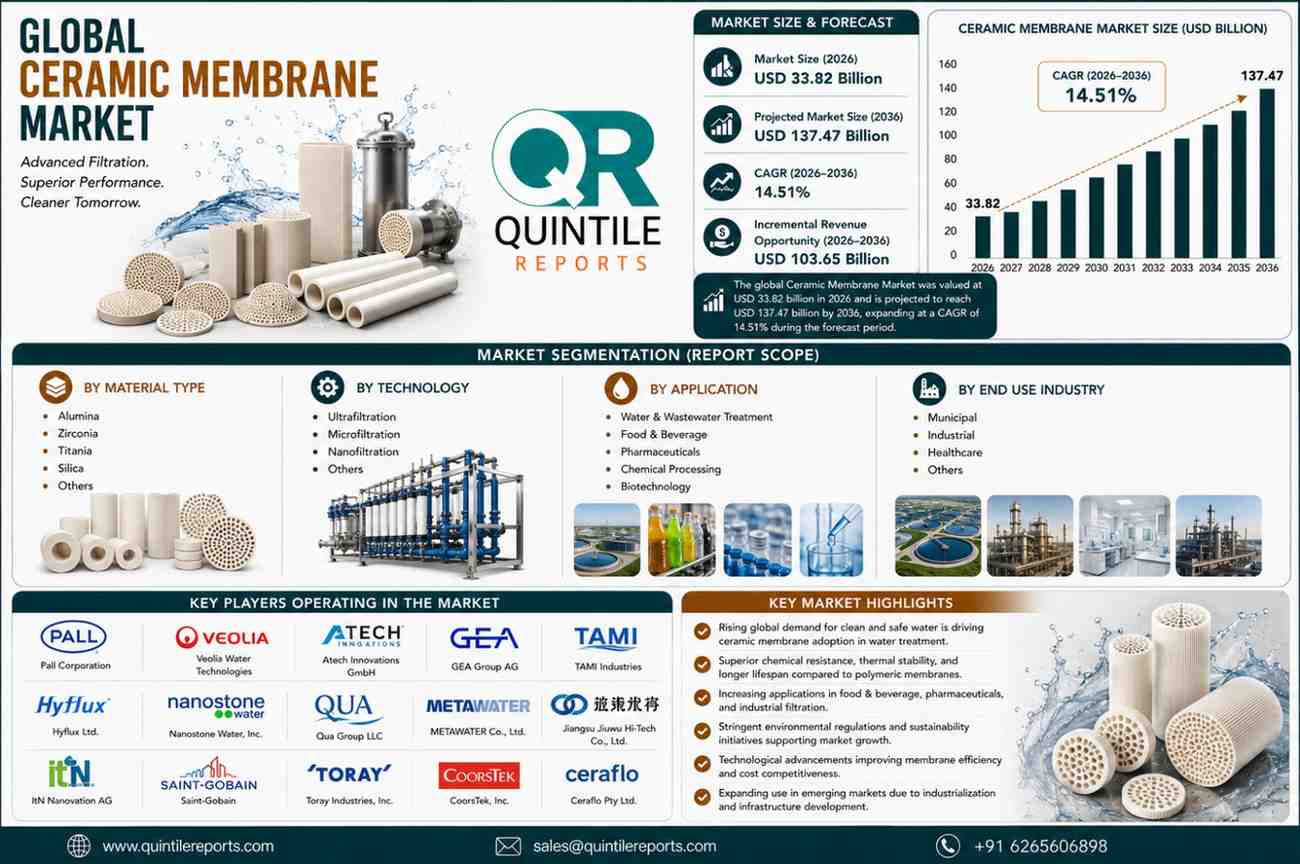
The ceramic membrane industry is experiencing rapid expansion due to the growing need for advanced filtration systems capable of addressing complex water treatment and industrial separation challenges. Water scarcity concerns, tightening environmental regulations, and increasing industrial wastewater generation are encouraging utilities and industrial operators to invest in robust membrane technologies that deliver long-term performance and operational reliability.
Beyond water treatment, ceramic membranes are gaining traction in pharmaceutical manufacturing, biotechnology research, food processing, and chemical production. Their ability to withstand aggressive cleaning agents, high temperatures, and corrosive operating environments makes them particularly valuable in applications requiring sterile filtration, product purity, and process consistency. Continuous innovation in membrane architecture, modular systems, and manufacturing technologies is further expanding the scope of ceramic membrane applications worldwide.
Growing concerns regarding water scarcity, industrial wastewater discharge, and environmental sustainability are driving demand for advanced filtration technologies. Ceramic membranes offer superior durability, filtration performance, and operational efficiency, making them increasingly attractive for municipal and industrial water treatment applications.
Governments worldwide are implementing stricter environmental regulations governing wastewater treatment and industrial effluent discharge. These requirements are encouraging industries to adopt high-performance membrane systems capable of meeting stringent compliance standards.
The pharmaceutical and biotechnology sectors continue to expand their use of ceramic membrane technologies for sterile filtration, protein concentration, bioprocessing, and pharmaceutical manufacturing applications. Their resistance to harsh cleaning protocols and contamination risks provides significant operational advantages.
Food and beverage manufacturers are increasingly utilizing ceramic membranes for milk protein separation, beverage clarification, wine filtration, and ingredient concentration processes. Their long lifespan and consistent performance support efficient production operations.
Ceramic membranes require significantly higher upfront investment compared to conventional polymeric membrane systems. The use of advanced raw materials and specialized manufacturing processes contributes to elevated acquisition costs, particularly for budget-sensitive projects.
Despite their durability under operational conditions, ceramic membranes remain susceptible to mechanical damage during transportation, installation, and maintenance activities. This can increase replacement costs and operational risks in certain applications.
Adoption in developing regions is often constrained by limited technical expertise, insufficient awareness regarding long-term benefits, and preference for lower-cost filtration alternatives.
Although ceramic membranes perform exceptionally well in many industrial applications, certain highly specialized process streams and variable operating conditions may require alternative filtration technologies, limiting adoption in specific use cases.
Governments and industries are increasingly investing in wastewater recycling and water reuse initiatives. Ceramic membrane technologies are well-positioned to support these programs due to their durability, reliability, and filtration efficiency.
Rapid expansion within pharmaceutical manufacturing, biotechnology research, vaccine production, and biologics processing is creating significant opportunities for advanced ceramic membrane solutions.
Industries are increasingly adopting sustainable production methods that emphasize resource recovery, waste minimization, and process efficiency. Ceramic membranes support these objectives by enabling high-performance separation and recycling processes.
Advancements in membrane materials, manufacturing techniques, and modular system design are improving scalability and cost efficiency, expanding adoption across new industrial sectors and applications.
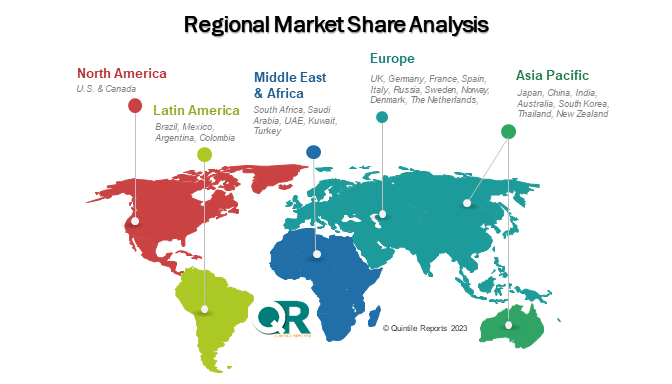
North America represents a significant market for ceramic membranes, supported by stringent environmental regulations, advanced industrial infrastructure, and growing investments in water reuse initiatives. Industries including pharmaceuticals, food processing, chemicals, and municipal utilities are increasingly deploying ceramic membrane systems to enhance operational efficiency and regulatory compliance.
Europe continues to demonstrate strong market demand driven by sustainability goals, wastewater treatment modernization programs, and circular economy initiatives. Countries such as Germany, France, the United Kingdom, and the Netherlands are actively investing in advanced membrane technologies to support industrial water recycling and environmental protection objectives.
Asia-Pacific is expected to remain the fastest-growing regional market throughout the forecast period. Rapid industrialization, urban population growth, water scarcity concerns, and government investments in environmental infrastructure are creating substantial demand for ceramic membrane systems. China, India, Japan, and South Korea are leading adoption across industrial processing, municipal treatment, and high-tech manufacturing sectors.
Latin America is witnessing gradual market expansion through increasing industrial development, water infrastructure investments, and environmental awareness.
Meanwhile, the Middle East & Africa region is emerging as an important growth market due to water scarcity challenges, desalination projects, industrial diversification efforts, and growing demand for advanced water treatment technologies.
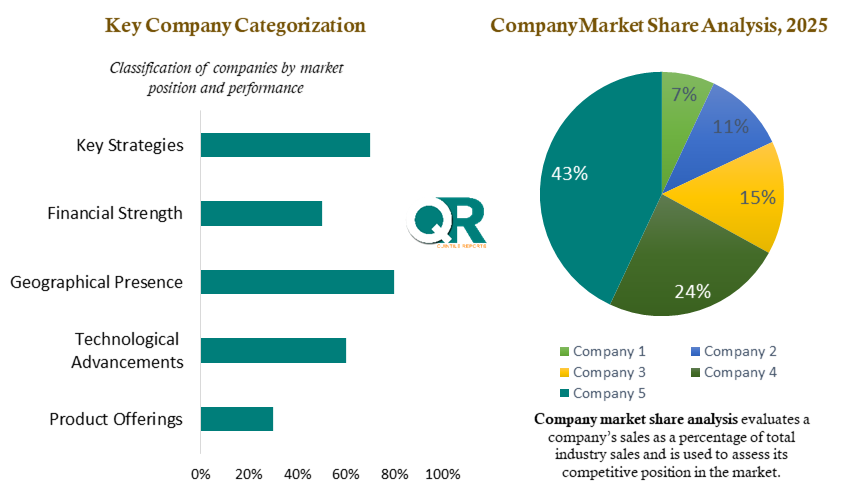
The ceramic membrane market is characterized by intense competition centered around membrane performance, operational lifespan, chemical resistance, and filtration efficiency. Leading manufacturers are investing heavily in material science innovations, advanced ceramic compositions, and next-generation membrane architectures designed to improve throughput and reduce operating costs.
Competition is increasingly shifting toward complete system solutions that integrate membrane modules, filtration equipment, automation technologies, and process control systems. Companies capable of delivering customized, turnkey filtration solutions tailored to specific industry requirements are gaining a competitive advantage in the market.
Additionally, strong technical support, application expertise, regional manufacturing capabilities, and after-sales service networks are becoming critical differentiators. As customers increasingly prioritize long-term operational reliability and lifecycle cost optimization, vendors offering comprehensive service capabilities are expected to strengthen their market positions.
| Report Scope | Details |
| Report Version | 2026 |
| Growth Rate | CAGR of 14.51 % from 2026 to 2036 |
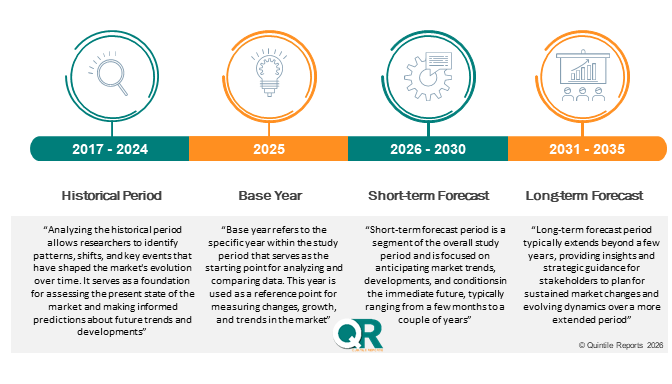
| Base Year | 2025 |
| Actual Estimates / Historical Data | 2017 - 2024 |
| Forecast Period | 2026 - 2036 |
| Quantitative Units | Revenue in USD million/billion & CAGR from 2026 to 2036 |
| Country Scope | North America (U.S., Canada), Europe (UK, Germany, France, Italy, Spain, Russia, Sweden, Denmark, Norway, Rest of Europe), Asia Pacific (Japan, China, India, Australia, South Korea, Thailand, Rest of Asia Pacific), Latin America (Brazil, Mexico, Argentina, Colombia, Rest of Latin America), Middle East & Africa (South Africa, Saudi Arabia, UAE, Kuwait, Rest of Middle East & Africa). |
| The Segment Covered by Material Type |
|
| The Segment Covered by Technology |
|
| Companies Covered |
|
| Report Coverage | Revenue forecast, company share, competitive landscape, growth factors, technology trends, and regional analysis |
| Free Customization Scope (Equivalent to 5 Analyst Working Days) | If you require additional insights beyond the current scope, our analysts can customize the report to meet your specific business needs. |
This report is developed through a comprehensive research framework that combines extensive primary interviews, industry consultations, and detailed secondary research from reputable sources. The study provides balanced, objective, and data-driven insights into market trends, technological advancements, competitive developments, and future growth opportunities.
All market forecasts and estimates are validated using advanced analytical models, market triangulation methodologies, supply-demand assessments, and expert review processes. This rigorous approach ensures high levels of accuracy, transparency, and reliability, enabling stakeholders to make informed strategic decisions.
The research methodology integrates both qualitative and quantitative techniques to evaluate the Ceramic Membrane Market. Secondary research includes analysis of industry reports, company disclosures, environmental regulations, technical publications, filtration technology studies, and market databases. These sources provide comprehensive insights into market structure, technological developments, and competitive dynamics.
Primary research involves interviews with membrane manufacturers, filtration technology providers, water treatment specialists, industrial end-users, engineering consultants, and industry experts. Advanced forecasting models, regional demand assessments, technology adoption analysis, and market validation techniques are employed to generate accurate market projections and strategic insights.

This report has been prepared by a team of experienced filtration technology analysts, environmental infrastructure researchers, and industrial process specialists with extensive expertise in membrane separation technologies, water treatment systems, and sustainable industrial solutions. The team combines deep technical knowledge with advanced analytical methodologies to deliver accurate, objective, and actionable market intelligence.
Through continuous monitoring of regulatory developments, technological innovations, industrial investment trends, and sustainability initiatives, our analysts provide valuable insights that help stakeholders navigate evolving market conditions and identify new growth opportunities. The report reflects a commitment to research excellence, transparency, and industry relevance, making it a trusted resource for manufacturers, investors, utilities, policymakers, and industrial operators worldwide.
List of Tables
Table 1 List of Abbreviation and acronyms
Table 2 List of Sources
Table 3 North America Global Ceramic Membrane Market, by Segment Analysis, (USD Million) 2017-2036
Table 4 North America Global Ceramic Membrane Market, by Region, (USD Million) 2017-2036
Table 5 U.S. Global Ceramic Membrane Market, by Segment Analysis, (USD Million) 2017-2036
Table 6 Canada Global Ceramic Membrane Market, by Segment Analysis, (USD Million) 2017-2036
Table 7 Europe Global Ceramic Membrane Market, by Segment Analysis, (USD Million) 2017-2036
Table 8 Europe Global Ceramic Membrane Market, by Region, (USD Million) 2017-2036
Table 9 Germany Global Ceramic Membrane Market, by Segment Analysis, (USD Million) 2017-2036
Table 10 U.K. Global Ceramic Membrane Market, by Segment Analysis, (USD Million) 2017-2036
Table 11 France Global Ceramic Membrane Market, by Segment Analysis, (USD Million) 2017-2036
Table 12 Italy Global Ceramic Membrane Market, by Segment Analysis, (USD Million) 2017-2036
Table 13 Spain Global Ceramic Membrane Market, by Segment Analysis, (USD Million) 2017-2036
Table 14 Sweden Global Ceramic Membrane Market, by Segment Analysis, (USD Million) 2017-2036
Table 15 Denmark Global Ceramic Membrane Market, by Segment Analysis, (USD Million) 2017-2036
Table 16 Norway Global Ceramic Membrane Market, by Segment Analysis, (USD Million) 2017-2036
Table 17 The Netherlands Global Ceramic Membrane Market, by Segment Analysis, (USD Million) 2017-2036
Table 18 Russia Global Ceramic Membrane Market, by Segment Analysis, (USD Million) 2017-2036
Table 19 Asia Pacific Global Ceramic Membrane Market, by Segment Analysis, (USD Million) 2017-2036
Table 20 Asia Pacific Global Ceramic Membrane Market, by Region, (USD Million) 2017-2036
Table 21 China Global Ceramic Membrane Market, by Segment Analysis, (USD Million) 2017-2036
Table 22 Japan Global Ceramic Membrane Market, by Segment Analysis, (USD Million) 2017-2036
Table 23 India Global Ceramic Membrane Market, by Segment Analysis, (USD Million) 2017-2036
Table 24 Australia Global Ceramic Membrane Market, by Segment Analysis, (USD Million) 2017-2036
Table 25 South Korea Global Ceramic Membrane Market, by Segment Analysis, (USD Million) 2017-2036
Table 26 Thailand Global Ceramic Membrane Market, by Segment Analysis, (USD Million) 2017-2036
Table 27 Latin America Global Ceramic Membrane Market, by Segment Analysis, (USD Million) 2017-2036
Table 28 Latin America Global Ceramic Membrane Market, by Region, (USD Million) 2017-2036
Table 29 Brazil Global Ceramic Membrane Market, by Segment Analysis, (USD Million) 2017-2036
Table 30 Mexico Global Ceramic Membrane Market, by Segment Analysis, (USD Million) 2017-2036
Table 31 Argentina Global Ceramic Membrane Market, by Segment Analysis, (USD Million) 2017-2036
Table 32 Middle East and Africa Global Ceramic Membrane Market, by Segment Analysis, (USD Million) 2017-2036
Table 33 Middle East and Africa Global Ceramic Membrane Market, by Region, (USD Million) 2017-2036
Table 34 South Africa Global Ceramic Membrane Market, by Segment Analysis, (USD Million) 2017-2036
Table 35 Saudi Arabia Global Ceramic Membrane Market, by Segment Analysis, (USD Million) 2017-2036
Table 36 UAE Global Ceramic Membrane Market, by Segment Analysis, (USD Million) 2017-2036
Table 37 Kuwait Global Ceramic Membrane Market, by Segment Analysis, (USD Million) 2017-2036
Table 38 Turkey Global Ceramic Membrane Market, by Segment Analysis, (USD Million) 2017-2036
Fig.1 Market research process
Fig.2 Market research approaches
Fig.3 Global Ceramic Membrane Market: market scenario
Fig.4 Global Ceramic Membrane Market competitive outlook
Fig.5 Global Ceramic Membrane Market driver analysis
Fig.6 Global Ceramic Membrane Market restraint analysis
Fig.7 Global Ceramic Membrane Market opportunity analysis
Fig.8 Global Ceramic Membrane Market trends analysis
Fig.9 Global Ceramic Membrane Market: Segment Analysis (Based on the scope)
Fig.10 Global Ceramic Membrane Market: regional analysis
Fig.11 Global market shares and leading market players
Fig.12 North America market share and leading players
Fig.13 Europe market share and leading players
Fig.14 Asia Pacific market share and leading players
Fig.15 Latin America market share and leading players
Fig.16 Middle East & Africa market share and leading players
Fig.17 North America, by country
Fig.18 North America
Fig.19 North America market estimates and forecast, 2017-2036
Fig.20 U.S.
Fig.21 Canada
Fig.22 Europe
Fig.23 Europe market estimates and forecast, 2017-2036
Fig.24 U.K.
Fig.25 Germany
Fig.26 France
Fig.27 Italy
Fig.28 Spain
Fig.29 Sweden
Fig.30 Denmark
Fig.31 Norway
Fig.32 The Netherlands
Fig.33 Russia
Fig.34 Asia Pacific
Fig.35 Asia Pacific market estimates and forecast, 2017-2036
Fig.36 China
Fig.37 Japan
Fig.38 India
Fig.39 Australia
Fig.40 South Korea
Fig.41 Thailand
Fig.42 Latin America
Fig.43 Latin America market estimates and forecast, 2017-2036
Fig.44 Brazil
Fig.45 Mexico
Fig.46 Argentina
Fig.47 Colombia
Fig.48 Middle East and Africa
Fig.49 Middle East and Africa market estimates and forecast, 2017-2036
Fig.50 Saudi Arabia
Fig.51 South Africa
Fig.52 UAE
Fig.53 Kuwait
Fig.54 Turkey
List of Tables
Table 1 List of Abbreviation and acronyms
Table 2 List of Sources
Table 3 North America Global Ceramic Membrane Market, by Segment Analysis, (USD Million) 2017-2036
Table 4 North America Global Ceramic Membrane Market, by Region, (USD Million) 2017-2036
Table 5 U.S. Global Ceramic Membrane Market, by Segment Analysis, (USD Million) 2017-2036
Table 6 Canada Global Ceramic Membrane Market, by Segment Analysis, (USD Million) 2017-2036
Table 7 Europe Global Ceramic Membrane Market, by Segment Analysis, (USD Million) 2017-2036
Table 8 Europe Global Ceramic Membrane Market, by Region, (USD Million) 2017-2036
Table 9 Germany Global Ceramic Membrane Market, by Segment Analysis, (USD Million) 2017-2036
Table 10 U.K. Global Ceramic Membrane Market, by Segment Analysis, (USD Million) 2017-2036
Table 11 France Global Ceramic Membrane Market, by Segment Analysis, (USD Million) 2017-2036
Table 12 Italy Global Ceramic Membrane Market, by Segment Analysis, (USD Million) 2017-2036
Table 13 Spain Global Ceramic Membrane Market, by Segment Analysis, (USD Million) 2017-2036
Table 14 Sweden Global Ceramic Membrane Market, by Segment Analysis, (USD Million) 2017-2036
Table 15 Denmark Global Ceramic Membrane Market, by Segment Analysis, (USD Million) 2017-2036
Table 16 Norway Global Ceramic Membrane Market, by Segment Analysis, (USD Million) 2017-2036
Table 17 The Netherlands Global Ceramic Membrane Market, by Segment Analysis, (USD Million) 2017-2036
Table 18 Russia Global Ceramic Membrane Market, by Segment Analysis, (USD Million) 2017-2036
Table 19 Asia Pacific Global Ceramic Membrane Market, by Segment Analysis, (USD Million) 2017-2036
Table 20 Asia Pacific Global Ceramic Membrane Market, by Region, (USD Million) 2017-2036
Table 21 China Global Ceramic Membrane Market, by Segment Analysis, (USD Million) 2017-2036
Table 22 Japan Global Ceramic Membrane Market, by Segment Analysis, (USD Million) 2017-2036
Table 23 India Global Ceramic Membrane Market, by Segment Analysis, (USD Million) 2017-2036
Table 24 Australia Global Ceramic Membrane Market, by Segment Analysis, (USD Million) 2017-2036
Table 25 South Korea Global Ceramic Membrane Market, by Segment Analysis, (USD Million) 2017-2036
Table 26 Thailand Global Ceramic Membrane Market, by Segment Analysis, (USD Million) 2017-2036
Table 27 Latin America Global Ceramic Membrane Market, by Segment Analysis, (USD Million) 2017-2036
Table 28 Latin America Global Ceramic Membrane Market, by Region, (USD Million) 2017-2036
Table 29 Brazil Global Ceramic Membrane Market, by Segment Analysis, (USD Million) 2017-2036
Table 30 Mexico Global Ceramic Membrane Market, by Segment Analysis, (USD Million) 2017-2036
Table 31 Argentina Global Ceramic Membrane Market, by Segment Analysis, (USD Million) 2017-2036
Table 32 Middle East and Africa Global Ceramic Membrane Market, by Segment Analysis, (USD Million) 2017-2036
Table 33 Middle East and Africa Global Ceramic Membrane Market, by Region, (USD Million) 2017-2036
Table 34 South Africa Global Ceramic Membrane Market, by Segment Analysis, (USD Million) 2017-2036
Table 35 Saudi Arabia Global Ceramic Membrane Market, by Segment Analysis, (USD Million) 2017-2036
Table 36 UAE Global Ceramic Membrane Market, by Segment Analysis, (USD Million) 2017-2036
Table 37 Kuwait Global Ceramic Membrane Market, by Segment Analysis, (USD Million) 2017-2036
Table 38 Turkey Global Ceramic Membrane Market, by Segment Analysis, (USD Million) 2017-2036
Fig.1 Market research process
Fig.2 Market research approaches
Fig.3 Global Ceramic Membrane Market: market scenario
Fig.4 Global Ceramic Membrane Market competitive outlook
Fig.5 Global Ceramic Membrane Market driver analysis
Fig.6 Global Ceramic Membrane Market restraint analysis
Fig.7 Global Ceramic Membrane Market opportunity analysis
Fig.8 Global Ceramic Membrane Market trends analysis
Fig.9 Global Ceramic Membrane Market: Segment Analysis (Based on the scope)
Fig.10 Global Ceramic Membrane Market: regional analysis
Fig.11 Global market shares and leading market players
Fig.12 North America market share and leading players
Fig.13 Europe market share and leading players
Fig.14 Asia Pacific market share and leading players
Fig.15 Latin America market share and leading players
Fig.16 Middle East & Africa market share and leading players
Fig.17 North America, by country
Fig.18 North America
Fig.19 North America market estimates and forecast, 2017-2036
Fig.20 U.S.
Fig.21 Canada
Fig.22 Europe
Fig.23 Europe market estimates and forecast, 2017-2036
Fig.24 U.K.
Fig.25 Germany
Fig.26 France
Fig.27 Italy
Fig.28 Spain
Fig.29 Sweden
Fig.30 Denmark
Fig.31 Norway
Fig.32 The Netherlands
Fig.33 Russia
Fig.34 Asia Pacific
Fig.35 Asia Pacific market estimates and forecast, 2017-2036
Fig.36 China
Fig.37 Japan
Fig.38 India
Fig.39 Australia
Fig.40 South Korea
Fig.41 Thailand
Fig.42 Latin America
Fig.43 Latin America market estimates and forecast, 2017-2036
Fig.44 Brazil
Fig.45 Mexico
Fig.46 Argentina
Fig.47 Colombia
Fig.48 Middle East and Africa
Fig.49 Middle East and Africa market estimates and forecast, 2017-2036
Fig.50 Saudi Arabia
Fig.51 South Africa
Fig.52 UAE
Fig.53 Kuwait
Fig.54 Turkey
The global Ceramic Membrane Market is projected to reach USD 137.47 billion by 2036, growing from USD 33.82 billion in 2026.
Market growth is driven by increasing demand for advanced water and wastewater treatment solutions, stricter environmental regulations, industrial sustainability initiatives, and expanding adoption across pharmaceutical, biotechnology, and food processing industries.
Ceramic membranes are widely used in water treatment, wastewater recycling, pharmaceutical processing, biotechnology applications, food and beverage filtration, and chemical processing due to their high durability, chemical resistance, and filtration efficiency.
Ceramic membranes offer superior thermal stability, chemical resistance, mechanical strength, and longer operational life compared to conventional polymeric membranes, making them suitable for harsh industrial environments.
Asia-Pacific is expected to dominate the market due to rapid industrialization, increasing water scarcity concerns, environmental infrastructure investments, and growing demand for advanced filtration technologies.
Major end users include municipal water treatment facilities, industrial manufacturers, pharmaceutical companies, biotechnology firms, food and beverage processors, and chemical processing industries.
Key players include Pall Corporation, Veolia Water Technologies, GEA Group AG, Saint-Gobain, and Toray Industries, Inc.
Yes. Ceramic membranes are highly effective for industrial wastewater treatment because they can withstand aggressive chemicals, high temperatures, and demanding operating conditions while maintaining long-term filtration performance.
The global Ceramic Membrane Market was valued at USD 33.82 billion in 2026 and is projected to reach USD 137.47 billion by 2036, expanding at an impressive CAGR of 14.51% during the forecast period. Ceramic membranes have emerged as a highly efficient and durable filtration technology capable of operating under extreme chemical, thermal, and mechanical conditions where conventional polymeric membranes often fail. Manufactured using advanced ceramic materials such as alumina, zirconia, and titania, these membranes offer exceptional chemical resistance, thermal stability, filtration accuracy, and operational longevity.
The market is benefiting from increasing global demand for sustainable water treatment solutions, industrial wastewater recycling, advanced pharmaceutical processing, and high-performance separation technologies. As industries seek more reliable, energy-efficient, and environmentally compliant filtration systems, ceramic membranes are becoming an increasingly attractive solution across municipal, industrial, and commercial applications.
Growth is supported by increasing demand for advanced filtration technologies, stricter environmental regulations, effective water scarcity management, and expanding industrial sustainability initiatives. As industries and municipalities seek reliable, long-lasting, and energy-efficient filtration solutions, ceramic membrane technologies continue to gain widespread adoption across water treatment, wastewater recycling, pharmaceutical processing, food and beverage production, and industrial separation applications.
The ceramic membrane industry is experiencing rapid expansion due to the growing need for advanced filtration systems capable of addressing complex water treatment and industrial separation challenges. Water scarcity concerns, tightening environmental regulations, and increasing industrial wastewater generation are encouraging utilities and industrial operators to invest in robust membrane technologies that deliver long-term performance and operational reliability.
Beyond water treatment, ceramic membranes are gaining traction in pharmaceutical manufacturing, biotechnology research, food processing, and chemical production. Their ability to withstand aggressive cleaning agents, high temperatures, and corrosive operating environments makes them particularly valuable in applications requiring sterile filtration, product purity, and process consistency. Continuous innovation in membrane architecture, modular systems, and manufacturing technologies is further expanding the scope of ceramic membrane applications worldwide.
Growing concerns regarding water scarcity, industrial wastewater discharge, and environmental sustainability are driving demand for advanced filtration technologies. Ceramic membranes offer superior durability, filtration performance, and operational efficiency, making them increasingly attractive for municipal and industrial water treatment applications.
Governments worldwide are implementing stricter environmental regulations governing wastewater treatment and industrial effluent discharge. These requirements are encouraging industries to adopt high-performance membrane systems capable of meeting stringent compliance standards.
The pharmaceutical and biotechnology sectors continue to expand their use of ceramic membrane technologies for sterile filtration, protein concentration, bioprocessing, and pharmaceutical manufacturing applications. Their resistance to harsh cleaning protocols and contamination risks provides significant operational advantages.
Food and beverage manufacturers are increasingly utilizing ceramic membranes for milk protein separation, beverage clarification, wine filtration, and ingredient concentration processes. Their long lifespan and consistent performance support efficient production operations.
Ceramic membranes require significantly higher upfront investment compared to conventional polymeric membrane systems. The use of advanced raw materials and specialized manufacturing processes contributes to elevated acquisition costs, particularly for budget-sensitive projects.
Despite their durability under operational conditions, ceramic membranes remain susceptible to mechanical damage during transportation, installation, and maintenance activities. This can increase replacement costs and operational risks in certain applications.
Adoption in developing regions is often constrained by limited technical expertise, insufficient awareness regarding long-term benefits, and preference for lower-cost filtration alternatives.
Although ceramic membranes perform exceptionally well in many industrial applications, certain highly specialized process streams and variable operating conditions may require alternative filtration technologies, limiting adoption in specific use cases.
Governments and industries are increasingly investing in wastewater recycling and water reuse initiatives. Ceramic membrane technologies are well-positioned to support these programs due to their durability, reliability, and filtration efficiency.
Rapid expansion within pharmaceutical manufacturing, biotechnology research, vaccine production, and biologics processing is creating significant opportunities for advanced ceramic membrane solutions.
Industries are increasingly adopting sustainable production methods that emphasize resource recovery, waste minimization, and process efficiency. Ceramic membranes support these objectives by enabling high-performance separation and recycling processes.
Advancements in membrane materials, manufacturing techniques, and modular system design are improving scalability and cost efficiency, expanding adoption across new industrial sectors and applications.
North America represents a significant market for ceramic membranes, supported by stringent environmental regulations, advanced industrial infrastructure, and growing investments in water reuse initiatives. Industries including pharmaceuticals, food processing, chemicals, and municipal utilities are increasingly deploying ceramic membrane systems to enhance operational efficiency and regulatory compliance.
Europe continues to demonstrate strong market demand driven by sustainability goals, wastewater treatment modernization programs, and circular economy initiatives. Countries such as Germany, France, the United Kingdom, and the Netherlands are actively investing in advanced membrane technologies to support industrial water recycling and environmental protection objectives.
Asia-Pacific is expected to remain the fastest-growing regional market throughout the forecast period. Rapid industrialization, urban population growth, water scarcity concerns, and government investments in environmental infrastructure are creating substantial demand for ceramic membrane systems. China, India, Japan, and South Korea are leading adoption across industrial processing, municipal treatment, and high-tech manufacturing sectors.
Latin America is witnessing gradual market expansion through increasing industrial development, water infrastructure investments, and environmental awareness.
Meanwhile, the Middle East & Africa region is emerging as an important growth market due to water scarcity challenges, desalination projects, industrial diversification efforts, and growing demand for advanced water treatment technologies.
The ceramic membrane market is characterized by intense competition centered around membrane performance, operational lifespan, chemical resistance, and filtration efficiency. Leading manufacturers are investing heavily in material science innovations, advanced ceramic compositions, and next-generation membrane architectures designed to improve throughput and reduce operating costs.
Competition is increasingly shifting toward complete system solutions that integrate membrane modules, filtration equipment, automation technologies, and process control systems. Companies capable of delivering customized, turnkey filtration solutions tailored to specific industry requirements are gaining a competitive advantage in the market.
Additionally, strong technical support, application expertise, regional manufacturing capabilities, and after-sales service networks are becoming critical differentiators. As customers increasingly prioritize long-term operational reliability and lifecycle cost optimization, vendors offering comprehensive service capabilities are expected to strengthen their market positions.
| Report Scope | Details |
| Report Version | 2026 |
| Growth Rate | CAGR of 14.51 % from 2026 to 2036 |
| Base Year | 2025 |
| Actual Estimates / Historical Data | 2017 - 2024 |
| Forecast Period | 2026 - 2036 |
| Quantitative Units | Revenue in USD million/billion & CAGR from 2026 to 2036 |
| Country Scope | North America (U.S., Canada), Europe (UK, Germany, France, Italy, Spain, Russia, Sweden, Denmark, Norway, Rest of Europe), Asia Pacific (Japan, China, India, Australia, South Korea, Thailand, Rest of Asia Pacific), Latin America (Brazil, Mexico, Argentina, Colombia, Rest of Latin America), Middle East & Africa (South Africa, Saudi Arabia, UAE, Kuwait, Rest of Middle East & Africa). |
| The Segment Covered by Material Type |
|
| The Segment Covered by Technology |
|
| Companies Covered |
|
| Report Coverage | Revenue forecast, company share, competitive landscape, growth factors, technology trends, and regional analysis |
| Free Customization Scope (Equivalent to 5 Analyst Working Days) | If you require additional insights beyond the current scope, our analysts can customize the report to meet your specific business needs. |
This report is developed through a comprehensive research framework that combines extensive primary interviews, industry consultations, and detailed secondary research from reputable sources. The study provides balanced, objective, and data-driven insights into market trends, technological advancements, competitive developments, and future growth opportunities.
All market forecasts and estimates are validated using advanced analytical models, market triangulation methodologies, supply-demand assessments, and expert review processes. This rigorous approach ensures high levels of accuracy, transparency, and reliability, enabling stakeholders to make informed strategic decisions.
The research methodology integrates both qualitative and quantitative techniques to evaluate the Ceramic Membrane Market. Secondary research includes analysis of industry reports, company disclosures, environmental regulations, technical publications, filtration technology studies, and market databases. These sources provide comprehensive insights into market structure, technological developments, and competitive dynamics.
Primary research involves interviews with membrane manufacturers, filtration technology providers, water treatment specialists, industrial end-users, engineering consultants, and industry experts. Advanced forecasting models, regional demand assessments, technology adoption analysis, and market validation techniques are employed to generate accurate market projections and strategic insights.
This report has been prepared by a team of experienced filtration technology analysts, environmental infrastructure researchers, and industrial process specialists with extensive expertise in membrane separation technologies, water treatment systems, and sustainable industrial solutions. The team combines deep technical knowledge with advanced analytical methodologies to deliver accurate, objective, and actionable market intelligence.
Through continuous monitoring of regulatory developments, technological innovations, industrial investment trends, and sustainability initiatives, our analysts provide valuable insights that help stakeholders navigate evolving market conditions and identify new growth opportunities. The report reflects a commitment to research excellence, transparency, and industry relevance, making it a trusted resource for manufacturers, investors, utilities, policymakers, and industrial operators worldwide.
Table 1 List of Abbreviation and acronyms
Table 2 List of Sources
Table 3 North America Global Ceramic Membrane Market, by Segment Analysis, (USD Million) 2017-2036
Table 4 North America Global Ceramic Membrane Market, by Region, (USD Million) 2017-2036
Table 5 U.S. Global Ceramic Membrane Market, by Segment Analysis, (USD Million) 2017-2036
Table 6 Canada Global Ceramic Membrane Market, by Segment Analysis, (USD Million) 2017-2036
Table 7 Europe Global Ceramic Membrane Market, by Segment Analysis, (USD Million) 2017-2036
Table 8 Europe Global Ceramic Membrane Market, by Region, (USD Million) 2017-2036
Table 9 Germany Global Ceramic Membrane Market, by Segment Analysis, (USD Million) 2017-2036
Table 10 U.K. Global Ceramic Membrane Market, by Segment Analysis, (USD Million) 2017-2036
Table 11 France Global Ceramic Membrane Market, by Segment Analysis, (USD Million) 2017-2036
Table 12 Italy Global Ceramic Membrane Market, by Segment Analysis, (USD Million) 2017-2036
Table 13 Spain Global Ceramic Membrane Market, by Segment Analysis, (USD Million) 2017-2036
Table 14 Sweden Global Ceramic Membrane Market, by Segment Analysis, (USD Million) 2017-2036
Table 15 Denmark Global Ceramic Membrane Market, by Segment Analysis, (USD Million) 2017-2036
Table 16 Norway Global Ceramic Membrane Market, by Segment Analysis, (USD Million) 2017-2036
Table 17 The Netherlands Global Ceramic Membrane Market, by Segment Analysis, (USD Million) 2017-2036
Table 18 Russia Global Ceramic Membrane Market, by Segment Analysis, (USD Million) 2017-2036
Table 19 Asia Pacific Global Ceramic Membrane Market, by Segment Analysis, (USD Million) 2017-2036
Table 20 Asia Pacific Global Ceramic Membrane Market, by Region, (USD Million) 2017-2036
Table 21 China Global Ceramic Membrane Market, by Segment Analysis, (USD Million) 2017-2036
Table 22 Japan Global Ceramic Membrane Market, by Segment Analysis, (USD Million) 2017-2036
Table 23 India Global Ceramic Membrane Market, by Segment Analysis, (USD Million) 2017-2036
Table 24 Australia Global Ceramic Membrane Market, by Segment Analysis, (USD Million) 2017-2036
Table 25 South Korea Global Ceramic Membrane Market, by Segment Analysis, (USD Million) 2017-2036
Table 26 Thailand Global Ceramic Membrane Market, by Segment Analysis, (USD Million) 2017-2036
Table 27 Latin America Global Ceramic Membrane Market, by Segment Analysis, (USD Million) 2017-2036
Table 28 Latin America Global Ceramic Membrane Market, by Region, (USD Million) 2017-2036
Table 29 Brazil Global Ceramic Membrane Market, by Segment Analysis, (USD Million) 2017-2036
Table 30 Mexico Global Ceramic Membrane Market, by Segment Analysis, (USD Million) 2017-2036
Table 31 Argentina Global Ceramic Membrane Market, by Segment Analysis, (USD Million) 2017-2036
Table 32 Middle East and Africa Global Ceramic Membrane Market, by Segment Analysis, (USD Million) 2017-2036
Table 33 Middle East and Africa Global Ceramic Membrane Market, by Region, (USD Million) 2017-2036
Table 34 South Africa Global Ceramic Membrane Market, by Segment Analysis, (USD Million) 2017-2036
Table 35 Saudi Arabia Global Ceramic Membrane Market, by Segment Analysis, (USD Million) 2017-2036
Table 36 UAE Global Ceramic Membrane Market, by Segment Analysis, (USD Million) 2017-2036
Table 37 Kuwait Global Ceramic Membrane Market, by Segment Analysis, (USD Million) 2017-2036
Table 38 Turkey Global Ceramic Membrane Market, by Segment Analysis, (USD Million) 2017-2036
Fig.1 Market research process
Fig.2 Market research approaches
Fig.3 Global Ceramic Membrane Market: market scenario
Fig.4 Global Ceramic Membrane Market competitive outlook
Fig.5 Global Ceramic Membrane Market driver analysis
Fig.6 Global Ceramic Membrane Market restraint analysis
Fig.7 Global Ceramic Membrane Market opportunity analysis
Fig.8 Global Ceramic Membrane Market trends analysis
Fig.9 Global Ceramic Membrane Market: Segment Analysis (Based on the scope)
Fig.10 Global Ceramic Membrane Market: regional analysis
Fig.11 Global market shares and leading market players
Fig.12 North America market share and leading players
Fig.13 Europe market share and leading players
Fig.14 Asia Pacific market share and leading players
Fig.15 Latin America market share and leading players
Fig.16 Middle East & Africa market share and leading players
Fig.17 North America, by country
Fig.18 North America
Fig.19 North America market estimates and forecast, 2017-2036
Fig.20 U.S.
Fig.21 Canada
Fig.22 Europe
Fig.23 Europe market estimates and forecast, 2017-2036
Fig.24 U.K.
Fig.25 Germany
Fig.26 France
Fig.27 Italy
Fig.28 Spain
Fig.29 Sweden
Fig.30 Denmark
Fig.31 Norway
Fig.32 The Netherlands
Fig.33 Russia
Fig.34 Asia Pacific
Fig.35 Asia Pacific market estimates and forecast, 2017-2036
Fig.36 China
Fig.37 Japan
Fig.38 India
Fig.39 Australia
Fig.40 South Korea
Fig.41 Thailand
Fig.42 Latin America
Fig.43 Latin America market estimates and forecast, 2017-2036
Fig.44 Brazil
Fig.45 Mexico
Fig.46 Argentina
Fig.47 Colombia
Fig.48 Middle East and Africa
Fig.49 Middle East and Africa market estimates and forecast, 2017-2036
Fig.50 Saudi Arabia
Fig.51 South Africa
Fig.52 UAE
Fig.53 Kuwait
Fig.54 Turkey
Table 1 List of Abbreviation and acronyms
Table 2 List of Sources
Table 3 North America Global Ceramic Membrane Market, by Segment Analysis, (USD Million) 2017-2036
Table 4 North America Global Ceramic Membrane Market, by Region, (USD Million) 2017-2036
Table 5 U.S. Global Ceramic Membrane Market, by Segment Analysis, (USD Million) 2017-2036
Table 6 Canada Global Ceramic Membrane Market, by Segment Analysis, (USD Million) 2017-2036
Table 7 Europe Global Ceramic Membrane Market, by Segment Analysis, (USD Million) 2017-2036
Table 8 Europe Global Ceramic Membrane Market, by Region, (USD Million) 2017-2036
Table 9 Germany Global Ceramic Membrane Market, by Segment Analysis, (USD Million) 2017-2036
Table 10 U.K. Global Ceramic Membrane Market, by Segment Analysis, (USD Million) 2017-2036
Table 11 France Global Ceramic Membrane Market, by Segment Analysis, (USD Million) 2017-2036
Table 12 Italy Global Ceramic Membrane Market, by Segment Analysis, (USD Million) 2017-2036
Table 13 Spain Global Ceramic Membrane Market, by Segment Analysis, (USD Million) 2017-2036
Table 14 Sweden Global Ceramic Membrane Market, by Segment Analysis, (USD Million) 2017-2036
Table 15 Denmark Global Ceramic Membrane Market, by Segment Analysis, (USD Million) 2017-2036
Table 16 Norway Global Ceramic Membrane Market, by Segment Analysis, (USD Million) 2017-2036
Table 17 The Netherlands Global Ceramic Membrane Market, by Segment Analysis, (USD Million) 2017-2036
Table 18 Russia Global Ceramic Membrane Market, by Segment Analysis, (USD Million) 2017-2036
Table 19 Asia Pacific Global Ceramic Membrane Market, by Segment Analysis, (USD Million) 2017-2036
Table 20 Asia Pacific Global Ceramic Membrane Market, by Region, (USD Million) 2017-2036
Table 21 China Global Ceramic Membrane Market, by Segment Analysis, (USD Million) 2017-2036
Table 22 Japan Global Ceramic Membrane Market, by Segment Analysis, (USD Million) 2017-2036
Table 23 India Global Ceramic Membrane Market, by Segment Analysis, (USD Million) 2017-2036
Table 24 Australia Global Ceramic Membrane Market, by Segment Analysis, (USD Million) 2017-2036
Table 25 South Korea Global Ceramic Membrane Market, by Segment Analysis, (USD Million) 2017-2036
Table 26 Thailand Global Ceramic Membrane Market, by Segment Analysis, (USD Million) 2017-2036
Table 27 Latin America Global Ceramic Membrane Market, by Segment Analysis, (USD Million) 2017-2036
Table 28 Latin America Global Ceramic Membrane Market, by Region, (USD Million) 2017-2036
Table 29 Brazil Global Ceramic Membrane Market, by Segment Analysis, (USD Million) 2017-2036
Table 30 Mexico Global Ceramic Membrane Market, by Segment Analysis, (USD Million) 2017-2036
Table 31 Argentina Global Ceramic Membrane Market, by Segment Analysis, (USD Million) 2017-2036
Table 32 Middle East and Africa Global Ceramic Membrane Market, by Segment Analysis, (USD Million) 2017-2036
Table 33 Middle East and Africa Global Ceramic Membrane Market, by Region, (USD Million) 2017-2036
Table 34 South Africa Global Ceramic Membrane Market, by Segment Analysis, (USD Million) 2017-2036
Table 35 Saudi Arabia Global Ceramic Membrane Market, by Segment Analysis, (USD Million) 2017-2036
Table 36 UAE Global Ceramic Membrane Market, by Segment Analysis, (USD Million) 2017-2036
Table 37 Kuwait Global Ceramic Membrane Market, by Segment Analysis, (USD Million) 2017-2036
Table 38 Turkey Global Ceramic Membrane Market, by Segment Analysis, (USD Million) 2017-2036
Fig.1 Market research process
Fig.2 Market research approaches
Fig.3 Global Ceramic Membrane Market: market scenario
Fig.4 Global Ceramic Membrane Market competitive outlook
Fig.5 Global Ceramic Membrane Market driver analysis
Fig.6 Global Ceramic Membrane Market restraint analysis
Fig.7 Global Ceramic Membrane Market opportunity analysis
Fig.8 Global Ceramic Membrane Market trends analysis
Fig.9 Global Ceramic Membrane Market: Segment Analysis (Based on the scope)
Fig.10 Global Ceramic Membrane Market: regional analysis
Fig.11 Global market shares and leading market players
Fig.12 North America market share and leading players
Fig.13 Europe market share and leading players
Fig.14 Asia Pacific market share and leading players
Fig.15 Latin America market share and leading players
Fig.16 Middle East & Africa market share and leading players
Fig.17 North America, by country
Fig.18 North America
Fig.19 North America market estimates and forecast, 2017-2036
Fig.20 U.S.
Fig.21 Canada
Fig.22 Europe
Fig.23 Europe market estimates and forecast, 2017-2036
Fig.24 U.K.
Fig.25 Germany
Fig.26 France
Fig.27 Italy
Fig.28 Spain
Fig.29 Sweden
Fig.30 Denmark
Fig.31 Norway
Fig.32 The Netherlands
Fig.33 Russia
Fig.34 Asia Pacific
Fig.35 Asia Pacific market estimates and forecast, 2017-2036
Fig.36 China
Fig.37 Japan
Fig.38 India
Fig.39 Australia
Fig.40 South Korea
Fig.41 Thailand
Fig.42 Latin America
Fig.43 Latin America market estimates and forecast, 2017-2036
Fig.44 Brazil
Fig.45 Mexico
Fig.46 Argentina
Fig.47 Colombia
Fig.48 Middle East and Africa
Fig.49 Middle East and Africa market estimates and forecast, 2017-2036
Fig.50 Saudi Arabia
Fig.51 South Africa
Fig.52 UAE
Fig.53 Kuwait
Fig.54 Turkey

A license granted to one user. Rules or conditions might be applied for e.g. the use of electric files (PDFs) or printings, depending on product.
A license granted to multiple users.
A license granted to a single business site/establishment.
A license granted to all employees within organisation access to the product.
Immediate / Within 24-48 hours - Working days
Online Payments with PayPal and CCavenue
You can order a report by picking any of the payment methods which is bank wire or online payment through any Debit/Credit card or PayPal.
Hard Copy
Aramid Fiber Market Overview The global Aramid Fiber Market was valued at USD 4.98 billion in 2026 a
Read MoreConcrete Market Overview The global concrete market forms the backbone of modern construction, provi
Read MoreSilicon Carbide Market Overview The global Silicon Carbide (SiC) Market was valued at USD 7.52 billi
Read More