Indias outdoor air pollution control market is gaining significant momentum as air quality concerns continue to intensify across major urban and industrial regions. The market is estimated at approximately INR 6,420 crore in 2024 and is expected to reach nearly INR 12,980 crore by 2030, registering a CAGR of around 12.5% during the forecast period. The growth reflects increasing investments in pollution management infrastructure, stricter environmental regulations, and rising awareness regarding the health and economic impact of poor air quality.
India remains one of the worlds fastest-growing industrial economies, but rapid urbanization and industrial expansion have also resulted in rising outdoor pollution levels. According to environmental monitoring agencies, several Indian cities frequently record particulate matter (PM2.5 and PM10) concentrations significantly higher than globally recommended safety standards. Industrial emissions, thermal power generation, vehicular exhaust, construction activities, and mining operations continue to be among the primary contributors to deteriorating air quality across the country.
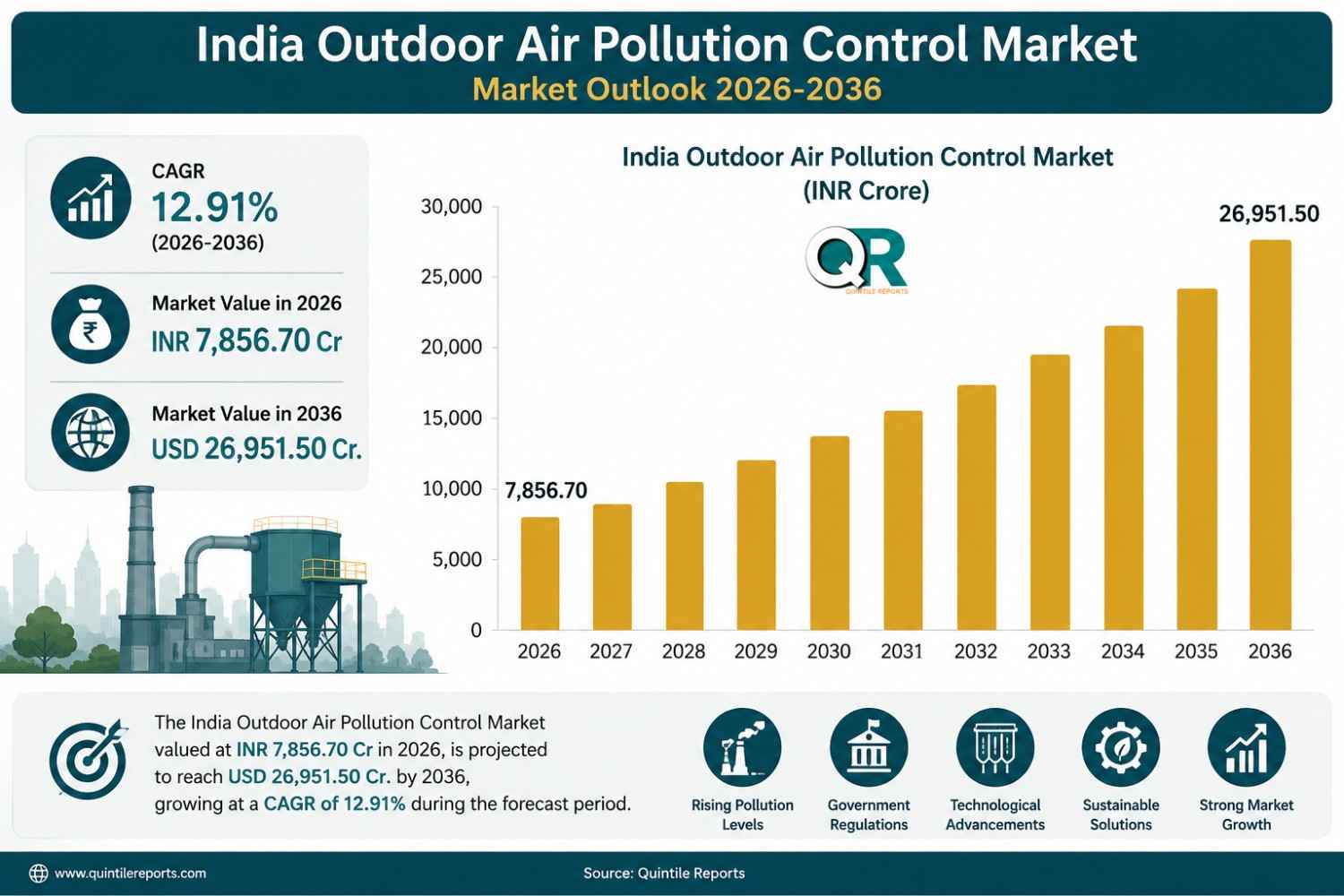
The India Outdoor Air Pollution Control Market was valued at approximately INR 7,856.70 Cr in 2026 and is projected to reach nearly INR 26,951.50 Cr by 2036, expanding at a CAGR of 12.91% during the forecast period. The market growth is primarily driven by rising industrial emissions, increasing urban air pollution levels, stringent environmental regulations, and growing investments in clean air infrastructure across India. Rapid industrialization, expansion of thermal power generation, rising vehicular emissions, and large-scale construction activities are significantly contributing to outdoor air pollution, thereby increasing the demand for advanced air pollution control systems and monitoring technologies throughout the country.
The growing burden of pollution-related health conditions is also increasing the urgency for large-scale air pollution control initiatives. Respiratory disorders, cardiovascular diseases, and chronic pulmonary conditions linked to air pollution are creating greater public and regulatory focus on emission reduction technologies. As environmental sustainability becomes a national priority, demand for advanced outdoor air pollution control systems is expected to accelerate steadily.
Government initiatives are playing a critical role in shaping the growth of the India outdoor air pollution control market. Regulatory authorities such as the Central Pollution Control Board (CPCB) and State Pollution Control Boards (SPCBs) are implementing stricter emission norms for industries and urban infrastructure projects. These policies are compelling industries to adopt efficient pollution control technologies to maintain regulatory compliance.
One of the most important policy frameworks supporting the market is the National Clean Air Programme (NCAP), which focuses on reducing particulate pollution levels across major non-attainment cities. The program has encouraged increased deployment of ambient air quality monitoring systems, industrial filtration equipment, and emission control infrastructure. In parallel, initiatives such as the Smart Cities Mission and urban sustainability projects are further strengthening demand for advanced outdoor air management solutions.
The Indian government is also emphasizing cleaner industrial operations through tighter environmental clearances and mandatory emission monitoring requirements. Industries operating in sectors such as thermal power, cement, steel, mining, chemicals, and oil & gas are increasingly required to install systems capable of reducing sulfur oxide (SOx), nitrogen oxide (NOx), dust, and hazardous particulate emissions.
Industrial emission management continues to represent one of the largest application areas within the market. Rapid industrialization across India has significantly increased the requirement for technologies that can effectively control airborne pollutants generated during manufacturing and energy production processes.
Thermal power plants remain major contributors to industrial air pollution, particularly due to high sulfur and particulate emissions. As a result, demand for flue gas desulfurization systems, electrostatic precipitators, and selective catalytic reduction technologies is witnessing strong growth. Cement plants and steel manufacturing facilities are also investing heavily in dust collection systems and industrial filtration technologies to reduce emissions and improve operational sustainability.
Mining and construction activities are further contributing to market demand. Increasing infrastructure development projects across highways, metro rail systems, industrial corridors, and smart cities are generating substantial levels of dust pollution, creating opportunities for outdoor dust suppression and air quality management systems. The rising need for environmentally compliant industrial operations is expected to remain a long-term growth driver for the market.
The expansion of air quality monitoring infrastructure is becoming a key trend within the India outdoor air pollution control market. Continuous Ambient Air Quality Monitoring Systems (CAAQMS) are being increasingly deployed by municipal authorities and environmental agencies to measure pollutant concentrations in real time.
Advanced monitoring technologies equipped with IoT sensors, cloud connectivity, and AI-based analytics are improving the efficiency of pollution tracking and environmental management. These systems help authorities identify pollution hotspots, monitor industrial emissions, and implement data-driven environmental policies.
Several smart city initiatives are integrating intelligent environmental monitoring systems into urban management frameworks. Real-time pollution monitoring is enabling faster response mechanisms and supporting the development of more effective pollution control strategies. The increasing reliance on environmental data analytics is expected to create strong opportunities for technology providers and monitoring equipment manufacturers.
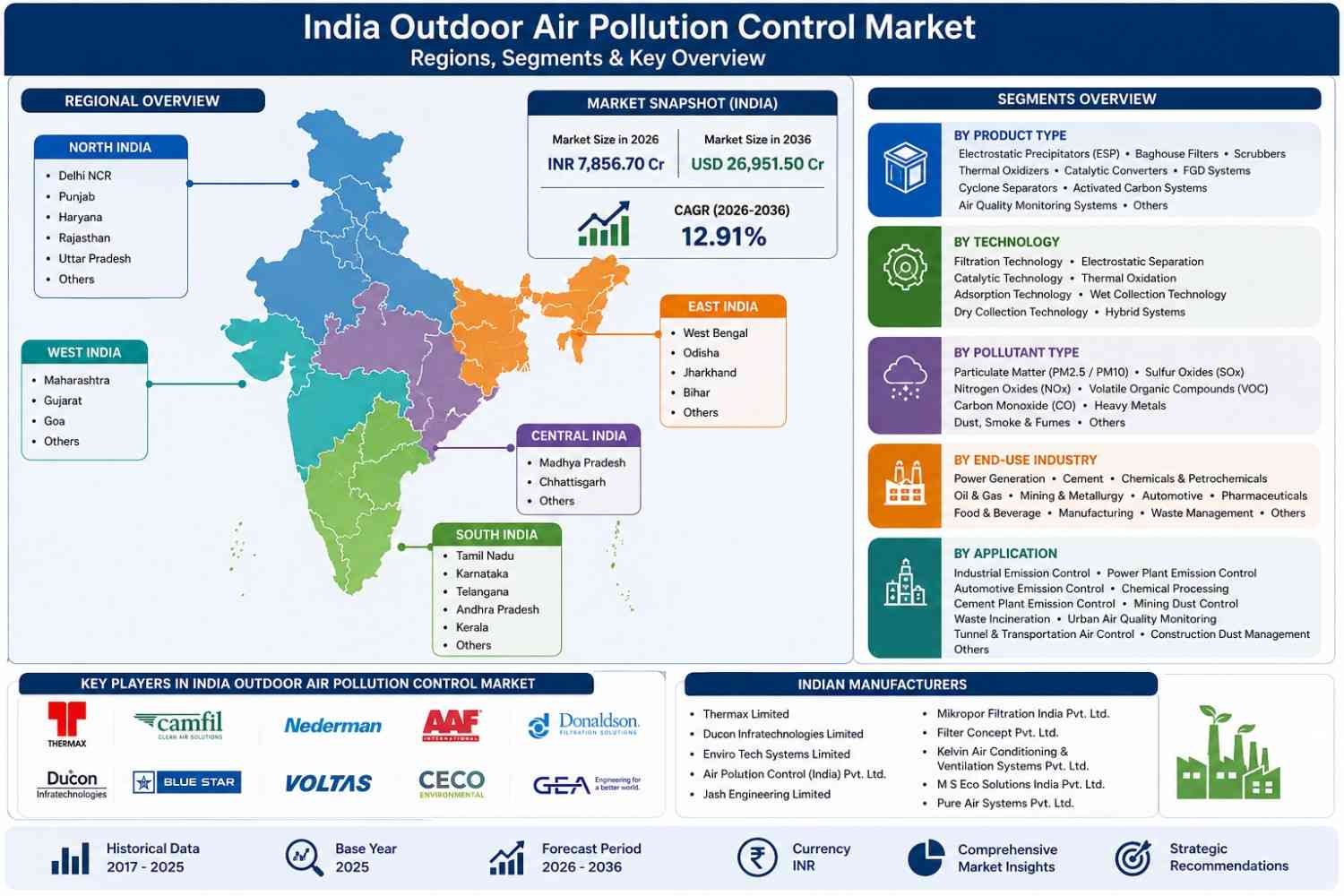
The India outdoor air pollution control market is highly competitive, with both domestic manufacturers and international environmental engineering companies actively operating across industrial, municipal, and commercial sectors. Companies are increasingly focusing on advanced filtration technologies, emission monitoring systems, energy-efficient pollution control equipment, and smart environmental management solutions to strengthen their market position. Rising industrial compliance requirements and government clean air initiatives are expected to further intensify competition within the market over the forecast period.
Several market participants are also expanding their manufacturing capabilities under the Make in India initiative, which is encouraging domestic production of environmental technologies and industrial equipment. The growing adoption of IoT-enabled monitoring systems, AI-based predictive maintenance, and automated emission control technologies is further shaping the competitive landscape of the India outdoor air pollution control market.
Public awareness regarding the harmful impact of outdoor air pollution has increased substantially in recent years. Exposure to polluted air has been linked to severe respiratory illnesses, asthma, reduced lung function, cardiovascular diseases, and premature mortality. The growing visibility of pollution-related health risks has increased pressure on both industries and governments to improve environmental standards.
Highly populated urban centers such as Delhi NCR, Mumbai, Kolkata, Chennai, and Bengaluru continue to experience periods of hazardous air quality, particularly during winter months and high industrial activity periods. Rising media attention and public discourse surrounding pollution-related health issues are encouraging stronger environmental accountability across sectors.
Educational institutions, hospitals, commercial complexes, and public infrastructure authorities are also increasingly adopting outdoor air monitoring and pollution management systems to improve environmental safety standards. The shift toward healthier urban environments is expected to further support market growth during the forecast period.
List of Tables
Table 1 List of Abbreviations and Acronyms
Table 2 List of Sources
Table 3 India Outdoor Air Pollution Control Market, by Product Type Analysis, (INR Cr) 2017-2036
Table 4 India Outdoor Air Pollution Control Market, by Technology Analysis, (INR Cr) 2017-2036
Table 5 India Outdoor Air Pollution Control Market, by Pollutant Type Analysis, (INR Cr) 2017-2036
Table 6 India Outdoor Air Pollution Control Market, by End-Use Industry Analysis, (INR Cr) 2017-2036
Table 7 India Outdoor Air Pollution Control Market, by Application Analysis, (INR Cr) 2017-2036
Table 8 North India Outdoor Air Pollution Control Market, by Segment Analysis, (INR Cr) 2017-2036
Table 9 South India Outdoor Air Pollution Control Market, by Segment Analysis, (INR Cr) 2017-2036
Table 10 East India Outdoor Air Pollution Control Market, by Segment Analysis, (INR Cr) 2017-2036
Table 11 West India Outdoor Air Pollution Control Market, by Segment Analysis, (INR Cr) 2017-2036
Table 12 Central India Outdoor Air Pollution Control Market, by Segment Analysis, (INR Cr) 2017-2036
Table 13 Delhi NCR Outdoor Air Pollution Control Market, by Segment Analysis, (INR Cr) 2017-2036
Table 14 Maharashtra Outdoor Air Pollution Control Market, by Segment Analysis, (INR Cr) 2017-2036
Table 15 Gujarat Outdoor Air Pollution Control Market, by Segment Analysis, (INR Cr) 2017-2036
Table 16 Tamil Nadu Outdoor Air Pollution Control Market, by Segment Analysis, (INR Cr) 2017-2036
Table 17 Karnataka Outdoor Air Pollution Control Market, by Segment Analysis, (INR Cr) 2017-2036
Table 18 Uttar Pradesh Outdoor Air Pollution Control Market, by Segment Analysis, (INR Cr) 2017-2036
Table 19 Competitive Benchmarking of Key Players
Table 20 Company Market Share Analysis
Table 21 Key Strategic Developments in the Market
Fig.1 Market research process
Fig.2 Market research approaches
Fig.3 India Outdoor Air Pollution Control Market: market scenario
Fig.4 India Outdoor Air Pollution Control Market competitive outlook
Fig.5 India Outdoor Air Pollution Control Market driver analysis
Fig.6 India Outdoor Air Pollution Control Market restraint analysis
Fig.7 India Outdoor Air Pollution Control Market opportunity analysis
Fig.8 India Outdoor Air Pollution Control Market trends analysis
Fig.9 India Outdoor Air Pollution Control Market: segment analysis
Fig.10 India Outdoor Air Pollution Control Market: regional analysis
Fig.11 India Outdoor Air Pollution Control Market shares and leading market players
Fig.12 Product Type Market Share Analysis
Fig.13 Technology Segment Market Share Analysis
Fig.14 Pollutant Type Segment Market Share Analysis
Fig.15 End-Use Industry Segment Market Share Analysis
Fig.16 Application Segment Market Share Analysis
Fig.17 North India Market Overview
Fig.18 South India Market Overview
Fig.19 East India Market Overview
Fig.20 West India Market Overview
Fig.21 Central India Market Overview
Fig.22 Delhi NCR Market Estimates and Forecast, 2017-2036
Fig.23 Maharashtra Market Estimates and Forecast, 2017-2036
Fig.24 Gujarat Market Estimates and Forecast, 2017-2036
Fig.25 Tamil Nadu Market Estimates and Forecast, 2017-2036
Fig.26 Karnataka Market Estimates and Forecast, 2017-2036
Fig.27 Uttar Pradesh Market Estimates and Forecast, 2017-2036
Fig.28 Competitive Landscape Analysis
Fig.29 Company Market Share Analysis
Fig.30 Future Market Growth Outlook
Indias outdoor air pollution control market is gaining significant momentum as air quality concerns continue to intensify across major urban and industrial regions. The market is estimated at approximately INR 6,420 crore in 2024 and is expected to reach nearly INR 12,980 crore by 2030, registering a CAGR of around 12.5% during the forecast period. The growth reflects increasing investments in pollution management infrastructure, stricter environmental regulations, and rising awareness regarding the health and economic impact of poor air quality.
India remains one of the worlds fastest-growing industrial economies, but rapid urbanization and industrial expansion have also resulted in rising outdoor pollution levels. According to environmental monitoring agencies, several Indian cities frequently record particulate matter (PM2.5 and PM10) concentrations significantly higher than globally recommended safety standards. Industrial emissions, thermal power generation, vehicular exhaust, construction activities, and mining operations continue to be among the primary contributors to deteriorating air quality across the country.
The India Outdoor Air Pollution Control Market was valued at approximately INR 7,856.70 Cr in 2026 and is projected to reach nearly INR 26,951.50 Cr by 2036, expanding at a CAGR of 12.91% during the forecast period. The market growth is primarily driven by rising industrial emissions, increasing urban air pollution levels, stringent environmental regulations, and growing investments in clean air infrastructure across India. Rapid industrialization, expansion of thermal power generation, rising vehicular emissions, and large-scale construction activities are significantly contributing to outdoor air pollution, thereby increasing the demand for advanced air pollution control systems and monitoring technologies throughout the country.
The growing burden of pollution-related health conditions is also increasing the urgency for large-scale air pollution control initiatives. Respiratory disorders, cardiovascular diseases, and chronic pulmonary conditions linked to air pollution are creating greater public and regulatory focus on emission reduction technologies. As environmental sustainability becomes a national priority, demand for advanced outdoor air pollution control systems is expected to accelerate steadily.
Government initiatives are playing a critical role in shaping the growth of the India outdoor air pollution control market. Regulatory authorities such as the Central Pollution Control Board (CPCB) and State Pollution Control Boards (SPCBs) are implementing stricter emission norms for industries and urban infrastructure projects. These policies are compelling industries to adopt efficient pollution control technologies to maintain regulatory compliance.
One of the most important policy frameworks supporting the market is the National Clean Air Programme (NCAP), which focuses on reducing particulate pollution levels across major non-attainment cities. The program has encouraged increased deployment of ambient air quality monitoring systems, industrial filtration equipment, and emission control infrastructure. In parallel, initiatives such as the Smart Cities Mission and urban sustainability projects are further strengthening demand for advanced outdoor air management solutions.
The Indian government is also emphasizing cleaner industrial operations through tighter environmental clearances and mandatory emission monitoring requirements. Industries operating in sectors such as thermal power, cement, steel, mining, chemicals, and oil & gas are increasingly required to install systems capable of reducing sulfur oxide (SOx), nitrogen oxide (NOx), dust, and hazardous particulate emissions.
Industrial emission management continues to represent one of the largest application areas within the market. Rapid industrialization across India has significantly increased the requirement for technologies that can effectively control airborne pollutants generated during manufacturing and energy production processes.
Thermal power plants remain major contributors to industrial air pollution, particularly due to high sulfur and particulate emissions. As a result, demand for flue gas desulfurization systems, electrostatic precipitators, and selective catalytic reduction technologies is witnessing strong growth. Cement plants and steel manufacturing facilities are also investing heavily in dust collection systems and industrial filtration technologies to reduce emissions and improve operational sustainability.
Mining and construction activities are further contributing to market demand. Increasing infrastructure development projects across highways, metro rail systems, industrial corridors, and smart cities are generating substantial levels of dust pollution, creating opportunities for outdoor dust suppression and air quality management systems. The rising need for environmentally compliant industrial operations is expected to remain a long-term growth driver for the market.
The expansion of air quality monitoring infrastructure is becoming a key trend within the India outdoor air pollution control market. Continuous Ambient Air Quality Monitoring Systems (CAAQMS) are being increasingly deployed by municipal authorities and environmental agencies to measure pollutant concentrations in real time.
Advanced monitoring technologies equipped with IoT sensors, cloud connectivity, and AI-based analytics are improving the efficiency of pollution tracking and environmental management. These systems help authorities identify pollution hotspots, monitor industrial emissions, and implement data-driven environmental policies.
Several smart city initiatives are integrating intelligent environmental monitoring systems into urban management frameworks. Real-time pollution monitoring is enabling faster response mechanisms and supporting the development of more effective pollution control strategies. The increasing reliance on environmental data analytics is expected to create strong opportunities for technology providers and monitoring equipment manufacturers.
The India outdoor air pollution control market is highly competitive, with both domestic manufacturers and international environmental engineering companies actively operating across industrial, municipal, and commercial sectors. Companies are increasingly focusing on advanced filtration technologies, emission monitoring systems, energy-efficient pollution control equipment, and smart environmental management solutions to strengthen their market position. Rising industrial compliance requirements and government clean air initiatives are expected to further intensify competition within the market over the forecast period.
Several market participants are also expanding their manufacturing capabilities under the Make in India initiative, which is encouraging domestic production of environmental technologies and industrial equipment. The growing adoption of IoT-enabled monitoring systems, AI-based predictive maintenance, and automated emission control technologies is further shaping the competitive landscape of the India outdoor air pollution control market.
Public awareness regarding the harmful impact of outdoor air pollution has increased substantially in recent years. Exposure to polluted air has been linked to severe respiratory illnesses, asthma, reduced lung function, cardiovascular diseases, and premature mortality. The growing visibility of pollution-related health risks has increased pressure on both industries and governments to improve environmental standards.
Highly populated urban centers such as Delhi NCR, Mumbai, Kolkata, Chennai, and Bengaluru continue to experience periods of hazardous air quality, particularly during winter months and high industrial activity periods. Rising media attention and public discourse surrounding pollution-related health issues are encouraging stronger environmental accountability across sectors.
Educational institutions, hospitals, commercial complexes, and public infrastructure authorities are also increasingly adopting outdoor air monitoring and pollution management systems to improve environmental safety standards. The shift toward healthier urban environments is expected to further support market growth during the forecast period.
Table 1 List of Abbreviations and Acronyms
Table 2 List of Sources
Table 3 India Outdoor Air Pollution Control Market, by Product Type Analysis, (INR Cr) 2017-2036
Table 4 India Outdoor Air Pollution Control Market, by Technology Analysis, (INR Cr) 2017-2036
Table 5 India Outdoor Air Pollution Control Market, by Pollutant Type Analysis, (INR Cr) 2017-2036
Table 6 India Outdoor Air Pollution Control Market, by End-Use Industry Analysis, (INR Cr) 2017-2036
Table 7 India Outdoor Air Pollution Control Market, by Application Analysis, (INR Cr) 2017-2036
Table 8 North India Outdoor Air Pollution Control Market, by Segment Analysis, (INR Cr) 2017-2036
Table 9 South India Outdoor Air Pollution Control Market, by Segment Analysis, (INR Cr) 2017-2036
Table 10 East India Outdoor Air Pollution Control Market, by Segment Analysis, (INR Cr) 2017-2036
Table 11 West India Outdoor Air Pollution Control Market, by Segment Analysis, (INR Cr) 2017-2036
Table 12 Central India Outdoor Air Pollution Control Market, by Segment Analysis, (INR Cr) 2017-2036
Table 13 Delhi NCR Outdoor Air Pollution Control Market, by Segment Analysis, (INR Cr) 2017-2036
Table 14 Maharashtra Outdoor Air Pollution Control Market, by Segment Analysis, (INR Cr) 2017-2036
Table 15 Gujarat Outdoor Air Pollution Control Market, by Segment Analysis, (INR Cr) 2017-2036
Table 16 Tamil Nadu Outdoor Air Pollution Control Market, by Segment Analysis, (INR Cr) 2017-2036
Table 17 Karnataka Outdoor Air Pollution Control Market, by Segment Analysis, (INR Cr) 2017-2036
Table 18 Uttar Pradesh Outdoor Air Pollution Control Market, by Segment Analysis, (INR Cr) 2017-2036
Table 19 Competitive Benchmarking of Key Players
Table 20 Company Market Share Analysis
Table 21 Key Strategic Developments in the Market
Fig.1 Market research process
Fig.2 Market research approaches
Fig.3 India Outdoor Air Pollution Control Market: market scenario
Fig.4 India Outdoor Air Pollution Control Market competitive outlook
Fig.5 India Outdoor Air Pollution Control Market driver analysis
Fig.6 India Outdoor Air Pollution Control Market restraint analysis
Fig.7 India Outdoor Air Pollution Control Market opportunity analysis
Fig.8 India Outdoor Air Pollution Control Market trends analysis
Fig.9 India Outdoor Air Pollution Control Market: segment analysis
Fig.10 India Outdoor Air Pollution Control Market: regional analysis
Fig.11 India Outdoor Air Pollution Control Market shares and leading market players
Fig.12 Product Type Market Share Analysis
Fig.13 Technology Segment Market Share Analysis
Fig.14 Pollutant Type Segment Market Share Analysis
Fig.15 End-Use Industry Segment Market Share Analysis
Fig.16 Application Segment Market Share Analysis
Fig.17 North India Market Overview
Fig.18 South India Market Overview
Fig.19 East India Market Overview
Fig.20 West India Market Overview
Fig.21 Central India Market Overview
Fig.22 Delhi NCR Market Estimates and Forecast, 2017-2036
Fig.23 Maharashtra Market Estimates and Forecast, 2017-2036
Fig.24 Gujarat Market Estimates and Forecast, 2017-2036
Fig.25 Tamil Nadu Market Estimates and Forecast, 2017-2036
Fig.26 Karnataka Market Estimates and Forecast, 2017-2036
Fig.27 Uttar Pradesh Market Estimates and Forecast, 2017-2036
Fig.28 Competitive Landscape Analysis
Fig.29 Company Market Share Analysis
Fig.30 Future Market Growth Outlook

A license granted to one user. Rules or conditions might be applied for e.g. the use of electric files (PDFs) or printings, depending on product.
A license granted to multiple users.
A license granted to a single business site/establishment.
A license granted to all employees within organisation access to the product.
Immediate / Within 24-48 hours - Working days
Online Payments with PayPal and CCavenue
You can order a report by picking any of the payment methods which is bank wire or online payment through any Debit/Credit card or PayPal.
Hard Copy
Aramid Fiber Market Overview The global Aramid Fiber Market was valued at USD 4.98 billion in 2026 a
Read MoreConcrete Market Overview The global concrete market forms the backbone of modern construction, provi
Read MoreSilicon Carbide Market Overview The global Silicon Carbide (SiC) Market was valued at USD 7.52 billi
Read More