The global Radiology Information System (RIS) Market was valued at USD 3.05 billion in 2026 and is projected to reach USD 6.55 billion by 2036, registering a CAGR of 7.72% during the forecast period from 2026 to 2036. The market growth is primarily driven by the increasing digitization of healthcare, rising volumes of diagnostic imaging procedures, and growing demand for integrated radiology workflow management solutions. Furthermore, continuous advancements in healthcare IT infrastructure, expanding adoption of cloud-based information systems, and increasing investments in enterprise imaging are expected to support market growth throughout the forecast period.
Radiology Information Systems (RIS) are specialized healthcare information management platforms designed to streamline radiology department operations by managing patient scheduling, registration, imaging workflows, reporting, billing, resource allocation, and clinical documentation. RIS solutions integrate with Picture Archiving and Communication Systems (PACS), Hospital Information Systems (HIS), Electronic Health Records (EHR), and medical imaging modalities to facilitate seamless data exchange, improve operational efficiency, and enhance patient care. Modern RIS platforms increasingly incorporate cloud computing, artificial intelligence-assisted workflow automation, voice recognition reporting, analytics dashboards, and interoperability standards to optimize radiology department performance and support value-based healthcare initiatives.
The increasing demand for efficient radiology workflow management, coupled with the rising number of diagnostic imaging procedures, has emerged as one of the primary factors driving the global Radiology Information System market. Healthcare providers are increasingly implementing advanced RIS platforms to automate scheduling, improve reporting accuracy, optimize resource utilization, and reduce administrative burdens. Growing emphasis on integrated healthcare delivery, interoperability, and patient-centered care continues to strengthen the adoption of RIS solutions across hospitals and diagnostic imaging centers.
The continuous advancement of healthcare information technologies is further accelerating market growth. Software vendors are increasingly developing next-generation RIS platforms featuring cloud-native architecture, artificial intelligence-powered workflow automation, predictive analytics, mobile accessibility, voice-enabled reporting, and cybersecurity enhancements to improve operational efficiency and clinical decision-making. Additionally, increasing healthcare expenditure, expanding digital transformation initiatives, supportive government policies promoting electronic health records, and rising investments in healthcare IT infrastructure are expected to create significant growth opportunities for market participants throughout the forecast period.
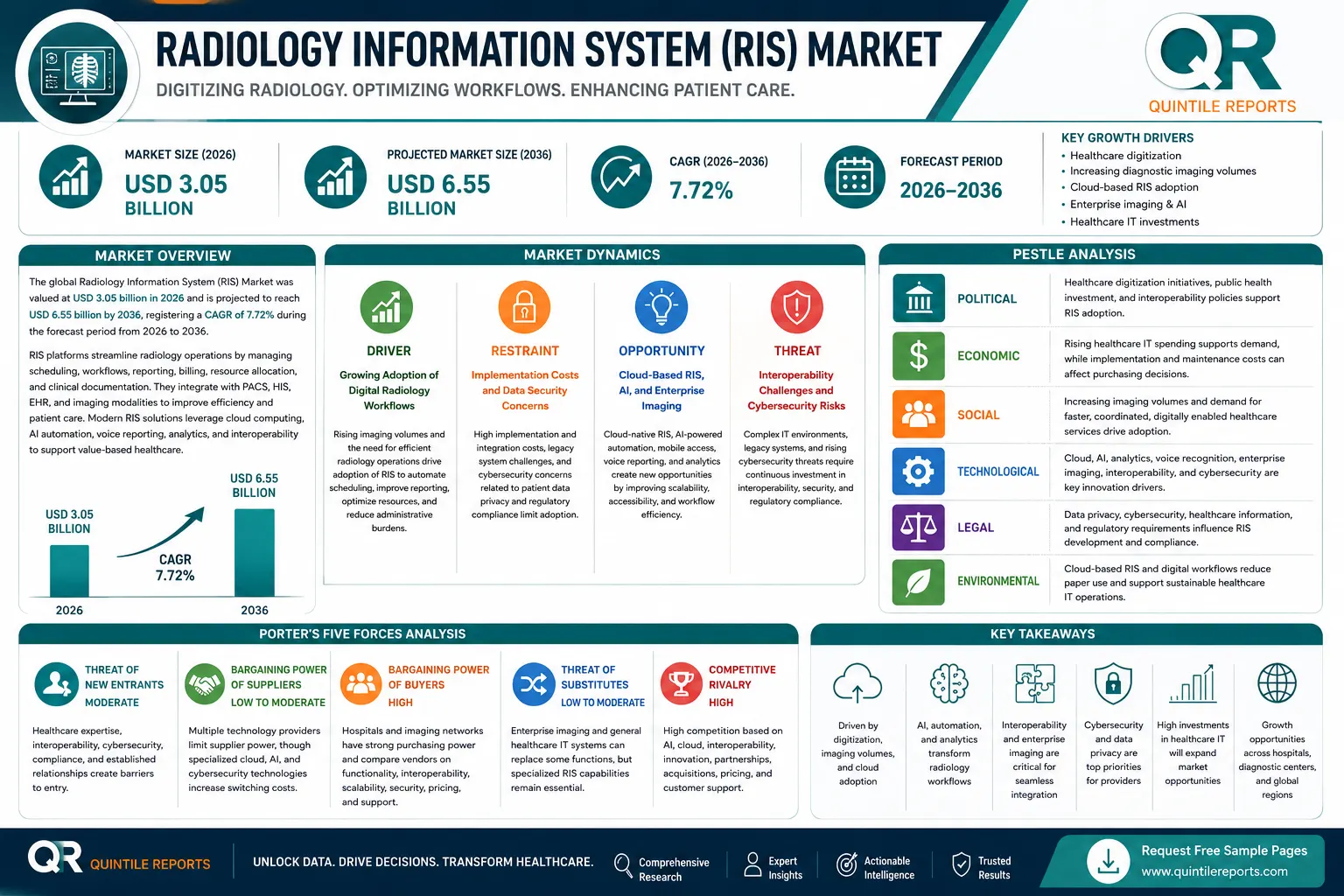
The global Radiology Information System (RIS) Market is driven by healthcare digitization, rising diagnostic imaging volumes, demand for efficient radiology workflows, cloud adoption, interoperability, and artificial intelligence. RIS platforms increasingly integrate with PACS, HIS, EHR, and imaging systems to improve scheduling, reporting, workflow coordination, and clinical data management.
Rising imaging volumes and the need for efficient radiology operations are increasing RIS adoption. Healthcare providers use RIS platforms to streamline scheduling, reporting, resource utilization, and departmental workflows while improving integration with broader digital healthcare systems.
High implementation, integration, training, maintenance, and cybersecurity costs can limit RIS adoption, particularly among smaller providers. Integration with legacy PACS, HIS, and EHR systems and growing concerns around patient-data privacy and regulatory compliance also create challenges.
Cloud-native RIS, AI-powered workflow automation, predictive analytics, mobile access, and voice-enabled reporting are creating new growth opportunities. These technologies can improve scalability, accessibility, workflow efficiency, and integration across enterprise imaging environments.
Complex healthcare IT environments and legacy systems can make RIS integration difficult. Increasing connectivity and cloud adoption also heighten cybersecurity risks, requiring vendors to strengthen interoperability, data protection, regulatory compliance, and system security.
| Factor | Impact on Radiology Information System (RIS) Market |
| Political | Healthcare digitization initiatives, public-sector IT investment, and interoperability policies support RIS adoption. |
| Economic | Rising healthcare IT spending supports demand, while implementation, integration, and maintenance costs can affect purchasing decisions. |
| Social | Increasing imaging volumes and demand for faster, coordinated, and digitally enabled healthcare services support RIS adoption. |
| Technological | Cloud computing, AI, analytics, voice recognition, enterprise imaging, interoperability, and cybersecurity are driving RIS innovation. |
| Legal | Data privacy, cybersecurity, healthcare information, and regulatory requirements influence RIS development, deployment, and compliance. |
| Environmental | Digital workflows and cloud-based systems can reduce paper-based processes and support more sustainable healthcare IT operations. |
| Porter's Five Forces | Impact on Radiology Information System (RIS) Market |
| Threat of New Entrants | Moderate – Healthcare expertise, interoperability, cybersecurity, regulatory requirements, and established customer relationships create entry barriers. |
| Bargaining Power of Suppliers | Low to Moderate – Multiple technology providers limit supplier power, although dependence on specialized cloud, AI, and cybersecurity technologies can increase switching costs. |
| Bargaining Power of Buyers | High – Hospitals and imaging networks can compare vendors based on functionality, interoperability, scalability, security, pricing, implementation, and support. |
| Threat of Substitutes | Low to Moderate – Enterprise imaging and general healthcare IT platforms can replace selected RIS functions, but specialized RIS capabilities remain important for radiology workflows. |
| Competitive Rivalry | High – Vendors compete through AI, cloud deployment, interoperability, cybersecurity, workflow automation, product innovation, partnerships, acquisitions, pricing, and customer support. |
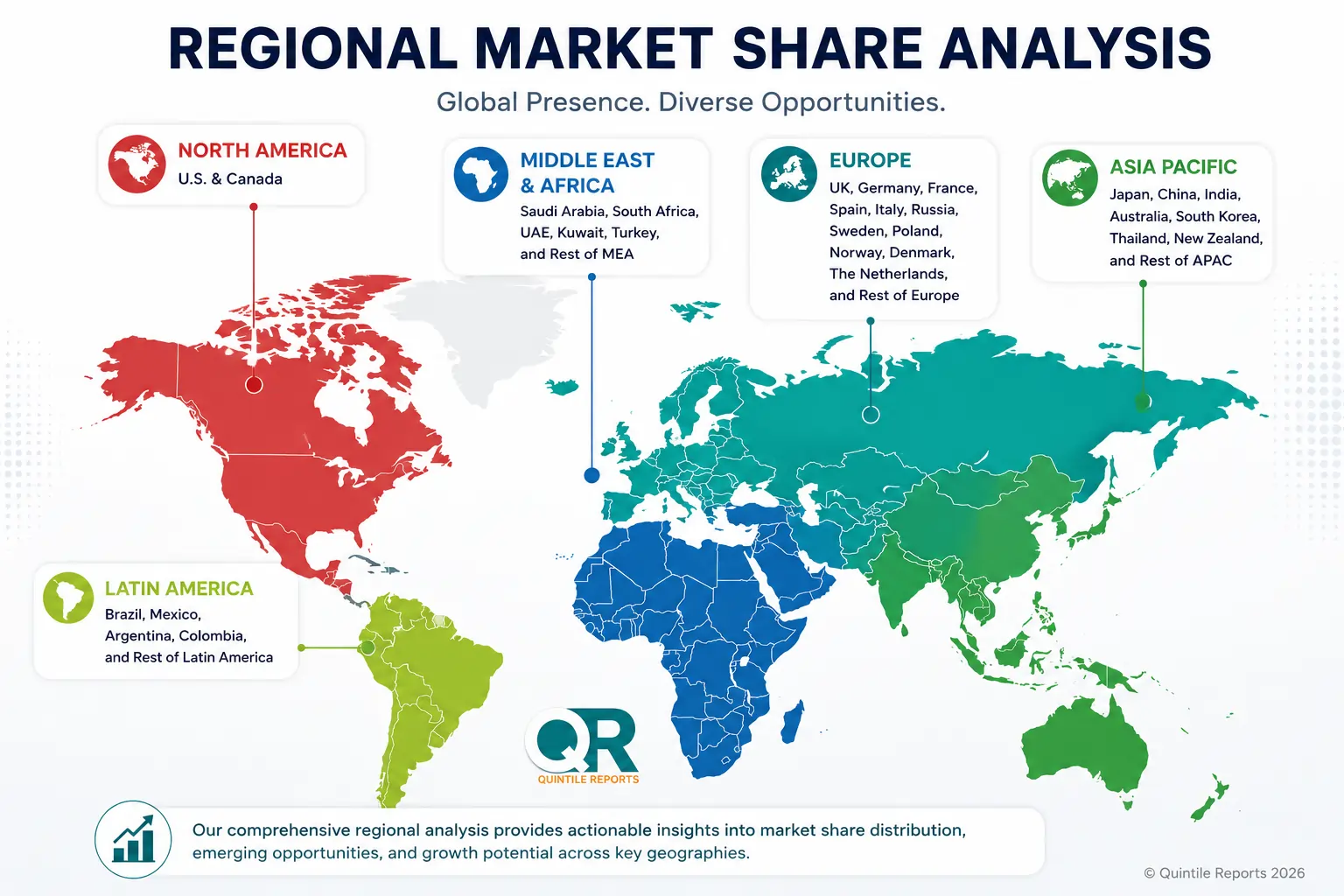
The global Radiology Information System (RIS) Market demonstrates considerable regional variation based on healthcare digitization, diagnostic imaging volumes, hospital IT maturity, interoperability requirements, and investments in enterprise healthcare platforms. North America currently represents the leading regional market, supported by mature healthcare information infrastructure, extensive use of electronic health records, high diagnostic imaging volumes, and established integration between RIS, PACS, and broader hospital information systems. Meanwhile, Asia Pacific is expected to register the fastest growth during the forecast period as hospitals, diagnostic centers, and healthcare networks accelerate digital transformation and adopt scalable radiology workflow solutions.
Across emerging markets, the transition from fragmented or manually managed radiology workflows toward integrated digital platforms is creating significant opportunities for RIS providers. The growing use of cloud computing, artificial intelligence, teleradiology, enterprise imaging, automated reporting, and analytics is also changing the way radiology departments manage examinations, patient information, reporting processes, and resource utilization.
North America holds the largest share of the global Radiology Information System market, benefiting from advanced healthcare infrastructure, high healthcare technology spending, widespread electronic health record adoption, and a well-established ecosystem of healthcare IT providers. The region's high volume of diagnostic imaging procedures creates continuous demand for systems capable of coordinating scheduling, patient information, reporting, billing, workflow management, and image-related data across multiple healthcare departments.
Healthcare organizations are increasingly moving beyond standalone departmental systems toward integrated enterprise imaging environments, creating opportunities for RIS platforms that can communicate seamlessly with PACS, EHR, hospital information systems, laboratory systems, and billing platforms. Demand is also increasing for cloud deployment, AI-assisted workflow management, voice recognition, analytics, remote reporting, and cybersecurity capabilities.
The United States represents the largest country-level market within North America. The market is supported by a highly developed healthcare IT ecosystem, extensive diagnostic imaging infrastructure, large hospital networks, and growing demand for technologies that improve radiology productivity and reporting efficiency.
Large healthcare systems are increasingly consolidating radiology operations across multiple hospitals and outpatient facilities, creating demand for centralized RIS platforms capable of supporting distributed workflows. The increasing adoption of enterprise imaging, cloud-based healthcare applications, AI-enabled radiology tools, and remote reporting is further creating opportunities for RIS vendors. Replacement of legacy systems and integration of RIS with broader clinical information platforms are expected to remain important sources of demand.
Canada represents a technologically developed but comparatively smaller RIS market. Adoption is being supported by healthcare digitization, modernization of hospital information systems, and the need to improve coordination between geographically distributed healthcare facilities.
The country's large geographic footprint creates particular demand for remote access, centralized imaging workflows, interoperability, and teleradiology capabilities. Healthcare organizations are increasingly focused on connecting radiology departments and diagnostic facilities through integrated digital platforms, creating opportunities for cloud-enabled RIS solutions.
Europe represents a mature RIS market characterized by well-established healthcare systems, strong digitalization initiatives, increasing interoperability requirements, and growing emphasis on secure management of patient information. Demand is increasingly shifting toward platforms that can connect radiology departments with enterprise-wide healthcare information environments rather than operating as isolated departmental applications.
The region's aging population and increasing diagnostic imaging requirements are generating additional pressure on radiology departments to improve scheduling, reporting turnaround times, workflow coordination, and resource utilization. At the same time, stringent data protection requirements are encouraging healthcare providers to prioritize secure, compliant, and interoperable RIS platforms.
The UK RIS market is supported by the extensive diagnostic imaging requirements of the National Health Service and private healthcare providers. Increasing examination volumes and pressure to improve radiology turnaround times are encouraging healthcare organizations to modernize workflow management systems.
The market is moving toward more connected radiology environments in which RIS, PACS, EHR, AI applications, and reporting technologies operate as part of a broader digital ecosystem. Demand for remote reporting and centralized radiology workflows is also creating opportunities for scalable RIS solutions.
Germany represents one of Europe's significant RIS markets, supported by a sophisticated healthcare infrastructure and increasing investment in healthcare digitalization. Hospitals and diagnostic providers are progressively modernizing legacy IT environments and seeking improved interoperability between radiology, hospital management, and electronic patient information systems.
Demand is particularly strong for solutions that combine workflow automation, secure data management, interoperability, and scalable deployment. The ongoing digital transformation of German healthcare is expected to support further RIS adoption.
France is witnessing increasing demand for RIS platforms as healthcare providers strengthen digital patient management and modernize diagnostic imaging workflows. Hospitals and imaging centers are seeking solutions that improve scheduling, reporting, departmental coordination, and information exchange.
The growing integration of digital health technologies with hospital information systems is expected to create opportunities for cloud-based and interoperable RIS solutions, particularly among larger healthcare networks.
Italy's RIS market is being supported by modernization of healthcare facilities and increasing adoption of digital clinical systems. The need to improve radiology workflow efficiency and coordinate patient and imaging information across hospitals and diagnostic centers is encouraging investment in RIS technology.
Growth opportunities are particularly associated with the replacement of older systems and integration of RIS with PACS, EHR, and broader hospital IT environments.
Spain continues to develop its digital radiology infrastructure as healthcare providers seek to improve imaging workflow coordination and reporting efficiency. Increasing use of electronic health information and connected diagnostic services is supporting demand for integrated RIS platforms.
Private imaging networks and larger healthcare organizations are expected to remain important adopters of advanced RIS technologies, particularly solutions offering centralized workflow management and interoperability.
Russia represents a developing opportunity within the European RIS landscape, with demand influenced by healthcare modernization and increasing digitization of diagnostic services. Market development is closely linked to investment in domestic healthcare IT capabilities, hospital infrastructure, and digital patient management systems.
Asia Pacific is projected to be the fastest-growing regional market for Radiology Information Systems. The region combines rapidly expanding healthcare infrastructure with increasing diagnostic imaging demand, rising healthcare expenditure, and accelerated adoption of digital technologies.
Unlike mature markets where RIS is often part of established healthcare IT ecosystems, many healthcare organizations in Asia Pacific are moving directly toward newer digital platforms as they expand hospital capacity and modernize clinical infrastructure. This creates opportunities for vendors offering scalable RIS solutions with cloud deployment, mobile access, AI capabilities, interoperability, and centralized management.
China represents one of the most significant growth opportunities in Asia Pacific. Expansion of hospitals and diagnostic facilities, increasing medical imaging volumes, and continued healthcare digitalization are supporting demand for radiology workflow management technologies.
Large healthcare organizations are increasingly seeking integrated platforms capable of handling substantial imaging volumes across multiple departments and facilities. The development of smart hospitals and growing interest in AI-enabled healthcare are expected to further increase demand for advanced RIS solutions.
India is expected to remain a high-potential RIS market due to rapid expansion of private hospitals, diagnostic imaging chains, digital healthcare infrastructure, and teleradiology services. Increasing diagnostic imaging demand is placing greater pressure on healthcare providers to improve scheduling, reporting, patient management, and data coordination.
Cloud-based RIS platforms offer particular opportunities in India because they can support multi-location diagnostic networks while reducing the infrastructure burden associated with traditional on-premise systems. Growing adoption of AI-assisted reporting and remote radiology services is expected to provide additional momentum.
Japan represents a technologically mature market supported by sophisticated healthcare infrastructure and strong demand for efficient management of diagnostic services. The country's aging population contributes to sustained demand for medical imaging, increasing the importance of efficient radiology workflow management.
RIS adoption is increasingly associated with interoperability, automation, advanced reporting, enterprise imaging, and integration with sophisticated hospital information systems.
Australia's RIS market benefits from an established healthcare system and significant demand for digital solutions capable of connecting healthcare facilities across geographically dispersed areas. Teleradiology and remote reporting are particularly relevant to the country's healthcare environment.
The adoption of cloud-based RIS, centralized reporting, and integrated imaging workflows is expected to support market growth, particularly across large diagnostic networks and healthcare organizations serving regional and remote populations.
South Korea has a technologically advanced healthcare environment and strong adoption of digital medical technologies. RIS deployment is increasingly supported by the integration of healthcare information systems with PACS, EHR platforms, AI applications, and cloud infrastructure.
The country's advanced technology ecosystem provides favorable conditions for adoption of intelligent radiology workflow solutions, particularly platforms focused on automation, analytics, and interoperability.
Thailand is emerging as an attractive RIS market within Southeast Asia as hospitals modernize their digital infrastructure and the country's healthcare and medical tourism sectors continue to expand. Increasing diagnostic imaging demand is creating a need for more efficient scheduling, reporting, and patient information management.
Investment in private hospitals and advanced diagnostic facilities is expected to provide additional opportunities for RIS providers.
Latin America represents an emerging growth market for Radiology Information Systems, supported by increasing private healthcare investment, hospital modernization, diagnostic imaging expansion, and gradual adoption of digital healthcare technologies.
Market development varies considerably between countries, with larger healthcare systems and private hospital networks generally adopting RIS more rapidly. The transition toward electronic patient records and integrated imaging environments is expected to gradually increase demand for RIS solutions.
Brazil is the largest opportunity in Latin America due to its extensive healthcare network, sizeable private hospital sector, and growing diagnostic imaging infrastructure. Large hospitals and imaging networks are increasingly investing in digital platforms to manage growing examination volumes and improve operational efficiency.
The expansion of multi-site diagnostic networks is creating demand for centralized RIS solutions capable of supporting scheduling, reporting, patient management, and information exchange across multiple facilities.
Mexico is experiencing increasing demand for healthcare IT solutions as private hospitals and diagnostic centers expand their digital capabilities. RIS adoption is being supported by increasing imaging volumes and the need to improve coordination between diagnostic departments and broader healthcare information systems.
Modernization of private healthcare infrastructure and growing adoption of connected clinical systems are expected to provide continued opportunities.
Argentina represents a developing RIS market supported by healthcare digitalization and modernization of diagnostic facilities. Adoption is expected to increase as hospitals and imaging centers seek to reduce administrative workloads and improve management of patient and radiology information.
Colombia is becoming an increasingly important market in Latin America as healthcare providers invest in digital infrastructure and modern diagnostic services. Expansion of private healthcare networks and increasing adoption of electronic clinical information systems are creating opportunities for RIS deployment.
The Middle East & Africa RIS market is gradually expanding as governments and private healthcare organizations invest in hospital modernization, digital healthcare infrastructure, advanced diagnostic centers, and smart healthcare technologies.
The market is particularly promising in countries with substantial healthcare investment programs, while adoption in several African markets remains constrained by infrastructure availability and technology costs. Nevertheless, increasing healthcare digitization and the expansion of private healthcare networks are creating a favorable long-term environment for RIS vendors.
Saudi Arabia represents one of the region's strongest growth opportunities due to significant healthcare modernization and digital transformation investments. Large hospitals and healthcare networks are increasingly adopting integrated digital platforms to improve patient management, clinical workflows, and diagnostic services.
The development of smart hospitals and centralized healthcare systems is creating opportunities for RIS solutions that can integrate with PACS, EHR, enterprise imaging, and AI-enabled applications.
The UAE is among the most technologically advanced healthcare markets in the Middle East. Investments in smart hospitals, cloud technologies, artificial intelligence, and digital patient services are supporting demand for advanced RIS platforms.
The country's growing private healthcare sector and medical tourism industry are also encouraging healthcare providers to invest in efficient and highly connected diagnostic imaging workflows.
Kuwait's RIS market is supported by public healthcare expenditure, hospital modernization, and the increasing use of digital technologies in clinical environments. Demand is expected to rise as healthcare providers upgrade information systems and seek more integrated radiology workflows.
South Africa represents an important African market, particularly through its established private hospital and diagnostic imaging sectors. Healthcare providers are increasingly focused on improving imaging workflow efficiency, patient information management, and connectivity between radiology systems.
The expansion of digital healthcare and remote reporting capabilities is expected to create further opportunities for RIS adoption.
The North American market is expected to retain its leadership through the forecast period because of its mature healthcare IT ecosystem, established RIS-PACS integration, high diagnostic imaging volumes, and strong investment in healthcare technology.
Asia Pacific is expected to demonstrate the strongest growth momentum, supported by expanding hospital infrastructure, increasing diagnostic imaging demand, healthcare digitalization, cloud adoption, teleradiology, and growing investments in AI-enabled healthcare technologies. China and India are expected to remain particularly important growth markets due to their large healthcare populations and rapidly expanding diagnostic networks.
Europe will continue to represent a significant and technologically mature market, with growth increasingly centered on interoperability, cloud deployment, enterprise imaging, cybersecurity, and replacement of legacy systems.
Latin America and Middle East & Africa offer longer-term expansion opportunities as healthcare providers modernize infrastructure, private healthcare networks expand, and governments increase investments in digital healthcare.
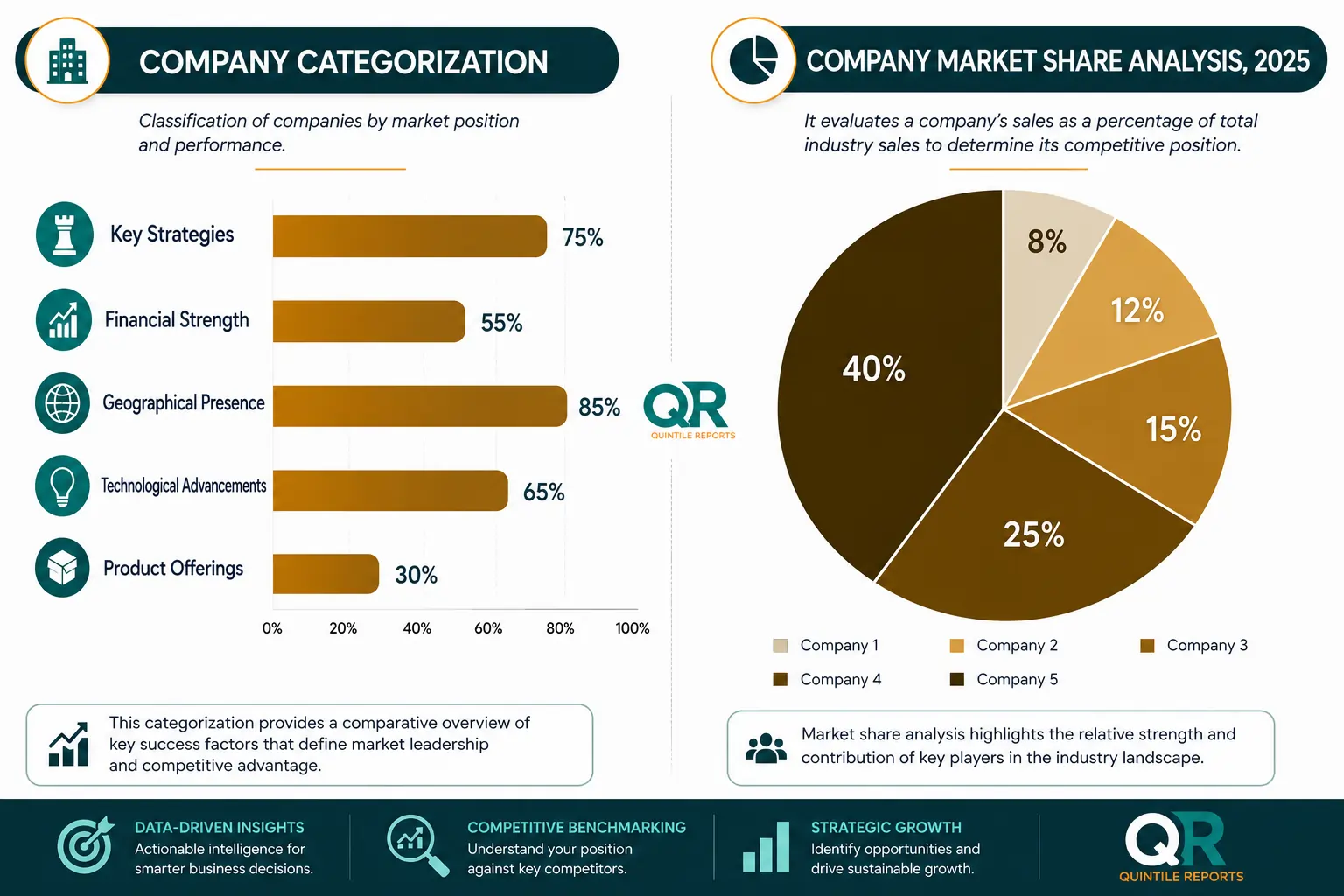
The global Radiology Information System (RIS) Market is evolving from a market centered on basic scheduling and reporting applications toward a broader radiology workflow and enterprise imaging ecosystem. Competition is shaped by the ability of vendors to connect RIS with PACS, EHR, HIS, imaging modalities, AI applications, analytics, and cloud infrastructure. Large healthcare technology companies compete through broad product portfolios and established healthcare relationships, while specialized radiology software providers differentiate themselves through workflow expertise, flexible deployment models, interoperability, and specialized functionality.
Competitive positioning is increasingly determined by technology capabilities, interoperability, workflow automation, scalability, cybersecurity, deployment flexibility, implementation expertise, customer support, and total cost of ownership. Vendors are also expanding their platforms with AI-assisted reporting, intelligent worklists, automated workflow management, cloud-based architecture, advanced analytics, and enterprise-wide imaging capabilities.
The market includes diversified medical technology companies, healthcare IT providers, enterprise imaging specialists, and dedicated radiology software companies. Larger vendors benefit from established relationships with hospitals and integrated healthcare networks, allowing them to offer RIS as part of broader imaging and clinical IT ecosystems. Specialized vendors, meanwhile, compete by providing customizable solutions, radiology-focused workflows, faster implementation, and solutions suited to diagnostic imaging centers and multi-site radiology practices.
GE HealthCare competes through its broad medical imaging and healthcare technology portfolio. Its presence across imaging equipment, digital solutions, and clinical workflows enables the company to position radiology information capabilities within wider healthcare environments. Its established customer relationships and imaging expertise provide an advantage when healthcare organizations seek integrated technology solutions.
Siemens Healthineers maintains a strong position through its combination of medical imaging, digital health, workflow, and clinical technology capabilities. Its competitive approach emphasizes connectivity between imaging systems and healthcare IT environments, making it well positioned to serve large hospitals and integrated healthcare networks.
Philips competes through an integrated healthcare technology strategy that combines diagnostic imaging, informatics, workflow solutions, and clinical applications. Its ability to connect imaging operations with broader digital healthcare environments supports its positioning among hospitals seeking consolidated technology ecosystems.
Fujifilm has established a significant presence in imaging informatics by combining its medical imaging expertise with enterprise imaging and healthcare IT capabilities. Its competitive proposition is centered on connected imaging workflows, interoperability, scalable platforms, and digital management of imaging information.
Oracle Health approaches the market from an enterprise healthcare information perspective. Its broader healthcare technology ecosystem provides opportunities to connect radiology workflows with electronic health records and other clinical information systems. This positioning can be particularly relevant for large healthcare organizations seeking greater integration across departments.
Epic Systems benefits from its extensive presence in electronic health records. Its position within hospital-wide clinical information environments can facilitate connections between radiology workflows and broader patient information. This creates a competitive advantage when healthcare organizations prioritize enterprise-level integration and centralized clinical data management.
Sectra focuses strongly on medical imaging and enterprise imaging environments. Its specialization in imaging workflows, diagnostic information management, and secure digital collaboration provides differentiation among healthcare organizations seeking imaging-focused technology solutions.
Agfa HealthCare competes through enterprise imaging and healthcare IT capabilities designed to coordinate imaging information across healthcare organizations. Its emphasis on workflow integration, interoperability, and centralized imaging management supports its position in hospitals and multi-site healthcare networks.
INFINITT Healthcare maintains a specialized position in imaging informatics, with capabilities spanning radiology workflow, PACS, enterprise imaging, and interoperability. Its focused approach enables it to compete with larger diversified healthcare technology companies, particularly in imaging-intensive environments.
MedInformatix focuses on radiology and healthcare information management, providing solutions designed to support scheduling, reporting, patient management, and departmental workflows. Its radiology-focused positioning provides an alternative for healthcare organizations seeking specialized rather than broad enterprise platforms.
| Report Scope | Details |
| Report Version | 2026 |
| Growth Rate | CAGR of 7.72 % from 2026 to 2036 |
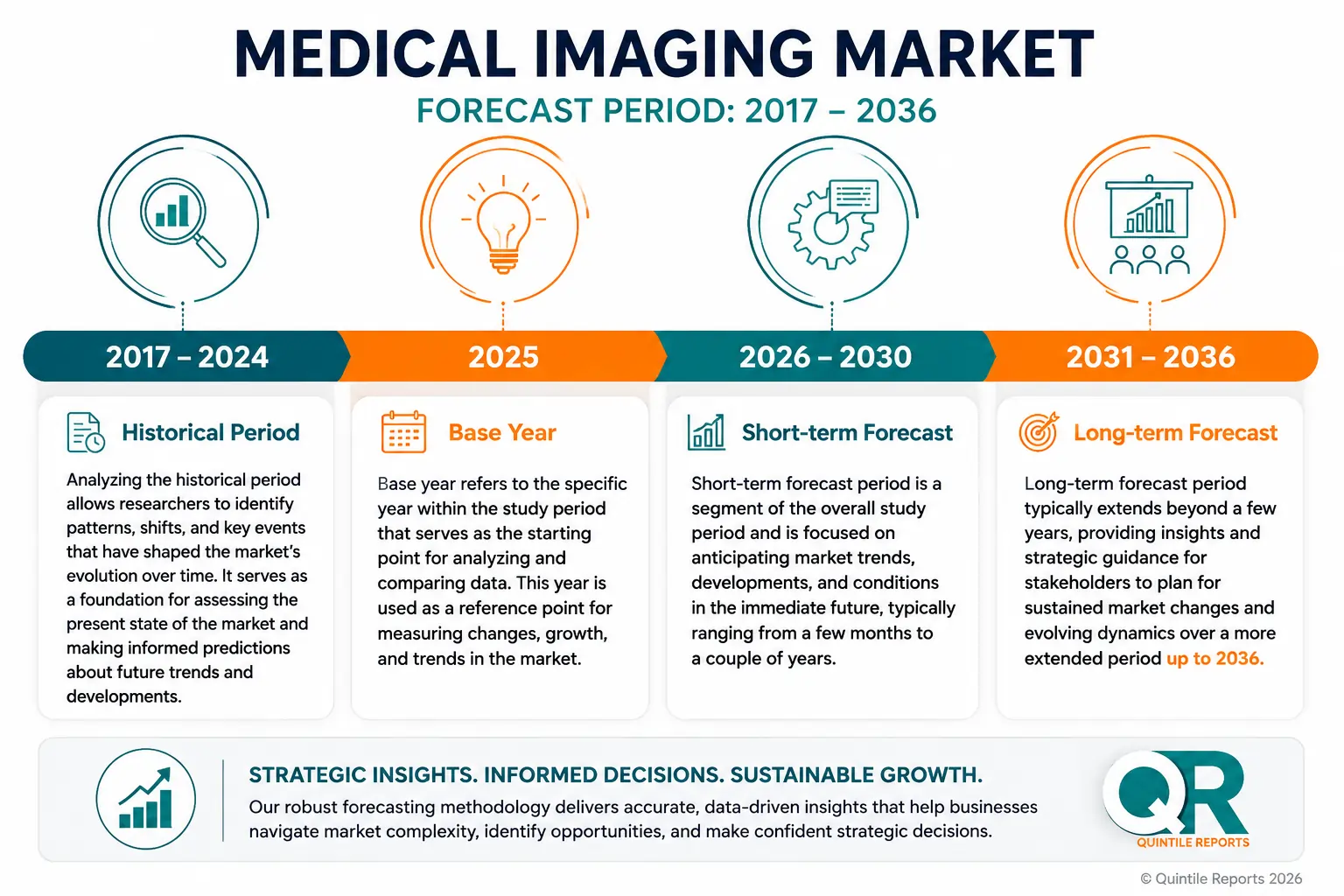
| Base Year | 2025 |
| Actual Estimates / Historical Data | 2017 - 2024 |
| Forecast Period | 2026 - 2036 |
| Quantitative Units | Revenue in USD million/billion & CAGR from 2026 to 2036 |
| Country Scope | North America (U.S., Canada), Europe (UK, Germany, France, Italy, Spain, Russia, Sweden, Denmark, Norway, Rest of Europe), Asia Pacific (Japan, China, India, Australia, South Korea, Thailand, Rest of Asia Pacific), Latin America (Brazil, Mexico, Argentina, Colombia, Rest of Latin America), Middle East & Africa (South Africa, Saudi Arabia, UAE, Kuwait, Rest of Middle East & Africa). |
| The Segment Covered by Component |
|
| The Segment Covered by Deployment |
|
| Companies Covered |
|
| Report Coverage | Revenue forecast, company share, competitive landscape, growth factors, technology trends, and regional analysis |
| Free Customization Scope (Equivalent to 5 Analyst Working Days) | If you require additional insights beyond the current scope, our analysts can customize the report to meet your specific business needs. |
The Global Radiology Information System (RIS) Market Report combines secondary research, primary industry validation, data triangulation, and analytical modeling to assess market trends, technology adoption, competitive developments, and growth opportunities.
Research draws on company reports, regulatory publications, industry databases, scientific journals, government sources, healthcare associations, press releases, and technology publications to establish market trends and industry benchmarks.
Industry interviews with healthcare IT professionals, RIS and PACS providers, hospital administrators, radiology managers, diagnostic centers, and technology specialists are used to validate market estimates, adoption trends, purchasing patterns, and competitive insights.
Top-down and bottom-up approaches are used to estimate market size and forecasts for 2026–2036, considering healthcare IT spending, imaging volumes, RIS deployment, cloud adoption, AI integration, interoperability, and regional investments.
Market performance is evaluated across technology, deployment, application, end-user, and geographic segments based on adoption trends, infrastructure, investment, competitive activity, and growth potential.
Key companies are assessed based on product portfolios, technology capabilities, interoperability, AI and cloud integration, cybersecurity, partnerships, acquisitions, product developments, and market positioning.
Findings are reviewed through data triangulation, cross-validation, and internal quality checks to improve the reliability of market estimates, forecasts, segment analysis, and regional insights.

Shivani Patil
Senior Healthcare & Life Sciences Research Analyst
Quintile Reports
This analysis has been developed by Quintile Reports' healthcare and life sciences research team using a combination of secondary research, industry intelligence, company-level analysis, technology assessment, and market modeling. The assessment considers RIS adoption across hospitals, diagnostic imaging centers, integrated healthcare networks, and enterprise imaging environments, with regional analysis covering North America, Europe, Asia Pacific, Latin America, and the Middle East & Africa.
Shivani Patil is a Senior Healthcare & Life Sciences Research Analyst specializing in healthcare IT, radiology informatics, medical imaging, diagnostic technologies, and digital healthcare solutions. Her research expertise covers market sizing and forecasting, competitive intelligence, technology assessment, regional analysis, industry trends, and strategic market evaluation.
She has extensive experience developing syndicated and customized market research studies covering Radiology Information Systems (RIS), PACS, enterprise imaging, artificial intelligence in healthcare, diagnostic imaging technologies, and healthcare information management platforms. Her work focuses on evaluating evolving healthcare workflows, technology adoption, interoperability, cloud transformation, regulatory developments, and competitive strategies across global markets.
At Quintile Reports, Shivani applies structured primary and secondary research methodologies, data validation, market modeling, and qualitative industry analysis to develop actionable market intelligence. Her research helps healthcare technology companies, medical device manufacturers, healthcare providers, investors, and other stakeholders assess market opportunities, understand competitive positioning, identify emerging technologies, and develop informed business strategies.
Her work combines industry research, quantitative analysis, technology evaluation, and strategic interpretation to provide reliable insights into rapidly evolving healthcare and healthcare IT markets.
Table 1 List of Abbreviation and Acronyms
Table 2 List of Sources
Table 3 North America Radiology Information System (RIS) Market, by Segment Analysis, (USD Million) 2017-2036
Table 4 North America Radiology Information System (RIS) Market, by Region, (USD Million) 2017-2036
Table 5 U.S. Radiology Information System (RIS) Market, by Segment Analysis, (USD Million) 2017-2036
Table 6 Canada Radiology Information System (RIS) Market, by Segment Analysis, (USD Million) 2017-2036
Table 7 Europe Radiology Information System (RIS) Market, by Segment Analysis, (USD Million) 2017-2036
Table 8 Europe Radiology Information System (RIS) Market, by Region, (USD Million) 2017-2036
Table 9 Germany Radiology Information System (RIS) Market, by Segment Analysis, (USD Million) 2017-2036
Table 10 U.K. Radiology Information System (RIS) Market, by Segment Analysis, (USD Million) 2017-2036
Table 11 France Radiology Information System (RIS) Market, by Segment Analysis, (USD Million) 2017-2036
Table 12 Italy Radiology Information System (RIS) Market, by Segment Analysis, (USD Million) 2017-2036
Table 13 Spain Radiology Information System (RIS) Market, by Segment Analysis, (USD Million) 2017-2036
Table 14 Sweden Radiology Information System (RIS) Market, by Segment Analysis, (USD Million) 2017-2036
Table 15 Denmark Radiology Information System (RIS) Market, by Segment Analysis, (USD Million) 2017-2036
Table 16 Norway Radiology Information System (RIS) Market, by Segment Analysis, (USD Million) 2017-2036
Table 17 The Netherlands Radiology Information System (RIS) Market, by Segment Analysis, (USD Million) 2017-2036
Table 18 Russia Radiology Information System (RIS) Market, by Segment Analysis, (USD Million) 2017-2036
Table 19 Asia Pacific Global Market, by Segment Analysis, (USD Million) 2017-2036
Table 20 Asia Pacific Radiology Information System (RIS) Market, by Region, (USD Million) 2017-2036
Table 21 China Radiology Information System (RIS) Market, by Segment Analysis, (USD Million) 2017-2036
Table 22 Japan Radiology Information System (RIS) Market, by Segment Analysis, (USD Million) 2017-2036
Table 23 India Radiology Information System (RIS) Market, by Segment Analysis, (USD Million) 2017-2036
Table 24 Australia Radiology Information System (RIS) Market, by Segment Analysis, (USD Million) 2017-2036
Table 25 South Korea Radiology Information System (RIS) Market, by Segment Analysis, (USD Million) 2017-2036
Table 26 Thailand Radiology Information System (RIS) Market, by Segment Analysis, (USD Million) 2017-2036
Table 27 Latin America Radiology Information System (RIS) Market, by Segment Analysis, (USD Million) 2017-2036
Table 28 Latin America Radiology Information System (RIS) Market, by Region, (USD Million) 2017-2036
Table 29 Brazil Radiology Information System (RIS) Market, by Segment Analysis, (USD Million) 2017-2036
Table 30 Mexico Radiology Information System (RIS) Market, by Segment Analysis, (USD Million) 2017-2036
Table 31 Argentina Radiology Information System (RIS) Market, by Segment Analysis, (USD Million) 2017-2036
Table 32 Middle East and Africa Radiology Information System (RIS) Market, by Segment Analysis, (USD Million) 2017-2036
Table 33 Middle East and Africa Radiology Information System (RIS) Market, by Region, (USD Million) 2017-2036
Table 34 South Africa Radiology Information System (RIS) Market, by Segment Analysis, (USD Million) 2017-2036
Table 35 Saudi Arabia Radiology Information System (RIS) Market, by Segment Analysis, (USD Million) 2017-2036
Table 36 UAE Radiology Information System (RIS) Market, by Segment Analysis, (USD Million) 2017-2036
Table 37 Kuwait Radiology Information System (RIS) Market, by Segment Analysis, (USD Million) 2017-2036
Table 38 Turkey Radiology Information System (RIS) Market, by Segment Analysis, (USD Million) 2017-2036
Fig.1 Market Research Process
Fig.2 Market Research Approaches
Fig.3 Global Radiology Information System (RIS) Market: Market Scenario
Fig.4 Global Radiology Information System (RIS) Market Competitive Outlook
Fig.5 Global Radiology Information System (RIS) Market Driver Analysis
Fig.6 Global Radiology Information System (RIS) Market Restraint Analysis
Fig.7 Global Radiology Information System (RIS) Market Opportunity Analysis
Fig.8 Global Radiology Information System (RIS) Market Trends Analysis
Fig.9 Global Radiology Information System (RIS) Market: Segment Analysis (Based on the Scope)
Fig.10 Global Radiology Information System (RIS) Market: Regional Analysis
Fig.11 Global Market Shares and Leading Market Players
Fig.12 North America Market Share and Leading Players
Fig.13 Europe Market Share and Leading Players
Fig.14 Asia Pacific Market Share and Leading Players
Fig.15 Latin America Market Share and Leading Players
Fig.16 Middle East & Africa Market Share and Leading Players
Fig.17 North America, by Country
Fig.18 North America
Fig.19 North America Market Estimates and Forecast, 2017-2036
Fig.20 U.S.
Fig.21 Canada
Fig.22 Europe
Fig.23 Europe Market Estimates and Forecast, 2017-2036
Fig.24 U.K.
Fig.25 Germany
Fig.26 France
Fig.27 Italy
Fig.28 Spain
Fig.29 Sweden
Fig.30 Denmark
Fig.31 Norway
Fig.32 The Netherlands
Fig.33 Russia
Fig.34 Asia Pacific
Fig.35 Asia Pacific Market Estimates and Forecast, 2017-2036
Fig.36 China
Fig.37 Japan
Fig.38 India
Fig.39 Australia
Fig.40 South Korea
Fig.41 Thailand
Fig.42 Latin America
Fig.43 Latin America Market Estimates and Forecast, 2017-2036
Fig.44 Brazil
Fig.45 Mexico
Fig.46 Argentina
Fig.47 Colombia
Fig.48 Middle East and Africa
Fig.49 Middle East and Africa Market Estimates and Forecast, 2017-2036
Fig.50 Saudi Arabia
Fig.51 South Africa
Fig.52 UAE
Fig.53 Kuwait
Fig.54 Turkey
Table 1 List of Abbreviation and Acronyms
Table 2 List of Sources
Table 3 North America Radiology Information System (RIS) Market, by Segment Analysis, (USD Million) 2017-2036
Table 4 North America Radiology Information System (RIS) Market, by Region, (USD Million) 2017-2036
Table 5 U.S. Radiology Information System (RIS) Market, by Segment Analysis, (USD Million) 2017-2036
Table 6 Canada Radiology Information System (RIS) Market, by Segment Analysis, (USD Million) 2017-2036
Table 7 Europe Radiology Information System (RIS) Market, by Segment Analysis, (USD Million) 2017-2036
Table 8 Europe Radiology Information System (RIS) Market, by Region, (USD Million) 2017-2036
Table 9 Germany Radiology Information System (RIS) Market, by Segment Analysis, (USD Million) 2017-2036
Table 10 U.K. Radiology Information System (RIS) Market, by Segment Analysis, (USD Million) 2017-2036
Table 11 France Radiology Information System (RIS) Market, by Segment Analysis, (USD Million) 2017-2036
Table 12 Italy Radiology Information System (RIS) Market, by Segment Analysis, (USD Million) 2017-2036
Table 13 Spain Radiology Information System (RIS) Market, by Segment Analysis, (USD Million) 2017-2036
Table 14 Sweden Radiology Information System (RIS) Market, by Segment Analysis, (USD Million) 2017-2036
Table 15 Denmark Radiology Information System (RIS) Market, by Segment Analysis, (USD Million) 2017-2036
Table 16 Norway Radiology Information System (RIS) Market, by Segment Analysis, (USD Million) 2017-2036
Table 17 The Netherlands Radiology Information System (RIS) Market, by Segment Analysis, (USD Million) 2017-2036
Table 18 Russia Radiology Information System (RIS) Market, by Segment Analysis, (USD Million) 2017-2036
Table 19 Asia Pacific Global Market, by Segment Analysis, (USD Million) 2017-2036
Table 20 Asia Pacific Radiology Information System (RIS) Market, by Region, (USD Million) 2017-2036
Table 21 China Radiology Information System (RIS) Market, by Segment Analysis, (USD Million) 2017-2036
Table 22 Japan Radiology Information System (RIS) Market, by Segment Analysis, (USD Million) 2017-2036
Table 23 India Radiology Information System (RIS) Market, by Segment Analysis, (USD Million) 2017-2036
Table 24 Australia Radiology Information System (RIS) Market, by Segment Analysis, (USD Million) 2017-2036
Table 25 South Korea Radiology Information System (RIS) Market, by Segment Analysis, (USD Million) 2017-2036
Table 26 Thailand Radiology Information System (RIS) Market, by Segment Analysis, (USD Million) 2017-2036
Table 27 Latin America Radiology Information System (RIS) Market, by Segment Analysis, (USD Million) 2017-2036
Table 28 Latin America Radiology Information System (RIS) Market, by Region, (USD Million) 2017-2036
Table 29 Brazil Radiology Information System (RIS) Market, by Segment Analysis, (USD Million) 2017-2036
Table 30 Mexico Radiology Information System (RIS) Market, by Segment Analysis, (USD Million) 2017-2036
Table 31 Argentina Radiology Information System (RIS) Market, by Segment Analysis, (USD Million) 2017-2036
Table 32 Middle East and Africa Radiology Information System (RIS) Market, by Segment Analysis, (USD Million) 2017-2036
Table 33 Middle East and Africa Radiology Information System (RIS) Market, by Region, (USD Million) 2017-2036
Table 34 South Africa Radiology Information System (RIS) Market, by Segment Analysis, (USD Million) 2017-2036
Table 35 Saudi Arabia Radiology Information System (RIS) Market, by Segment Analysis, (USD Million) 2017-2036
Table 36 UAE Radiology Information System (RIS) Market, by Segment Analysis, (USD Million) 2017-2036
Table 37 Kuwait Radiology Information System (RIS) Market, by Segment Analysis, (USD Million) 2017-2036
Table 38 Turkey Radiology Information System (RIS) Market, by Segment Analysis, (USD Million) 2017-2036
Fig.1 Market Research Process
Fig.2 Market Research Approaches
Fig.3 Global Radiology Information System (RIS) Market: Market Scenario
Fig.4 Global Radiology Information System (RIS) Market Competitive Outlook
Fig.5 Global Radiology Information System (RIS) Market Driver Analysis
Fig.6 Global Radiology Information System (RIS) Market Restraint Analysis
Fig.7 Global Radiology Information System (RIS) Market Opportunity Analysis
Fig.8 Global Radiology Information System (RIS) Market Trends Analysis
Fig.9 Global Radiology Information System (RIS) Market: Segment Analysis (Based on the Scope)
Fig.10 Global Radiology Information System (RIS) Market: Regional Analysis
Fig.11 Global Market Shares and Leading Market Players
Fig.12 North America Market Share and Leading Players
Fig.13 Europe Market Share and Leading Players
Fig.14 Asia Pacific Market Share and Leading Players
Fig.15 Latin America Market Share and Leading Players
Fig.16 Middle East & Africa Market Share and Leading Players
Fig.17 North America, by Country
Fig.18 North America
Fig.19 North America Market Estimates and Forecast, 2017-2036
Fig.20 U.S.
Fig.21 Canada
Fig.22 Europe
Fig.23 Europe Market Estimates and Forecast, 2017-2036
Fig.24 U.K.
Fig.25 Germany
Fig.26 France
Fig.27 Italy
Fig.28 Spain
Fig.29 Sweden
Fig.30 Denmark
Fig.31 Norway
Fig.32 The Netherlands
Fig.33 Russia
Fig.34 Asia Pacific
Fig.35 Asia Pacific Market Estimates and Forecast, 2017-2036
Fig.36 China
Fig.37 Japan
Fig.38 India
Fig.39 Australia
Fig.40 South Korea
Fig.41 Thailand
Fig.42 Latin America
Fig.43 Latin America Market Estimates and Forecast, 2017-2036
Fig.44 Brazil
Fig.45 Mexico
Fig.46 Argentina
Fig.47 Colombia
Fig.48 Middle East and Africa
Fig.49 Middle East and Africa Market Estimates and Forecast, 2017-2036
Fig.50 Saudi Arabia
Fig.51 South Africa
Fig.52 UAE
Fig.53 Kuwait
Fig.54 Turkey
The global Radiology Information System (RIS) Market is valued at approximately USD 3.05 billion in 2026. The market is projected to reach USD 6.55 billion by 2036, expanding at a CAGR of 7.72% from 2026 to 2036.
RIS market growth is primarily driven by the digitization of healthcare, increasing diagnostic imaging volumes, demand for efficient radiology workflows, cloud-based healthcare IT adoption, enterprise imaging, interoperability, and AI-enabled workflow automation. Healthcare providers are increasingly using RIS platforms to streamline scheduling, reporting, resource allocation, and radiology department operations.
Key RIS market trends include the adoption of cloud-native RIS platforms, AI-powered workflow automation, predictive analytics, voice-enabled reporting, mobile accessibility, enterprise imaging, interoperability, and cybersecurity technologies. These capabilities are increasingly being integrated into RIS platforms to improve scalability, workflow efficiency, reporting, and connectivity with broader healthcare IT environments.
North America currently represents the leading regional RIS market, supported by mature healthcare IT infrastructure, high healthcare technology spending, established EHR adoption, substantial diagnostic imaging volumes, and integration between RIS, PACS, and other healthcare information systems.
Asia Pacific is projected to be the fastest-growing regional market during the forecast period. Growth is supported by expanding healthcare infrastructure, increasing diagnostic imaging demand, healthcare digitalization, cloud adoption, teleradiology, and growing investment in AI-enabled healthcare technologies. China and India are expected to be particularly important growth markets.
The RIS market is segmented by component, deployment, product type, and end user. Components include software and services; deployment includes on-premise, cloud-based, and hybrid models; product types include integrated and standalone RIS; and end users include hospitals, diagnostic imaging centers, ambulatory surgical centers, and specialty clinics.
AI is expanding the capabilities of RIS platforms through workflow automation, intelligent worklists, reporting assistance, predictive analytics, clinical decision support, and operational optimization. AI integration is also becoming an important competitive factor as healthcare organizations seek more efficient radiology workflows and improved coordination across enterprise imaging environments.
RIS is designed to exchange information with systems such as Picture Archiving and Communication Systems (PACS), Electronic Health Records (EHR), Hospital Information Systems (HIS), and medical imaging modalities. This integration supports patient registration, scheduling, imaging workflow coordination, reporting, billing, clinical documentation, and broader enterprise imaging workflows.
The global Radiology Information System (RIS) Market was valued at USD 3.05 billion in 2026 and is projected to reach USD 6.55 billion by 2036, registering a CAGR of 7.72% during the forecast period from 2026 to 2036. The market growth is primarily driven by the increasing digitization of healthcare, rising volumes of diagnostic imaging procedures, and growing demand for integrated radiology workflow management solutions. Furthermore, continuous advancements in healthcare IT infrastructure, expanding adoption of cloud-based information systems, and increasing investments in enterprise imaging are expected to support market growth throughout the forecast period.
Radiology Information Systems (RIS) are specialized healthcare information management platforms designed to streamline radiology department operations by managing patient scheduling, registration, imaging workflows, reporting, billing, resource allocation, and clinical documentation. RIS solutions integrate with Picture Archiving and Communication Systems (PACS), Hospital Information Systems (HIS), Electronic Health Records (EHR), and medical imaging modalities to facilitate seamless data exchange, improve operational efficiency, and enhance patient care. Modern RIS platforms increasingly incorporate cloud computing, artificial intelligence-assisted workflow automation, voice recognition reporting, analytics dashboards, and interoperability standards to optimize radiology department performance and support value-based healthcare initiatives.
The increasing demand for efficient radiology workflow management, coupled with the rising number of diagnostic imaging procedures, has emerged as one of the primary factors driving the global Radiology Information System market. Healthcare providers are increasingly implementing advanced RIS platforms to automate scheduling, improve reporting accuracy, optimize resource utilization, and reduce administrative burdens. Growing emphasis on integrated healthcare delivery, interoperability, and patient-centered care continues to strengthen the adoption of RIS solutions across hospitals and diagnostic imaging centers.
The continuous advancement of healthcare information technologies is further accelerating market growth. Software vendors are increasingly developing next-generation RIS platforms featuring cloud-native architecture, artificial intelligence-powered workflow automation, predictive analytics, mobile accessibility, voice-enabled reporting, and cybersecurity enhancements to improve operational efficiency and clinical decision-making. Additionally, increasing healthcare expenditure, expanding digital transformation initiatives, supportive government policies promoting electronic health records, and rising investments in healthcare IT infrastructure are expected to create significant growth opportunities for market participants throughout the forecast period.
The global Radiology Information System (RIS) Market is driven by healthcare digitization, rising diagnostic imaging volumes, demand for efficient radiology workflows, cloud adoption, interoperability, and artificial intelligence. RIS platforms increasingly integrate with PACS, HIS, EHR, and imaging systems to improve scheduling, reporting, workflow coordination, and clinical data management.
Rising imaging volumes and the need for efficient radiology operations are increasing RIS adoption. Healthcare providers use RIS platforms to streamline scheduling, reporting, resource utilization, and departmental workflows while improving integration with broader digital healthcare systems.
High implementation, integration, training, maintenance, and cybersecurity costs can limit RIS adoption, particularly among smaller providers. Integration with legacy PACS, HIS, and EHR systems and growing concerns around patient-data privacy and regulatory compliance also create challenges.
Cloud-native RIS, AI-powered workflow automation, predictive analytics, mobile access, and voice-enabled reporting are creating new growth opportunities. These technologies can improve scalability, accessibility, workflow efficiency, and integration across enterprise imaging environments.
Complex healthcare IT environments and legacy systems can make RIS integration difficult. Increasing connectivity and cloud adoption also heighten cybersecurity risks, requiring vendors to strengthen interoperability, data protection, regulatory compliance, and system security.
| Factor | Impact on Radiology Information System (RIS) Market |
| Political | Healthcare digitization initiatives, public-sector IT investment, and interoperability policies support RIS adoption. |
| Economic | Rising healthcare IT spending supports demand, while implementation, integration, and maintenance costs can affect purchasing decisions. |
| Social | Increasing imaging volumes and demand for faster, coordinated, and digitally enabled healthcare services support RIS adoption. |
| Technological | Cloud computing, AI, analytics, voice recognition, enterprise imaging, interoperability, and cybersecurity are driving RIS innovation. |
| Legal | Data privacy, cybersecurity, healthcare information, and regulatory requirements influence RIS development, deployment, and compliance. |
| Environmental | Digital workflows and cloud-based systems can reduce paper-based processes and support more sustainable healthcare IT operations. |
| Porter's Five Forces | Impact on Radiology Information System (RIS) Market |
| Threat of New Entrants | Moderate – Healthcare expertise, interoperability, cybersecurity, regulatory requirements, and established customer relationships create entry barriers. |
| Bargaining Power of Suppliers | Low to Moderate – Multiple technology providers limit supplier power, although dependence on specialized cloud, AI, and cybersecurity technologies can increase switching costs. |
| Bargaining Power of Buyers | High – Hospitals and imaging networks can compare vendors based on functionality, interoperability, scalability, security, pricing, implementation, and support. |
| Threat of Substitutes | Low to Moderate – Enterprise imaging and general healthcare IT platforms can replace selected RIS functions, but specialized RIS capabilities remain important for radiology workflows. |
| Competitive Rivalry | High – Vendors compete through AI, cloud deployment, interoperability, cybersecurity, workflow automation, product innovation, partnerships, acquisitions, pricing, and customer support. |
The global Radiology Information System (RIS) Market demonstrates considerable regional variation based on healthcare digitization, diagnostic imaging volumes, hospital IT maturity, interoperability requirements, and investments in enterprise healthcare platforms. North America currently represents the leading regional market, supported by mature healthcare information infrastructure, extensive use of electronic health records, high diagnostic imaging volumes, and established integration between RIS, PACS, and broader hospital information systems. Meanwhile, Asia Pacific is expected to register the fastest growth during the forecast period as hospitals, diagnostic centers, and healthcare networks accelerate digital transformation and adopt scalable radiology workflow solutions.
Across emerging markets, the transition from fragmented or manually managed radiology workflows toward integrated digital platforms is creating significant opportunities for RIS providers. The growing use of cloud computing, artificial intelligence, teleradiology, enterprise imaging, automated reporting, and analytics is also changing the way radiology departments manage examinations, patient information, reporting processes, and resource utilization.
North America holds the largest share of the global Radiology Information System market, benefiting from advanced healthcare infrastructure, high healthcare technology spending, widespread electronic health record adoption, and a well-established ecosystem of healthcare IT providers. The region's high volume of diagnostic imaging procedures creates continuous demand for systems capable of coordinating scheduling, patient information, reporting, billing, workflow management, and image-related data across multiple healthcare departments.
Healthcare organizations are increasingly moving beyond standalone departmental systems toward integrated enterprise imaging environments, creating opportunities for RIS platforms that can communicate seamlessly with PACS, EHR, hospital information systems, laboratory systems, and billing platforms. Demand is also increasing for cloud deployment, AI-assisted workflow management, voice recognition, analytics, remote reporting, and cybersecurity capabilities.
The United States represents the largest country-level market within North America. The market is supported by a highly developed healthcare IT ecosystem, extensive diagnostic imaging infrastructure, large hospital networks, and growing demand for technologies that improve radiology productivity and reporting efficiency.
Large healthcare systems are increasingly consolidating radiology operations across multiple hospitals and outpatient facilities, creating demand for centralized RIS platforms capable of supporting distributed workflows. The increasing adoption of enterprise imaging, cloud-based healthcare applications, AI-enabled radiology tools, and remote reporting is further creating opportunities for RIS vendors. Replacement of legacy systems and integration of RIS with broader clinical information platforms are expected to remain important sources of demand.
Canada represents a technologically developed but comparatively smaller RIS market. Adoption is being supported by healthcare digitization, modernization of hospital information systems, and the need to improve coordination between geographically distributed healthcare facilities.
The country's large geographic footprint creates particular demand for remote access, centralized imaging workflows, interoperability, and teleradiology capabilities. Healthcare organizations are increasingly focused on connecting radiology departments and diagnostic facilities through integrated digital platforms, creating opportunities for cloud-enabled RIS solutions.
Europe represents a mature RIS market characterized by well-established healthcare systems, strong digitalization initiatives, increasing interoperability requirements, and growing emphasis on secure management of patient information. Demand is increasingly shifting toward platforms that can connect radiology departments with enterprise-wide healthcare information environments rather than operating as isolated departmental applications.
The region's aging population and increasing diagnostic imaging requirements are generating additional pressure on radiology departments to improve scheduling, reporting turnaround times, workflow coordination, and resource utilization. At the same time, stringent data protection requirements are encouraging healthcare providers to prioritize secure, compliant, and interoperable RIS platforms.
The UK RIS market is supported by the extensive diagnostic imaging requirements of the National Health Service and private healthcare providers. Increasing examination volumes and pressure to improve radiology turnaround times are encouraging healthcare organizations to modernize workflow management systems.
The market is moving toward more connected radiology environments in which RIS, PACS, EHR, AI applications, and reporting technologies operate as part of a broader digital ecosystem. Demand for remote reporting and centralized radiology workflows is also creating opportunities for scalable RIS solutions.
Germany represents one of Europe's significant RIS markets, supported by a sophisticated healthcare infrastructure and increasing investment in healthcare digitalization. Hospitals and diagnostic providers are progressively modernizing legacy IT environments and seeking improved interoperability between radiology, hospital management, and electronic patient information systems.
Demand is particularly strong for solutions that combine workflow automation, secure data management, interoperability, and scalable deployment. The ongoing digital transformation of German healthcare is expected to support further RIS adoption.
France is witnessing increasing demand for RIS platforms as healthcare providers strengthen digital patient management and modernize diagnostic imaging workflows. Hospitals and imaging centers are seeking solutions that improve scheduling, reporting, departmental coordination, and information exchange.
The growing integration of digital health technologies with hospital information systems is expected to create opportunities for cloud-based and interoperable RIS solutions, particularly among larger healthcare networks.
Italy's RIS market is being supported by modernization of healthcare facilities and increasing adoption of digital clinical systems. The need to improve radiology workflow efficiency and coordinate patient and imaging information across hospitals and diagnostic centers is encouraging investment in RIS technology.
Growth opportunities are particularly associated with the replacement of older systems and integration of RIS with PACS, EHR, and broader hospital IT environments.
Spain continues to develop its digital radiology infrastructure as healthcare providers seek to improve imaging workflow coordination and reporting efficiency. Increasing use of electronic health information and connected diagnostic services is supporting demand for integrated RIS platforms.
Private imaging networks and larger healthcare organizations are expected to remain important adopters of advanced RIS technologies, particularly solutions offering centralized workflow management and interoperability.
Russia represents a developing opportunity within the European RIS landscape, with demand influenced by healthcare modernization and increasing digitization of diagnostic services. Market development is closely linked to investment in domestic healthcare IT capabilities, hospital infrastructure, and digital patient management systems.
Asia Pacific is projected to be the fastest-growing regional market for Radiology Information Systems. The region combines rapidly expanding healthcare infrastructure with increasing diagnostic imaging demand, rising healthcare expenditure, and accelerated adoption of digital technologies.
Unlike mature markets where RIS is often part of established healthcare IT ecosystems, many healthcare organizations in Asia Pacific are moving directly toward newer digital platforms as they expand hospital capacity and modernize clinical infrastructure. This creates opportunities for vendors offering scalable RIS solutions with cloud deployment, mobile access, AI capabilities, interoperability, and centralized management.
China represents one of the most significant growth opportunities in Asia Pacific. Expansion of hospitals and diagnostic facilities, increasing medical imaging volumes, and continued healthcare digitalization are supporting demand for radiology workflow management technologies.
Large healthcare organizations are increasingly seeking integrated platforms capable of handling substantial imaging volumes across multiple departments and facilities. The development of smart hospitals and growing interest in AI-enabled healthcare are expected to further increase demand for advanced RIS solutions.
India is expected to remain a high-potential RIS market due to rapid expansion of private hospitals, diagnostic imaging chains, digital healthcare infrastructure, and teleradiology services. Increasing diagnostic imaging demand is placing greater pressure on healthcare providers to improve scheduling, reporting, patient management, and data coordination.
Cloud-based RIS platforms offer particular opportunities in India because they can support multi-location diagnostic networks while reducing the infrastructure burden associated with traditional on-premise systems. Growing adoption of AI-assisted reporting and remote radiology services is expected to provide additional momentum.
Japan represents a technologically mature market supported by sophisticated healthcare infrastructure and strong demand for efficient management of diagnostic services. The country's aging population contributes to sustained demand for medical imaging, increasing the importance of efficient radiology workflow management.
RIS adoption is increasingly associated with interoperability, automation, advanced reporting, enterprise imaging, and integration with sophisticated hospital information systems.
Australia's RIS market benefits from an established healthcare system and significant demand for digital solutions capable of connecting healthcare facilities across geographically dispersed areas. Teleradiology and remote reporting are particularly relevant to the country's healthcare environment.
The adoption of cloud-based RIS, centralized reporting, and integrated imaging workflows is expected to support market growth, particularly across large diagnostic networks and healthcare organizations serving regional and remote populations.
South Korea has a technologically advanced healthcare environment and strong adoption of digital medical technologies. RIS deployment is increasingly supported by the integration of healthcare information systems with PACS, EHR platforms, AI applications, and cloud infrastructure.
The country's advanced technology ecosystem provides favorable conditions for adoption of intelligent radiology workflow solutions, particularly platforms focused on automation, analytics, and interoperability.
Thailand is emerging as an attractive RIS market within Southeast Asia as hospitals modernize their digital infrastructure and the country's healthcare and medical tourism sectors continue to expand. Increasing diagnostic imaging demand is creating a need for more efficient scheduling, reporting, and patient information management.
Investment in private hospitals and advanced diagnostic facilities is expected to provide additional opportunities for RIS providers.
Latin America represents an emerging growth market for Radiology Information Systems, supported by increasing private healthcare investment, hospital modernization, diagnostic imaging expansion, and gradual adoption of digital healthcare technologies.
Market development varies considerably between countries, with larger healthcare systems and private hospital networks generally adopting RIS more rapidly. The transition toward electronic patient records and integrated imaging environments is expected to gradually increase demand for RIS solutions.
Brazil is the largest opportunity in Latin America due to its extensive healthcare network, sizeable private hospital sector, and growing diagnostic imaging infrastructure. Large hospitals and imaging networks are increasingly investing in digital platforms to manage growing examination volumes and improve operational efficiency.
The expansion of multi-site diagnostic networks is creating demand for centralized RIS solutions capable of supporting scheduling, reporting, patient management, and information exchange across multiple facilities.
Mexico is experiencing increasing demand for healthcare IT solutions as private hospitals and diagnostic centers expand their digital capabilities. RIS adoption is being supported by increasing imaging volumes and the need to improve coordination between diagnostic departments and broader healthcare information systems.
Modernization of private healthcare infrastructure and growing adoption of connected clinical systems are expected to provide continued opportunities.
Argentina represents a developing RIS market supported by healthcare digitalization and modernization of diagnostic facilities. Adoption is expected to increase as hospitals and imaging centers seek to reduce administrative workloads and improve management of patient and radiology information.
Colombia is becoming an increasingly important market in Latin America as healthcare providers invest in digital infrastructure and modern diagnostic services. Expansion of private healthcare networks and increasing adoption of electronic clinical information systems are creating opportunities for RIS deployment.
The Middle East & Africa RIS market is gradually expanding as governments and private healthcare organizations invest in hospital modernization, digital healthcare infrastructure, advanced diagnostic centers, and smart healthcare technologies.
The market is particularly promising in countries with substantial healthcare investment programs, while adoption in several African markets remains constrained by infrastructure availability and technology costs. Nevertheless, increasing healthcare digitization and the expansion of private healthcare networks are creating a favorable long-term environment for RIS vendors.
Saudi Arabia represents one of the region's strongest growth opportunities due to significant healthcare modernization and digital transformation investments. Large hospitals and healthcare networks are increasingly adopting integrated digital platforms to improve patient management, clinical workflows, and diagnostic services.
The development of smart hospitals and centralized healthcare systems is creating opportunities for RIS solutions that can integrate with PACS, EHR, enterprise imaging, and AI-enabled applications.
The UAE is among the most technologically advanced healthcare markets in the Middle East. Investments in smart hospitals, cloud technologies, artificial intelligence, and digital patient services are supporting demand for advanced RIS platforms.
The country's growing private healthcare sector and medical tourism industry are also encouraging healthcare providers to invest in efficient and highly connected diagnostic imaging workflows.
Kuwait's RIS market is supported by public healthcare expenditure, hospital modernization, and the increasing use of digital technologies in clinical environments. Demand is expected to rise as healthcare providers upgrade information systems and seek more integrated radiology workflows.
South Africa represents an important African market, particularly through its established private hospital and diagnostic imaging sectors. Healthcare providers are increasingly focused on improving imaging workflow efficiency, patient information management, and connectivity between radiology systems.
The expansion of digital healthcare and remote reporting capabilities is expected to create further opportunities for RIS adoption.
The North American market is expected to retain its leadership through the forecast period because of its mature healthcare IT ecosystem, established RIS-PACS integration, high diagnostic imaging volumes, and strong investment in healthcare technology.
Asia Pacific is expected to demonstrate the strongest growth momentum, supported by expanding hospital infrastructure, increasing diagnostic imaging demand, healthcare digitalization, cloud adoption, teleradiology, and growing investments in AI-enabled healthcare technologies. China and India are expected to remain particularly important growth markets due to their large healthcare populations and rapidly expanding diagnostic networks.
Europe will continue to represent a significant and technologically mature market, with growth increasingly centered on interoperability, cloud deployment, enterprise imaging, cybersecurity, and replacement of legacy systems.
Latin America and Middle East & Africa offer longer-term expansion opportunities as healthcare providers modernize infrastructure, private healthcare networks expand, and governments increase investments in digital healthcare.
The global Radiology Information System (RIS) Market is evolving from a market centered on basic scheduling and reporting applications toward a broader radiology workflow and enterprise imaging ecosystem. Competition is shaped by the ability of vendors to connect RIS with PACS, EHR, HIS, imaging modalities, AI applications, analytics, and cloud infrastructure. Large healthcare technology companies compete through broad product portfolios and established healthcare relationships, while specialized radiology software providers differentiate themselves through workflow expertise, flexible deployment models, interoperability, and specialized functionality.
Competitive positioning is increasingly determined by technology capabilities, interoperability, workflow automation, scalability, cybersecurity, deployment flexibility, implementation expertise, customer support, and total cost of ownership. Vendors are also expanding their platforms with AI-assisted reporting, intelligent worklists, automated workflow management, cloud-based architecture, advanced analytics, and enterprise-wide imaging capabilities.
The market includes diversified medical technology companies, healthcare IT providers, enterprise imaging specialists, and dedicated radiology software companies. Larger vendors benefit from established relationships with hospitals and integrated healthcare networks, allowing them to offer RIS as part of broader imaging and clinical IT ecosystems. Specialized vendors, meanwhile, compete by providing customizable solutions, radiology-focused workflows, faster implementation, and solutions suited to diagnostic imaging centers and multi-site radiology practices.
GE HealthCare competes through its broad medical imaging and healthcare technology portfolio. Its presence across imaging equipment, digital solutions, and clinical workflows enables the company to position radiology information capabilities within wider healthcare environments. Its established customer relationships and imaging expertise provide an advantage when healthcare organizations seek integrated technology solutions.
Siemens Healthineers maintains a strong position through its combination of medical imaging, digital health, workflow, and clinical technology capabilities. Its competitive approach emphasizes connectivity between imaging systems and healthcare IT environments, making it well positioned to serve large hospitals and integrated healthcare networks.
Philips competes through an integrated healthcare technology strategy that combines diagnostic imaging, informatics, workflow solutions, and clinical applications. Its ability to connect imaging operations with broader digital healthcare environments supports its positioning among hospitals seeking consolidated technology ecosystems.
Fujifilm has established a significant presence in imaging informatics by combining its medical imaging expertise with enterprise imaging and healthcare IT capabilities. Its competitive proposition is centered on connected imaging workflows, interoperability, scalable platforms, and digital management of imaging information.
Oracle Health approaches the market from an enterprise healthcare information perspective. Its broader healthcare technology ecosystem provides opportunities to connect radiology workflows with electronic health records and other clinical information systems. This positioning can be particularly relevant for large healthcare organizations seeking greater integration across departments.
Epic Systems benefits from its extensive presence in electronic health records. Its position within hospital-wide clinical information environments can facilitate connections between radiology workflows and broader patient information. This creates a competitive advantage when healthcare organizations prioritize enterprise-level integration and centralized clinical data management.
Sectra focuses strongly on medical imaging and enterprise imaging environments. Its specialization in imaging workflows, diagnostic information management, and secure digital collaboration provides differentiation among healthcare organizations seeking imaging-focused technology solutions.
Agfa HealthCare competes through enterprise imaging and healthcare IT capabilities designed to coordinate imaging information across healthcare organizations. Its emphasis on workflow integration, interoperability, and centralized imaging management supports its position in hospitals and multi-site healthcare networks.
INFINITT Healthcare maintains a specialized position in imaging informatics, with capabilities spanning radiology workflow, PACS, enterprise imaging, and interoperability. Its focused approach enables it to compete with larger diversified healthcare technology companies, particularly in imaging-intensive environments.
MedInformatix focuses on radiology and healthcare information management, providing solutions designed to support scheduling, reporting, patient management, and departmental workflows. Its radiology-focused positioning provides an alternative for healthcare organizations seeking specialized rather than broad enterprise platforms.
| Report Scope | Details |
| Report Version | 2026 |
| Growth Rate | CAGR of 7.72 % from 2026 to 2036 |
| Base Year | 2025 |
| Actual Estimates / Historical Data | 2017 - 2024 |
| Forecast Period | 2026 - 2036 |
| Quantitative Units | Revenue in USD million/billion & CAGR from 2026 to 2036 |
| Country Scope | North America (U.S., Canada), Europe (UK, Germany, France, Italy, Spain, Russia, Sweden, Denmark, Norway, Rest of Europe), Asia Pacific (Japan, China, India, Australia, South Korea, Thailand, Rest of Asia Pacific), Latin America (Brazil, Mexico, Argentina, Colombia, Rest of Latin America), Middle East & Africa (South Africa, Saudi Arabia, UAE, Kuwait, Rest of Middle East & Africa). |
| The Segment Covered by Component |
|
| The Segment Covered by Deployment |
|
| Companies Covered |
|
| Report Coverage | Revenue forecast, company share, competitive landscape, growth factors, technology trends, and regional analysis |
| Free Customization Scope (Equivalent to 5 Analyst Working Days) | If you require additional insights beyond the current scope, our analysts can customize the report to meet your specific business needs. |
The Global Radiology Information System (RIS) Market Report combines secondary research, primary industry validation, data triangulation, and analytical modeling to assess market trends, technology adoption, competitive developments, and growth opportunities.
Research draws on company reports, regulatory publications, industry databases, scientific journals, government sources, healthcare associations, press releases, and technology publications to establish market trends and industry benchmarks.
Industry interviews with healthcare IT professionals, RIS and PACS providers, hospital administrators, radiology managers, diagnostic centers, and technology specialists are used to validate market estimates, adoption trends, purchasing patterns, and competitive insights.
Top-down and bottom-up approaches are used to estimate market size and forecasts for 2026–2036, considering healthcare IT spending, imaging volumes, RIS deployment, cloud adoption, AI integration, interoperability, and regional investments.
Market performance is evaluated across technology, deployment, application, end-user, and geographic segments based on adoption trends, infrastructure, investment, competitive activity, and growth potential.
Key companies are assessed based on product portfolios, technology capabilities, interoperability, AI and cloud integration, cybersecurity, partnerships, acquisitions, product developments, and market positioning.
Findings are reviewed through data triangulation, cross-validation, and internal quality checks to improve the reliability of market estimates, forecasts, segment analysis, and regional insights.
Shivani Patil
Senior Healthcare & Life Sciences Research Analyst
Quintile Reports
This analysis has been developed by Quintile Reports' healthcare and life sciences research team using a combination of secondary research, industry intelligence, company-level analysis, technology assessment, and market modeling. The assessment considers RIS adoption across hospitals, diagnostic imaging centers, integrated healthcare networks, and enterprise imaging environments, with regional analysis covering North America, Europe, Asia Pacific, Latin America, and the Middle East & Africa.
Shivani Patil is a Senior Healthcare & Life Sciences Research Analyst specializing in healthcare IT, radiology informatics, medical imaging, diagnostic technologies, and digital healthcare solutions. Her research expertise covers market sizing and forecasting, competitive intelligence, technology assessment, regional analysis, industry trends, and strategic market evaluation.
She has extensive experience developing syndicated and customized market research studies covering Radiology Information Systems (RIS), PACS, enterprise imaging, artificial intelligence in healthcare, diagnostic imaging technologies, and healthcare information management platforms. Her work focuses on evaluating evolving healthcare workflows, technology adoption, interoperability, cloud transformation, regulatory developments, and competitive strategies across global markets.
At Quintile Reports, Shivani applies structured primary and secondary research methodologies, data validation, market modeling, and qualitative industry analysis to develop actionable market intelligence. Her research helps healthcare technology companies, medical device manufacturers, healthcare providers, investors, and other stakeholders assess market opportunities, understand competitive positioning, identify emerging technologies, and develop informed business strategies.
Her work combines industry research, quantitative analysis, technology evaluation, and strategic interpretation to provide reliable insights into rapidly evolving healthcare and healthcare IT markets.
Table 1 List of Abbreviation and Acronyms
Table 2 List of Sources
Table 3 North America Radiology Information System (RIS) Market, by Segment Analysis, (USD Million) 2017-2036
Table 4 North America Radiology Information System (RIS) Market, by Region, (USD Million) 2017-2036
Table 5 U.S. Radiology Information System (RIS) Market, by Segment Analysis, (USD Million) 2017-2036
Table 6 Canada Radiology Information System (RIS) Market, by Segment Analysis, (USD Million) 2017-2036
Table 7 Europe Radiology Information System (RIS) Market, by Segment Analysis, (USD Million) 2017-2036
Table 8 Europe Radiology Information System (RIS) Market, by Region, (USD Million) 2017-2036
Table 9 Germany Radiology Information System (RIS) Market, by Segment Analysis, (USD Million) 2017-2036
Table 10 U.K. Radiology Information System (RIS) Market, by Segment Analysis, (USD Million) 2017-2036
Table 11 France Radiology Information System (RIS) Market, by Segment Analysis, (USD Million) 2017-2036
Table 12 Italy Radiology Information System (RIS) Market, by Segment Analysis, (USD Million) 2017-2036
Table 13 Spain Radiology Information System (RIS) Market, by Segment Analysis, (USD Million) 2017-2036
Table 14 Sweden Radiology Information System (RIS) Market, by Segment Analysis, (USD Million) 2017-2036
Table 15 Denmark Radiology Information System (RIS) Market, by Segment Analysis, (USD Million) 2017-2036
Table 16 Norway Radiology Information System (RIS) Market, by Segment Analysis, (USD Million) 2017-2036
Table 17 The Netherlands Radiology Information System (RIS) Market, by Segment Analysis, (USD Million) 2017-2036
Table 18 Russia Radiology Information System (RIS) Market, by Segment Analysis, (USD Million) 2017-2036
Table 19 Asia Pacific Global Market, by Segment Analysis, (USD Million) 2017-2036
Table 20 Asia Pacific Radiology Information System (RIS) Market, by Region, (USD Million) 2017-2036
Table 21 China Radiology Information System (RIS) Market, by Segment Analysis, (USD Million) 2017-2036
Table 22 Japan Radiology Information System (RIS) Market, by Segment Analysis, (USD Million) 2017-2036
Table 23 India Radiology Information System (RIS) Market, by Segment Analysis, (USD Million) 2017-2036
Table 24 Australia Radiology Information System (RIS) Market, by Segment Analysis, (USD Million) 2017-2036
Table 25 South Korea Radiology Information System (RIS) Market, by Segment Analysis, (USD Million) 2017-2036
Table 26 Thailand Radiology Information System (RIS) Market, by Segment Analysis, (USD Million) 2017-2036
Table 27 Latin America Radiology Information System (RIS) Market, by Segment Analysis, (USD Million) 2017-2036
Table 28 Latin America Radiology Information System (RIS) Market, by Region, (USD Million) 2017-2036
Table 29 Brazil Radiology Information System (RIS) Market, by Segment Analysis, (USD Million) 2017-2036
Table 30 Mexico Radiology Information System (RIS) Market, by Segment Analysis, (USD Million) 2017-2036
Table 31 Argentina Radiology Information System (RIS) Market, by Segment Analysis, (USD Million) 2017-2036
Table 32 Middle East and Africa Radiology Information System (RIS) Market, by Segment Analysis, (USD Million) 2017-2036
Table 33 Middle East and Africa Radiology Information System (RIS) Market, by Region, (USD Million) 2017-2036
Table 34 South Africa Radiology Information System (RIS) Market, by Segment Analysis, (USD Million) 2017-2036
Table 35 Saudi Arabia Radiology Information System (RIS) Market, by Segment Analysis, (USD Million) 2017-2036
Table 36 UAE Radiology Information System (RIS) Market, by Segment Analysis, (USD Million) 2017-2036
Table 37 Kuwait Radiology Information System (RIS) Market, by Segment Analysis, (USD Million) 2017-2036
Table 38 Turkey Radiology Information System (RIS) Market, by Segment Analysis, (USD Million) 2017-2036
Fig.1 Market Research Process
Fig.2 Market Research Approaches
Fig.3 Global Radiology Information System (RIS) Market: Market Scenario
Fig.4 Global Radiology Information System (RIS) Market Competitive Outlook
Fig.5 Global Radiology Information System (RIS) Market Driver Analysis
Fig.6 Global Radiology Information System (RIS) Market Restraint Analysis
Fig.7 Global Radiology Information System (RIS) Market Opportunity Analysis
Fig.8 Global Radiology Information System (RIS) Market Trends Analysis
Fig.9 Global Radiology Information System (RIS) Market: Segment Analysis (Based on the Scope)
Fig.10 Global Radiology Information System (RIS) Market: Regional Analysis
Fig.11 Global Market Shares and Leading Market Players
Fig.12 North America Market Share and Leading Players
Fig.13 Europe Market Share and Leading Players
Fig.14 Asia Pacific Market Share and Leading Players
Fig.15 Latin America Market Share and Leading Players
Fig.16 Middle East & Africa Market Share and Leading Players
Fig.17 North America, by Country
Fig.18 North America
Fig.19 North America Market Estimates and Forecast, 2017-2036
Fig.20 U.S.
Fig.21 Canada
Fig.22 Europe
Fig.23 Europe Market Estimates and Forecast, 2017-2036
Fig.24 U.K.
Fig.25 Germany
Fig.26 France
Fig.27 Italy
Fig.28 Spain
Fig.29 Sweden
Fig.30 Denmark
Fig.31 Norway
Fig.32 The Netherlands
Fig.33 Russia
Fig.34 Asia Pacific
Fig.35 Asia Pacific Market Estimates and Forecast, 2017-2036
Fig.36 China
Fig.37 Japan
Fig.38 India
Fig.39 Australia
Fig.40 South Korea
Fig.41 Thailand
Fig.42 Latin America
Fig.43 Latin America Market Estimates and Forecast, 2017-2036
Fig.44 Brazil
Fig.45 Mexico
Fig.46 Argentina
Fig.47 Colombia
Fig.48 Middle East and Africa
Fig.49 Middle East and Africa Market Estimates and Forecast, 2017-2036
Fig.50 Saudi Arabia
Fig.51 South Africa
Fig.52 UAE
Fig.53 Kuwait
Fig.54 Turkey
Table 1 List of Abbreviation and Acronyms
Table 2 List of Sources
Table 3 North America Radiology Information System (RIS) Market, by Segment Analysis, (USD Million) 2017-2036
Table 4 North America Radiology Information System (RIS) Market, by Region, (USD Million) 2017-2036
Table 5 U.S. Radiology Information System (RIS) Market, by Segment Analysis, (USD Million) 2017-2036
Table 6 Canada Radiology Information System (RIS) Market, by Segment Analysis, (USD Million) 2017-2036
Table 7 Europe Radiology Information System (RIS) Market, by Segment Analysis, (USD Million) 2017-2036
Table 8 Europe Radiology Information System (RIS) Market, by Region, (USD Million) 2017-2036
Table 9 Germany Radiology Information System (RIS) Market, by Segment Analysis, (USD Million) 2017-2036
Table 10 U.K. Radiology Information System (RIS) Market, by Segment Analysis, (USD Million) 2017-2036
Table 11 France Radiology Information System (RIS) Market, by Segment Analysis, (USD Million) 2017-2036
Table 12 Italy Radiology Information System (RIS) Market, by Segment Analysis, (USD Million) 2017-2036
Table 13 Spain Radiology Information System (RIS) Market, by Segment Analysis, (USD Million) 2017-2036
Table 14 Sweden Radiology Information System (RIS) Market, by Segment Analysis, (USD Million) 2017-2036
Table 15 Denmark Radiology Information System (RIS) Market, by Segment Analysis, (USD Million) 2017-2036
Table 16 Norway Radiology Information System (RIS) Market, by Segment Analysis, (USD Million) 2017-2036
Table 17 The Netherlands Radiology Information System (RIS) Market, by Segment Analysis, (USD Million) 2017-2036
Table 18 Russia Radiology Information System (RIS) Market, by Segment Analysis, (USD Million) 2017-2036
Table 19 Asia Pacific Global Market, by Segment Analysis, (USD Million) 2017-2036
Table 20 Asia Pacific Radiology Information System (RIS) Market, by Region, (USD Million) 2017-2036
Table 21 China Radiology Information System (RIS) Market, by Segment Analysis, (USD Million) 2017-2036
Table 22 Japan Radiology Information System (RIS) Market, by Segment Analysis, (USD Million) 2017-2036
Table 23 India Radiology Information System (RIS) Market, by Segment Analysis, (USD Million) 2017-2036
Table 24 Australia Radiology Information System (RIS) Market, by Segment Analysis, (USD Million) 2017-2036
Table 25 South Korea Radiology Information System (RIS) Market, by Segment Analysis, (USD Million) 2017-2036
Table 26 Thailand Radiology Information System (RIS) Market, by Segment Analysis, (USD Million) 2017-2036
Table 27 Latin America Radiology Information System (RIS) Market, by Segment Analysis, (USD Million) 2017-2036
Table 28 Latin America Radiology Information System (RIS) Market, by Region, (USD Million) 2017-2036
Table 29 Brazil Radiology Information System (RIS) Market, by Segment Analysis, (USD Million) 2017-2036
Table 30 Mexico Radiology Information System (RIS) Market, by Segment Analysis, (USD Million) 2017-2036
Table 31 Argentina Radiology Information System (RIS) Market, by Segment Analysis, (USD Million) 2017-2036
Table 32 Middle East and Africa Radiology Information System (RIS) Market, by Segment Analysis, (USD Million) 2017-2036
Table 33 Middle East and Africa Radiology Information System (RIS) Market, by Region, (USD Million) 2017-2036
Table 34 South Africa Radiology Information System (RIS) Market, by Segment Analysis, (USD Million) 2017-2036
Table 35 Saudi Arabia Radiology Information System (RIS) Market, by Segment Analysis, (USD Million) 2017-2036
Table 36 UAE Radiology Information System (RIS) Market, by Segment Analysis, (USD Million) 2017-2036
Table 37 Kuwait Radiology Information System (RIS) Market, by Segment Analysis, (USD Million) 2017-2036
Table 38 Turkey Radiology Information System (RIS) Market, by Segment Analysis, (USD Million) 2017-2036
Fig.1 Market Research Process
Fig.2 Market Research Approaches
Fig.3 Global Radiology Information System (RIS) Market: Market Scenario
Fig.4 Global Radiology Information System (RIS) Market Competitive Outlook
Fig.5 Global Radiology Information System (RIS) Market Driver Analysis
Fig.6 Global Radiology Information System (RIS) Market Restraint Analysis
Fig.7 Global Radiology Information System (RIS) Market Opportunity Analysis
Fig.8 Global Radiology Information System (RIS) Market Trends Analysis
Fig.9 Global Radiology Information System (RIS) Market: Segment Analysis (Based on the Scope)
Fig.10 Global Radiology Information System (RIS) Market: Regional Analysis
Fig.11 Global Market Shares and Leading Market Players
Fig.12 North America Market Share and Leading Players
Fig.13 Europe Market Share and Leading Players
Fig.14 Asia Pacific Market Share and Leading Players
Fig.15 Latin America Market Share and Leading Players
Fig.16 Middle East & Africa Market Share and Leading Players
Fig.17 North America, by Country
Fig.18 North America
Fig.19 North America Market Estimates and Forecast, 2017-2036
Fig.20 U.S.
Fig.21 Canada
Fig.22 Europe
Fig.23 Europe Market Estimates and Forecast, 2017-2036
Fig.24 U.K.
Fig.25 Germany
Fig.26 France
Fig.27 Italy
Fig.28 Spain
Fig.29 Sweden
Fig.30 Denmark
Fig.31 Norway
Fig.32 The Netherlands
Fig.33 Russia
Fig.34 Asia Pacific
Fig.35 Asia Pacific Market Estimates and Forecast, 2017-2036
Fig.36 China
Fig.37 Japan
Fig.38 India
Fig.39 Australia
Fig.40 South Korea
Fig.41 Thailand
Fig.42 Latin America
Fig.43 Latin America Market Estimates and Forecast, 2017-2036
Fig.44 Brazil
Fig.45 Mexico
Fig.46 Argentina
Fig.47 Colombia
Fig.48 Middle East and Africa
Fig.49 Middle East and Africa Market Estimates and Forecast, 2017-2036
Fig.50 Saudi Arabia
Fig.51 South Africa
Fig.52 UAE
Fig.53 Kuwait
Fig.54 Turkey

A license granted to one user. Rules or conditions might be applied for e.g. the use of electric files (PDFs) or printings, depending on product.
A license granted to multiple users.
A license granted to a single business site/establishment.
A license granted to all employees within organisation access to the product.
Immediate / Within 24-48 hours - Working days
Online Payments with PayPal and CCavenue
You can order a report by picking any of the payment methods which is bank wire or online payment through any Debit/Credit card or PayPal.
Hard Copy