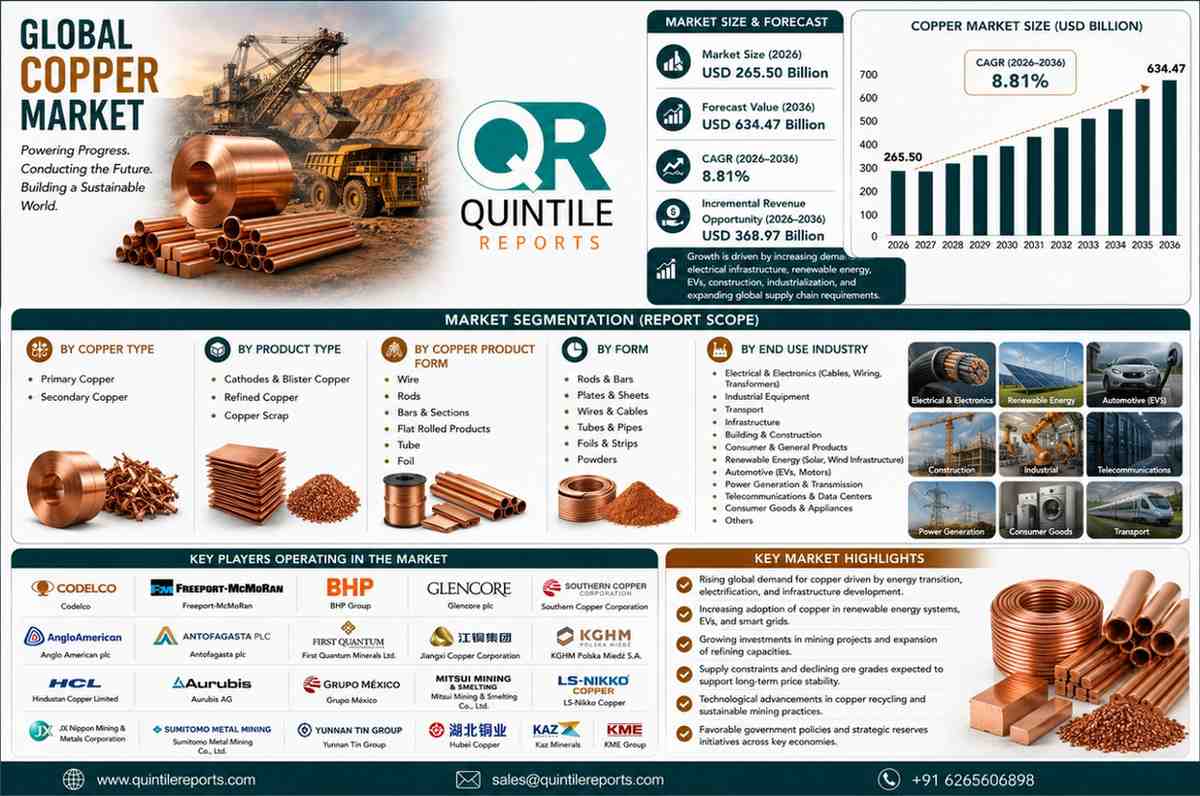
The global Copper Market was valued at USD 265.50 billion in 2026 and is projected to reach USD 634.47 billion by 2036, registering a robust CAGR of 8.81% during the forecast period. Copper remains one of the world's most strategically important industrial metals due to its superior electrical conductivity, thermal efficiency, corrosion resistance, and recyclability. The metal plays a fundamental role across construction, power generation, electrical infrastructure, transportation, electronics, telecommunications, and industrial manufacturing sectors.
The market is entering a period of accelerated growth as global economies pursue electrification, renewable energy adoption, and carbon reduction initiatives. Increasing investments in electric vehicles, power transmission networks, smart grids, and clean energy infrastructure are significantly expanding copper demand. Simultaneously, rapid urbanization, industrialization, and technological innovation continue to strengthen consumption across both developed and emerging economies.
Copper has emerged as a critical enabler of the global energy transition due to its extensive use in renewable power systems, electric mobility solutions, and advanced electrical infrastructure. Electric vehicles require substantially more copper than conventional internal combustion engine vehicles, while solar farms, wind turbines, battery storage systems, and grid modernization projects rely heavily on copper-intensive components.
The growing digital economy is also supporting demand growth. Data centers, telecommunications infrastructure, semiconductors, consumer electronics, and industrial automation systems increasingly depend on copper for efficient energy transfer and connectivity. As governments continue to invest in sustainable infrastructure and industrial electrification programs, copper demand is expected to rise steadily throughout the forecast period.
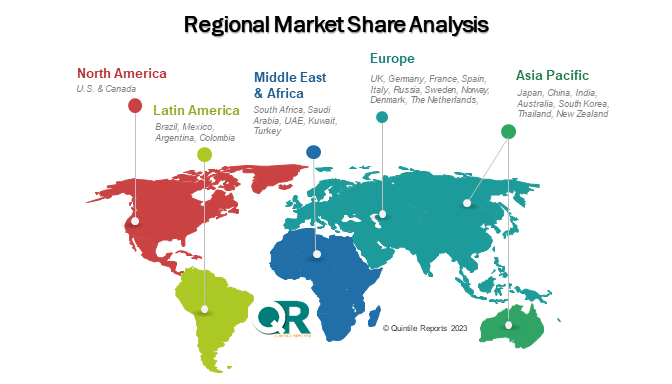
Asia-Pacific remains the dominant force in the global copper market, accounting for the largest share of both production and consumption. China continues to lead global demand due to extensive infrastructure projects, renewable energy investments, electric vehicle manufacturing, and electronics production. India is also emerging as a significant growth market, supported by industrial expansion, urbanization, and power sector modernization initiatives.
North America is witnessing increasing copper demand due to government-backed infrastructure programs, grid modernization projects, and clean energy investments. The United States is actively strengthening domestic supply chains to support EV manufacturing, renewable energy deployment, and advanced industrial applications. Canada contributes significantly through mining activities and refining capacity expansion.
Europe continues to experience strong demand driven by renewable energy targets, industrial electrification, and electric mobility adoption. Germany, France, and the United Kingdom remain key consumers due to their investments in sustainable infrastructure and clean energy systems. The region's emphasis on recycling and circular economy practices further supports market stability.
Latin America remains a cornerstone of global copper production, with Chile and Peru serving as major exporters and mining investment destinations. Meanwhile, the Middle East and Africa are gradually increasing copper consumption through infrastructure development, renewable energy projects, and industrial diversification initiatives.
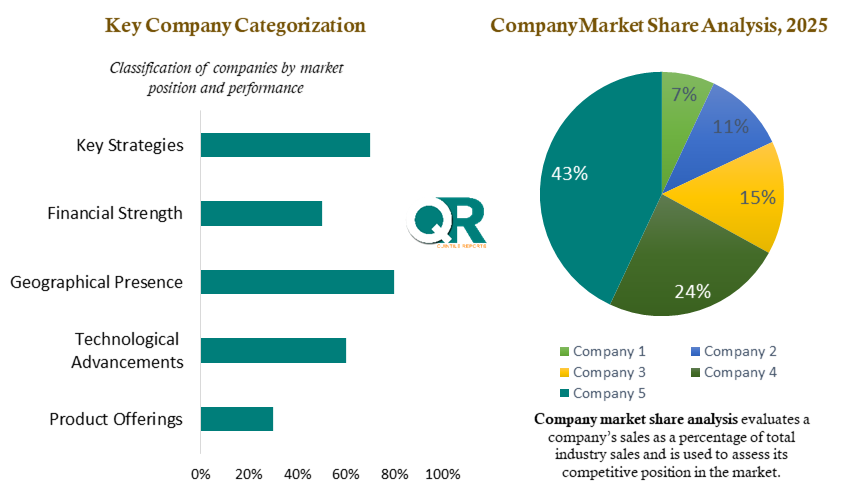
The copper market is highly competitive, characterized by the presence of global mining companies, integrated metal producers, refiners, and recycling specialists. Competitive differentiation increasingly depends on production efficiency, resource availability, sustainability initiatives, and downstream integration capabilities.
Major market participants are investing in mine expansions, new exploration projects, refining capacity upgrades, and recycling technologies to secure long-term supply. Companies are also adopting digital mining solutions, automation technologies, and carbon reduction strategies to improve operational efficiency and environmental performance.
Sustainability has become a critical competitive factor as customers increasingly prioritize responsibly sourced materials and low-carbon supply chains. Organizations with strong ESG performance, recycling capabilities, and transparent sourcing practices are expected to strengthen their market positions as demand for sustainable materials continues to grow.
| Report Scope | Details |
| Report Version | 2026 |
| Growth Rate | CAGR of 8.81 % from 2026 to 2036 |
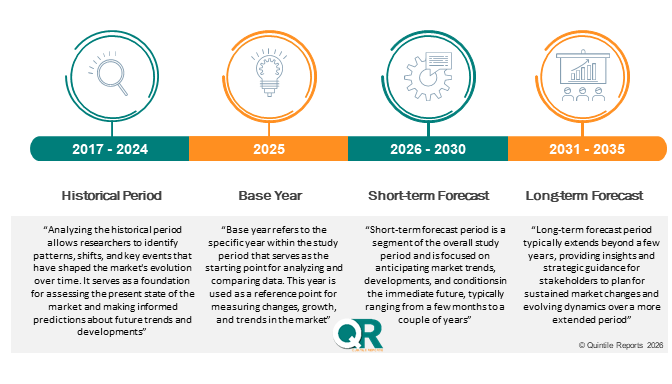
| Base Year | 2025 |
| Actual Estimates / Historical Data | 2017 - 2024 |
| Forecast Period | 2026 - 2036 |
| Quantitative Units | Revenue in USD million/billion & CAGR from 2026 to 2036 |
| Country Scope | North America (U.S., Canada), Europe (UK, Germany, France, Italy, Spain, Russia, Sweden, Denmark, Norway, Rest of Europe), Asia Pacific (Japan, China, India, Australia, South Korea, Thailand, Rest of Asia Pacific), Latin America (Brazil, Mexico, Argentina, Colombia, Rest of Latin America), Middle East & Africa (South Africa, Saudi Arabia, UAE, Kuwait, Rest of Middle East & Africa). |
| The Segment Covered by Copper Type |
|
| The Segment Covered by Product Type |
|
| Companies Covered |
|
| Report Coverage | Revenue forecast, company share, competitive landscape, growth factors, technology trends, and regional analysis |
| Free Customization Scope (Equivalent to 5 Analyst Working Days) | If you require additional insights beyond the current scope, our analysts can customize the report to meet your specific business needs. |
This report is developed using a comprehensive research framework that integrates extensive primary interviews, industry consultations, and detailed secondary research from reputable sources. The analysis combines quantitative market modeling with qualitative industry expertise to deliver reliable and actionable intelligence.
All market estimates undergo rigorous validation processes, including data triangulation, trend analysis, supply-demand assessments, and expert review. This methodology ensures a high degree of accuracy, consistency, and transparency, enabling stakeholders to make informed strategic decisions.
The study employs a structured combination of primary and secondary research methodologies. Secondary research includes the analysis of mining industry reports, government publications, commodity databases, corporate disclosures, trade statistics, and industry journals. Primary research involves interviews with mining executives, metal traders, refiners, manufacturers, industry experts, and procurement specialists.
Advanced forecasting models, demand-supply analysis, regional consumption assessments, and macroeconomic evaluations are applied to generate market projections. Data validation through triangulation and expert verification further strengthens the reliability of the report's findings.

This report has been prepared by a team of experienced metals and mining analysts, commodity market specialists, and industry researchers with extensive expertise in global resource markets. The research team combines technical knowledge, market intelligence, and advanced analytical methodologies to provide accurate, objective, and actionable insights.
Through continuous monitoring of commodity trends, mining investments, regulatory developments, sustainability initiatives, and technological advancements, our analysts deliver strategic intelligence that helps stakeholders navigate evolving market conditions and capitalize on emerging opportunities. The report reflects a commitment to research excellence, transparency, and industry relevance, making it a trusted resource for investors, producers, manufacturers, policymakers, and industry participants worldwide.
List of Tables
Table 1 List of Abbreviation and acronyms
Table 2 List of Sources
Table 3 North America Global Copper Market, by Segment Analysis, (USD Million) 2017-2036
Table 4 North America Global Copper Market, by Region, (USD Million) 2017-2036
Table 5 U.S. Global Copper Market, by Segment Analysis, (USD Million) 2017-2036
Table 6 Canada Global Copper Market, by Segment Analysis, (USD Million) 2017-2036
Table 7 Europe Global Copper Market, by Segment Analysis, (USD Million) 2017-2036
Table 8 Europe Global Copper Market, by Region, (USD Million) 2017-2036
Table 9 Germany Global Copper Market, by Segment Analysis, (USD Million) 2017-2036
Table 10 U.K. Global Copper Market, by Segment Analysis, (USD Million) 2017-2036
Table 11 France Global Copper Market, by Segment Analysis, (USD Million) 2017-2036
Table 12 Italy Global Copper Market, by Segment Analysis, (USD Million) 2017-2036
Table 13 Spain Global Copper Market, by Segment Analysis, (USD Million) 2017-2036
Table 14 Sweden Global Copper Market, by Segment Analysis, (USD Million) 2017-2036
Table 15 Denmark Global Copper Market, by Segment Analysis, (USD Million) 2017-2036
Table 16 Norway Global Copper Market, by Segment Analysis, (USD Million) 2017-2036
Table 17 The Netherlands Global Copper Market, by Segment Analysis, (USD Million) 2017-2036
Table 18 Russia Global Copper Market, by Segment Analysis, (USD Million) 2017-2036
Table 19 Asia Pacific Global Copper Market, by Segment Analysis, (USD Million) 2017-2036
Table 20 Asia Pacific Global Copper Market, by Region, (USD Million) 2017-2036
Table 21 China Global Copper Market, by Segment Analysis, (USD Million) 2017-2036
Table 22 Japan Global Copper Market, by Segment Analysis, (USD Million) 2017-2036
Table 23 India Global Copper Market, by Segment Analysis, (USD Million) 2017-2036
Table 24 Australia Global Copper Market, by Segment Analysis, (USD Million) 2017-2036
Table 25 South Korea Global Copper Market, by Segment Analysis, (USD Million) 2017-2036
Table 26 Thailand Global Copper Market, by Segment Analysis, (USD Million) 2017-2036
Table 27 Latin America Global Copper Market, by Segment Analysis, (USD Million) 2017-2036
Table 28 Latin America Global Copper Market, by Region, (USD Million) 2017-2036
Table 29 Brazil Global Copper Market, by Segment Analysis, (USD Million) 2017-2036
Table 30 Mexico Global Copper Market, by Segment Analysis, (USD Million) 2017-2036
Table 31 Argentina Global Copper Market, by Segment Analysis, (USD Million) 2017-2036
Table 32 Middle East and Africa Global Copper Market, by Segment Analysis, (USD Million) 2017-2036
Table 33 Middle East and Africa Global Copper Market, by Region, (USD Million) 2017-2036
Table 34 South Africa Global Copper Market, by Segment Analysis, (USD Million) 2017-2036
Table 35 Saudi Arabia Global Copper Market, by Segment Analysis, (USD Million) 2017-2036
Table 36 UAE Global Copper Market, by Segment Analysis, (USD Million) 2017-2036
Table 37 Kuwait Global Copper Market, by Segment Analysis, (USD Million) 2017-2036
Table 38 Turkey Global Copper Market, by Segment Analysis, (USD Million) 2017-2036
Fig.1 Market research process
Fig.2 Market research approaches
Fig.3 Global Copper Market: market scenario
Fig.4 Global Copper Market competitive outlook
Fig.5 Global Copper Market driver analysis
Fig.6 Global Copper Market restraint analysis
Fig.7 Global Copper Market opportunity analysis
Fig.8 Global Copper Market trends analysis
Fig.9 Global Copper Market: Segment Analysis (Based on the scope)
Fig.10 Global Copper Market: regional analysis
Fig.11 Global market shares and leading market players
Fig.12 North America market share and leading players
Fig.13 Europe market share and leading players
Fig.14 Asia Pacific market share and leading players
Fig.15 Latin America market share and leading players
Fig.16 Middle East & Africa market share and leading players
Fig.17 North America, by country
Fig.18 North America
Fig.19 North America market estimates and forecast, 2017-2036
Fig.20 U.S.
Fig.21 Canada
Fig.22 Europe
Fig.23 Europe market estimates and forecast, 2017-2036
Fig.24 U.K.
Fig.25 Germany
Fig.26 France
Fig.27 Italy
Fig.28 Spain
Fig.29 Sweden
Fig.30 Denmark
Fig.31 Norway
Fig.32 The Netherlands
Fig.33 Russia
Fig.34 Asia Pacific
Fig.35 Asia Pacific market estimates and forecast, 2017-2036
Fig.36 China
Fig.37 Japan
Fig.38 India
Fig.39 Australia
Fig.40 South Korea
Fig.41 Thailand
Fig.42 Latin America
Fig.43 Latin America market estimates and forecast, 2017-2036
Fig.44 Brazil
Fig.45 Mexico
Fig.46 Argentina
Fig.47 Colombia
Fig.48 Middle East and Africa
Fig.49 Middle East and Africa market estimates and forecast, 2017-2036
Fig.50 Saudi Arabia
Fig.51 South Africa
Fig.52 UAE
Fig.53 Kuwait
Fig.54 Turkey
List of Tables
Table 1 List of Abbreviation and acronyms
Table 2 List of Sources
Table 3 North America Global Copper Market, by Segment Analysis, (USD Million) 2017-2036
Table 4 North America Global Copper Market, by Region, (USD Million) 2017-2036
Table 5 U.S. Global Copper Market, by Segment Analysis, (USD Million) 2017-2036
Table 6 Canada Global Copper Market, by Segment Analysis, (USD Million) 2017-2036
Table 7 Europe Global Copper Market, by Segment Analysis, (USD Million) 2017-2036
Table 8 Europe Global Copper Market, by Region, (USD Million) 2017-2036
Table 9 Germany Global Copper Market, by Segment Analysis, (USD Million) 2017-2036
Table 10 U.K. Global Copper Market, by Segment Analysis, (USD Million) 2017-2036
Table 11 France Global Copper Market, by Segment Analysis, (USD Million) 2017-2036
Table 12 Italy Global Copper Market, by Segment Analysis, (USD Million) 2017-2036
Table 13 Spain Global Copper Market, by Segment Analysis, (USD Million) 2017-2036
Table 14 Sweden Global Copper Market, by Segment Analysis, (USD Million) 2017-2036
Table 15 Denmark Global Copper Market, by Segment Analysis, (USD Million) 2017-2036
Table 16 Norway Global Copper Market, by Segment Analysis, (USD Million) 2017-2036
Table 17 The Netherlands Global Copper Market, by Segment Analysis, (USD Million) 2017-2036
Table 18 Russia Global Copper Market, by Segment Analysis, (USD Million) 2017-2036
Table 19 Asia Pacific Global Copper Market, by Segment Analysis, (USD Million) 2017-2036
Table 20 Asia Pacific Global Copper Market, by Region, (USD Million) 2017-2036
Table 21 China Global Copper Market, by Segment Analysis, (USD Million) 2017-2036
Table 22 Japan Global Copper Market, by Segment Analysis, (USD Million) 2017-2036
Table 23 India Global Copper Market, by Segment Analysis, (USD Million) 2017-2036
Table 24 Australia Global Copper Market, by Segment Analysis, (USD Million) 2017-2036
Table 25 South Korea Global Copper Market, by Segment Analysis, (USD Million) 2017-2036
Table 26 Thailand Global Copper Market, by Segment Analysis, (USD Million) 2017-2036
Table 27 Latin America Global Copper Market, by Segment Analysis, (USD Million) 2017-2036
Table 28 Latin America Global Copper Market, by Region, (USD Million) 2017-2036
Table 29 Brazil Global Copper Market, by Segment Analysis, (USD Million) 2017-2036
Table 30 Mexico Global Copper Market, by Segment Analysis, (USD Million) 2017-2036
Table 31 Argentina Global Copper Market, by Segment Analysis, (USD Million) 2017-2036
Table 32 Middle East and Africa Global Copper Market, by Segment Analysis, (USD Million) 2017-2036
Table 33 Middle East and Africa Global Copper Market, by Region, (USD Million) 2017-2036
Table 34 South Africa Global Copper Market, by Segment Analysis, (USD Million) 2017-2036
Table 35 Saudi Arabia Global Copper Market, by Segment Analysis, (USD Million) 2017-2036
Table 36 UAE Global Copper Market, by Segment Analysis, (USD Million) 2017-2036
Table 37 Kuwait Global Copper Market, by Segment Analysis, (USD Million) 2017-2036
Table 38 Turkey Global Copper Market, by Segment Analysis, (USD Million) 2017-2036
Fig.1 Market research process
Fig.2 Market research approaches
Fig.3 Global Copper Market: market scenario
Fig.4 Global Copper Market competitive outlook
Fig.5 Global Copper Market driver analysis
Fig.6 Global Copper Market restraint analysis
Fig.7 Global Copper Market opportunity analysis
Fig.8 Global Copper Market trends analysis
Fig.9 Global Copper Market: Segment Analysis (Based on the scope)
Fig.10 Global Copper Market: regional analysis
Fig.11 Global market shares and leading market players
Fig.12 North America market share and leading players
Fig.13 Europe market share and leading players
Fig.14 Asia Pacific market share and leading players
Fig.15 Latin America market share and leading players
Fig.16 Middle East & Africa market share and leading players
Fig.17 North America, by country
Fig.18 North America
Fig.19 North America market estimates and forecast, 2017-2036
Fig.20 U.S.
Fig.21 Canada
Fig.22 Europe
Fig.23 Europe market estimates and forecast, 2017-2036
Fig.24 U.K.
Fig.25 Germany
Fig.26 France
Fig.27 Italy
Fig.28 Spain
Fig.29 Sweden
Fig.30 Denmark
Fig.31 Norway
Fig.32 The Netherlands
Fig.33 Russia
Fig.34 Asia Pacific
Fig.35 Asia Pacific market estimates and forecast, 2017-2036
Fig.36 China
Fig.37 Japan
Fig.38 India
Fig.39 Australia
Fig.40 South Korea
Fig.41 Thailand
Fig.42 Latin America
Fig.43 Latin America market estimates and forecast, 2017-2036
Fig.44 Brazil
Fig.45 Mexico
Fig.46 Argentina
Fig.47 Colombia
Fig.48 Middle East and Africa
Fig.49 Middle East and Africa market estimates and forecast, 2017-2036
Fig.50 Saudi Arabia
Fig.51 South Africa
Fig.52 UAE
Fig.53 Kuwait
Fig.54 Turkey
The global Copper Market is projected to grow from USD 265.50 billion in 2026 to approximately USD 634.47 billion by 2036, driven by increasing demand from electric vehicles, renewable energy projects, power infrastructure, and industrial applications.
The Copper Market is expected to register a compound annual growth rate (CAGR) of 8.81% during the forecast period from 2026 to 2036.
Key factors driving market growth include the rapid adoption of electric vehicles, expansion of renewable energy infrastructure, modernization of power grids, increasing urbanization, growth in construction activities, and rising demand from data centers, telecommunications, and industrial manufacturing sectors.
Copper is essential for electric vehicles and renewable energy systems due to its superior electrical conductivity and durability. EVs require significantly more copper than conventional vehicles for motors, batteries, charging systems, and wiring. Similarly, solar panels, wind turbines, battery storage systems, and transmission networks rely heavily on copper for efficient energy generation and distribution.
Asia-Pacific dominates the global Copper Market, led by China’s extensive infrastructure development, renewable energy investments, electric vehicle production, and electronics manufacturing. India is also emerging as a major growth market due to rapid industrialization and urban expansion.
Major companies operating in the Copper Market include Codelco, Freeport-McMoRan, BHP Group, Glencore plc, Southern Copper Corporation, Anglo American plc, Antofagasta plc, First Quantum Minerals Ltd., Jiangxi Copper Corporation, KGHM Polska Miedź S.A., Hindustan Copper Limited, and Aurubis AG.
Copper recycling is playing an increasingly important role in market growth by supporting sustainability goals, reducing environmental impact, and helping meet rising demand. Recycled copper retains nearly all of its original properties, making it a cost-effective and environmentally responsible alternative to primary copper production.
Significant opportunities exist in smart grid deployment, renewable energy integration, electric vehicle charging infrastructure, energy storage systems, and transmission network modernization. As governments invest in electrification and energy transition initiatives, demand for copper-intensive electrical equipment, cables, transformers, and grid technologies is expected to increase substantially.
The global Copper Market was valued at USD 265.50 billion in 2026 and is projected to reach USD 634.47 billion by 2036, registering a robust CAGR of 8.81% during the forecast period. Copper remains one of the world's most strategically important industrial metals due to its superior electrical conductivity, thermal efficiency, corrosion resistance, and recyclability. The metal plays a fundamental role across construction, power generation, electrical infrastructure, transportation, electronics, telecommunications, and industrial manufacturing sectors.
The market is entering a period of accelerated growth as global economies pursue electrification, renewable energy adoption, and carbon reduction initiatives. Increasing investments in electric vehicles, power transmission networks, smart grids, and clean energy infrastructure are significantly expanding copper demand. Simultaneously, rapid urbanization, industrialization, and technological innovation continue to strengthen consumption across both developed and emerging economies.
Copper has emerged as a critical enabler of the global energy transition due to its extensive use in renewable power systems, electric mobility solutions, and advanced electrical infrastructure. Electric vehicles require substantially more copper than conventional internal combustion engine vehicles, while solar farms, wind turbines, battery storage systems, and grid modernization projects rely heavily on copper-intensive components.
The growing digital economy is also supporting demand growth. Data centers, telecommunications infrastructure, semiconductors, consumer electronics, and industrial automation systems increasingly depend on copper for efficient energy transfer and connectivity. As governments continue to invest in sustainable infrastructure and industrial electrification programs, copper demand is expected to rise steadily throughout the forecast period.
Asia-Pacific remains the dominant force in the global copper market, accounting for the largest share of both production and consumption. China continues to lead global demand due to extensive infrastructure projects, renewable energy investments, electric vehicle manufacturing, and electronics production. India is also emerging as a significant growth market, supported by industrial expansion, urbanization, and power sector modernization initiatives.
North America is witnessing increasing copper demand due to government-backed infrastructure programs, grid modernization projects, and clean energy investments. The United States is actively strengthening domestic supply chains to support EV manufacturing, renewable energy deployment, and advanced industrial applications. Canada contributes significantly through mining activities and refining capacity expansion.
Europe continues to experience strong demand driven by renewable energy targets, industrial electrification, and electric mobility adoption. Germany, France, and the United Kingdom remain key consumers due to their investments in sustainable infrastructure and clean energy systems. The region's emphasis on recycling and circular economy practices further supports market stability.
Latin America remains a cornerstone of global copper production, with Chile and Peru serving as major exporters and mining investment destinations. Meanwhile, the Middle East and Africa are gradually increasing copper consumption through infrastructure development, renewable energy projects, and industrial diversification initiatives.
The copper market is highly competitive, characterized by the presence of global mining companies, integrated metal producers, refiners, and recycling specialists. Competitive differentiation increasingly depends on production efficiency, resource availability, sustainability initiatives, and downstream integration capabilities.
Major market participants are investing in mine expansions, new exploration projects, refining capacity upgrades, and recycling technologies to secure long-term supply. Companies are also adopting digital mining solutions, automation technologies, and carbon reduction strategies to improve operational efficiency and environmental performance.
Sustainability has become a critical competitive factor as customers increasingly prioritize responsibly sourced materials and low-carbon supply chains. Organizations with strong ESG performance, recycling capabilities, and transparent sourcing practices are expected to strengthen their market positions as demand for sustainable materials continues to grow.
| Report Scope | Details |
| Report Version | 2026 |
| Growth Rate | CAGR of 8.81 % from 2026 to 2036 |
| Base Year | 2025 |
| Actual Estimates / Historical Data | 2017 - 2024 |
| Forecast Period | 2026 - 2036 |
| Quantitative Units | Revenue in USD million/billion & CAGR from 2026 to 2036 |
| Country Scope | North America (U.S., Canada), Europe (UK, Germany, France, Italy, Spain, Russia, Sweden, Denmark, Norway, Rest of Europe), Asia Pacific (Japan, China, India, Australia, South Korea, Thailand, Rest of Asia Pacific), Latin America (Brazil, Mexico, Argentina, Colombia, Rest of Latin America), Middle East & Africa (South Africa, Saudi Arabia, UAE, Kuwait, Rest of Middle East & Africa). |
| The Segment Covered by Copper Type |
|
| The Segment Covered by Product Type |
|
| Companies Covered |
|
| Report Coverage | Revenue forecast, company share, competitive landscape, growth factors, technology trends, and regional analysis |
| Free Customization Scope (Equivalent to 5 Analyst Working Days) | If you require additional insights beyond the current scope, our analysts can customize the report to meet your specific business needs. |
This report is developed using a comprehensive research framework that integrates extensive primary interviews, industry consultations, and detailed secondary research from reputable sources. The analysis combines quantitative market modeling with qualitative industry expertise to deliver reliable and actionable intelligence.
All market estimates undergo rigorous validation processes, including data triangulation, trend analysis, supply-demand assessments, and expert review. This methodology ensures a high degree of accuracy, consistency, and transparency, enabling stakeholders to make informed strategic decisions.
The study employs a structured combination of primary and secondary research methodologies. Secondary research includes the analysis of mining industry reports, government publications, commodity databases, corporate disclosures, trade statistics, and industry journals. Primary research involves interviews with mining executives, metal traders, refiners, manufacturers, industry experts, and procurement specialists.
Advanced forecasting models, demand-supply analysis, regional consumption assessments, and macroeconomic evaluations are applied to generate market projections. Data validation through triangulation and expert verification further strengthens the reliability of the report's findings.
This report has been prepared by a team of experienced metals and mining analysts, commodity market specialists, and industry researchers with extensive expertise in global resource markets. The research team combines technical knowledge, market intelligence, and advanced analytical methodologies to provide accurate, objective, and actionable insights.
Through continuous monitoring of commodity trends, mining investments, regulatory developments, sustainability initiatives, and technological advancements, our analysts deliver strategic intelligence that helps stakeholders navigate evolving market conditions and capitalize on emerging opportunities. The report reflects a commitment to research excellence, transparency, and industry relevance, making it a trusted resource for investors, producers, manufacturers, policymakers, and industry participants worldwide.
Table 1 List of Abbreviation and acronyms
Table 2 List of Sources
Table 3 North America Global Copper Market, by Segment Analysis, (USD Million) 2017-2036
Table 4 North America Global Copper Market, by Region, (USD Million) 2017-2036
Table 5 U.S. Global Copper Market, by Segment Analysis, (USD Million) 2017-2036
Table 6 Canada Global Copper Market, by Segment Analysis, (USD Million) 2017-2036
Table 7 Europe Global Copper Market, by Segment Analysis, (USD Million) 2017-2036
Table 8 Europe Global Copper Market, by Region, (USD Million) 2017-2036
Table 9 Germany Global Copper Market, by Segment Analysis, (USD Million) 2017-2036
Table 10 U.K. Global Copper Market, by Segment Analysis, (USD Million) 2017-2036
Table 11 France Global Copper Market, by Segment Analysis, (USD Million) 2017-2036
Table 12 Italy Global Copper Market, by Segment Analysis, (USD Million) 2017-2036
Table 13 Spain Global Copper Market, by Segment Analysis, (USD Million) 2017-2036
Table 14 Sweden Global Copper Market, by Segment Analysis, (USD Million) 2017-2036
Table 15 Denmark Global Copper Market, by Segment Analysis, (USD Million) 2017-2036
Table 16 Norway Global Copper Market, by Segment Analysis, (USD Million) 2017-2036
Table 17 The Netherlands Global Copper Market, by Segment Analysis, (USD Million) 2017-2036
Table 18 Russia Global Copper Market, by Segment Analysis, (USD Million) 2017-2036
Table 19 Asia Pacific Global Copper Market, by Segment Analysis, (USD Million) 2017-2036
Table 20 Asia Pacific Global Copper Market, by Region, (USD Million) 2017-2036
Table 21 China Global Copper Market, by Segment Analysis, (USD Million) 2017-2036
Table 22 Japan Global Copper Market, by Segment Analysis, (USD Million) 2017-2036
Table 23 India Global Copper Market, by Segment Analysis, (USD Million) 2017-2036
Table 24 Australia Global Copper Market, by Segment Analysis, (USD Million) 2017-2036
Table 25 South Korea Global Copper Market, by Segment Analysis, (USD Million) 2017-2036
Table 26 Thailand Global Copper Market, by Segment Analysis, (USD Million) 2017-2036
Table 27 Latin America Global Copper Market, by Segment Analysis, (USD Million) 2017-2036
Table 28 Latin America Global Copper Market, by Region, (USD Million) 2017-2036
Table 29 Brazil Global Copper Market, by Segment Analysis, (USD Million) 2017-2036
Table 30 Mexico Global Copper Market, by Segment Analysis, (USD Million) 2017-2036
Table 31 Argentina Global Copper Market, by Segment Analysis, (USD Million) 2017-2036
Table 32 Middle East and Africa Global Copper Market, by Segment Analysis, (USD Million) 2017-2036
Table 33 Middle East and Africa Global Copper Market, by Region, (USD Million) 2017-2036
Table 34 South Africa Global Copper Market, by Segment Analysis, (USD Million) 2017-2036
Table 35 Saudi Arabia Global Copper Market, by Segment Analysis, (USD Million) 2017-2036
Table 36 UAE Global Copper Market, by Segment Analysis, (USD Million) 2017-2036
Table 37 Kuwait Global Copper Market, by Segment Analysis, (USD Million) 2017-2036
Table 38 Turkey Global Copper Market, by Segment Analysis, (USD Million) 2017-2036
Fig.1 Market research process
Fig.2 Market research approaches
Fig.3 Global Copper Market: market scenario
Fig.4 Global Copper Market competitive outlook
Fig.5 Global Copper Market driver analysis
Fig.6 Global Copper Market restraint analysis
Fig.7 Global Copper Market opportunity analysis
Fig.8 Global Copper Market trends analysis
Fig.9 Global Copper Market: Segment Analysis (Based on the scope)
Fig.10 Global Copper Market: regional analysis
Fig.11 Global market shares and leading market players
Fig.12 North America market share and leading players
Fig.13 Europe market share and leading players
Fig.14 Asia Pacific market share and leading players
Fig.15 Latin America market share and leading players
Fig.16 Middle East & Africa market share and leading players
Fig.17 North America, by country
Fig.18 North America
Fig.19 North America market estimates and forecast, 2017-2036
Fig.20 U.S.
Fig.21 Canada
Fig.22 Europe
Fig.23 Europe market estimates and forecast, 2017-2036
Fig.24 U.K.
Fig.25 Germany
Fig.26 France
Fig.27 Italy
Fig.28 Spain
Fig.29 Sweden
Fig.30 Denmark
Fig.31 Norway
Fig.32 The Netherlands
Fig.33 Russia
Fig.34 Asia Pacific
Fig.35 Asia Pacific market estimates and forecast, 2017-2036
Fig.36 China
Fig.37 Japan
Fig.38 India
Fig.39 Australia
Fig.40 South Korea
Fig.41 Thailand
Fig.42 Latin America
Fig.43 Latin America market estimates and forecast, 2017-2036
Fig.44 Brazil
Fig.45 Mexico
Fig.46 Argentina
Fig.47 Colombia
Fig.48 Middle East and Africa
Fig.49 Middle East and Africa market estimates and forecast, 2017-2036
Fig.50 Saudi Arabia
Fig.51 South Africa
Fig.52 UAE
Fig.53 Kuwait
Fig.54 Turkey
Table 1 List of Abbreviation and acronyms
Table 2 List of Sources
Table 3 North America Global Copper Market, by Segment Analysis, (USD Million) 2017-2036
Table 4 North America Global Copper Market, by Region, (USD Million) 2017-2036
Table 5 U.S. Global Copper Market, by Segment Analysis, (USD Million) 2017-2036
Table 6 Canada Global Copper Market, by Segment Analysis, (USD Million) 2017-2036
Table 7 Europe Global Copper Market, by Segment Analysis, (USD Million) 2017-2036
Table 8 Europe Global Copper Market, by Region, (USD Million) 2017-2036
Table 9 Germany Global Copper Market, by Segment Analysis, (USD Million) 2017-2036
Table 10 U.K. Global Copper Market, by Segment Analysis, (USD Million) 2017-2036
Table 11 France Global Copper Market, by Segment Analysis, (USD Million) 2017-2036
Table 12 Italy Global Copper Market, by Segment Analysis, (USD Million) 2017-2036
Table 13 Spain Global Copper Market, by Segment Analysis, (USD Million) 2017-2036
Table 14 Sweden Global Copper Market, by Segment Analysis, (USD Million) 2017-2036
Table 15 Denmark Global Copper Market, by Segment Analysis, (USD Million) 2017-2036
Table 16 Norway Global Copper Market, by Segment Analysis, (USD Million) 2017-2036
Table 17 The Netherlands Global Copper Market, by Segment Analysis, (USD Million) 2017-2036
Table 18 Russia Global Copper Market, by Segment Analysis, (USD Million) 2017-2036
Table 19 Asia Pacific Global Copper Market, by Segment Analysis, (USD Million) 2017-2036
Table 20 Asia Pacific Global Copper Market, by Region, (USD Million) 2017-2036
Table 21 China Global Copper Market, by Segment Analysis, (USD Million) 2017-2036
Table 22 Japan Global Copper Market, by Segment Analysis, (USD Million) 2017-2036
Table 23 India Global Copper Market, by Segment Analysis, (USD Million) 2017-2036
Table 24 Australia Global Copper Market, by Segment Analysis, (USD Million) 2017-2036
Table 25 South Korea Global Copper Market, by Segment Analysis, (USD Million) 2017-2036
Table 26 Thailand Global Copper Market, by Segment Analysis, (USD Million) 2017-2036
Table 27 Latin America Global Copper Market, by Segment Analysis, (USD Million) 2017-2036
Table 28 Latin America Global Copper Market, by Region, (USD Million) 2017-2036
Table 29 Brazil Global Copper Market, by Segment Analysis, (USD Million) 2017-2036
Table 30 Mexico Global Copper Market, by Segment Analysis, (USD Million) 2017-2036
Table 31 Argentina Global Copper Market, by Segment Analysis, (USD Million) 2017-2036
Table 32 Middle East and Africa Global Copper Market, by Segment Analysis, (USD Million) 2017-2036
Table 33 Middle East and Africa Global Copper Market, by Region, (USD Million) 2017-2036
Table 34 South Africa Global Copper Market, by Segment Analysis, (USD Million) 2017-2036
Table 35 Saudi Arabia Global Copper Market, by Segment Analysis, (USD Million) 2017-2036
Table 36 UAE Global Copper Market, by Segment Analysis, (USD Million) 2017-2036
Table 37 Kuwait Global Copper Market, by Segment Analysis, (USD Million) 2017-2036
Table 38 Turkey Global Copper Market, by Segment Analysis, (USD Million) 2017-2036
Fig.1 Market research process
Fig.2 Market research approaches
Fig.3 Global Copper Market: market scenario
Fig.4 Global Copper Market competitive outlook
Fig.5 Global Copper Market driver analysis
Fig.6 Global Copper Market restraint analysis
Fig.7 Global Copper Market opportunity analysis
Fig.8 Global Copper Market trends analysis
Fig.9 Global Copper Market: Segment Analysis (Based on the scope)
Fig.10 Global Copper Market: regional analysis
Fig.11 Global market shares and leading market players
Fig.12 North America market share and leading players
Fig.13 Europe market share and leading players
Fig.14 Asia Pacific market share and leading players
Fig.15 Latin America market share and leading players
Fig.16 Middle East & Africa market share and leading players
Fig.17 North America, by country
Fig.18 North America
Fig.19 North America market estimates and forecast, 2017-2036
Fig.20 U.S.
Fig.21 Canada
Fig.22 Europe
Fig.23 Europe market estimates and forecast, 2017-2036
Fig.24 U.K.
Fig.25 Germany
Fig.26 France
Fig.27 Italy
Fig.28 Spain
Fig.29 Sweden
Fig.30 Denmark
Fig.31 Norway
Fig.32 The Netherlands
Fig.33 Russia
Fig.34 Asia Pacific
Fig.35 Asia Pacific market estimates and forecast, 2017-2036
Fig.36 China
Fig.37 Japan
Fig.38 India
Fig.39 Australia
Fig.40 South Korea
Fig.41 Thailand
Fig.42 Latin America
Fig.43 Latin America market estimates and forecast, 2017-2036
Fig.44 Brazil
Fig.45 Mexico
Fig.46 Argentina
Fig.47 Colombia
Fig.48 Middle East and Africa
Fig.49 Middle East and Africa market estimates and forecast, 2017-2036
Fig.50 Saudi Arabia
Fig.51 South Africa
Fig.52 UAE
Fig.53 Kuwait
Fig.54 Turkey

A license granted to one user. Rules or conditions might be applied for e.g. the use of electric files (PDFs) or printings, depending on product.
A license granted to multiple users.
A license granted to a single business site/establishment.
A license granted to all employees within organisation access to the product.
Immediate / Within 24-48 hours - Working days
Online Payments with PayPal and CCavenue
You can order a report by picking any of the payment methods which is bank wire or online payment through any Debit/Credit card or PayPal.
Hard Copy
Aramid Fiber Market Overview The global Aramid Fiber Market was valued at USD 4.98 billion in 2026 a
Read MoreConcrete Market Overview The global concrete market forms the backbone of modern construction, provi
Read MoreSilicon Carbide Market Overview The global Silicon Carbide (SiC) Market was valued at USD 7.52 billi
Read More