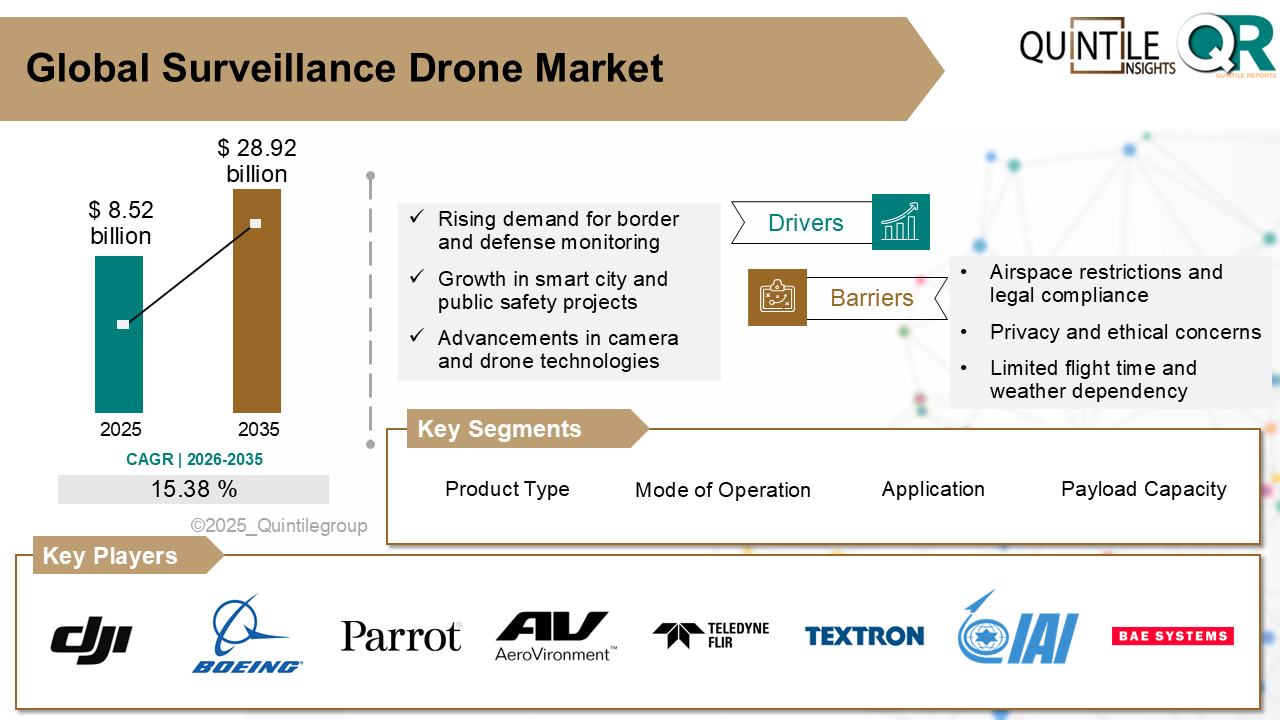
The Global Surveillance Drone Market was valued at USD 8.52 billion in 2025 and is anticipated to reach USD 28.92 billion by 2035, growing at a robust CAGR of 15.38% during the forecast period from 2026 to 2035. The Surveillance Drone market report presents a comprehensive overview of the industry by assessing macroeconomic conditions, emerging technologies, regulatory frameworks, and shifting consumer behavior to provide a clear outlook on future market expansion.
The surveillance drone market includes unmanned aerial vehicles (UAVs) equipped with cameras, sensors, and communication systems used for real-time monitoring. These drones are deployed by military, government, law enforcement, and commercial sectors for activities such as border patrol, crowd surveillance, infrastructure inspection, traffic monitoring, disaster response, and agricultural surveillance.
With 2025 serving as the base year, the Surveillance Drone market is experiencing stable growth supported by rising demand across key end-use industries and continuous technological innovation. Companies operating in the market are enhancing their go-to-market (GTM) strategies to capture emerging opportunities and navigate evolving competitive dynamics effectively.
By 2035, the market is expected to demonstrate strong growth potential, driven by sustained investments in innovation, increasing strategic partnerships, and growing merger and acquisition activities. Organizations that prioritize customer-centric solutions, innovation, and agile GTM execution are likely to strengthen their market presence and achieve long-term success. The report provides detailed insights into major market drivers, restraints, opportunities, and challenges across segments, regions, and countries, supported by extensive qualitative and quantitative analysis from 2017 to 2035.
As drone technology becomes more advanced, surveillance UAVs are increasingly used in place of manned patrols and fixed cameras. They offer high mobility, extended aerial coverage, and the ability to stream real-time data. The growing need for flexible, cost-effective surveillance systems is leading to wider adoption of drones across both developed and developing countries.
A key driver is the rising demand for border security and public safety surveillance. Governments are investing in UAVs to monitor remote areas and reduce the need for manned patrols. Drones can quickly cover large geographic zones, stream live video, and detect unauthorized movement, making them suitable for high-risk zones and difficult terrain.
The commercial sector is also growing rapidly. Surveillance drones are used in critical infrastructure inspections, including railways, pipelines, power lines, and telecom towers. These drones help reduce inspection time and improve worker safety by reaching high or hazardous areas. Their use in traffic monitoring and emergency services is also expanding in urban settings.
Disaster management is another important area where drones offer significant value. During floods, fires, earthquakes, and search-and-rescue operations, drones provide aerial views of affected zones and support fast decision-making. Their deployment by civil defense agencies and humanitarian groups is becoming more common.
Policy changes are improving market access. In many countries, civil aviation authorities are easing restrictions for commercial drone flights. Licensing systems, pilot training programs, and drone corridors are being established to support safe and scalable drone operations. These frameworks make it easier for public and private users to deploy surveillance UAVs.
Privacy concerns are among the most debated issues in drone surveillance. The use of UAVs to monitor public and private spaces raises questions about data use, unauthorized filming, and surveillance abuse. Without clear regulations, public opposition can slow deployment or limit operational areas.
Regulatory barriers still exist in many regions. Strict flight restrictions, airspace control, and complex licensing requirements can delay or restrict drone use. In some countries, night flying or beyond-visual-line-of-sight operations are limited, which reduces drone effectiveness in real-world surveillance tasks.
Battery limitations and payload restrictions also pose challenges. Most surveillance drones have limited flight time, which restricts their ability to cover large areas in a single mission. Carrying heavier cameras or multi-sensor setups can reduce efficiency unless high-end drone models are used.
Technical failures, cyber threats, and data security risks are also concerns. Surveillance drones may be exposed to jamming, GPS spoofing, or hacking if not properly secured. These risks require investment in cybersecurity and safe data transmission protocols, which add to operational costs.
North America leads in military and commercial surveillance drone applications. The United States uses drones for border security, city policing, and disaster response. Commercial firms use drones for inspection and security in utilities and construction.
European countries deploy drones for smart city monitoring, border patrol, and critical infrastructure protection. Regulatory progress by the European Union Aviation Safety Agency is helping streamline civil drone use across member states.
Asia Pacific is expanding fast in both military and civilian drone use. China, India, Japan, and South Korea invest heavily in surveillance drones for border, industrial, and public safety purposes. Urban crowd monitoring and traffic surveillance are growing applications.
Latin American countries are adopting drones for crime prevention, coastal surveillance, and disaster management. Brazil and Mexico lead in deploying UAVs for public security, but adoption is slower in rural regions due to limited funding.
Middle Eastern countries use drones for facility protection and oilfield monitoring. In Africa, surveillance drones support wildlife protection, border control, and humanitarian logistics. Market growth depends on improvements in drone policy and investment in technology infrastructure.
The United States is one of the largest users of surveillance drones. Agencies such as Customs and Border Protection, police departments, and disaster response teams use UAVs to monitor borders, manage crowds, and assess damage after storms or fires. These drones enhance situational awareness while reducing risk to personnel.
Federal Aviation Administration (FAA) approved waivers and commercial drone licensing frameworks have allowed companies and municipalities to use drones for inspecting power lines, buildings, and transport systems. Integration with 5G and AI analytics is helping U.S.-based drone programs become more advanced and responsive to real-time events.
Germany is expanding drone use in law enforcement, firefighting, and public safety. Drones are used to monitor large events, secure public infrastructure, and conduct search-and-rescue operations. Police and municipal authorities use real-time video to make fast, informed decisions in urban security.
German aviation authorities support drone corridors and advanced pilot training. Companies in the country are developing lightweight surveillance drones for logistics hubs, traffic control, and critical site monitoring. Local governments are increasingly including UAVs in their smart city programs and infrastructure maintenance plans.
Japan uses surveillance drones for city monitoring, traffic surveillance, and industrial inspections. Due to its vulnerability to natural disasters, the country also deploys drones in earthquake zones and landslide-prone regions to guide emergency response teams.
The government supports drone deployment under national digital transformation initiatives. Updated regulations have made it easier for trained operators to fly UAVs in populated areas. Drones are increasingly used in highway patrol, airport security, and monitoring infrastructure such as tunnels, bridges, and dams.
The surveillance drone market includes global aerospace and defense companies, drone manufacturers, and specialized system integrators. Large firms provide drones with long-range capabilities, night vision, and AI-based analytics primarily for military and government applications. These players focus on rugged design, long endurance, and integration with national defense systems.
Mid-sized drone manufacturers target law enforcement, infrastructure inspection, and disaster management. Their systems emphasize ease of deployment, operational flexibility, and cost-efficiency. Many offer modular drone platforms that can integrate different payloads such as thermal cameras, optical zoom sensors, and mapping equipment.
Innovation in sensors and connectivity is transforming the market. Some companies are integrating facial recognition, object tracking, and cloud-based video analytics into drone platforms. Real-time data sharing with command centers and mobile devices has become a standard feature in modern surveillance systems.
Collaborations between drone manufacturers, government agencies, and research institutions are also expanding. These partnerships support pilot training programs, maintenance services, and regulatory compliance while improving operational safety.
Key players in the market include DJI, Elbit Systems Ltd., Lockheed Martin Corporation, Northrop Grumman Corporation, Thales Group, Israel Aerospace Industries (IAI), BAE Systems, Raytheon Technologies Corporation, General Atomics, Boeing, Parrot Drones SAS, AeroVironment Inc., FLIR Systems Inc., Teledyne FLIR LLC, Textron Systems, and other players.
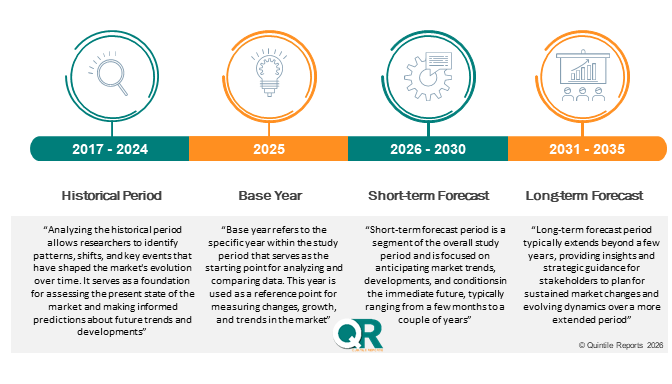
Our team of experienced researchers has meticulously gathered and analyzed data to deliver a thorough examination of market dynamics, competitive landscape, and emerging technologies. With a focus on delivering actionable intelligence, this report aims to empower decision-makers with the information needed to make informed choices and stay ahead of the competition. Whether you are a seasoned industry player or a new entrant, our market research report serves as a strategic tool to navigate the complexities of the market, aiding in successful business planning and growth strategies.
This chapter of our Surveillance Drone market report provides an in-depth examination of the factors shaping the industry landscape. This section typically encompasses several key elements to offer a comprehensive understanding of the industry landscape such as market drivers & restraints analysis, market opportunities & trend analysis, market size & growth analysis, competitive analysis, SWOT analysis, business environment tools such as Porter's five forces & PESTEL analysis, Ansoff Matrix analysis, penetration & growth prospect analysis, regulatory framework & reimbursement scenario analysis, impact of macro & micro economic factors analysis such as Covid-19 impact, GDP growth, market inflation, U.S.- China trade war, Russia-Ukraine war impact, and supply chain analysis.
The segment analysis chapter of Surveillance Drone market report is a critical section that delves into a detailed examination of the market's various segments. Segmentation involves dividing the market into distinct categories based on certain criteria to better understand and address the diverse needs of consumers. This chapter typically follows the introduction and provides a more granular view of the market, offering valuable insights for businesses and stakeholders. The components of the chapter lude segment definitions to understand the inclusions and exclusions of the study, assumptions, market size estimates and growth trend analysis of each segment, qualitative analysis of the segment, technological advancements, market penetration rate, market adoption rate, market share examination by each segment, segment growth drivers and restraint barriers, consumer behaviour and challenge analysis.
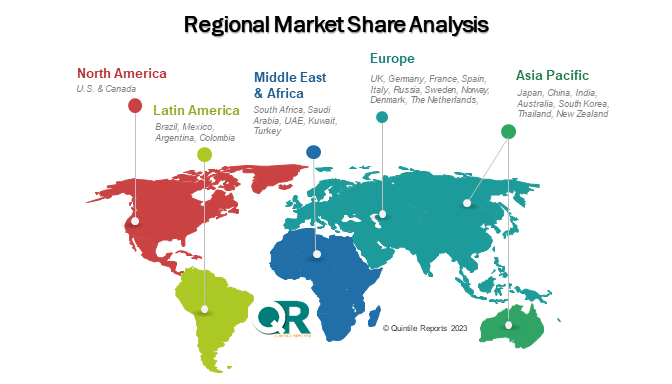
The chapter in Surveillance Drone market research report is a pivotal section that examines and predicts the market dynamics and trends specific to different geographical regions. This chapter is crucial for businesses and stakeholders seeking a comprehensive understanding of how the market behaves across various locations, enabling them to tailor strategies and make informed decisions based on regional variations. The regional analysis chapter of our Surveillance Drone market report is classified into regions & country-level. The chapter consists of North America (U.S., Canada), Europe (UK, Germany, France, Italy, Spain, Russia, Sweden, Denmark, Norway, Rest of Europe), Asia Pacific (Japan, China, India, Australia, South Korea, Thailand, Rest of Asia Pacific), Latin America (Brazil, Mexico, Argentina, Colombia, Rest of Latin America), Middle East & Africa (South Africa, Saudi Arabia, UAE, Kuwait, Rest of Middle East & Africa).
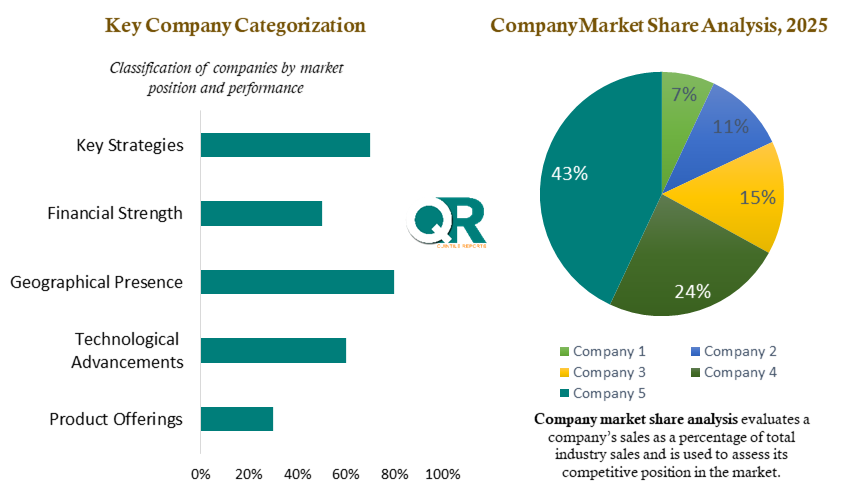
This section of a Surveillance Drone market report is a crucial segment that provides a comprehensive overview of the competitive landscape within the market. This section is vital for businesses, investors, and stakeholders seeking insights into key players, their market positioning, strengths, weaknesses, strategies, and potential impacts on the overall market dynamics. The chapter includes research methodology used to analyse the market competition, list of key players operating in the market, detailed company profile section which includes company overview, business verticals, financial performance, product/services benchmarking, geographical presence, and strategic initiatives.
| Report Scope | Details |
| Report Version | 2026 |
| Growth Rate | CAGR of 15.38 from 2026 to 2035 |
| Base Year | 2025 |
| Actual Estimates / Historical Data | 2017 - 2024 |
| Forecast Period | 2026 - 2035 |
| Quantitative Units | Revenue in USD million/billion & CAGR from 2026 to 2035 |
| Country Scope | North America (U.S., Canada), Europe (UK, Germany, France, Italy, Spain, Russia, Sweden, Denmark, Norway, Rest of Europe), Asia Pacific (Japan, China, India, Australia, South Korea, Thailand, Rest of Asia Pacific), Latin America (Brazil, Mexico, Argentina, Colombia, Rest of Latin America), Middle East & Africa (South Africa, Saudi Arabia, UAE, Kuwait, Rest of Middle East & Africa). |
| The Segment Covered by Drone Type |
|
| The Segment Covered by Range |
|
| Companies Covered |
|
| Report Coverage | Revenue forecast, company share, competitive landscape, growth factors, and trends |
| Free Customization Scope (Equivalent to 5 Analyst Working Days) | If you need specific information, which is not currently within the scope of the report, we will provide it to you as a part of the customization |

Statistics for the 2025 Surveillance Drone market share, size, and revenue growth rate were created by Quintile Report™. Surveillance Drone analysis includes a market forecast outlook for 2035 and a historical overview. Get a free PDF sample of this market analysis, please get in touch with our principal analyst at sales@quintilereports.com
List of Tables
Table 1 List of Abbreviation and acronyms
Table 2 List of Sources
Table 3 North America Global Surveillance Drone Market, by Segment Analysis, (USD Million) 2017-2035
Table 4 North America Global Surveillance Drone Market, by Region, (USD Million) 2017-2035
Table 5 U.S. Global Surveillance Drone Market, by Segment Analysis, (USD Million) 2017-2035
Table 6 Canada Global Surveillance Drone Market, by Segment Analysis, (USD Million) 2017-2035
Table 7 Europe Global Surveillance Drone Market, by Segment Analysis, (USD Million) 2017-2035
Table 8 Europe Global Surveillance Drone Market, by Region, (USD Million) 2017-2035
Table 9 Germany Global Surveillance Drone Market, by Segment Analysis, (USD Million) 2017-2035
Table 10 U.K. Global Surveillance Drone Market, by Segment Analysis, (USD Million) 2017-2035
Table 11 France Global Surveillance Drone Market, by Segment Analysis, (USD Million) 2017-2035
Table 12 Italy Global Surveillance Drone Market, by Segment Analysis, (USD Million) 2017-2035
Table 13 Spain Global Surveillance Drone Market, by Segment Analysis, (USD Million) 2017-2035
Table 14 Sweden Global Surveillance Drone Market, by Segment Analysis, (USD Million) 2017-2035
Table 15 Denmark Global Surveillance Drone Market, by Segment Analysis, (USD Million) 2017-2035
Table 16 Norway Global Surveillance Drone Market, by Segment Analysis, (USD Million) 2017-2035
Table 17 The Netherlands Global Surveillance Drone Market, by Segment Analysis, (USD Million) 2017-2035
Table 18 Russia Global Surveillance Drone Market, by Segment Analysis, (USD Million) 2017-2035
Table 19 Asia Pacific Global Surveillance Drone Market, by Segment Analysis, (USD Million) 2017-2035
Table 20 Asia Pacific Global Surveillance Drone Market, by Region, (USD Million) 2017-2035
Table 21 China Global Surveillance Drone Market, by Segment Analysis, (USD Million) 2017-2035
Table 22 Japan Global Surveillance Drone Market, by Segment Analysis, (USD Million) 2017-2035
Table 23 India Global Surveillance Drone Market, by Segment Analysis, (USD Million) 2017-2035
Table 24 Australia Global Surveillance Drone Market, by Segment Analysis, (USD Million) 2017-2035
Table 25 South Korea Global Surveillance Drone Market, by Segment Analysis, (USD Million) 2017-2035
Table 26 Thailand Global Surveillance Drone Market, by Segment Analysis, (USD Million) 2017-2035
Table 27 Latin America Global Surveillance Drone Market, by Segment Analysis, (USD Million) 2017-2035
Table 28 Latin America Global Surveillance Drone Market, by Region, (USD Million) 2017-2035
Table 29 Brazil Global Surveillance Drone Market, by Segment Analysis, (USD Million) 2017-2035
Table 30 Mexico Global Surveillance Drone Market, by Segment Analysis, (USD Million) 2017-2035
Table 31 Argentina Global Surveillance Drone Market, by Segment Analysis, (USD Million) 2017-2035
Table 32 Middle East and Africa Global Surveillance Drone Market, by Segment Analysis, (USD Million) 2017-2035
Table 33 Middle East and Africa Global Surveillance Drone Market, by Region, (USD Million) 2017-2035
Table 34 South Africa Global Surveillance Drone Market, by Segment Analysis, (USD Million) 2017-2035
Table 35 Saudi Arabia Global Surveillance Drone Market, by Segment Analysis, (USD Million) 2017-2035
Table 36 UAE Global Surveillance Drone Market, by Segment Analysis, (USD Million) 2017-2035
Table 37 Kuwait Global Surveillance Drone Market, by Segment Analysis, (USD Million) 2017-2035
Table 38 Turkey Global Surveillance Drone Market, by Segment Analysis, (USD Million) 2017-2035
Fig.1 Market research process
Fig.2 Market research approaches
Fig.3 Global Surveillance Drone Market: market scenario
Fig.4 Global Surveillance Drone Market competitive outlook
Fig.5 Global Surveillance Drone Market driver analysis
Fig.6 Global Surveillance Drone Market restraint analysis
Fig.7 Global Surveillance Drone Market opportunity analysis
Fig.8 Global Surveillance Drone Market trends analysis
Fig.9 Global Surveillance Drone Market: Segment Analysis (Based on the scope)
Fig.10 Global Surveillance Drone Market: regional analysis
Fig.11 Global market shares and leading market players
Fig.12 North America market share and leading players
Fig.13 Europe market share and leading players
Fig.14 Asia Pacific market share and leading players
Fig.15 Latin America market share and leading players
Fig.16 Middle East & Africa market share and leading players
Fig.17 North America, by country
Fig.18 North America
Fig.19 North America market estimates and forecast, 2017-2035
Fig.20 U.S.
Fig.21 Canada
Fig.22 Europe
Fig.23 Europe market estimates and forecast, 2017-2035
Fig.24 U.K.
Fig.25 Germany
Fig.26 France
Fig.27 Italy
Fig.28 Spain
Fig.29 Sweden
Fig.30 Denmark
Fig.31 Norway
Fig.32 The Netherlands
Fig.33 Russia
Fig.34 Asia Pacific
Fig.35 Asia Pacific market estimates and forecast, 2017-2035
Fig.36 China
Fig.37 Japan
Fig.38 India
Fig.39 Australia
Fig.40 South Korea
Fig.41 Thailand
Fig.42 Latin America
Fig.43 Latin America market estimates and forecast, 2017-2035
Fig.44 Brazil
Fig.45 Mexico
Fig.46 Argentina
Fig.47 Colombia
Fig.48 Middle East and Africa
Fig.49 Middle East and Africa market estimates and forecast, 2017-2035
Fig.50 Saudi Arabia
Fig.51 South Africa
Fig.52 UAE
Fig.53 Kuwait
Fig.54 Turkey
The Global Surveillance Drone Market was valued at USD 8.52 billion in 2025 and is anticipated to reach USD 28.92 billion by 2035, growing at a robust CAGR of 15.38% during the forecast period from 2026 to 2035. The Surveillance Drone market report presents a comprehensive overview of the industry by assessing macroeconomic conditions, emerging technologies, regulatory frameworks, and shifting consumer behavior to provide a clear outlook on future market expansion.
The surveillance drone market includes unmanned aerial vehicles (UAVs) equipped with cameras, sensors, and communication systems used for real-time monitoring. These drones are deployed by military, government, law enforcement, and commercial sectors for activities such as border patrol, crowd surveillance, infrastructure inspection, traffic monitoring, disaster response, and agricultural surveillance.
With 2025 serving as the base year, the Surveillance Drone market is experiencing stable growth supported by rising demand across key end-use industries and continuous technological innovation. Companies operating in the market are enhancing their go-to-market (GTM) strategies to capture emerging opportunities and navigate evolving competitive dynamics effectively.
By 2035, the market is expected to demonstrate strong growth potential, driven by sustained investments in innovation, increasing strategic partnerships, and growing merger and acquisition activities. Organizations that prioritize customer-centric solutions, innovation, and agile GTM execution are likely to strengthen their market presence and achieve long-term success. The report provides detailed insights into major market drivers, restraints, opportunities, and challenges across segments, regions, and countries, supported by extensive qualitative and quantitative analysis from 2017 to 2035.
As drone technology becomes more advanced, surveillance UAVs are increasingly used in place of manned patrols and fixed cameras. They offer high mobility, extended aerial coverage, and the ability to stream real-time data. The growing need for flexible, cost-effective surveillance systems is leading to wider adoption of drones across both developed and developing countries.
A key driver is the rising demand for border security and public safety surveillance. Governments are investing in UAVs to monitor remote areas and reduce the need for manned patrols. Drones can quickly cover large geographic zones, stream live video, and detect unauthorized movement, making them suitable for high-risk zones and difficult terrain.
The commercial sector is also growing rapidly. Surveillance drones are used in critical infrastructure inspections, including railways, pipelines, power lines, and telecom towers. These drones help reduce inspection time and improve worker safety by reaching high or hazardous areas. Their use in traffic monitoring and emergency services is also expanding in urban settings.
Disaster management is another important area where drones offer significant value. During floods, fires, earthquakes, and search-and-rescue operations, drones provide aerial views of affected zones and support fast decision-making. Their deployment by civil defense agencies and humanitarian groups is becoming more common.
Policy changes are improving market access. In many countries, civil aviation authorities are easing restrictions for commercial drone flights. Licensing systems, pilot training programs, and drone corridors are being established to support safe and scalable drone operations. These frameworks make it easier for public and private users to deploy surveillance UAVs.
Privacy concerns are among the most debated issues in drone surveillance. The use of UAVs to monitor public and private spaces raises questions about data use, unauthorized filming, and surveillance abuse. Without clear regulations, public opposition can slow deployment or limit operational areas.
Regulatory barriers still exist in many regions. Strict flight restrictions, airspace control, and complex licensing requirements can delay or restrict drone use. In some countries, night flying or beyond-visual-line-of-sight operations are limited, which reduces drone effectiveness in real-world surveillance tasks.
Battery limitations and payload restrictions also pose challenges. Most surveillance drones have limited flight time, which restricts their ability to cover large areas in a single mission. Carrying heavier cameras or multi-sensor setups can reduce efficiency unless high-end drone models are used.
Technical failures, cyber threats, and data security risks are also concerns. Surveillance drones may be exposed to jamming, GPS spoofing, or hacking if not properly secured. These risks require investment in cybersecurity and safe data transmission protocols, which add to operational costs.
North America leads in military and commercial surveillance drone applications. The United States uses drones for border security, city policing, and disaster response. Commercial firms use drones for inspection and security in utilities and construction.
European countries deploy drones for smart city monitoring, border patrol, and critical infrastructure protection. Regulatory progress by the European Union Aviation Safety Agency is helping streamline civil drone use across member states.
Asia Pacific is expanding fast in both military and civilian drone use. China, India, Japan, and South Korea invest heavily in surveillance drones for border, industrial, and public safety purposes. Urban crowd monitoring and traffic surveillance are growing applications.
Latin American countries are adopting drones for crime prevention, coastal surveillance, and disaster management. Brazil and Mexico lead in deploying UAVs for public security, but adoption is slower in rural regions due to limited funding.
Middle Eastern countries use drones for facility protection and oilfield monitoring. In Africa, surveillance drones support wildlife protection, border control, and humanitarian logistics. Market growth depends on improvements in drone policy and investment in technology infrastructure.
The United States is one of the largest users of surveillance drones. Agencies such as Customs and Border Protection, police departments, and disaster response teams use UAVs to monitor borders, manage crowds, and assess damage after storms or fires. These drones enhance situational awareness while reducing risk to personnel.
Federal Aviation Administration (FAA) approved waivers and commercial drone licensing frameworks have allowed companies and municipalities to use drones for inspecting power lines, buildings, and transport systems. Integration with 5G and AI analytics is helping U.S.-based drone programs become more advanced and responsive to real-time events.
Germany is expanding drone use in law enforcement, firefighting, and public safety. Drones are used to monitor large events, secure public infrastructure, and conduct search-and-rescue operations. Police and municipal authorities use real-time video to make fast, informed decisions in urban security.
German aviation authorities support drone corridors and advanced pilot training. Companies in the country are developing lightweight surveillance drones for logistics hubs, traffic control, and critical site monitoring. Local governments are increasingly including UAVs in their smart city programs and infrastructure maintenance plans.
Japan uses surveillance drones for city monitoring, traffic surveillance, and industrial inspections. Due to its vulnerability to natural disasters, the country also deploys drones in earthquake zones and landslide-prone regions to guide emergency response teams.
The government supports drone deployment under national digital transformation initiatives. Updated regulations have made it easier for trained operators to fly UAVs in populated areas. Drones are increasingly used in highway patrol, airport security, and monitoring infrastructure such as tunnels, bridges, and dams.
The surveillance drone market includes global aerospace and defense companies, drone manufacturers, and specialized system integrators. Large firms provide drones with long-range capabilities, night vision, and AI-based analytics primarily for military and government applications. These players focus on rugged design, long endurance, and integration with national defense systems.
Mid-sized drone manufacturers target law enforcement, infrastructure inspection, and disaster management. Their systems emphasize ease of deployment, operational flexibility, and cost-efficiency. Many offer modular drone platforms that can integrate different payloads such as thermal cameras, optical zoom sensors, and mapping equipment.
Innovation in sensors and connectivity is transforming the market. Some companies are integrating facial recognition, object tracking, and cloud-based video analytics into drone platforms. Real-time data sharing with command centers and mobile devices has become a standard feature in modern surveillance systems.
Collaborations between drone manufacturers, government agencies, and research institutions are also expanding. These partnerships support pilot training programs, maintenance services, and regulatory compliance while improving operational safety.
Key players in the market include DJI, Elbit Systems Ltd., Lockheed Martin Corporation, Northrop Grumman Corporation, Thales Group, Israel Aerospace Industries (IAI), BAE Systems, Raytheon Technologies Corporation, General Atomics, Boeing, Parrot Drones SAS, AeroVironment Inc., FLIR Systems Inc., Teledyne FLIR LLC, Textron Systems, and other players.
Our team of experienced researchers has meticulously gathered and analyzed data to deliver a thorough examination of market dynamics, competitive landscape, and emerging technologies. With a focus on delivering actionable intelligence, this report aims to empower decision-makers with the information needed to make informed choices and stay ahead of the competition. Whether you are a seasoned industry player or a new entrant, our market research report serves as a strategic tool to navigate the complexities of the market, aiding in successful business planning and growth strategies.
This chapter of our Surveillance Drone market report provides an in-depth examination of the factors shaping the industry landscape. This section typically encompasses several key elements to offer a comprehensive understanding of the industry landscape such as market drivers & restraints analysis, market opportunities & trend analysis, market size & growth analysis, competitive analysis, SWOT analysis, business environment tools such as Porter's five forces & PESTEL analysis, Ansoff Matrix analysis, penetration & growth prospect analysis, regulatory framework & reimbursement scenario analysis, impact of macro & micro economic factors analysis such as Covid-19 impact, GDP growth, market inflation, U.S.- China trade war, Russia-Ukraine war impact, and supply chain analysis.
The segment analysis chapter of Surveillance Drone market report is a critical section that delves into a detailed examination of the market's various segments. Segmentation involves dividing the market into distinct categories based on certain criteria to better understand and address the diverse needs of consumers. This chapter typically follows the introduction and provides a more granular view of the market, offering valuable insights for businesses and stakeholders. The components of the chapter lude segment definitions to understand the inclusions and exclusions of the study, assumptions, market size estimates and growth trend analysis of each segment, qualitative analysis of the segment, technological advancements, market penetration rate, market adoption rate, market share examination by each segment, segment growth drivers and restraint barriers, consumer behaviour and challenge analysis.
The chapter in Surveillance Drone market research report is a pivotal section that examines and predicts the market dynamics and trends specific to different geographical regions. This chapter is crucial for businesses and stakeholders seeking a comprehensive understanding of how the market behaves across various locations, enabling them to tailor strategies and make informed decisions based on regional variations. The regional analysis chapter of our Surveillance Drone market report is classified into regions & country-level. The chapter consists of North America (U.S., Canada), Europe (UK, Germany, France, Italy, Spain, Russia, Sweden, Denmark, Norway, Rest of Europe), Asia Pacific (Japan, China, India, Australia, South Korea, Thailand, Rest of Asia Pacific), Latin America (Brazil, Mexico, Argentina, Colombia, Rest of Latin America), Middle East & Africa (South Africa, Saudi Arabia, UAE, Kuwait, Rest of Middle East & Africa).
This section of a Surveillance Drone market report is a crucial segment that provides a comprehensive overview of the competitive landscape within the market. This section is vital for businesses, investors, and stakeholders seeking insights into key players, their market positioning, strengths, weaknesses, strategies, and potential impacts on the overall market dynamics. The chapter includes research methodology used to analyse the market competition, list of key players operating in the market, detailed company profile section which includes company overview, business verticals, financial performance, product/services benchmarking, geographical presence, and strategic initiatives.
| Report Scope | Details |
| Report Version | 2026 |
| Growth Rate | CAGR of 15.38 from 2026 to 2035 |
| Base Year | 2025 |
| Actual Estimates / Historical Data | 2017 - 2024 |
| Forecast Period | 2026 - 2035 |
| Quantitative Units | Revenue in USD million/billion & CAGR from 2026 to 2035 |
| Country Scope | North America (U.S., Canada), Europe (UK, Germany, France, Italy, Spain, Russia, Sweden, Denmark, Norway, Rest of Europe), Asia Pacific (Japan, China, India, Australia, South Korea, Thailand, Rest of Asia Pacific), Latin America (Brazil, Mexico, Argentina, Colombia, Rest of Latin America), Middle East & Africa (South Africa, Saudi Arabia, UAE, Kuwait, Rest of Middle East & Africa). |
| The Segment Covered by Drone Type |
|
| The Segment Covered by Range |
|
| Companies Covered |
|
| Report Coverage | Revenue forecast, company share, competitive landscape, growth factors, and trends |
| Free Customization Scope (Equivalent to 5 Analyst Working Days) | If you need specific information, which is not currently within the scope of the report, we will provide it to you as a part of the customization |
Statistics for the 2025 Surveillance Drone market share, size, and revenue growth rate were created by Quintile Report™. Surveillance Drone analysis includes a market forecast outlook for 2035 and a historical overview. Get a free PDF sample of this market analysis, please get in touch with our principal analyst at sales@quintilereports.com
Table 1 List of Abbreviation and acronyms
Table 2 List of Sources
Table 3 North America Global Surveillance Drone Market, by Segment Analysis, (USD Million) 2017-2035
Table 4 North America Global Surveillance Drone Market, by Region, (USD Million) 2017-2035
Table 5 U.S. Global Surveillance Drone Market, by Segment Analysis, (USD Million) 2017-2035
Table 6 Canada Global Surveillance Drone Market, by Segment Analysis, (USD Million) 2017-2035
Table 7 Europe Global Surveillance Drone Market, by Segment Analysis, (USD Million) 2017-2035
Table 8 Europe Global Surveillance Drone Market, by Region, (USD Million) 2017-2035
Table 9 Germany Global Surveillance Drone Market, by Segment Analysis, (USD Million) 2017-2035
Table 10 U.K. Global Surveillance Drone Market, by Segment Analysis, (USD Million) 2017-2035
Table 11 France Global Surveillance Drone Market, by Segment Analysis, (USD Million) 2017-2035
Table 12 Italy Global Surveillance Drone Market, by Segment Analysis, (USD Million) 2017-2035
Table 13 Spain Global Surveillance Drone Market, by Segment Analysis, (USD Million) 2017-2035
Table 14 Sweden Global Surveillance Drone Market, by Segment Analysis, (USD Million) 2017-2035
Table 15 Denmark Global Surveillance Drone Market, by Segment Analysis, (USD Million) 2017-2035
Table 16 Norway Global Surveillance Drone Market, by Segment Analysis, (USD Million) 2017-2035
Table 17 The Netherlands Global Surveillance Drone Market, by Segment Analysis, (USD Million) 2017-2035
Table 18 Russia Global Surveillance Drone Market, by Segment Analysis, (USD Million) 2017-2035
Table 19 Asia Pacific Global Surveillance Drone Market, by Segment Analysis, (USD Million) 2017-2035
Table 20 Asia Pacific Global Surveillance Drone Market, by Region, (USD Million) 2017-2035
Table 21 China Global Surveillance Drone Market, by Segment Analysis, (USD Million) 2017-2035
Table 22 Japan Global Surveillance Drone Market, by Segment Analysis, (USD Million) 2017-2035
Table 23 India Global Surveillance Drone Market, by Segment Analysis, (USD Million) 2017-2035
Table 24 Australia Global Surveillance Drone Market, by Segment Analysis, (USD Million) 2017-2035
Table 25 South Korea Global Surveillance Drone Market, by Segment Analysis, (USD Million) 2017-2035
Table 26 Thailand Global Surveillance Drone Market, by Segment Analysis, (USD Million) 2017-2035
Table 27 Latin America Global Surveillance Drone Market, by Segment Analysis, (USD Million) 2017-2035
Table 28 Latin America Global Surveillance Drone Market, by Region, (USD Million) 2017-2035
Table 29 Brazil Global Surveillance Drone Market, by Segment Analysis, (USD Million) 2017-2035
Table 30 Mexico Global Surveillance Drone Market, by Segment Analysis, (USD Million) 2017-2035
Table 31 Argentina Global Surveillance Drone Market, by Segment Analysis, (USD Million) 2017-2035
Table 32 Middle East and Africa Global Surveillance Drone Market, by Segment Analysis, (USD Million) 2017-2035
Table 33 Middle East and Africa Global Surveillance Drone Market, by Region, (USD Million) 2017-2035
Table 34 South Africa Global Surveillance Drone Market, by Segment Analysis, (USD Million) 2017-2035
Table 35 Saudi Arabia Global Surveillance Drone Market, by Segment Analysis, (USD Million) 2017-2035
Table 36 UAE Global Surveillance Drone Market, by Segment Analysis, (USD Million) 2017-2035
Table 37 Kuwait Global Surveillance Drone Market, by Segment Analysis, (USD Million) 2017-2035
Table 38 Turkey Global Surveillance Drone Market, by Segment Analysis, (USD Million) 2017-2035
Fig.1 Market research process
Fig.2 Market research approaches
Fig.3 Global Surveillance Drone Market: market scenario
Fig.4 Global Surveillance Drone Market competitive outlook
Fig.5 Global Surveillance Drone Market driver analysis
Fig.6 Global Surveillance Drone Market restraint analysis
Fig.7 Global Surveillance Drone Market opportunity analysis
Fig.8 Global Surveillance Drone Market trends analysis
Fig.9 Global Surveillance Drone Market: Segment Analysis (Based on the scope)
Fig.10 Global Surveillance Drone Market: regional analysis
Fig.11 Global market shares and leading market players
Fig.12 North America market share and leading players
Fig.13 Europe market share and leading players
Fig.14 Asia Pacific market share and leading players
Fig.15 Latin America market share and leading players
Fig.16 Middle East & Africa market share and leading players
Fig.17 North America, by country
Fig.18 North America
Fig.19 North America market estimates and forecast, 2017-2035
Fig.20 U.S.
Fig.21 Canada
Fig.22 Europe
Fig.23 Europe market estimates and forecast, 2017-2035
Fig.24 U.K.
Fig.25 Germany
Fig.26 France
Fig.27 Italy
Fig.28 Spain
Fig.29 Sweden
Fig.30 Denmark
Fig.31 Norway
Fig.32 The Netherlands
Fig.33 Russia
Fig.34 Asia Pacific
Fig.35 Asia Pacific market estimates and forecast, 2017-2035
Fig.36 China
Fig.37 Japan
Fig.38 India
Fig.39 Australia
Fig.40 South Korea
Fig.41 Thailand
Fig.42 Latin America
Fig.43 Latin America market estimates and forecast, 2017-2035
Fig.44 Brazil
Fig.45 Mexico
Fig.46 Argentina
Fig.47 Colombia
Fig.48 Middle East and Africa
Fig.49 Middle East and Africa market estimates and forecast, 2017-2035
Fig.50 Saudi Arabia
Fig.51 South Africa
Fig.52 UAE
Fig.53 Kuwait
Fig.54 Turkey

A license granted to one user. Rules or conditions might be applied for e.g. the use of electric files (PDFs) or printings, depending on product.
A license granted to multiple users.
A license granted to a single business site/establishment.
A license granted to all employees within organisation access to the product.
Immediate / Within 24-48 hours - Working days
Online Payments with PayPal and CCavenue
You can order a report by picking any of the payment methods which is bank wire or online payment through any Debit/Credit card or PayPal.
Hard Copy
 U.S. : +1-201-772-7734