The Global Sandblasting PPE Market was valued at USD 2.92 billion in 2025 and is anticipated to reach USD 4.72 billion by 2035, growing at a robust CAGR of 8.98% during the forecast period from 2026 to 2035. The Sandblasting PPE market report presents a comprehensive overview of the industry by assessing macroeconomic conditions, emerging technologies, regulatory frameworks, and shifting consumer behavior to provide a clear outlook on future market expansion.
The sandblasting PPE market covers the global industry that manufactures and distributes personal protective equipment specifically designed for abrasive blasting operations. This includes respirators (supplied-air and powered-air purifying), full-face blast helmets, abrasion-resistant suits, gloves, boots, hearing protection, and face shields all tailored to protect against hazards like silica dust, flying debris, high noise levels, and skin abrasion common in sandblasting environments.
With 2025 serving as the base year, the Sandblasting PPE market is experiencing stable growth supported by rising demand across key end-use industries and continuous technological innovation. Companies operating in the market are enhancing their go-to-market (GTM) strategies to capture emerging opportunities and navigate evolving competitive dynamics effectively.
By 2035, the market is expected to demonstrate strong growth potential, driven by sustained investments in innovation, increasing strategic partnerships, and growing merger and acquisition activities. Organizations that prioritize customer-centric solutions, innovation, and agile GTM execution are likely to strengthen their market presence and achieve long-term success. The report provides detailed insights into major market drivers, restraints, opportunities, and challenges across segments, regions, and countries, supported by extensive qualitative and quantitative analysis from 2017 to 2035.
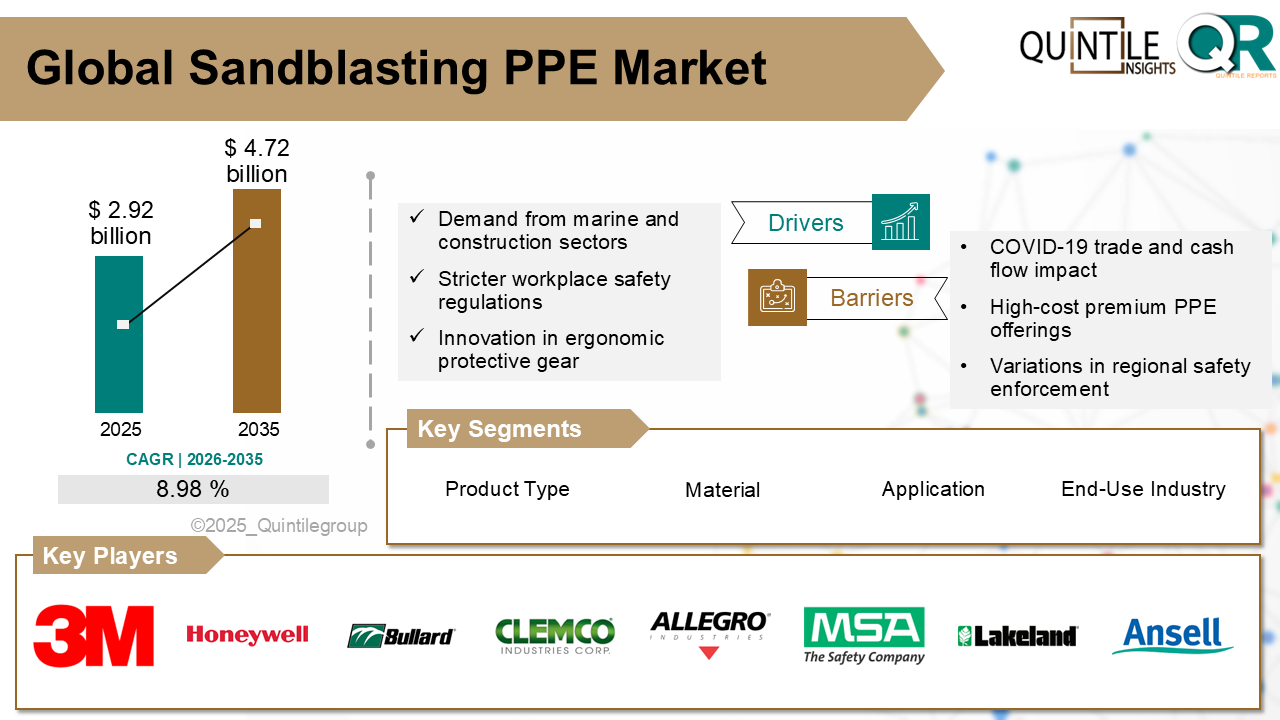
This market serves sectors such as construction, automotive, marine, oil & gas, and mining, where regulatory standards (e.g., OSHA, NIOSH, EU-OSHA) enforce stringent safety measures. Key trends include advances in lightweight, breathable fabrics (like Kevlar/Nomex), integration of smart sensors for environmental monitoring, and enhancements such as anti-static, flame-resistant coatings, and anti-fog visuals. The market spans both OEM and aftermarket channels, with strong growth in regions like North America, Europe, and Asia-Pacific.
The growing emphasis on workplace safety and strict regulatory enforcement is a primary market driver. Agencies like OSHA, NIOSH, and EU-OSHA enforce rigorous safety standards for sandblasting operations, mandating items like respirators and protective suits, which significantly boosts PPE demand.
Expanding applications in construction, mining, oil & gas, and marine industries are fueling PPE requirements. These sectors rely heavily on sandblasting for surface preparation and maintenance, driving demand for comprehensive PPE kits across gloves, suits, respirators, and hearing protection gear.
The health hazards of silica dust and airborne particles are intensifying PPE adoption. Exposure to respirable crystalline silica and abrasive debris leads to severe respiratory conditions, necessitating respirators, full-face shields, and supplied-air systems to safeguard worker health.
Technological advancements in PPE design, materials, and functionality are enhancing safety and compliance. Innovations include lightweight, ergonomic respirators (like PAPRs), flame-resistant suits, polycarbonate face shields with anti-fog coatings, and hearing protection systems, all improving user comfort and effectiveness.
The trend toward automation and industry-wide sustainability standards is also supportive. Growing automation in sandblasting reduces direct exposure but still necessitates PPE during maintenance or manual operations; meanwhile, eco-conscious companies are seeking gear made from recyclable materials and designed to minimize environmental impact.
The high cost of premium PPE and accessories is a significant barrier in the sandblasting PPE market. While advanced protective suits made from materials like Kevlar and Nomex, as well as specialized blast hoods, respirators, and hearing protection are essential, their high prices often deter smaller shops and budget-sensitive operations.
Strict health and safety regulations, particularly around silica exposure, dust control, and respiratory protection drive demand for specialized equipment but also raise expenses. Compliance with OSHA, NIOSH, and equivalent standards means businesses must invest in supplied-air respirators, particulate filters, and maintenance protocols, which can strain smaller outfits budgets and resources.
Supply chain volatility and raw material variability further restrain the market. Prices and availability of materials like specialty fabrics, filters, and electronic sensors can swing due to global resin fluctuations, logistics logjams, or chip shortages, pushing manufacturers to raise PPE prices or face stock-outs.
The technical complexity of PPE selection and usage, and lack of user compliance or training hinder effectiveness. Proper gear such as blast hoods with suitable Assigned Protection Factors (APF), hearing protection, gloves, and suits requires knowledgeable fit-testing and usage protocols. Without training, even basic rules (e.g., that dust masks arent enough) are often overlooked, reducing protection and deterring adoption.
North America shows strong demand for sandblasting PPE due to mature industrial sectors such as construction, automotive, oil & gas, and marine and stringent workplace-safety regulations set by agencies like OSHA and NIOSH. The emphasis on protecting workers from silica dust and abrasive particles drives widespread use of full-face respirators, hearing protection, suits, gloves, and boots. High uptake of advanced designs with ergonomic and lightweight materials underscores a mature safety culture supported by direct sales and industrial distribution.
Europe maintains a mature and safety-conscious sandblasting PPE market, underpinned by strong EU-level and national regulations on workplace safety. Countries like Germany, France, and the UK are investing in eco-friendly and sustainable PPE such as suits made from recycled fabrics and promoting advanced respirators and hearing protection. OEMs and distributors are frequently incorporating sustainability and high-performance emphasis into their product offerings.
Asia-Pacific is the fastest-growing region for sandblasting PPE, driven by rapid industrialization, infrastructure growth, and increasing regulatory awareness in countries like China, India, and Japan. The rise of construction, manufacturing, and mining sectors has heightened demand for comprehensive PPE kits. However, varied enforcement standards create opportunities for premium international brands that meet global compliance while local manufacturers bolster affordability for broader adoption.
Latin Americas PPE market is developing steadily, anchored by growth in mining, construction, and oil & gas industries especially in Brazil, Mexico, and Argentina. With evolving infrastructure regulations, demand for respirators, hearing protection, and protective clothing is increasing. Although local suppliers offer cost-effective solutions, compliance with international safety standards remains a key concern.
The Middle East & Africa region is emerging as a significant market for sandblasting PPE, propelled by the oil & gas and construction boom in Gulf countries, stringent safety needs on industrial sites, and donor-supported safety programs in Sub-Saharan Africa. High demand for heavy-duty respirators, suits, and hearing protection is notable in Saudi Arabia, UAE, and South Africa. Meanwhile, awareness and infrastructure gaps still limit adoption in other parts of Africa.
The enforcement of OSHAs Respirable Crystalline Silica Standard (effective 2016) has been a major catalyst driving demand for specialized PPE in sandblasting operations. This regulation limits silica dust exposure to 50 g/m over an 8-hour shift, compelling employers in industries like construction, marine, and infrastructure maintenance to use engineering controls such as wet methods and local exhaust ventilation and, when necessary, provide high-grade respirators and protective clothing to ensure compliance.
OSHA estimates that around 2 million U.S. workers in over 600,000 workplaces are exposed to silica dust, with more than 840,000 exceeding the permissible limit. To comply, companies are adopting full-face helmets, powered air-purifying respirators (PAPRs), abrasion-resistant suits, gloves, and hearing protection especially in sandblasting applications. These PPE products not only protect workers from silicosis, lung cancer, and other respiratory diseases, but also support legally required exposure-control and medical surveillance programs.
Under the European Unions 2017 amendment to REACH (Directive 2017/2398), respirable crystalline silica is now classified as a Substance of Very High Concern (SVHC), and its use in abrasive blasting is banned in Germany since January 2020. This regulation prohibits silica sand in sandblasting operations, compelling industries from automotive to construction to switch to alternative media like garnet or aluminium oxide.
These substitutes significantly reduce airborne silica dust but still require comprehensive PPE usage including P3-rated respirators, full-face shields, and protective clothing under EU and German workplace safety laws. The regulatory shift has heightened safety protocols around sandblasting, making PPE a critical component of compliance.
Japans Ministry of Health, Labour and Welfare (MHLW), under the Industrial Safety and Health Act, enforces a tight occupational exposure limit (OEL) for respirable crystalline silica at just 0.03 mg/m, one of the worlds strictest standards. This low exposure threshold compels industries using sandblasting such as shipbuilding, automotive, and construction to implement robust dust-control measures and provide high-grade PPE.
Companies are also investing in ergonomic, lightweight PPE designed for long-duration wear without compromising safety. Advanced features like air quality sensors and temperature control liners are gaining popularity in shipyards and metal-treatment facilities.
The Sandblasting PPE market is highly competitive and innovation-driven, with brands focusing on advanced materials, ergonomic design, and integrated safety features. Leading players RPB Safety, Honeywell, 3M, Lakeland, and others are launching lightweight respirators, airflow-engineered helmets, flame-resistant suits, and high-filtration systems to improve comfort and protection during abrasive blasting.
This innovation focus enables competition through R&D strength, regulatory compliance, and go-to-market agility. Firms are investing in ergonomic improvements, supplier partnerships, and compliance with regional safety standards (e.g., OSHA, ANSI, EN). Customizable systems tailored for sectors like marine, construction, and oil & gas are being offered to meet specific regulatory and operational requirements.
Price competitiveness remains crucial, especially in emerging markets where industrial activity is rising. While global brands benefit from scale economies, mid-tier and regional firms offer cost-effective alternatives.
Key players in the market are 3M Company, Honeywell International Inc., RPB Safety LLC, Bullard, Clemco Industries Corp., Allegro Industries, MSA Safety Inc., Lakeland Industries Inc., Ansell Ltd., Delta Plus Group, DuPont, TST Sweden AB, Uvex Safety Group, Kappler Inc., and Kimberly-Clark Corporation.
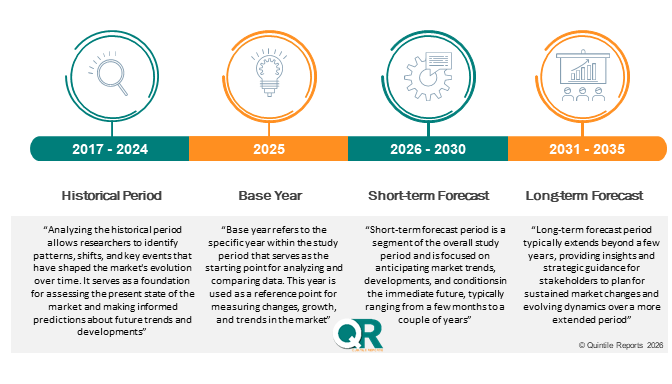
Our team of experienced researchers has meticulously gathered and analyzed data to deliver a thorough examination of market dynamics, competitive landscape, and emerging technologies. With a focus on delivering actionable intelligence, this report aims to empower decision-makers with the information needed to make informed choices and stay ahead of the competition. Whether you are a seasoned industry player or a new entrant, our market research report serves as a strategic tool to navigate the complexities of the market, aiding in successful business planning and growth strategies.
This chapter of our Sandblasting PPE market report provides an in-depth examination of the factors shaping the industry landscape. This section typically encompasses several key elements to offer a comprehensive understanding of the industry landscape such as market drivers & restraints analysis, market opportunities & trend analysis, market size & growth analysis, competitive analysis, SWOT analysis, business environment tools such as Porter's five forces & PESTEL analysis, Ansoff Matrix analysis, penetration & growth prospect analysis, regulatory framework & reimbursement scenario analysis, impact of macro & micro economic factors analysis such as Covid-19 impact, GDP growth, market inflation, U.S.- China trade war, Russia-Ukraine war impact, and supply chain analysis.
The segment analysis chapter of Sandblasting PPE market report is a critical section that delves into a detailed examination of the market's various segments. Segmentation involves dividing the market into distinct categories based on certain criteria to better understand and address the diverse needs of consumers. This chapter typically follows the introduction and provides a more granular view of the market, offering valuable insights for businesses and stakeholders. The components of the chapter lude segment definitions to understand the inclusions and exclusions of the study, assumptions, market size estimates and growth trend analysis of each segment, qualitative analysis of the segment, technological advancements, market penetration rate, market adoption rate, market share examination by each segment, segment growth drivers and restraint barriers, consumer behaviour and challenge analysis.
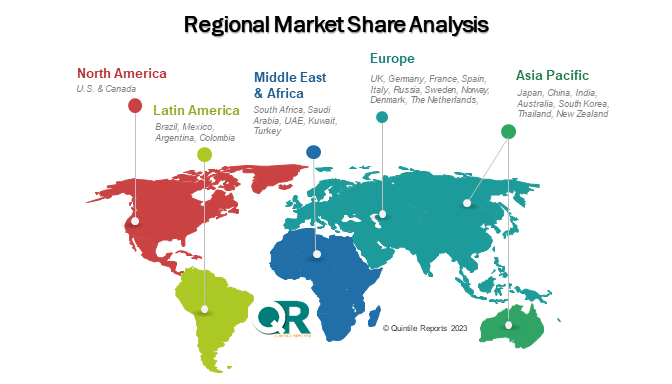
The chapter in Sandblasting PPE market research report is a pivotal section that examines and predicts the market dynamics and trends specific to different geographical regions. This chapter is crucial for businesses and stakeholders seeking a comprehensive understanding of how the market behaves across various locations, enabling them to tailor strategies and make informed decisions based on regional variations. The regional analysis chapter of our Sandblasting PPE market report is classified into regions & country-level. The chapter consists of North America (U.S., Canada), Europe (UK, Germany, France, Italy, Spain, Russia, Sweden, Denmark, Norway, Rest of Europe), Asia Pacific (Japan, China, India, Australia, South Korea, Thailand, Rest of Asia Pacific), Latin America (Brazil, Mexico, Argentina, Colombia, Rest of Latin America), Middle East & Africa (South Africa, Saudi Arabia, UAE, Kuwait, Rest of Middle East & Africa).
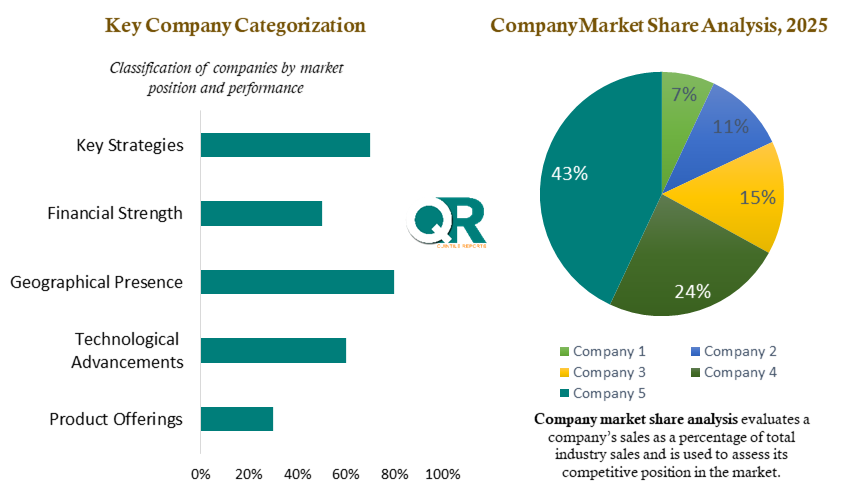
This section of a Sandblasting PPE market report is a crucial segment that provides a comprehensive overview of the competitive landscape within the market. This section is vital for businesses, investors, and stakeholders seeking insights into key players, their market positioning, strengths, weaknesses, strategies, and potential impacts on the overall market dynamics. The chapter includes research methodology used to analyse the market competition, list of key players operating in the market, detailed company profile section which includes company overview, business verticals, financial performance, product/services benchmarking, geographical presence, and strategic initiatives.
| Report Scope | Details |
| Report Version | 2026 |
| Growth Rate | CAGR of 8.98 from 2026 to 2035 |
| Base Year | 2025 |
| Actual Estimates / Historical Data | 2017 - 2024 |
| Forecast Period | 2026 - 2035 |
| Quantitative Units | Revenue in USD million/billion & CAGR from 2026 to 2035 |
| Country Scope | North America (U.S., Canada), Europe (UK, Germany, France, Italy, Spain, Russia, Sweden, Denmark, Norway, Rest of Europe), Asia Pacific (Japan, China, India, Australia, South Korea, Thailand, Rest of Asia Pacific), Latin America (Brazil, Mexico, Argentina, Colombia, Rest of Latin America), Middle East & Africa (South Africa, Saudi Arabia, UAE, Kuwait, Rest of Middle East & Africa). |
| The Segment Covered by Product Type |
|
| The Segment Covered by Material |
|
| Companies Covered |
|
| Report Coverage | Revenue forecast, company share, competitive landscape, growth factors, and trends |
| Free Customization Scope (Equivalent to 5 Analyst Working Days) | If you need specific information, which is not currently within the scope of the report, we will provide it to you as a part of the customization |

Statistics for the 2025 Sandblasting PPE market share, size, and revenue growth rate were created by Quintile Report™. Sandblasting PPE analysis includes a market forecast outlook for 2035 and a historical overview. Get a free PDF sample of this market analysis, please get in touch with our principal analyst at sales@quintilereports.com
List of Tables
Table 1 List of Abbreviation and acronyms
Table 2 List of Sources
Table 3 North America Global Sandblasting PPE Market, by Segment Analysis, (USD Million) 2017-2035
Table 4 North America Global Sandblasting PPE Market, by Region, (USD Million) 2017-2035
Table 5 U.S. Global Sandblasting PPE Market, by Segment Analysis, (USD Million) 2017-2035
Table 6 Canada Global Sandblasting PPE Market, by Segment Analysis, (USD Million) 2017-2035
Table 7 Europe Global Sandblasting PPE Market, by Segment Analysis, (USD Million) 2017-2035
Table 8 Europe Global Sandblasting PPE Market, by Region, (USD Million) 2017-2035
Table 9 Germany Global Sandblasting PPE Market, by Segment Analysis, (USD Million) 2017-2035
Table 10 U.K. Global Sandblasting PPE Market, by Segment Analysis, (USD Million) 2017-2035
Table 11 France Global Sandblasting PPE Market, by Segment Analysis, (USD Million) 2017-2035
Table 12 Italy Global Sandblasting PPE Market, by Segment Analysis, (USD Million) 2017-2035
Table 13 Spain Global Sandblasting PPE Market, by Segment Analysis, (USD Million) 2017-2035
Table 14 Sweden Global Sandblasting PPE Market, by Segment Analysis, (USD Million) 2017-2035
Table 15 Denmark Global Sandblasting PPE Market, by Segment Analysis, (USD Million) 2017-2035
Table 16 Norway Global Sandblasting PPE Market, by Segment Analysis, (USD Million) 2017-2035
Table 17 The Netherlands Global Sandblasting PPE Market, by Segment Analysis, (USD Million) 2017-2035
Table 18 Russia Global Sandblasting PPE Market, by Segment Analysis, (USD Million) 2017-2035
Table 19 Asia Pacific Global Sandblasting PPE Market, by Segment Analysis, (USD Million) 2017-2035
Table 20 Asia Pacific Global Sandblasting PPE Market, by Region, (USD Million) 2017-2035
Table 21 China Global Sandblasting PPE Market, by Segment Analysis, (USD Million) 2017-2035
Table 22 Japan Global Sandblasting PPE Market, by Segment Analysis, (USD Million) 2017-2035
Table 23 India Global Sandblasting PPE Market, by Segment Analysis, (USD Million) 2017-2035
Table 24 Australia Global Sandblasting PPE Market, by Segment Analysis, (USD Million) 2017-2035
Table 25 South Korea Global Sandblasting PPE Market, by Segment Analysis, (USD Million) 2017-2035
Table 26 Thailand Global Sandblasting PPE Market, by Segment Analysis, (USD Million) 2017-2035
Table 27 Latin America Global Sandblasting PPE Market, by Segment Analysis, (USD Million) 2017-2035
Table 28 Latin America Global Sandblasting PPE Market, by Region, (USD Million) 2017-2035
Table 29 Brazil Global Sandblasting PPE Market, by Segment Analysis, (USD Million) 2017-2035
Table 30 Mexico Global Sandblasting PPE Market, by Segment Analysis, (USD Million) 2017-2035
Table 31 Argentina Global Sandblasting PPE Market, by Segment Analysis, (USD Million) 2017-2035
Table 32 Middle East and Africa Global Sandblasting PPE Market, by Segment Analysis, (USD Million) 2017-2035
Table 33 Middle East and Africa Global Sandblasting PPE Market, by Region, (USD Million) 2017-2035
Table 34 South Africa Global Sandblasting PPE Market, by Segment Analysis, (USD Million) 2017-2035
Table 35 Saudi Arabia Global Sandblasting PPE Market, by Segment Analysis, (USD Million) 2017-2035
Table 36 UAE Global Sandblasting PPE Market, by Segment Analysis, (USD Million) 2017-2035
Table 37 Kuwait Global Sandblasting PPE Market, by Segment Analysis, (USD Million) 2017-2035
Table 38 Turkey Global Sandblasting PPE Market, by Segment Analysis, (USD Million) 2017-2035
Fig.1 Market research process
Fig.2 Market research approaches
Fig.3 Global Sandblasting PPE Market: market scenario
Fig.4 Global Sandblasting PPE Market competitive outlook
Fig.5 Global Sandblasting PPE Market driver analysis
Fig.6 Global Sandblasting PPE Market restraint analysis
Fig.7 Global Sandblasting PPE Market opportunity analysis
Fig.8 Global Sandblasting PPE Market trends analysis
Fig.9 Global Sandblasting PPE Market: Segment Analysis (Based on the scope)
Fig.10 Global Sandblasting PPE Market: regional analysis
Fig.11 Global market shares and leading market players
Fig.12 North America market share and leading players
Fig.13 Europe market share and leading players
Fig.14 Asia Pacific market share and leading players
Fig.15 Latin America market share and leading players
Fig.16 Middle East & Africa market share and leading players
Fig.17 North America, by country
Fig.18 North America
Fig.19 North America market estimates and forecast, 2017-2035
Fig.20 U.S.
Fig.21 Canada
Fig.22 Europe
Fig.23 Europe market estimates and forecast, 2017-2035
Fig.24 U.K.
Fig.25 Germany
Fig.26 France
Fig.27 Italy
Fig.28 Spain
Fig.29 Sweden
Fig.30 Denmark
Fig.31 Norway
Fig.32 The Netherlands
Fig.33 Russia
Fig.34 Asia Pacific
Fig.35 Asia Pacific market estimates and forecast, 2017-2035
Fig.36 China
Fig.37 Japan
Fig.38 India
Fig.39 Australia
Fig.40 South Korea
Fig.41 Thailand
Fig.42 Latin America
Fig.43 Latin America market estimates and forecast, 2017-2035
Fig.44 Brazil
Fig.45 Mexico
Fig.46 Argentina
Fig.47 Colombia
Fig.48 Middle East and Africa
Fig.49 Middle East and Africa market estimates and forecast, 2017-2035
Fig.50 Saudi Arabia
Fig.51 South Africa
Fig.52 UAE
Fig.53 Kuwait
Fig.54 Turkey
The Global Sandblasting PPE Market was valued at USD 2.92 billion in 2025 and is anticipated to reach USD 4.72 billion by 2035, growing at a robust CAGR of 8.98% during the forecast period from 2026 to 2035. The Sandblasting PPE market report presents a comprehensive overview of the industry by assessing macroeconomic conditions, emerging technologies, regulatory frameworks, and shifting consumer behavior to provide a clear outlook on future market expansion.
The sandblasting PPE market covers the global industry that manufactures and distributes personal protective equipment specifically designed for abrasive blasting operations. This includes respirators (supplied-air and powered-air purifying), full-face blast helmets, abrasion-resistant suits, gloves, boots, hearing protection, and face shields all tailored to protect against hazards like silica dust, flying debris, high noise levels, and skin abrasion common in sandblasting environments.
With 2025 serving as the base year, the Sandblasting PPE market is experiencing stable growth supported by rising demand across key end-use industries and continuous technological innovation. Companies operating in the market are enhancing their go-to-market (GTM) strategies to capture emerging opportunities and navigate evolving competitive dynamics effectively.
By 2035, the market is expected to demonstrate strong growth potential, driven by sustained investments in innovation, increasing strategic partnerships, and growing merger and acquisition activities. Organizations that prioritize customer-centric solutions, innovation, and agile GTM execution are likely to strengthen their market presence and achieve long-term success. The report provides detailed insights into major market drivers, restraints, opportunities, and challenges across segments, regions, and countries, supported by extensive qualitative and quantitative analysis from 2017 to 2035.
This market serves sectors such as construction, automotive, marine, oil & gas, and mining, where regulatory standards (e.g., OSHA, NIOSH, EU-OSHA) enforce stringent safety measures. Key trends include advances in lightweight, breathable fabrics (like Kevlar/Nomex), integration of smart sensors for environmental monitoring, and enhancements such as anti-static, flame-resistant coatings, and anti-fog visuals. The market spans both OEM and aftermarket channels, with strong growth in regions like North America, Europe, and Asia-Pacific.
The growing emphasis on workplace safety and strict regulatory enforcement is a primary market driver. Agencies like OSHA, NIOSH, and EU-OSHA enforce rigorous safety standards for sandblasting operations, mandating items like respirators and protective suits, which significantly boosts PPE demand.
Expanding applications in construction, mining, oil & gas, and marine industries are fueling PPE requirements. These sectors rely heavily on sandblasting for surface preparation and maintenance, driving demand for comprehensive PPE kits across gloves, suits, respirators, and hearing protection gear.
The health hazards of silica dust and airborne particles are intensifying PPE adoption. Exposure to respirable crystalline silica and abrasive debris leads to severe respiratory conditions, necessitating respirators, full-face shields, and supplied-air systems to safeguard worker health.
Technological advancements in PPE design, materials, and functionality are enhancing safety and compliance. Innovations include lightweight, ergonomic respirators (like PAPRs), flame-resistant suits, polycarbonate face shields with anti-fog coatings, and hearing protection systems, all improving user comfort and effectiveness.
The trend toward automation and industry-wide sustainability standards is also supportive. Growing automation in sandblasting reduces direct exposure but still necessitates PPE during maintenance or manual operations; meanwhile, eco-conscious companies are seeking gear made from recyclable materials and designed to minimize environmental impact.
The high cost of premium PPE and accessories is a significant barrier in the sandblasting PPE market. While advanced protective suits made from materials like Kevlar and Nomex, as well as specialized blast hoods, respirators, and hearing protection are essential, their high prices often deter smaller shops and budget-sensitive operations.
Strict health and safety regulations, particularly around silica exposure, dust control, and respiratory protection drive demand for specialized equipment but also raise expenses. Compliance with OSHA, NIOSH, and equivalent standards means businesses must invest in supplied-air respirators, particulate filters, and maintenance protocols, which can strain smaller outfits budgets and resources.
Supply chain volatility and raw material variability further restrain the market. Prices and availability of materials like specialty fabrics, filters, and electronic sensors can swing due to global resin fluctuations, logistics logjams, or chip shortages, pushing manufacturers to raise PPE prices or face stock-outs.
The technical complexity of PPE selection and usage, and lack of user compliance or training hinder effectiveness. Proper gear such as blast hoods with suitable Assigned Protection Factors (APF), hearing protection, gloves, and suits requires knowledgeable fit-testing and usage protocols. Without training, even basic rules (e.g., that dust masks arent enough) are often overlooked, reducing protection and deterring adoption.
North America shows strong demand for sandblasting PPE due to mature industrial sectors such as construction, automotive, oil & gas, and marine and stringent workplace-safety regulations set by agencies like OSHA and NIOSH. The emphasis on protecting workers from silica dust and abrasive particles drives widespread use of full-face respirators, hearing protection, suits, gloves, and boots. High uptake of advanced designs with ergonomic and lightweight materials underscores a mature safety culture supported by direct sales and industrial distribution.
Europe maintains a mature and safety-conscious sandblasting PPE market, underpinned by strong EU-level and national regulations on workplace safety. Countries like Germany, France, and the UK are investing in eco-friendly and sustainable PPE such as suits made from recycled fabrics and promoting advanced respirators and hearing protection. OEMs and distributors are frequently incorporating sustainability and high-performance emphasis into their product offerings.
Asia-Pacific is the fastest-growing region for sandblasting PPE, driven by rapid industrialization, infrastructure growth, and increasing regulatory awareness in countries like China, India, and Japan. The rise of construction, manufacturing, and mining sectors has heightened demand for comprehensive PPE kits. However, varied enforcement standards create opportunities for premium international brands that meet global compliance while local manufacturers bolster affordability for broader adoption.
Latin Americas PPE market is developing steadily, anchored by growth in mining, construction, and oil & gas industries especially in Brazil, Mexico, and Argentina. With evolving infrastructure regulations, demand for respirators, hearing protection, and protective clothing is increasing. Although local suppliers offer cost-effective solutions, compliance with international safety standards remains a key concern.
The Middle East & Africa region is emerging as a significant market for sandblasting PPE, propelled by the oil & gas and construction boom in Gulf countries, stringent safety needs on industrial sites, and donor-supported safety programs in Sub-Saharan Africa. High demand for heavy-duty respirators, suits, and hearing protection is notable in Saudi Arabia, UAE, and South Africa. Meanwhile, awareness and infrastructure gaps still limit adoption in other parts of Africa.
The enforcement of OSHAs Respirable Crystalline Silica Standard (effective 2016) has been a major catalyst driving demand for specialized PPE in sandblasting operations. This regulation limits silica dust exposure to 50 g/m over an 8-hour shift, compelling employers in industries like construction, marine, and infrastructure maintenance to use engineering controls such as wet methods and local exhaust ventilation and, when necessary, provide high-grade respirators and protective clothing to ensure compliance.
OSHA estimates that around 2 million U.S. workers in over 600,000 workplaces are exposed to silica dust, with more than 840,000 exceeding the permissible limit. To comply, companies are adopting full-face helmets, powered air-purifying respirators (PAPRs), abrasion-resistant suits, gloves, and hearing protection especially in sandblasting applications. These PPE products not only protect workers from silicosis, lung cancer, and other respiratory diseases, but also support legally required exposure-control and medical surveillance programs.
Under the European Unions 2017 amendment to REACH (Directive 2017/2398), respirable crystalline silica is now classified as a Substance of Very High Concern (SVHC), and its use in abrasive blasting is banned in Germany since January 2020. This regulation prohibits silica sand in sandblasting operations, compelling industries from automotive to construction to switch to alternative media like garnet or aluminium oxide.
These substitutes significantly reduce airborne silica dust but still require comprehensive PPE usage including P3-rated respirators, full-face shields, and protective clothing under EU and German workplace safety laws. The regulatory shift has heightened safety protocols around sandblasting, making PPE a critical component of compliance.
Japans Ministry of Health, Labour and Welfare (MHLW), under the Industrial Safety and Health Act, enforces a tight occupational exposure limit (OEL) for respirable crystalline silica at just 0.03 mg/m, one of the worlds strictest standards. This low exposure threshold compels industries using sandblasting such as shipbuilding, automotive, and construction to implement robust dust-control measures and provide high-grade PPE.
Companies are also investing in ergonomic, lightweight PPE designed for long-duration wear without compromising safety. Advanced features like air quality sensors and temperature control liners are gaining popularity in shipyards and metal-treatment facilities.
The Sandblasting PPE market is highly competitive and innovation-driven, with brands focusing on advanced materials, ergonomic design, and integrated safety features. Leading players RPB Safety, Honeywell, 3M, Lakeland, and others are launching lightweight respirators, airflow-engineered helmets, flame-resistant suits, and high-filtration systems to improve comfort and protection during abrasive blasting.
This innovation focus enables competition through R&D strength, regulatory compliance, and go-to-market agility. Firms are investing in ergonomic improvements, supplier partnerships, and compliance with regional safety standards (e.g., OSHA, ANSI, EN). Customizable systems tailored for sectors like marine, construction, and oil & gas are being offered to meet specific regulatory and operational requirements.
Price competitiveness remains crucial, especially in emerging markets where industrial activity is rising. While global brands benefit from scale economies, mid-tier and regional firms offer cost-effective alternatives.
Key players in the market are 3M Company, Honeywell International Inc., RPB Safety LLC, Bullard, Clemco Industries Corp., Allegro Industries, MSA Safety Inc., Lakeland Industries Inc., Ansell Ltd., Delta Plus Group, DuPont, TST Sweden AB, Uvex Safety Group, Kappler Inc., and Kimberly-Clark Corporation.
Our team of experienced researchers has meticulously gathered and analyzed data to deliver a thorough examination of market dynamics, competitive landscape, and emerging technologies. With a focus on delivering actionable intelligence, this report aims to empower decision-makers with the information needed to make informed choices and stay ahead of the competition. Whether you are a seasoned industry player or a new entrant, our market research report serves as a strategic tool to navigate the complexities of the market, aiding in successful business planning and growth strategies.
This chapter of our Sandblasting PPE market report provides an in-depth examination of the factors shaping the industry landscape. This section typically encompasses several key elements to offer a comprehensive understanding of the industry landscape such as market drivers & restraints analysis, market opportunities & trend analysis, market size & growth analysis, competitive analysis, SWOT analysis, business environment tools such as Porter's five forces & PESTEL analysis, Ansoff Matrix analysis, penetration & growth prospect analysis, regulatory framework & reimbursement scenario analysis, impact of macro & micro economic factors analysis such as Covid-19 impact, GDP growth, market inflation, U.S.- China trade war, Russia-Ukraine war impact, and supply chain analysis.
The segment analysis chapter of Sandblasting PPE market report is a critical section that delves into a detailed examination of the market's various segments. Segmentation involves dividing the market into distinct categories based on certain criteria to better understand and address the diverse needs of consumers. This chapter typically follows the introduction and provides a more granular view of the market, offering valuable insights for businesses and stakeholders. The components of the chapter lude segment definitions to understand the inclusions and exclusions of the study, assumptions, market size estimates and growth trend analysis of each segment, qualitative analysis of the segment, technological advancements, market penetration rate, market adoption rate, market share examination by each segment, segment growth drivers and restraint barriers, consumer behaviour and challenge analysis.
The chapter in Sandblasting PPE market research report is a pivotal section that examines and predicts the market dynamics and trends specific to different geographical regions. This chapter is crucial for businesses and stakeholders seeking a comprehensive understanding of how the market behaves across various locations, enabling them to tailor strategies and make informed decisions based on regional variations. The regional analysis chapter of our Sandblasting PPE market report is classified into regions & country-level. The chapter consists of North America (U.S., Canada), Europe (UK, Germany, France, Italy, Spain, Russia, Sweden, Denmark, Norway, Rest of Europe), Asia Pacific (Japan, China, India, Australia, South Korea, Thailand, Rest of Asia Pacific), Latin America (Brazil, Mexico, Argentina, Colombia, Rest of Latin America), Middle East & Africa (South Africa, Saudi Arabia, UAE, Kuwait, Rest of Middle East & Africa).
This section of a Sandblasting PPE market report is a crucial segment that provides a comprehensive overview of the competitive landscape within the market. This section is vital for businesses, investors, and stakeholders seeking insights into key players, their market positioning, strengths, weaknesses, strategies, and potential impacts on the overall market dynamics. The chapter includes research methodology used to analyse the market competition, list of key players operating in the market, detailed company profile section which includes company overview, business verticals, financial performance, product/services benchmarking, geographical presence, and strategic initiatives.
| Report Scope | Details |
| Report Version | 2026 |
| Growth Rate | CAGR of 8.98 from 2026 to 2035 |
| Base Year | 2025 |
| Actual Estimates / Historical Data | 2017 - 2024 |
| Forecast Period | 2026 - 2035 |
| Quantitative Units | Revenue in USD million/billion & CAGR from 2026 to 2035 |
| Country Scope | North America (U.S., Canada), Europe (UK, Germany, France, Italy, Spain, Russia, Sweden, Denmark, Norway, Rest of Europe), Asia Pacific (Japan, China, India, Australia, South Korea, Thailand, Rest of Asia Pacific), Latin America (Brazil, Mexico, Argentina, Colombia, Rest of Latin America), Middle East & Africa (South Africa, Saudi Arabia, UAE, Kuwait, Rest of Middle East & Africa). |
| The Segment Covered by Product Type |
|
| The Segment Covered by Material |
|
| Companies Covered |
|
| Report Coverage | Revenue forecast, company share, competitive landscape, growth factors, and trends |
| Free Customization Scope (Equivalent to 5 Analyst Working Days) | If you need specific information, which is not currently within the scope of the report, we will provide it to you as a part of the customization |
Statistics for the 2025 Sandblasting PPE market share, size, and revenue growth rate were created by Quintile Report™. Sandblasting PPE analysis includes a market forecast outlook for 2035 and a historical overview. Get a free PDF sample of this market analysis, please get in touch with our principal analyst at sales@quintilereports.com
Table 1 List of Abbreviation and acronyms
Table 2 List of Sources
Table 3 North America Global Sandblasting PPE Market, by Segment Analysis, (USD Million) 2017-2035
Table 4 North America Global Sandblasting PPE Market, by Region, (USD Million) 2017-2035
Table 5 U.S. Global Sandblasting PPE Market, by Segment Analysis, (USD Million) 2017-2035
Table 6 Canada Global Sandblasting PPE Market, by Segment Analysis, (USD Million) 2017-2035
Table 7 Europe Global Sandblasting PPE Market, by Segment Analysis, (USD Million) 2017-2035
Table 8 Europe Global Sandblasting PPE Market, by Region, (USD Million) 2017-2035
Table 9 Germany Global Sandblasting PPE Market, by Segment Analysis, (USD Million) 2017-2035
Table 10 U.K. Global Sandblasting PPE Market, by Segment Analysis, (USD Million) 2017-2035
Table 11 France Global Sandblasting PPE Market, by Segment Analysis, (USD Million) 2017-2035
Table 12 Italy Global Sandblasting PPE Market, by Segment Analysis, (USD Million) 2017-2035
Table 13 Spain Global Sandblasting PPE Market, by Segment Analysis, (USD Million) 2017-2035
Table 14 Sweden Global Sandblasting PPE Market, by Segment Analysis, (USD Million) 2017-2035
Table 15 Denmark Global Sandblasting PPE Market, by Segment Analysis, (USD Million) 2017-2035
Table 16 Norway Global Sandblasting PPE Market, by Segment Analysis, (USD Million) 2017-2035
Table 17 The Netherlands Global Sandblasting PPE Market, by Segment Analysis, (USD Million) 2017-2035
Table 18 Russia Global Sandblasting PPE Market, by Segment Analysis, (USD Million) 2017-2035
Table 19 Asia Pacific Global Sandblasting PPE Market, by Segment Analysis, (USD Million) 2017-2035
Table 20 Asia Pacific Global Sandblasting PPE Market, by Region, (USD Million) 2017-2035
Table 21 China Global Sandblasting PPE Market, by Segment Analysis, (USD Million) 2017-2035
Table 22 Japan Global Sandblasting PPE Market, by Segment Analysis, (USD Million) 2017-2035
Table 23 India Global Sandblasting PPE Market, by Segment Analysis, (USD Million) 2017-2035
Table 24 Australia Global Sandblasting PPE Market, by Segment Analysis, (USD Million) 2017-2035
Table 25 South Korea Global Sandblasting PPE Market, by Segment Analysis, (USD Million) 2017-2035
Table 26 Thailand Global Sandblasting PPE Market, by Segment Analysis, (USD Million) 2017-2035
Table 27 Latin America Global Sandblasting PPE Market, by Segment Analysis, (USD Million) 2017-2035
Table 28 Latin America Global Sandblasting PPE Market, by Region, (USD Million) 2017-2035
Table 29 Brazil Global Sandblasting PPE Market, by Segment Analysis, (USD Million) 2017-2035
Table 30 Mexico Global Sandblasting PPE Market, by Segment Analysis, (USD Million) 2017-2035
Table 31 Argentina Global Sandblasting PPE Market, by Segment Analysis, (USD Million) 2017-2035
Table 32 Middle East and Africa Global Sandblasting PPE Market, by Segment Analysis, (USD Million) 2017-2035
Table 33 Middle East and Africa Global Sandblasting PPE Market, by Region, (USD Million) 2017-2035
Table 34 South Africa Global Sandblasting PPE Market, by Segment Analysis, (USD Million) 2017-2035
Table 35 Saudi Arabia Global Sandblasting PPE Market, by Segment Analysis, (USD Million) 2017-2035
Table 36 UAE Global Sandblasting PPE Market, by Segment Analysis, (USD Million) 2017-2035
Table 37 Kuwait Global Sandblasting PPE Market, by Segment Analysis, (USD Million) 2017-2035
Table 38 Turkey Global Sandblasting PPE Market, by Segment Analysis, (USD Million) 2017-2035
Fig.1 Market research process
Fig.2 Market research approaches
Fig.3 Global Sandblasting PPE Market: market scenario
Fig.4 Global Sandblasting PPE Market competitive outlook
Fig.5 Global Sandblasting PPE Market driver analysis
Fig.6 Global Sandblasting PPE Market restraint analysis
Fig.7 Global Sandblasting PPE Market opportunity analysis
Fig.8 Global Sandblasting PPE Market trends analysis
Fig.9 Global Sandblasting PPE Market: Segment Analysis (Based on the scope)
Fig.10 Global Sandblasting PPE Market: regional analysis
Fig.11 Global market shares and leading market players
Fig.12 North America market share and leading players
Fig.13 Europe market share and leading players
Fig.14 Asia Pacific market share and leading players
Fig.15 Latin America market share and leading players
Fig.16 Middle East & Africa market share and leading players
Fig.17 North America, by country
Fig.18 North America
Fig.19 North America market estimates and forecast, 2017-2035
Fig.20 U.S.
Fig.21 Canada
Fig.22 Europe
Fig.23 Europe market estimates and forecast, 2017-2035
Fig.24 U.K.
Fig.25 Germany
Fig.26 France
Fig.27 Italy
Fig.28 Spain
Fig.29 Sweden
Fig.30 Denmark
Fig.31 Norway
Fig.32 The Netherlands
Fig.33 Russia
Fig.34 Asia Pacific
Fig.35 Asia Pacific market estimates and forecast, 2017-2035
Fig.36 China
Fig.37 Japan
Fig.38 India
Fig.39 Australia
Fig.40 South Korea
Fig.41 Thailand
Fig.42 Latin America
Fig.43 Latin America market estimates and forecast, 2017-2035
Fig.44 Brazil
Fig.45 Mexico
Fig.46 Argentina
Fig.47 Colombia
Fig.48 Middle East and Africa
Fig.49 Middle East and Africa market estimates and forecast, 2017-2035
Fig.50 Saudi Arabia
Fig.51 South Africa
Fig.52 UAE
Fig.53 Kuwait
Fig.54 Turkey

A license granted to one user. Rules or conditions might be applied for e.g. the use of electric files (PDFs) or printings, depending on product.
A license granted to multiple users.
A license granted to a single business site/establishment.
A license granted to all employees within organisation access to the product.
Immediate / Within 24-48 hours - Working days
Online Payments with PayPal and CCavenue
You can order a report by picking any of the payment methods which is bank wire or online payment through any Debit/Credit card or PayPal.
Hard Copy
 U.S. : +1-201-772-7734