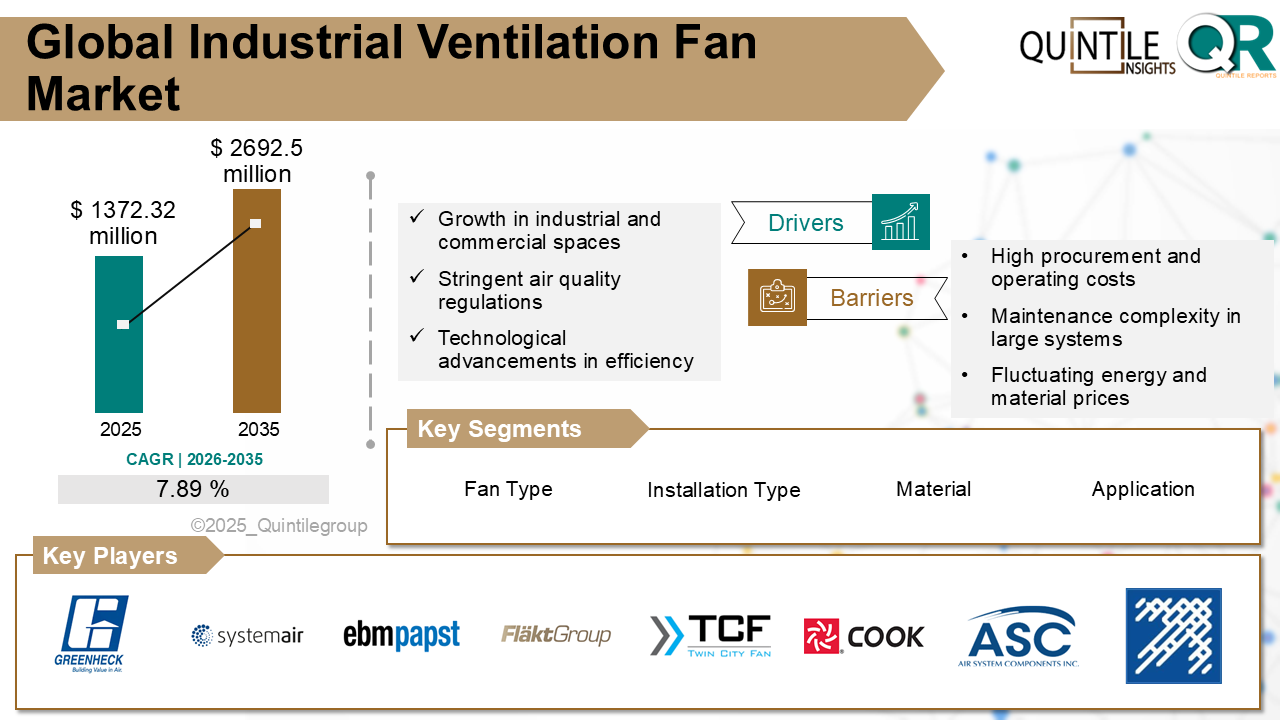
The Global Industrial Ventilation Fan Market was valued at USD 1372.32 million in 2025 and is forecast to reach USD 2692.5 million by 2035, expanding at a healthy CAGR of 7.89% between 2026 and 2035. The Industrial Ventilation Fan market report delivers a strategic overview of the industry by analyzing macroeconomic factors, technological innovations, regulatory developments, and changing consumer preferences to assess future market growth potential.
The industrial ventilation fan market refers to the global industry focused on the production, distribution, and application of specialized fans designed to regulate airflow, remove pollutants, manage temperature, and improve air circulation within industrial facilities. These industrial-grade fansincluding axial, centrifugal, and mixed-flow modelsare engineered to handle high air volumes and pressure levels, supporting air quality management and operational efficiency in industries such as manufacturing, mining, chemicals, automotive, pharmaceuticals, and food and beverage processing.
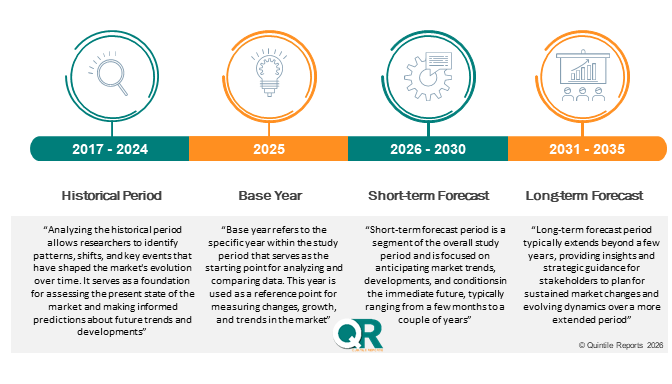
With 2025 considered the base year, the Industrial Ventilation Fan market is witnessing progressive growth driven by continuous product innovation, increasing demand from diverse end-use industries, and advancements in digital technologies. Market stakeholders are actively strengthening their go-to-market (GTM) strategies to unlock new opportunities and enhance their competitive capabilities.
Looking forward to 2035, the market is expected to continue its upward trajectory, supported by growing R&D initiatives, expanding strategic collaborations, and increasing merger and acquisition activities. Companies that invest in innovation, adopt flexible GTM strategies, and align with evolving customer requirements are expected to achieve sustainable market leadership. The report provides detailed insights into the markets drivers, restraints, opportunities, and challenges across segments, regions, and countries, supported by comprehensive qualitative and quantitative analysis from 2017 to 2035.
The market includes both HVAC-integrated ceiling-mounted units and heavy-duty wall or duct-mounted ventilation systems, distributed through original equipment manufacturers (OEMs) and aftermarket channels. Modern industrial ventilation fans are increasingly equipped with energy-efficient motors, IoT-enabled monitoring systems, and compliance certifications such as AMCA, UL, and ATEX. These advanced features enable predictive maintenance, enhanced safety compliance, and optimized energy consumption. Market growth is strongly linked to expanding industrialization, stricter workplace safety regulations, and the transition toward smart, energy-efficient ventilation solutions.
Increasing enforcement of workplace air quality and worker safety regulations represents a major driver for the industrial ventilation fan market. Regulatory authorities such as OSHA, the Environmental Protection Agency (EPA), and European safety agencies require proper ventilation systems to control hazardous gases, dust, and particulate matter in industrial facilities. This regulatory pressure encourages industries to adopt advanced ventilation systems to maintain safe working environments.
Growing emphasis on energy efficiency and environmental sustainability is also boosting demand. Industries are implementing energy-efficient technologies such as electronically commutated (EC) motors, variable frequency drives (VFDs), and intelligent sensor systems to reduce energy consumption while improving operational performance and lowering carbon emissions.
Rapid industrialization and urbanization in emerging economies further accelerate market growth. Expanding manufacturing hubs, construction projects, and infrastructure developmentparticularly in Asia-Pacific, Latin America, and Africacreate strong demand for industrial ventilation systems capable of managing heat, contaminants, and airflow within large facilities.
Technological innovation and digital integration are transforming the ventilation industry. IoT-enabled ventilation systems equipped with real-time monitoring, automated airflow adjustment, predictive maintenance features, and advanced analytics help companies improve efficiency, reduce downtime, and optimize operational performance.
Rising awareness of indoor air quality and workplace comfort also contributes to demand. Companies are increasingly investing in systems that reduce noise levels, maintain thermal comfort, and improve air quality in industrial workplaces, enhancing employee safety and productivity.
High initial purchase and installation costs remain one of the primary barriers in the industrial ventilation fan market. Advanced systems equipped with high-efficiency motors, variable speed drives, and IoT connectivity typically cost significantly more than conventional ventilation units. Maintenance expenses, including servicing, filter replacements, and energy consumption, further add to operational costs.
Technical challenges associated with retrofitting older facilities also limit adoption. Installing modern ventilation systems often requires modifications to ductwork, electrical infrastructure, and integration with building management systems. These retrofits can disrupt operations and increase project costs.
Strict regulatory compliance requirements present additional complexities for both manufacturers and industrial users. Companies must comply with evolving air quality standards, noise regulations, vibration limits, and energy efficiency mandates established by various regulatory bodies. Meeting these requirements often requires continuous equipment upgrades and certification processes.
Volatility in raw material prices and supply chain disruptions also impact the market. Industrial fans rely heavily on materials such as steel, aluminum, copper, and electronic components. Fluctuating material prices and global logistics challenges can increase manufacturing costs and extend production timelines.
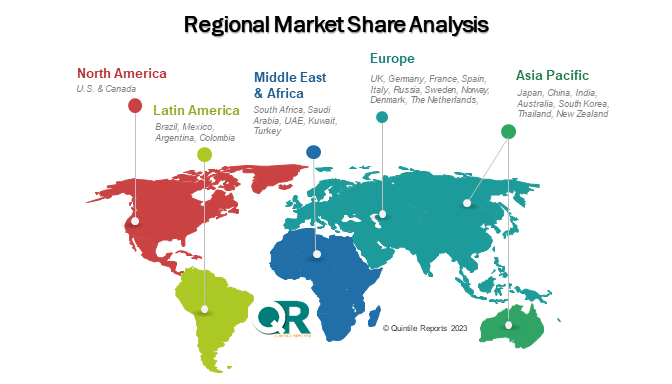
North America represents a significant market for industrial ventilation fans due to its mature industrial infrastructure and strict regulatory environment. Industries such as automotive, aerospace, chemicals, and food processing rely on advanced ventilation systems to maintain compliance with workplace safety and environmental regulations. The adoption of smart ventilation systems with sensor-based monitoring and variable frequency drives is particularly prominent in the United States.
Europe maintains steady growth driven by stringent environmental regulations and industrial modernization initiatives. Countries including Germany, the United Kingdom, France, and Italy are investing in energy-efficient ventilation systems integrated with HVAC infrastructure and cleanroom environments. Government incentives and green building certifications are encouraging adoption of low-noise, energy-efficient fan technologies.
Asia-Pacific is the largest and fastest-growing regional market. Rapid industrialization, expanding manufacturing sectors, and large infrastructure projects across China, India, Japan, and South Korea are driving demand for industrial ventilation systems. Additionally, pollution control regulations and smart manufacturing initiatives are encouraging companies to deploy advanced ventilation technologies.
Latin America is experiencing steady growth as industries upgrade aging facilities and invest in modern ventilation systems. Countries such as Brazil, Mexico, and Argentina are adopting heavy-duty ventilation solutions to support mining, oil and gas, and manufacturing sectors that operate in challenging environmental conditions.
The Middle East and Africa are gradually expanding markets for industrial ventilation fans. Demand is driven by oil and gas operations, petrochemical processing, power generation facilities, and large-scale construction projects. Countries such as Saudi Arabia and the United Arab Emirates are investing in advanced ventilation systems to improve industrial safety and operational efficiency.
In the United States, strict enforcement of indoor air quality regulations by agencies such as OSHA and the Department of Energy is encouraging industries to upgrade their ventilation systems. Manufacturing clusters in sectors such as metalworking, chemical processing, and automotive production are replacing outdated ventilation units with high-efficiency systems equipped with EC motors and advanced airflow controls.
Smart ventilation technologies are becoming increasingly popular, with IoT-enabled fans and variable-frequency drives allowing facilities to monitor airflow and energy usage in real time. These systems can significantly reduce energy consumption while maintaining safe working environments.
Germanys adoption of updated Ecodesign regulations for industrial fans is driving the transition toward more energy-efficient ventilation systems. These regulations require improved efficiency, repairability, and component availability for industrial fans used across manufacturing and commercial facilities.
Industrial operators in Germany are upgrading ventilation systems with variable-speed drives, IoT-enabled monitoring sensors, and modular fan components that support easier maintenance. These improvements help reduce energy consumption while supporting the countrys broader sustainability and energy efficiency objectives.
Japans Energy Conservation Act and its national carbon neutrality goals are encouraging industries to adopt energy-efficient ventilation technologies. Industrial facilities are increasingly installing fans equipped with EC motors, variable frequency drives, and heat recovery systems to improve energy performance.
The rise of smart factories and Industry 5.0 initiatives in cities such as Tokyo, Osaka, and Nagoya is further driving demand for IoT-enabled ventilation systems capable of predictive airflow control and real-time environmental monitoring.
The industrial ventilation fan market is highly competitive and innovation-driven, with manufacturers focusing on energy efficiency, smart connectivity, and advanced materials. Many modern systems incorporate variable frequency drives, smart sensors, and predictive maintenance capabilities that help reduce energy consumption while improving operational reliability.
Leading companies are introducing advanced fan technologies equipped with EC motors, cloud-based monitoring dashboards, and intelligent diagnostics systems. These innovations allow industrial operators to monitor performance metrics such as airflow, vibration, and temperature in real time.
Price competitiveness remains an important factor, particularly in emerging markets where regional manufacturers offer cost-effective ventilation solutions tailored to local industrial requirements. Global manufacturers maintain competitive advantages through large-scale production capabilities and integrated service offerings.
Competition is increasingly shifting toward service ecosystems that combine hardware, smart controls, analytics software, and maintenance services. Retrofit kits that convert older ventilation systems into intelligent units are becoming a key strategy for companies targeting modernization projects in existing facilities.
Key players in the market include Greenheck Fan Corporation, Systemair AB, ebm-papst Group, FlktGroup, Howden Group, Twin City Fan Companies Ltd., Loren Cook Company, Air Systems Components Inc., Cincinnati Fan, Ventmeca, Zhejiang Shangfeng Industrial Holdings Co. Ltd., S&P Sistemas de Ventilacin (Soler & Palau), Johnson Controls, and Nortek Air Solutions.
Our team of experienced researchers has meticulously gathered and analyzed data to deliver a thorough examination of market dynamics, competitive landscape, and emerging technologies. With a focus on delivering actionable intelligence, this report aims to empower decision-makers with the information needed to make informed choices and stay ahead of the competition. Whether you are a seasoned industry player or a new entrant, our market research report serves as a strategic tool to navigate the complexities of the market, aiding in successful business planning and growth strategies.
This chapter of our Industrial Ventilation Fan market report provides an in-depth examination of the factors shaping the industry landscape. This section typically encompasses several key elements to offer a comprehensive understanding of the industry landscape such as market drivers & restraints analysis, market opportunities & trend analysis, market size & growth analysis, competitive analysis, SWOT analysis, business environment tools such as Porter's five forces & PESTEL analysis, Ansoff Matrix analysis, penetration & growth prospect analysis, regulatory framework & reimbursement scenario analysis, impact of macro & micro economic factors analysis such as Covid-19 impact, GDP growth, market inflation, U.S.- China trade war, Russia-Ukraine war impact, and supply chain analysis.
The segment analysis chapter of Industrial Ventilation Fan market report is a critical section that delves into a detailed examination of the market's various segments. Segmentation involves dividing the market into distinct categories based on certain criteria to better understand and address the diverse needs of consumers. This chapter typically follows the introduction and provides a more granular view of the market, offering valuable insights for businesses and stakeholders. The components of the chapter lude segment definitions to understand the inclusions and exclusions of the study, assumptions, market size estimates and growth trend analysis of each segment, qualitative analysis of the segment, technological advancements, market penetration rate, market adoption rate, market share examination by each segment, segment growth drivers and restraint barriers, consumer behaviour and challenge analysis.
The chapter in Industrial Ventilation Fan market research report is a pivotal section that examines and predicts the market dynamics and trends specific to different geographical regions. This chapter is crucial for businesses and stakeholders seeking a comprehensive understanding of how the market behaves across various locations, enabling them to tailor strategies and make informed decisions based on regional variations. The regional analysis chapter of our Industrial Ventilation Fan market report is classified into regions & country-level. The chapter consists of North America (U.S., Canada), Europe (UK, Germany, France, Italy, Spain, Russia, Sweden, Denmark, Norway, Rest of Europe), Asia Pacific (Japan, China, India, Australia, South Korea, Thailand, Rest of Asia Pacific), Latin America (Brazil, Mexico, Argentina, Colombia, Rest of Latin America), Middle East & Africa (South Africa, Saudi Arabia, UAE, Kuwait, Rest of Middle East & Africa).
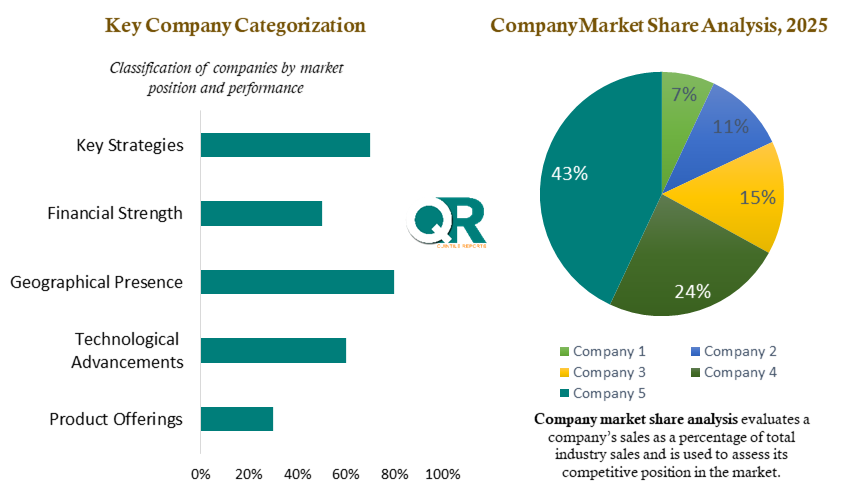
This section of a Industrial Ventilation Fan market report is a crucial segment that provides a comprehensive overview of the competitive landscape within the market. This section is vital for businesses, investors, and stakeholders seeking insights into key players, their market positioning, strengths, weaknesses, strategies, and potential impacts on the overall market dynamics. The chapter includes research methodology used to analyse the market competition, list of key players operating in the market, detailed company profile section which includes company overview, business verticals, financial performance, product/services benchmarking, geographical presence, and strategic initiatives.
| Report Scope | Details |
| Report Version | 2026 |
| Growth Rate | CAGR of 7.89 from 2026 to 2035 |
| Base Year | 2025 |
| Actual Estimates / Historical Data | 2017 - 2024 |
| Forecast Period | 2026 - 2035 |
| Quantitative Units | Revenue in USD million/billion & CAGR from 2026 to 2035 |
| Country Scope | North America (U.S., Canada), Europe (UK, Germany, France, Italy, Spain, Russia, Sweden, Denmark, Norway, Rest of Europe), Asia Pacific (Japan, China, India, Australia, South Korea, Thailand, Rest of Asia Pacific), Latin America (Brazil, Mexico, Argentina, Colombia, Rest of Latin America), Middle East & Africa (South Africa, Saudi Arabia, UAE, Kuwait, Rest of Middle East & Africa). |
| The Segment Covered by Fan Type |
|
| The Segment Covered by Installation Type |
|
| Companies Covered |
|
| Report Coverage | Revenue forecast, company share, competitive landscape, growth factors, and trends |
| Free Customization Scope (Equivalent to 5 Analyst Working Days) | If you need specific information, which is not currently within the scope of the report, we will provide it to you as a part of the customization |

Statistics for the 2025 Industrial Ventilation Fan market share, size, and revenue growth rate were created by Quintile Report™. Industrial Ventilation Fan analysis includes a market forecast outlook for 2035 and a historical overview. Get a free PDF sample of this market analysis, please get in touch with our principal analyst at sales@quintilereports.com
List of Tables
Table 1 List of Abbreviation and acronyms
Table 2 List of Sources
Table 3 North America Global Industrial Ventilation Fan Market, by Segment Analysis, (USD Million) 2017-2035
Table 4 North America Global Industrial Ventilation Fan Market, by Region, (USD Million) 2017-2035
Table 5 U.S. Global Industrial Ventilation Fan Market, by Segment Analysis, (USD Million) 2017-2035
Table 6 Canada Global Industrial Ventilation Fan Market, by Segment Analysis, (USD Million) 2017-2035
Table 7 Europe Global Industrial Ventilation Fan Market, by Segment Analysis, (USD Million) 2017-2035
Table 8 Europe Global Industrial Ventilation Fan Market, by Region, (USD Million) 2017-2035
Table 9 Germany Global Industrial Ventilation Fan Market, by Segment Analysis, (USD Million) 2017-2035
Table 10 U.K. Global Industrial Ventilation Fan Market, by Segment Analysis, (USD Million) 2017-2035
Table 11 France Global Industrial Ventilation Fan Market, by Segment Analysis, (USD Million) 2017-2035
Table 12 Italy Global Industrial Ventilation Fan Market, by Segment Analysis, (USD Million) 2017-2035
Table 13 Spain Global Industrial Ventilation Fan Market, by Segment Analysis, (USD Million) 2017-2035
Table 14 Sweden Global Industrial Ventilation Fan Market, by Segment Analysis, (USD Million) 2017-2035
Table 15 Denmark Global Industrial Ventilation Fan Market, by Segment Analysis, (USD Million) 2017-2035
Table 16 Norway Global Industrial Ventilation Fan Market, by Segment Analysis, (USD Million) 2017-2035
Table 17 The Netherlands Global Industrial Ventilation Fan Market, by Segment Analysis, (USD Million) 2017-2035
Table 18 Russia Global Industrial Ventilation Fan Market, by Segment Analysis, (USD Million) 2017-2035
Table 19 Asia Pacific Global Industrial Ventilation Fan Market, by Segment Analysis, (USD Million) 2017-2035
Table 20 Asia Pacific Global Industrial Ventilation Fan Market, by Region, (USD Million) 2017-2035
Table 21 China Global Industrial Ventilation Fan Market, by Segment Analysis, (USD Million) 2017-2035
Table 22 Japan Global Industrial Ventilation Fan Market, by Segment Analysis, (USD Million) 2017-2035
Table 23 India Global Industrial Ventilation Fan Market, by Segment Analysis, (USD Million) 2017-2035
Table 24 Australia Global Industrial Ventilation Fan Market, by Segment Analysis, (USD Million) 2017-2035
Table 25 South Korea Global Industrial Ventilation Fan Market, by Segment Analysis, (USD Million) 2017-2035
Table 26 Thailand Global Industrial Ventilation Fan Market, by Segment Analysis, (USD Million) 2017-2035
Table 27 Latin America Global Industrial Ventilation Fan Market, by Segment Analysis, (USD Million) 2017-2035
Table 28 Latin America Global Industrial Ventilation Fan Market, by Region, (USD Million) 2017-2035
Table 29 Brazil Global Industrial Ventilation Fan Market, by Segment Analysis, (USD Million) 2017-2035
Table 30 Mexico Global Industrial Ventilation Fan Market, by Segment Analysis, (USD Million) 2017-2035
Table 31 Argentina Global Industrial Ventilation Fan Market, by Segment Analysis, (USD Million) 2017-2035
Table 32 Middle East and Africa Global Industrial Ventilation Fan Market, by Segment Analysis, (USD Million) 2017-2035
Table 33 Middle East and Africa Global Industrial Ventilation Fan Market, by Region, (USD Million) 2017-2035
Table 34 South Africa Global Industrial Ventilation Fan Market, by Segment Analysis, (USD Million) 2017-2035
Table 35 Saudi Arabia Global Industrial Ventilation Fan Market, by Segment Analysis, (USD Million) 2017-2035
Table 36 UAE Global Industrial Ventilation Fan Market, by Segment Analysis, (USD Million) 2017-2035
Table 37 Kuwait Global Industrial Ventilation Fan Market, by Segment Analysis, (USD Million) 2017-2035
Table 38 Turkey Global Industrial Ventilation Fan Market, by Segment Analysis, (USD Million) 2017-2035
Fig.1 Market research process
Fig.2 Market research approaches
Fig.3 Global Industrial Ventilation Fan Market: market scenario
Fig.4 Global Industrial Ventilation Fan Market competitive outlook
Fig.5 Global Industrial Ventilation Fan Market driver analysis
Fig.6 Global Industrial Ventilation Fan Market restraint analysis
Fig.7 Global Industrial Ventilation Fan Market opportunity analysis
Fig.8 Global Industrial Ventilation Fan Market trends analysis
Fig.9 Global Industrial Ventilation Fan Market: Segment Analysis (Based on the scope)
Fig.10 Global Industrial Ventilation Fan Market: regional analysis
Fig.11 Global market shares and leading market players
Fig.12 North America market share and leading players
Fig.13 Europe market share and leading players
Fig.14 Asia Pacific market share and leading players
Fig.15 Latin America market share and leading players
Fig.16 Middle East & Africa market share and leading players
Fig.17 North America, by country
Fig.18 North America
Fig.19 North America market estimates and forecast, 2017-2035
Fig.20 U.S.
Fig.21 Canada
Fig.22 Europe
Fig.23 Europe market estimates and forecast, 2017-2035
Fig.24 U.K.
Fig.25 Germany
Fig.26 France
Fig.27 Italy
Fig.28 Spain
Fig.29 Sweden
Fig.30 Denmark
Fig.31 Norway
Fig.32 The Netherlands
Fig.33 Russia
Fig.34 Asia Pacific
Fig.35 Asia Pacific market estimates and forecast, 2017-2035
Fig.36 China
Fig.37 Japan
Fig.38 India
Fig.39 Australia
Fig.40 South Korea
Fig.41 Thailand
Fig.42 Latin America
Fig.43 Latin America market estimates and forecast, 2017-2035
Fig.44 Brazil
Fig.45 Mexico
Fig.46 Argentina
Fig.47 Colombia
Fig.48 Middle East and Africa
Fig.49 Middle East and Africa market estimates and forecast, 2017-2035
Fig.50 Saudi Arabia
Fig.51 South Africa
Fig.52 UAE
Fig.53 Kuwait
Fig.54 Turkey
The Global Industrial Ventilation Fan Market was valued at USD 1372.32 million in 2025 and is forecast to reach USD 2692.5 million by 2035, expanding at a healthy CAGR of 7.89% between 2026 and 2035. The Industrial Ventilation Fan market report delivers a strategic overview of the industry by analyzing macroeconomic factors, technological innovations, regulatory developments, and changing consumer preferences to assess future market growth potential.
The industrial ventilation fan market refers to the global industry focused on the production, distribution, and application of specialized fans designed to regulate airflow, remove pollutants, manage temperature, and improve air circulation within industrial facilities. These industrial-grade fansincluding axial, centrifugal, and mixed-flow modelsare engineered to handle high air volumes and pressure levels, supporting air quality management and operational efficiency in industries such as manufacturing, mining, chemicals, automotive, pharmaceuticals, and food and beverage processing.
With 2025 considered the base year, the Industrial Ventilation Fan market is witnessing progressive growth driven by continuous product innovation, increasing demand from diverse end-use industries, and advancements in digital technologies. Market stakeholders are actively strengthening their go-to-market (GTM) strategies to unlock new opportunities and enhance their competitive capabilities.
Looking forward to 2035, the market is expected to continue its upward trajectory, supported by growing R&D initiatives, expanding strategic collaborations, and increasing merger and acquisition activities. Companies that invest in innovation, adopt flexible GTM strategies, and align with evolving customer requirements are expected to achieve sustainable market leadership. The report provides detailed insights into the markets drivers, restraints, opportunities, and challenges across segments, regions, and countries, supported by comprehensive qualitative and quantitative analysis from 2017 to 2035.
The market includes both HVAC-integrated ceiling-mounted units and heavy-duty wall or duct-mounted ventilation systems, distributed through original equipment manufacturers (OEMs) and aftermarket channels. Modern industrial ventilation fans are increasingly equipped with energy-efficient motors, IoT-enabled monitoring systems, and compliance certifications such as AMCA, UL, and ATEX. These advanced features enable predictive maintenance, enhanced safety compliance, and optimized energy consumption. Market growth is strongly linked to expanding industrialization, stricter workplace safety regulations, and the transition toward smart, energy-efficient ventilation solutions.
Increasing enforcement of workplace air quality and worker safety regulations represents a major driver for the industrial ventilation fan market. Regulatory authorities such as OSHA, the Environmental Protection Agency (EPA), and European safety agencies require proper ventilation systems to control hazardous gases, dust, and particulate matter in industrial facilities. This regulatory pressure encourages industries to adopt advanced ventilation systems to maintain safe working environments.
Growing emphasis on energy efficiency and environmental sustainability is also boosting demand. Industries are implementing energy-efficient technologies such as electronically commutated (EC) motors, variable frequency drives (VFDs), and intelligent sensor systems to reduce energy consumption while improving operational performance and lowering carbon emissions.
Rapid industrialization and urbanization in emerging economies further accelerate market growth. Expanding manufacturing hubs, construction projects, and infrastructure developmentparticularly in Asia-Pacific, Latin America, and Africacreate strong demand for industrial ventilation systems capable of managing heat, contaminants, and airflow within large facilities.
Technological innovation and digital integration are transforming the ventilation industry. IoT-enabled ventilation systems equipped with real-time monitoring, automated airflow adjustment, predictive maintenance features, and advanced analytics help companies improve efficiency, reduce downtime, and optimize operational performance.
Rising awareness of indoor air quality and workplace comfort also contributes to demand. Companies are increasingly investing in systems that reduce noise levels, maintain thermal comfort, and improve air quality in industrial workplaces, enhancing employee safety and productivity.
High initial purchase and installation costs remain one of the primary barriers in the industrial ventilation fan market. Advanced systems equipped with high-efficiency motors, variable speed drives, and IoT connectivity typically cost significantly more than conventional ventilation units. Maintenance expenses, including servicing, filter replacements, and energy consumption, further add to operational costs.
Technical challenges associated with retrofitting older facilities also limit adoption. Installing modern ventilation systems often requires modifications to ductwork, electrical infrastructure, and integration with building management systems. These retrofits can disrupt operations and increase project costs.
Strict regulatory compliance requirements present additional complexities for both manufacturers and industrial users. Companies must comply with evolving air quality standards, noise regulations, vibration limits, and energy efficiency mandates established by various regulatory bodies. Meeting these requirements often requires continuous equipment upgrades and certification processes.
Volatility in raw material prices and supply chain disruptions also impact the market. Industrial fans rely heavily on materials such as steel, aluminum, copper, and electronic components. Fluctuating material prices and global logistics challenges can increase manufacturing costs and extend production timelines.
North America represents a significant market for industrial ventilation fans due to its mature industrial infrastructure and strict regulatory environment. Industries such as automotive, aerospace, chemicals, and food processing rely on advanced ventilation systems to maintain compliance with workplace safety and environmental regulations. The adoption of smart ventilation systems with sensor-based monitoring and variable frequency drives is particularly prominent in the United States.
Europe maintains steady growth driven by stringent environmental regulations and industrial modernization initiatives. Countries including Germany, the United Kingdom, France, and Italy are investing in energy-efficient ventilation systems integrated with HVAC infrastructure and cleanroom environments. Government incentives and green building certifications are encouraging adoption of low-noise, energy-efficient fan technologies.
Asia-Pacific is the largest and fastest-growing regional market. Rapid industrialization, expanding manufacturing sectors, and large infrastructure projects across China, India, Japan, and South Korea are driving demand for industrial ventilation systems. Additionally, pollution control regulations and smart manufacturing initiatives are encouraging companies to deploy advanced ventilation technologies.
Latin America is experiencing steady growth as industries upgrade aging facilities and invest in modern ventilation systems. Countries such as Brazil, Mexico, and Argentina are adopting heavy-duty ventilation solutions to support mining, oil and gas, and manufacturing sectors that operate in challenging environmental conditions.
The Middle East and Africa are gradually expanding markets for industrial ventilation fans. Demand is driven by oil and gas operations, petrochemical processing, power generation facilities, and large-scale construction projects. Countries such as Saudi Arabia and the United Arab Emirates are investing in advanced ventilation systems to improve industrial safety and operational efficiency.
In the United States, strict enforcement of indoor air quality regulations by agencies such as OSHA and the Department of Energy is encouraging industries to upgrade their ventilation systems. Manufacturing clusters in sectors such as metalworking, chemical processing, and automotive production are replacing outdated ventilation units with high-efficiency systems equipped with EC motors and advanced airflow controls.
Smart ventilation technologies are becoming increasingly popular, with IoT-enabled fans and variable-frequency drives allowing facilities to monitor airflow and energy usage in real time. These systems can significantly reduce energy consumption while maintaining safe working environments.
Germanys adoption of updated Ecodesign regulations for industrial fans is driving the transition toward more energy-efficient ventilation systems. These regulations require improved efficiency, repairability, and component availability for industrial fans used across manufacturing and commercial facilities.
Industrial operators in Germany are upgrading ventilation systems with variable-speed drives, IoT-enabled monitoring sensors, and modular fan components that support easier maintenance. These improvements help reduce energy consumption while supporting the countrys broader sustainability and energy efficiency objectives.
Japans Energy Conservation Act and its national carbon neutrality goals are encouraging industries to adopt energy-efficient ventilation technologies. Industrial facilities are increasingly installing fans equipped with EC motors, variable frequency drives, and heat recovery systems to improve energy performance.
The rise of smart factories and Industry 5.0 initiatives in cities such as Tokyo, Osaka, and Nagoya is further driving demand for IoT-enabled ventilation systems capable of predictive airflow control and real-time environmental monitoring.
The industrial ventilation fan market is highly competitive and innovation-driven, with manufacturers focusing on energy efficiency, smart connectivity, and advanced materials. Many modern systems incorporate variable frequency drives, smart sensors, and predictive maintenance capabilities that help reduce energy consumption while improving operational reliability.
Leading companies are introducing advanced fan technologies equipped with EC motors, cloud-based monitoring dashboards, and intelligent diagnostics systems. These innovations allow industrial operators to monitor performance metrics such as airflow, vibration, and temperature in real time.
Price competitiveness remains an important factor, particularly in emerging markets where regional manufacturers offer cost-effective ventilation solutions tailored to local industrial requirements. Global manufacturers maintain competitive advantages through large-scale production capabilities and integrated service offerings.
Competition is increasingly shifting toward service ecosystems that combine hardware, smart controls, analytics software, and maintenance services. Retrofit kits that convert older ventilation systems into intelligent units are becoming a key strategy for companies targeting modernization projects in existing facilities.
Key players in the market include Greenheck Fan Corporation, Systemair AB, ebm-papst Group, FlktGroup, Howden Group, Twin City Fan Companies Ltd., Loren Cook Company, Air Systems Components Inc., Cincinnati Fan, Ventmeca, Zhejiang Shangfeng Industrial Holdings Co. Ltd., S&P Sistemas de Ventilacin (Soler & Palau), Johnson Controls, and Nortek Air Solutions.
Our team of experienced researchers has meticulously gathered and analyzed data to deliver a thorough examination of market dynamics, competitive landscape, and emerging technologies. With a focus on delivering actionable intelligence, this report aims to empower decision-makers with the information needed to make informed choices and stay ahead of the competition. Whether you are a seasoned industry player or a new entrant, our market research report serves as a strategic tool to navigate the complexities of the market, aiding in successful business planning and growth strategies.
This chapter of our Industrial Ventilation Fan market report provides an in-depth examination of the factors shaping the industry landscape. This section typically encompasses several key elements to offer a comprehensive understanding of the industry landscape such as market drivers & restraints analysis, market opportunities & trend analysis, market size & growth analysis, competitive analysis, SWOT analysis, business environment tools such as Porter's five forces & PESTEL analysis, Ansoff Matrix analysis, penetration & growth prospect analysis, regulatory framework & reimbursement scenario analysis, impact of macro & micro economic factors analysis such as Covid-19 impact, GDP growth, market inflation, U.S.- China trade war, Russia-Ukraine war impact, and supply chain analysis.
The segment analysis chapter of Industrial Ventilation Fan market report is a critical section that delves into a detailed examination of the market's various segments. Segmentation involves dividing the market into distinct categories based on certain criteria to better understand and address the diverse needs of consumers. This chapter typically follows the introduction and provides a more granular view of the market, offering valuable insights for businesses and stakeholders. The components of the chapter lude segment definitions to understand the inclusions and exclusions of the study, assumptions, market size estimates and growth trend analysis of each segment, qualitative analysis of the segment, technological advancements, market penetration rate, market adoption rate, market share examination by each segment, segment growth drivers and restraint barriers, consumer behaviour and challenge analysis.
The chapter in Industrial Ventilation Fan market research report is a pivotal section that examines and predicts the market dynamics and trends specific to different geographical regions. This chapter is crucial for businesses and stakeholders seeking a comprehensive understanding of how the market behaves across various locations, enabling them to tailor strategies and make informed decisions based on regional variations. The regional analysis chapter of our Industrial Ventilation Fan market report is classified into regions & country-level. The chapter consists of North America (U.S., Canada), Europe (UK, Germany, France, Italy, Spain, Russia, Sweden, Denmark, Norway, Rest of Europe), Asia Pacific (Japan, China, India, Australia, South Korea, Thailand, Rest of Asia Pacific), Latin America (Brazil, Mexico, Argentina, Colombia, Rest of Latin America), Middle East & Africa (South Africa, Saudi Arabia, UAE, Kuwait, Rest of Middle East & Africa).
This section of a Industrial Ventilation Fan market report is a crucial segment that provides a comprehensive overview of the competitive landscape within the market. This section is vital for businesses, investors, and stakeholders seeking insights into key players, their market positioning, strengths, weaknesses, strategies, and potential impacts on the overall market dynamics. The chapter includes research methodology used to analyse the market competition, list of key players operating in the market, detailed company profile section which includes company overview, business verticals, financial performance, product/services benchmarking, geographical presence, and strategic initiatives.
| Report Scope | Details |
| Report Version | 2026 |
| Growth Rate | CAGR of 7.89 from 2026 to 2035 |
| Base Year | 2025 |
| Actual Estimates / Historical Data | 2017 - 2024 |
| Forecast Period | 2026 - 2035 |
| Quantitative Units | Revenue in USD million/billion & CAGR from 2026 to 2035 |
| Country Scope | North America (U.S., Canada), Europe (UK, Germany, France, Italy, Spain, Russia, Sweden, Denmark, Norway, Rest of Europe), Asia Pacific (Japan, China, India, Australia, South Korea, Thailand, Rest of Asia Pacific), Latin America (Brazil, Mexico, Argentina, Colombia, Rest of Latin America), Middle East & Africa (South Africa, Saudi Arabia, UAE, Kuwait, Rest of Middle East & Africa). |
| The Segment Covered by Fan Type |
|
| The Segment Covered by Installation Type |
|
| Companies Covered |
|
| Report Coverage | Revenue forecast, company share, competitive landscape, growth factors, and trends |
| Free Customization Scope (Equivalent to 5 Analyst Working Days) | If you need specific information, which is not currently within the scope of the report, we will provide it to you as a part of the customization |
Statistics for the 2025 Industrial Ventilation Fan market share, size, and revenue growth rate were created by Quintile Report™. Industrial Ventilation Fan analysis includes a market forecast outlook for 2035 and a historical overview. Get a free PDF sample of this market analysis, please get in touch with our principal analyst at sales@quintilereports.com
Table 1 List of Abbreviation and acronyms
Table 2 List of Sources
Table 3 North America Global Industrial Ventilation Fan Market, by Segment Analysis, (USD Million) 2017-2035
Table 4 North America Global Industrial Ventilation Fan Market, by Region, (USD Million) 2017-2035
Table 5 U.S. Global Industrial Ventilation Fan Market, by Segment Analysis, (USD Million) 2017-2035
Table 6 Canada Global Industrial Ventilation Fan Market, by Segment Analysis, (USD Million) 2017-2035
Table 7 Europe Global Industrial Ventilation Fan Market, by Segment Analysis, (USD Million) 2017-2035
Table 8 Europe Global Industrial Ventilation Fan Market, by Region, (USD Million) 2017-2035
Table 9 Germany Global Industrial Ventilation Fan Market, by Segment Analysis, (USD Million) 2017-2035
Table 10 U.K. Global Industrial Ventilation Fan Market, by Segment Analysis, (USD Million) 2017-2035
Table 11 France Global Industrial Ventilation Fan Market, by Segment Analysis, (USD Million) 2017-2035
Table 12 Italy Global Industrial Ventilation Fan Market, by Segment Analysis, (USD Million) 2017-2035
Table 13 Spain Global Industrial Ventilation Fan Market, by Segment Analysis, (USD Million) 2017-2035
Table 14 Sweden Global Industrial Ventilation Fan Market, by Segment Analysis, (USD Million) 2017-2035
Table 15 Denmark Global Industrial Ventilation Fan Market, by Segment Analysis, (USD Million) 2017-2035
Table 16 Norway Global Industrial Ventilation Fan Market, by Segment Analysis, (USD Million) 2017-2035
Table 17 The Netherlands Global Industrial Ventilation Fan Market, by Segment Analysis, (USD Million) 2017-2035
Table 18 Russia Global Industrial Ventilation Fan Market, by Segment Analysis, (USD Million) 2017-2035
Table 19 Asia Pacific Global Industrial Ventilation Fan Market, by Segment Analysis, (USD Million) 2017-2035
Table 20 Asia Pacific Global Industrial Ventilation Fan Market, by Region, (USD Million) 2017-2035
Table 21 China Global Industrial Ventilation Fan Market, by Segment Analysis, (USD Million) 2017-2035
Table 22 Japan Global Industrial Ventilation Fan Market, by Segment Analysis, (USD Million) 2017-2035
Table 23 India Global Industrial Ventilation Fan Market, by Segment Analysis, (USD Million) 2017-2035
Table 24 Australia Global Industrial Ventilation Fan Market, by Segment Analysis, (USD Million) 2017-2035
Table 25 South Korea Global Industrial Ventilation Fan Market, by Segment Analysis, (USD Million) 2017-2035
Table 26 Thailand Global Industrial Ventilation Fan Market, by Segment Analysis, (USD Million) 2017-2035
Table 27 Latin America Global Industrial Ventilation Fan Market, by Segment Analysis, (USD Million) 2017-2035
Table 28 Latin America Global Industrial Ventilation Fan Market, by Region, (USD Million) 2017-2035
Table 29 Brazil Global Industrial Ventilation Fan Market, by Segment Analysis, (USD Million) 2017-2035
Table 30 Mexico Global Industrial Ventilation Fan Market, by Segment Analysis, (USD Million) 2017-2035
Table 31 Argentina Global Industrial Ventilation Fan Market, by Segment Analysis, (USD Million) 2017-2035
Table 32 Middle East and Africa Global Industrial Ventilation Fan Market, by Segment Analysis, (USD Million) 2017-2035
Table 33 Middle East and Africa Global Industrial Ventilation Fan Market, by Region, (USD Million) 2017-2035
Table 34 South Africa Global Industrial Ventilation Fan Market, by Segment Analysis, (USD Million) 2017-2035
Table 35 Saudi Arabia Global Industrial Ventilation Fan Market, by Segment Analysis, (USD Million) 2017-2035
Table 36 UAE Global Industrial Ventilation Fan Market, by Segment Analysis, (USD Million) 2017-2035
Table 37 Kuwait Global Industrial Ventilation Fan Market, by Segment Analysis, (USD Million) 2017-2035
Table 38 Turkey Global Industrial Ventilation Fan Market, by Segment Analysis, (USD Million) 2017-2035
Fig.1 Market research process
Fig.2 Market research approaches
Fig.3 Global Industrial Ventilation Fan Market: market scenario
Fig.4 Global Industrial Ventilation Fan Market competitive outlook
Fig.5 Global Industrial Ventilation Fan Market driver analysis
Fig.6 Global Industrial Ventilation Fan Market restraint analysis
Fig.7 Global Industrial Ventilation Fan Market opportunity analysis
Fig.8 Global Industrial Ventilation Fan Market trends analysis
Fig.9 Global Industrial Ventilation Fan Market: Segment Analysis (Based on the scope)
Fig.10 Global Industrial Ventilation Fan Market: regional analysis
Fig.11 Global market shares and leading market players
Fig.12 North America market share and leading players
Fig.13 Europe market share and leading players
Fig.14 Asia Pacific market share and leading players
Fig.15 Latin America market share and leading players
Fig.16 Middle East & Africa market share and leading players
Fig.17 North America, by country
Fig.18 North America
Fig.19 North America market estimates and forecast, 2017-2035
Fig.20 U.S.
Fig.21 Canada
Fig.22 Europe
Fig.23 Europe market estimates and forecast, 2017-2035
Fig.24 U.K.
Fig.25 Germany
Fig.26 France
Fig.27 Italy
Fig.28 Spain
Fig.29 Sweden
Fig.30 Denmark
Fig.31 Norway
Fig.32 The Netherlands
Fig.33 Russia
Fig.34 Asia Pacific
Fig.35 Asia Pacific market estimates and forecast, 2017-2035
Fig.36 China
Fig.37 Japan
Fig.38 India
Fig.39 Australia
Fig.40 South Korea
Fig.41 Thailand
Fig.42 Latin America
Fig.43 Latin America market estimates and forecast, 2017-2035
Fig.44 Brazil
Fig.45 Mexico
Fig.46 Argentina
Fig.47 Colombia
Fig.48 Middle East and Africa
Fig.49 Middle East and Africa market estimates and forecast, 2017-2035
Fig.50 Saudi Arabia
Fig.51 South Africa
Fig.52 UAE
Fig.53 Kuwait
Fig.54 Turkey

A license granted to one user. Rules or conditions might be applied for e.g. the use of electric files (PDFs) or printings, depending on product.
A license granted to multiple users.
A license granted to a single business site/establishment.
A license granted to all employees within organisation access to the product.
Immediate / Within 24-48 hours - Working days
Online Payments with PayPal and CCavenue
You can order a report by picking any of the payment methods which is bank wire or online payment through any Debit/Credit card or PayPal.
Hard Copy
 U.S. : +1-201-772-7734