The Global Automatic Waste Collection System Market was valued at USD 370.32 million in 2025 and is projected to reach USD 983.5 million by 2035, registering a strong CAGR of 11.19% during the forecast period from 2026 to 2035. The Automatic Waste Collection System market report offers a detailed evaluation of the industry by examining macroeconomic trends, technological developments, regulatory landscapes, and changing consumer dynamics to outline the markets future growth prospects.
Using 2025 as the base year, the Automatic Waste Collection System market continues to expand steadily due to ongoing innovation, growing adoption across multiple end-use sectors, and rapid advancements in technology. Industry participants are actively refining their go-to-market (GTM) strategies to leverage new growth avenues and strengthen their competitive positioning in a rapidly evolving marketplace.
Looking toward 2035, the market is expected to sustain significant growth momentum, driven by continuous investments in research and development, strategic alliances, and increased merger and acquisition activity. Companies that emphasize innovation, implement agile GTM strategies, and remain aligned with shifting customer expectations are well positioned to achieve sustainable long-term growth. The report delivers comprehensive insights into key drivers, restraints, opportunities, and challenges across segments, regions, and countries, supported by qualitative and quantitative analysis covering 2017 to 2035.
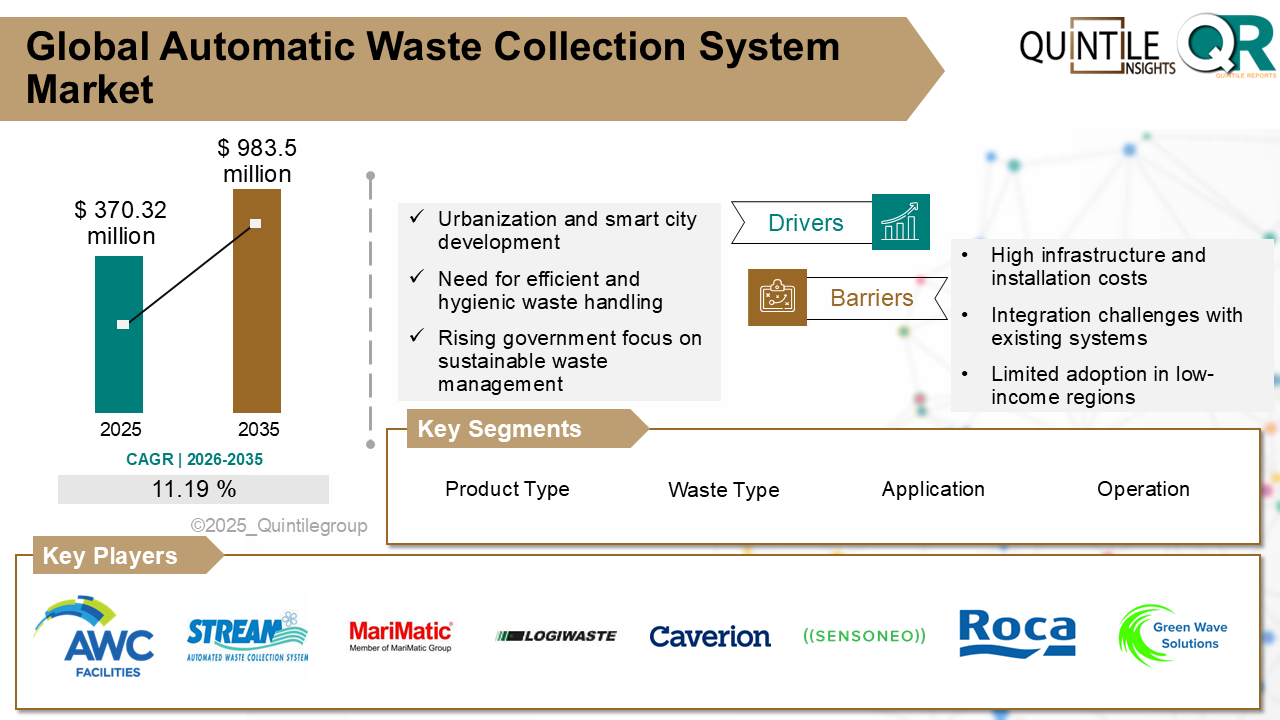
The automatic waste collection system market includes the design, installation, and operation of vacuum-powered infrastructure that collects and transports waste through sealed underground pipelines. These systems use air suction to move garbage from buildings or public spaces to a central collection station, eliminating the need for traditional manual or vehicle-based waste collection.
These systems are integrated into airports, hospitals, residential buildings, commercial areas, and smart city developments to enhance cleanliness, reduce labour costs, and improve waste handling efficiency. As urban density increases and cities invest in smart infrastructure, the demand for automatic waste collection systems continues to grow globally.
There is increase in investment in smart cities and modern infrastructure. Automatic waste collection systems provide cleaner, faster, and more efficient waste removal, reducing dependence on trucks and manual handling in crowded urban areas.
Health and hygiene are also major factors. These systems help limit odour, reduce direct contact with waste, and prevent the spread of disease, making them particularly valuable in hospitals, airports, and densely populated housing complexes.
As labour costs rise globally, cities and building developers are turning to automation to cut recurring expenses related to waste collection. Automatic waste collection systems reduce the need for large teams of sanitation workers and help streamline operations.
Environmental goals are driving further adoption. By removing the need for garbage trucks to make frequent stops, these systems help reduce noise, emissions, and road congestion aligning with green building and low-carbon development targets.
Space savings is an important benefit. Automatic waste collection systems eliminate the need for large trash bins and collection areas, freeing up space in buildings, streets, and public areas that can be used for other purposes.
The biggest barrier to adoption is the high installation cost. Automatic waste collection systems require underground pipe networks, centralized collection stations, and vacuum infrastructure, making initial setup expensive compared to traditional methods.
Retrofitting older buildings and existing urban areas is often not feasible without significant structural changes. This limits most installations to new developments or planned infrastructure projects.
The system also requires ongoing technical support and skilled maintenance. If not properly maintained, blockages, suction failure, or system downtime can disrupt waste collection entirely, which can be problematic in hospitals or large residential complexes.
Another challenge is the lack of public familiarity. Decision-makers in municipalities or property firms may not fully understand the long-term benefits, leading to hesitation or resistance, especially where budgets are tight.
North America is beginning to adopt automatic waste collection systems, especially in airports, hospitals, and high-rise residential buildings. Pilot programs are being tested in smart city zones across the United States and Canada, with interest rising among private developers.
Europe leads global adoption. Countries like Sweden, Spain, Finland, and the Netherlands have widely implemented automatic waste collection systems in urban neighbourhoods. These systems are supported by strong environmental laws and city-level planning strategies.
Asia Pacific is experiencing rapid adoption, especially in smart cities across China, South Korea, Singapore, and India. Government-driven infrastructure projects and high-density housing developments are helping to increase installations.
Latin America is developing more slowly, with a few cities in Brazil, Chile, and Colombia exploring automatic waste collection systems for urban renewal zones or airport complexes. Cost remains a key limitation in many areas.
Middle East & Africa are emerging markets. The United Arab Emirates and Saudi Arabia are using automatic waste collection systems in new smart city projects. In parts of Africa, pilot projects are being supported through partnerships with international urban planning agencies.
The United States is gradually adopting automatic waste collection systems in select high-density projects such as airports, hospitals, university campuses, and new residential developments. Although still in early stages compared to Europe or Asia, growing interest in automation, environmental efficiency, and public health is supporting pilot installations across major urban areas.
Smart city programs, especially in states like California, Texas, and New York, are evaluating these systems as part of broader efforts to reduce traffic congestion, lower emissions from garbage trucks, and improve sanitation standards in growing metropolitan regions. Hospitals and medical centres are showing interest due to the hygiene benefits, particularly in controlling odour and reducing contact with infectious waste.
Japan is actively using automatic waste collection systems in high-density urban centres, healthcare complexes, and railway stations. The countrys emphasis on compact, high-performance infrastructure makes these systems an ideal fit for modern urban living.
Urban planning authorities integrate automatic waste collection systems into smart buildings, mixed-use developments, and public transport hubs to reduce waste-related congestion and improve hygiene. The Japanese government encourages the adoption of contactless systems that align with national goals for automation and cleanliness. Local manufacturers also play a key role in designing compact and energy-efficient systems tailored to Japans limited urban space.
Germany is adopting automatic waste collection systems as part of its broader efforts to modernize waste infrastructure and reduce environmental impact. Cities like Hamburg and Munich are exploring the use of underground systems in eco-friendly housing developments and urban renewal projects.
Backed by the countrys strong environmental regulations and focus on public health, Germanys approach emphasizes energy-efficient designs and integration with smart grid platforms. Collaborations between municipalities, engineering firms, and packaging recyclers help streamline waste flow from residential and commercial areas into centralized collection points. German innovation also contributes to exporting these systems across Europe.
The automatic waste collection system market includes global engineering firms, automation solution providers, and infrastructure technology developers. Companies offer full turnkey systems including underground pipe networks, air suction systems, waste separation stations, and digital monitoring tools.
Larger firms focus on urban planning projects, working with governments and real estate developers to deliver large-scale, multi-building installations. These companies often manage everything from feasibility studies to post-installation maintenance.
Mid-sized firms and technology startups are focusing on specific applications such as healthcare, transit hubs, or modular residential blocks. Their systems are often compact and suited for smaller projects where budget and space are limited.
Innovation is a critical competitive factor. Companies that offer energy-efficient vacuum units, smart control panels, and cloud-based monitoring dashboards are gaining interest from cities seeking scalable, low-maintenance systems.
Strategic partnerships are also shaping the market. Firms that collaborate with architecture firms, smart city consultants, and green building certifiers have better access to long-term projects. Providing maintenance services, staff training, and technical support is also important for client retention and reliability.
Key players in the market are Envac AB, STREAM Environment Sdn. Bhd., MariMatic Oy, Logiwaste AB, Caverion Corporation, MEIKO Group, Ros Roca Group, Green Wave Solutions, AWC Berhad, Cleantech Civils Pvt. Ltd., MetroTaifun, Europa Co. Ltd., Aerbin APS, and other players.
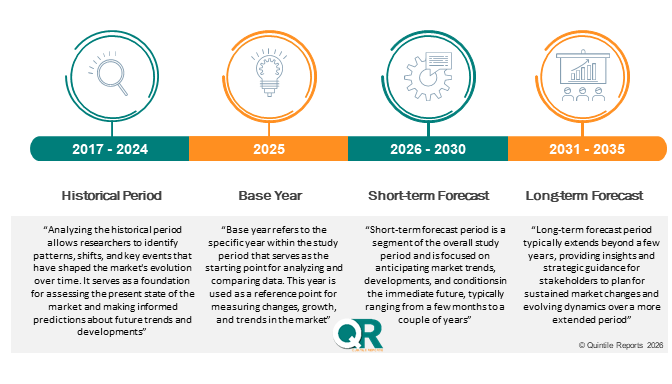
Our team of experienced researchers has meticulously gathered and analyzed data to deliver a thorough examination of market dynamics, competitive landscape, and emerging technologies. With a focus on delivering actionable intelligence, this report aims to empower decision-makers with the information needed to make informed choices and stay ahead of the competition. Whether you are a seasoned industry player or a new entrant, our market research report serves as a strategic tool to navigate the complexities of the market, aiding in successful business planning and growth strategies.
This chapter of our Automatic Waste Collection System market report provides an in-depth examination of the factors shaping the industry landscape. This section typically encompasses several key elements to offer a comprehensive understanding of the industry landscape such as market drivers & restraints analysis, market opportunities & trend analysis, market size & growth analysis, competitive analysis, SWOT analysis, business environment tools such as Porter's five forces & PESTEL analysis, Ansoff Matrix analysis, penetration & growth prospect analysis, regulatory framework & reimbursement scenario analysis, impact of macro & micro economic factors analysis such as Covid-19 impact, GDP growth, market inflation, U.S.- China trade war, Russia-Ukraine war impact, and supply chain analysis.
The segment analysis chapter of Automatic Waste Collection System market report is a critical section that delves into a detailed examination of the market's various segments. Segmentation involves dividing the market into distinct categories based on certain criteria to better understand and address the diverse needs of consumers. This chapter typically follows the introduction and provides a more granular view of the market, offering valuable insights for businesses and stakeholders. The components of the chapter lude segment definitions to understand the inclusions and exclusions of the study, assumptions, market size estimates and growth trend analysis of each segment, qualitative analysis of the segment, technological advancements, market penetration rate, market adoption rate, market share examination by each segment, segment growth drivers and restraint barriers, consumer behaviour and challenge analysis.
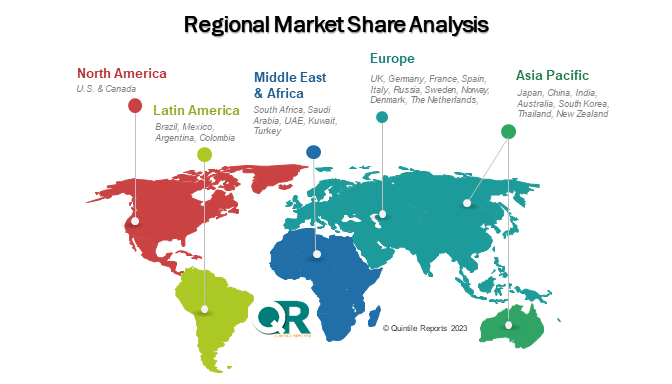
The chapter in Automatic Waste Collection System market research report is a pivotal section that examines and predicts the market dynamics and trends specific to different geographical regions. This chapter is crucial for businesses and stakeholders seeking a comprehensive understanding of how the market behaves across various locations, enabling them to tailor strategies and make informed decisions based on regional variations. The regional analysis chapter of our Automatic Waste Collection System market report is classified into regions & country-level. The chapter consists of North America (U.S., Canada), Europe (UK, Germany, France, Italy, Spain, Russia, Sweden, Denmark, Norway, Rest of Europe), Asia Pacific (Japan, China, India, Australia, South Korea, Thailand, Rest of Asia Pacific), Latin America (Brazil, Mexico, Argentina, Colombia, Rest of Latin America), Middle East & Africa (South Africa, Saudi Arabia, UAE, Kuwait, Rest of Middle East & Africa).
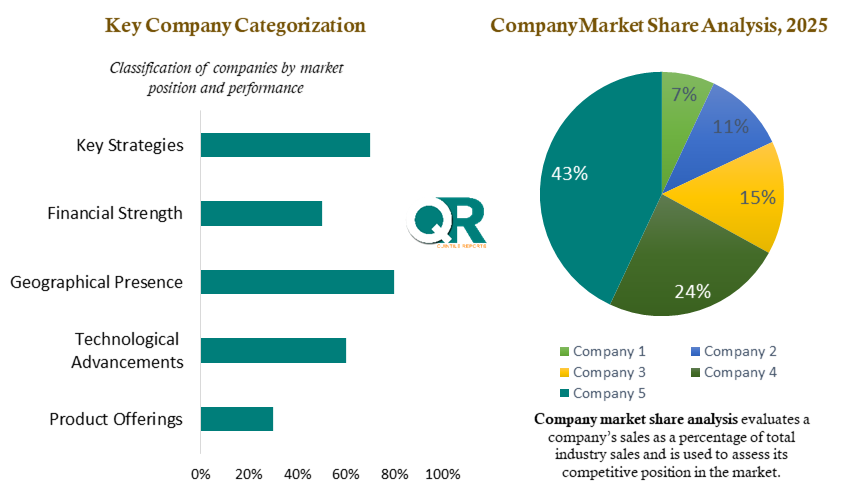
This section of a Automatic Waste Collection System market report is a crucial segment that provides a comprehensive overview of the competitive landscape within the market. This section is vital for businesses, investors, and stakeholders seeking insights into key players, their market positioning, strengths, weaknesses, strategies, and potential impacts on the overall market dynamics. The chapter includes research methodology used to analyse the market competition, list of key players operating in the market, detailed company profile section which includes company overview, business verticals, financial performance, product/services benchmarking, geographical presence, and strategic initiatives.
| Report Scope | Details |
| Report Version | 2026 |
| Growth Rate | CAGR of 11.19 from 2026 to 2035 |
| Base Year | 2025 |
| Actual Estimates / Historical Data | 2017 - 2024 |
| Forecast Period | 2026 - 2035 |
| Quantitative Units | Revenue in USD million/billion & CAGR from 2026 to 2035 |
| Country Scope | North America (U.S., Canada), Europe (UK, Germany, France, Italy, Spain, Russia, Sweden, Denmark, Norway, Rest of Europe), Asia Pacific (Japan, China, India, Australia, South Korea, Thailand, Rest of Asia Pacific), Latin America (Brazil, Mexico, Argentina, Colombia, Rest of Latin America), Middle East & Africa (South Africa, Saudi Arabia, UAE, Kuwait, Rest of Middle East & Africa). |
| The Segment Covered by System Type |
|
| The Segment Covered by Component |
|
| Companies Covered |
|
| Report Coverage | Revenue forecast, company share, competitive landscape, growth factors, and trends |
| Free Customization Scope (Equivalent to 5 Analyst Working Days) | If you need specific information, which is not currently within the scope of the report, we will provide it to you as a part of the customization |

Statistics for the 2025 Automatic Waste Collection System market share, size, and revenue growth rate were created by Quintile Report™. Automatic Waste Collection System analysis includes a market forecast outlook for 2035 and a historical overview. Get a free PDF sample of this market analysis, please get in touch with our principal analyst at sales@quintilereports.com
List of Tables
Table 1 List of Abbreviation and acronyms
Table 2 List of Sources
Table 3 North America Global Automatic Waste Collection System Market, by Segment Analysis, (USD Million) 2017-2035
Table 4 North America Global Automatic Waste Collection System Market, by Region, (USD Million) 2017-2035
Table 5 U.S. Global Automatic Waste Collection System Market, by Segment Analysis, (USD Million) 2017-2035
Table 6 Canada Global Automatic Waste Collection System Market, by Segment Analysis, (USD Million) 2017-2035
Table 7 Europe Global Automatic Waste Collection System Market, by Segment Analysis, (USD Million) 2017-2035
Table 8 Europe Global Automatic Waste Collection System Market, by Region, (USD Million) 2017-2035
Table 9 Germany Global Automatic Waste Collection System Market, by Segment Analysis, (USD Million) 2017-2035
Table 10 U.K. Global Automatic Waste Collection System Market, by Segment Analysis, (USD Million) 2017-2035
Table 11 France Global Automatic Waste Collection System Market, by Segment Analysis, (USD Million) 2017-2035
Table 12 Italy Global Automatic Waste Collection System Market, by Segment Analysis, (USD Million) 2017-2035
Table 13 Spain Global Automatic Waste Collection System Market, by Segment Analysis, (USD Million) 2017-2035
Table 14 Sweden Global Automatic Waste Collection System Market, by Segment Analysis, (USD Million) 2017-2035
Table 15 Denmark Global Automatic Waste Collection System Market, by Segment Analysis, (USD Million) 2017-2035
Table 16 Norway Global Automatic Waste Collection System Market, by Segment Analysis, (USD Million) 2017-2035
Table 17 The Netherlands Global Automatic Waste Collection System Market, by Segment Analysis, (USD Million) 2017-2035
Table 18 Russia Global Automatic Waste Collection System Market, by Segment Analysis, (USD Million) 2017-2035
Table 19 Asia Pacific Global Automatic Waste Collection System Market, by Segment Analysis, (USD Million) 2017-2035
Table 20 Asia Pacific Global Automatic Waste Collection System Market, by Region, (USD Million) 2017-2035
Table 21 China Global Automatic Waste Collection System Market, by Segment Analysis, (USD Million) 2017-2035
Table 22 Japan Global Automatic Waste Collection System Market, by Segment Analysis, (USD Million) 2017-2035
Table 23 India Global Automatic Waste Collection System Market, by Segment Analysis, (USD Million) 2017-2035
Table 24 Australia Global Automatic Waste Collection System Market, by Segment Analysis, (USD Million) 2017-2035
Table 25 South Korea Global Automatic Waste Collection System Market, by Segment Analysis, (USD Million) 2017-2035
Table 26 Thailand Global Automatic Waste Collection System Market, by Segment Analysis, (USD Million) 2017-2035
Table 27 Latin America Global Automatic Waste Collection System Market, by Segment Analysis, (USD Million) 2017-2035
Table 28 Latin America Global Automatic Waste Collection System Market, by Region, (USD Million) 2017-2035
Table 29 Brazil Global Automatic Waste Collection System Market, by Segment Analysis, (USD Million) 2017-2035
Table 30 Mexico Global Automatic Waste Collection System Market, by Segment Analysis, (USD Million) 2017-2035
Table 31 Argentina Global Automatic Waste Collection System Market, by Segment Analysis, (USD Million) 2017-2035
Table 32 Middle East and Africa Global Automatic Waste Collection System Market, by Segment Analysis, (USD Million) 2017-2035
Table 33 Middle East and Africa Global Automatic Waste Collection System Market, by Region, (USD Million) 2017-2035
Table 34 South Africa Global Automatic Waste Collection System Market, by Segment Analysis, (USD Million) 2017-2035
Table 35 Saudi Arabia Global Automatic Waste Collection System Market, by Segment Analysis, (USD Million) 2017-2035
Table 36 UAE Global Automatic Waste Collection System Market, by Segment Analysis, (USD Million) 2017-2035
Table 37 Kuwait Global Automatic Waste Collection System Market, by Segment Analysis, (USD Million) 2017-2035
Table 38 Turkey Global Automatic Waste Collection System Market, by Segment Analysis, (USD Million) 2017-2035
Fig.1 Market research process
Fig.2 Market research approaches
Fig.3 Global Automatic Waste Collection System Market: market scenario
Fig.4 Global Automatic Waste Collection System Market competitive outlook
Fig.5 Global Automatic Waste Collection System Market driver analysis
Fig.6 Global Automatic Waste Collection System Market restraint analysis
Fig.7 Global Automatic Waste Collection System Market opportunity analysis
Fig.8 Global Automatic Waste Collection System Market trends analysis
Fig.9 Global Automatic Waste Collection System Market: Segment Analysis (Based on the scope)
Fig.10 Global Automatic Waste Collection System Market: regional analysis
Fig.11 Global market shares and leading market players
Fig.12 North America market share and leading players
Fig.13 Europe market share and leading players
Fig.14 Asia Pacific market share and leading players
Fig.15 Latin America market share and leading players
Fig.16 Middle East & Africa market share and leading players
Fig.17 North America, by country
Fig.18 North America
Fig.19 North America market estimates and forecast, 2017-2035
Fig.20 U.S.
Fig.21 Canada
Fig.22 Europe
Fig.23 Europe market estimates and forecast, 2017-2035
Fig.24 U.K.
Fig.25 Germany
Fig.26 France
Fig.27 Italy
Fig.28 Spain
Fig.29 Sweden
Fig.30 Denmark
Fig.31 Norway
Fig.32 The Netherlands
Fig.33 Russia
Fig.34 Asia Pacific
Fig.35 Asia Pacific market estimates and forecast, 2017-2035
Fig.36 China
Fig.37 Japan
Fig.38 India
Fig.39 Australia
Fig.40 South Korea
Fig.41 Thailand
Fig.42 Latin America
Fig.43 Latin America market estimates and forecast, 2017-2035
Fig.44 Brazil
Fig.45 Mexico
Fig.46 Argentina
Fig.47 Colombia
Fig.48 Middle East and Africa
Fig.49 Middle East and Africa market estimates and forecast, 2017-2035
Fig.50 Saudi Arabia
Fig.51 South Africa
Fig.52 UAE
Fig.53 Kuwait
Fig.54 Turkey
The Global Automatic Waste Collection System Market was valued at USD 370.32 million in 2025 and is projected to reach USD 983.5 million by 2035, registering a strong CAGR of 11.19% during the forecast period from 2026 to 2035. The Automatic Waste Collection System market report offers a detailed evaluation of the industry by examining macroeconomic trends, technological developments, regulatory landscapes, and changing consumer dynamics to outline the markets future growth prospects.
Using 2025 as the base year, the Automatic Waste Collection System market continues to expand steadily due to ongoing innovation, growing adoption across multiple end-use sectors, and rapid advancements in technology. Industry participants are actively refining their go-to-market (GTM) strategies to leverage new growth avenues and strengthen their competitive positioning in a rapidly evolving marketplace.
Looking toward 2035, the market is expected to sustain significant growth momentum, driven by continuous investments in research and development, strategic alliances, and increased merger and acquisition activity. Companies that emphasize innovation, implement agile GTM strategies, and remain aligned with shifting customer expectations are well positioned to achieve sustainable long-term growth. The report delivers comprehensive insights into key drivers, restraints, opportunities, and challenges across segments, regions, and countries, supported by qualitative and quantitative analysis covering 2017 to 2035.
The automatic waste collection system market includes the design, installation, and operation of vacuum-powered infrastructure that collects and transports waste through sealed underground pipelines. These systems use air suction to move garbage from buildings or public spaces to a central collection station, eliminating the need for traditional manual or vehicle-based waste collection.
These systems are integrated into airports, hospitals, residential buildings, commercial areas, and smart city developments to enhance cleanliness, reduce labour costs, and improve waste handling efficiency. As urban density increases and cities invest in smart infrastructure, the demand for automatic waste collection systems continues to grow globally.
There is increase in investment in smart cities and modern infrastructure. Automatic waste collection systems provide cleaner, faster, and more efficient waste removal, reducing dependence on trucks and manual handling in crowded urban areas.
Health and hygiene are also major factors. These systems help limit odour, reduce direct contact with waste, and prevent the spread of disease, making them particularly valuable in hospitals, airports, and densely populated housing complexes.
As labour costs rise globally, cities and building developers are turning to automation to cut recurring expenses related to waste collection. Automatic waste collection systems reduce the need for large teams of sanitation workers and help streamline operations.
Environmental goals are driving further adoption. By removing the need for garbage trucks to make frequent stops, these systems help reduce noise, emissions, and road congestion aligning with green building and low-carbon development targets.
Space savings is an important benefit. Automatic waste collection systems eliminate the need for large trash bins and collection areas, freeing up space in buildings, streets, and public areas that can be used for other purposes.
The biggest barrier to adoption is the high installation cost. Automatic waste collection systems require underground pipe networks, centralized collection stations, and vacuum infrastructure, making initial setup expensive compared to traditional methods.
Retrofitting older buildings and existing urban areas is often not feasible without significant structural changes. This limits most installations to new developments or planned infrastructure projects.
The system also requires ongoing technical support and skilled maintenance. If not properly maintained, blockages, suction failure, or system downtime can disrupt waste collection entirely, which can be problematic in hospitals or large residential complexes.
Another challenge is the lack of public familiarity. Decision-makers in municipalities or property firms may not fully understand the long-term benefits, leading to hesitation or resistance, especially where budgets are tight.
North America is beginning to adopt automatic waste collection systems, especially in airports, hospitals, and high-rise residential buildings. Pilot programs are being tested in smart city zones across the United States and Canada, with interest rising among private developers.
Europe leads global adoption. Countries like Sweden, Spain, Finland, and the Netherlands have widely implemented automatic waste collection systems in urban neighbourhoods. These systems are supported by strong environmental laws and city-level planning strategies.
Asia Pacific is experiencing rapid adoption, especially in smart cities across China, South Korea, Singapore, and India. Government-driven infrastructure projects and high-density housing developments are helping to increase installations.
Latin America is developing more slowly, with a few cities in Brazil, Chile, and Colombia exploring automatic waste collection systems for urban renewal zones or airport complexes. Cost remains a key limitation in many areas.
Middle East & Africa are emerging markets. The United Arab Emirates and Saudi Arabia are using automatic waste collection systems in new smart city projects. In parts of Africa, pilot projects are being supported through partnerships with international urban planning agencies.
The United States is gradually adopting automatic waste collection systems in select high-density projects such as airports, hospitals, university campuses, and new residential developments. Although still in early stages compared to Europe or Asia, growing interest in automation, environmental efficiency, and public health is supporting pilot installations across major urban areas.
Smart city programs, especially in states like California, Texas, and New York, are evaluating these systems as part of broader efforts to reduce traffic congestion, lower emissions from garbage trucks, and improve sanitation standards in growing metropolitan regions. Hospitals and medical centres are showing interest due to the hygiene benefits, particularly in controlling odour and reducing contact with infectious waste.
Japan is actively using automatic waste collection systems in high-density urban centres, healthcare complexes, and railway stations. The countrys emphasis on compact, high-performance infrastructure makes these systems an ideal fit for modern urban living.
Urban planning authorities integrate automatic waste collection systems into smart buildings, mixed-use developments, and public transport hubs to reduce waste-related congestion and improve hygiene. The Japanese government encourages the adoption of contactless systems that align with national goals for automation and cleanliness. Local manufacturers also play a key role in designing compact and energy-efficient systems tailored to Japans limited urban space.
Germany is adopting automatic waste collection systems as part of its broader efforts to modernize waste infrastructure and reduce environmental impact. Cities like Hamburg and Munich are exploring the use of underground systems in eco-friendly housing developments and urban renewal projects.
Backed by the countrys strong environmental regulations and focus on public health, Germanys approach emphasizes energy-efficient designs and integration with smart grid platforms. Collaborations between municipalities, engineering firms, and packaging recyclers help streamline waste flow from residential and commercial areas into centralized collection points. German innovation also contributes to exporting these systems across Europe.
The automatic waste collection system market includes global engineering firms, automation solution providers, and infrastructure technology developers. Companies offer full turnkey systems including underground pipe networks, air suction systems, waste separation stations, and digital monitoring tools.
Larger firms focus on urban planning projects, working with governments and real estate developers to deliver large-scale, multi-building installations. These companies often manage everything from feasibility studies to post-installation maintenance.
Mid-sized firms and technology startups are focusing on specific applications such as healthcare, transit hubs, or modular residential blocks. Their systems are often compact and suited for smaller projects where budget and space are limited.
Innovation is a critical competitive factor. Companies that offer energy-efficient vacuum units, smart control panels, and cloud-based monitoring dashboards are gaining interest from cities seeking scalable, low-maintenance systems.
Strategic partnerships are also shaping the market. Firms that collaborate with architecture firms, smart city consultants, and green building certifiers have better access to long-term projects. Providing maintenance services, staff training, and technical support is also important for client retention and reliability.
Key players in the market are Envac AB, STREAM Environment Sdn. Bhd., MariMatic Oy, Logiwaste AB, Caverion Corporation, MEIKO Group, Ros Roca Group, Green Wave Solutions, AWC Berhad, Cleantech Civils Pvt. Ltd., MetroTaifun, Europa Co. Ltd., Aerbin APS, and other players.
Our team of experienced researchers has meticulously gathered and analyzed data to deliver a thorough examination of market dynamics, competitive landscape, and emerging technologies. With a focus on delivering actionable intelligence, this report aims to empower decision-makers with the information needed to make informed choices and stay ahead of the competition. Whether you are a seasoned industry player or a new entrant, our market research report serves as a strategic tool to navigate the complexities of the market, aiding in successful business planning and growth strategies.
This chapter of our Automatic Waste Collection System market report provides an in-depth examination of the factors shaping the industry landscape. This section typically encompasses several key elements to offer a comprehensive understanding of the industry landscape such as market drivers & restraints analysis, market opportunities & trend analysis, market size & growth analysis, competitive analysis, SWOT analysis, business environment tools such as Porter's five forces & PESTEL analysis, Ansoff Matrix analysis, penetration & growth prospect analysis, regulatory framework & reimbursement scenario analysis, impact of macro & micro economic factors analysis such as Covid-19 impact, GDP growth, market inflation, U.S.- China trade war, Russia-Ukraine war impact, and supply chain analysis.
The segment analysis chapter of Automatic Waste Collection System market report is a critical section that delves into a detailed examination of the market's various segments. Segmentation involves dividing the market into distinct categories based on certain criteria to better understand and address the diverse needs of consumers. This chapter typically follows the introduction and provides a more granular view of the market, offering valuable insights for businesses and stakeholders. The components of the chapter lude segment definitions to understand the inclusions and exclusions of the study, assumptions, market size estimates and growth trend analysis of each segment, qualitative analysis of the segment, technological advancements, market penetration rate, market adoption rate, market share examination by each segment, segment growth drivers and restraint barriers, consumer behaviour and challenge analysis.
The chapter in Automatic Waste Collection System market research report is a pivotal section that examines and predicts the market dynamics and trends specific to different geographical regions. This chapter is crucial for businesses and stakeholders seeking a comprehensive understanding of how the market behaves across various locations, enabling them to tailor strategies and make informed decisions based on regional variations. The regional analysis chapter of our Automatic Waste Collection System market report is classified into regions & country-level. The chapter consists of North America (U.S., Canada), Europe (UK, Germany, France, Italy, Spain, Russia, Sweden, Denmark, Norway, Rest of Europe), Asia Pacific (Japan, China, India, Australia, South Korea, Thailand, Rest of Asia Pacific), Latin America (Brazil, Mexico, Argentina, Colombia, Rest of Latin America), Middle East & Africa (South Africa, Saudi Arabia, UAE, Kuwait, Rest of Middle East & Africa).
This section of a Automatic Waste Collection System market report is a crucial segment that provides a comprehensive overview of the competitive landscape within the market. This section is vital for businesses, investors, and stakeholders seeking insights into key players, their market positioning, strengths, weaknesses, strategies, and potential impacts on the overall market dynamics. The chapter includes research methodology used to analyse the market competition, list of key players operating in the market, detailed company profile section which includes company overview, business verticals, financial performance, product/services benchmarking, geographical presence, and strategic initiatives.
| Report Scope | Details |
| Report Version | 2026 |
| Growth Rate | CAGR of 11.19 from 2026 to 2035 |
| Base Year | 2025 |
| Actual Estimates / Historical Data | 2017 - 2024 |
| Forecast Period | 2026 - 2035 |
| Quantitative Units | Revenue in USD million/billion & CAGR from 2026 to 2035 |
| Country Scope | North America (U.S., Canada), Europe (UK, Germany, France, Italy, Spain, Russia, Sweden, Denmark, Norway, Rest of Europe), Asia Pacific (Japan, China, India, Australia, South Korea, Thailand, Rest of Asia Pacific), Latin America (Brazil, Mexico, Argentina, Colombia, Rest of Latin America), Middle East & Africa (South Africa, Saudi Arabia, UAE, Kuwait, Rest of Middle East & Africa). |
| The Segment Covered by System Type |
|
| The Segment Covered by Component |
|
| Companies Covered |
|
| Report Coverage | Revenue forecast, company share, competitive landscape, growth factors, and trends |
| Free Customization Scope (Equivalent to 5 Analyst Working Days) | If you need specific information, which is not currently within the scope of the report, we will provide it to you as a part of the customization |
Statistics for the 2025 Automatic Waste Collection System market share, size, and revenue growth rate were created by Quintile Report™. Automatic Waste Collection System analysis includes a market forecast outlook for 2035 and a historical overview. Get a free PDF sample of this market analysis, please get in touch with our principal analyst at sales@quintilereports.com
Table 1 List of Abbreviation and acronyms
Table 2 List of Sources
Table 3 North America Global Automatic Waste Collection System Market, by Segment Analysis, (USD Million) 2017-2035
Table 4 North America Global Automatic Waste Collection System Market, by Region, (USD Million) 2017-2035
Table 5 U.S. Global Automatic Waste Collection System Market, by Segment Analysis, (USD Million) 2017-2035
Table 6 Canada Global Automatic Waste Collection System Market, by Segment Analysis, (USD Million) 2017-2035
Table 7 Europe Global Automatic Waste Collection System Market, by Segment Analysis, (USD Million) 2017-2035
Table 8 Europe Global Automatic Waste Collection System Market, by Region, (USD Million) 2017-2035
Table 9 Germany Global Automatic Waste Collection System Market, by Segment Analysis, (USD Million) 2017-2035
Table 10 U.K. Global Automatic Waste Collection System Market, by Segment Analysis, (USD Million) 2017-2035
Table 11 France Global Automatic Waste Collection System Market, by Segment Analysis, (USD Million) 2017-2035
Table 12 Italy Global Automatic Waste Collection System Market, by Segment Analysis, (USD Million) 2017-2035
Table 13 Spain Global Automatic Waste Collection System Market, by Segment Analysis, (USD Million) 2017-2035
Table 14 Sweden Global Automatic Waste Collection System Market, by Segment Analysis, (USD Million) 2017-2035
Table 15 Denmark Global Automatic Waste Collection System Market, by Segment Analysis, (USD Million) 2017-2035
Table 16 Norway Global Automatic Waste Collection System Market, by Segment Analysis, (USD Million) 2017-2035
Table 17 The Netherlands Global Automatic Waste Collection System Market, by Segment Analysis, (USD Million) 2017-2035
Table 18 Russia Global Automatic Waste Collection System Market, by Segment Analysis, (USD Million) 2017-2035
Table 19 Asia Pacific Global Automatic Waste Collection System Market, by Segment Analysis, (USD Million) 2017-2035
Table 20 Asia Pacific Global Automatic Waste Collection System Market, by Region, (USD Million) 2017-2035
Table 21 China Global Automatic Waste Collection System Market, by Segment Analysis, (USD Million) 2017-2035
Table 22 Japan Global Automatic Waste Collection System Market, by Segment Analysis, (USD Million) 2017-2035
Table 23 India Global Automatic Waste Collection System Market, by Segment Analysis, (USD Million) 2017-2035
Table 24 Australia Global Automatic Waste Collection System Market, by Segment Analysis, (USD Million) 2017-2035
Table 25 South Korea Global Automatic Waste Collection System Market, by Segment Analysis, (USD Million) 2017-2035
Table 26 Thailand Global Automatic Waste Collection System Market, by Segment Analysis, (USD Million) 2017-2035
Table 27 Latin America Global Automatic Waste Collection System Market, by Segment Analysis, (USD Million) 2017-2035
Table 28 Latin America Global Automatic Waste Collection System Market, by Region, (USD Million) 2017-2035
Table 29 Brazil Global Automatic Waste Collection System Market, by Segment Analysis, (USD Million) 2017-2035
Table 30 Mexico Global Automatic Waste Collection System Market, by Segment Analysis, (USD Million) 2017-2035
Table 31 Argentina Global Automatic Waste Collection System Market, by Segment Analysis, (USD Million) 2017-2035
Table 32 Middle East and Africa Global Automatic Waste Collection System Market, by Segment Analysis, (USD Million) 2017-2035
Table 33 Middle East and Africa Global Automatic Waste Collection System Market, by Region, (USD Million) 2017-2035
Table 34 South Africa Global Automatic Waste Collection System Market, by Segment Analysis, (USD Million) 2017-2035
Table 35 Saudi Arabia Global Automatic Waste Collection System Market, by Segment Analysis, (USD Million) 2017-2035
Table 36 UAE Global Automatic Waste Collection System Market, by Segment Analysis, (USD Million) 2017-2035
Table 37 Kuwait Global Automatic Waste Collection System Market, by Segment Analysis, (USD Million) 2017-2035
Table 38 Turkey Global Automatic Waste Collection System Market, by Segment Analysis, (USD Million) 2017-2035
Fig.1 Market research process
Fig.2 Market research approaches
Fig.3 Global Automatic Waste Collection System Market: market scenario
Fig.4 Global Automatic Waste Collection System Market competitive outlook
Fig.5 Global Automatic Waste Collection System Market driver analysis
Fig.6 Global Automatic Waste Collection System Market restraint analysis
Fig.7 Global Automatic Waste Collection System Market opportunity analysis
Fig.8 Global Automatic Waste Collection System Market trends analysis
Fig.9 Global Automatic Waste Collection System Market: Segment Analysis (Based on the scope)
Fig.10 Global Automatic Waste Collection System Market: regional analysis
Fig.11 Global market shares and leading market players
Fig.12 North America market share and leading players
Fig.13 Europe market share and leading players
Fig.14 Asia Pacific market share and leading players
Fig.15 Latin America market share and leading players
Fig.16 Middle East & Africa market share and leading players
Fig.17 North America, by country
Fig.18 North America
Fig.19 North America market estimates and forecast, 2017-2035
Fig.20 U.S.
Fig.21 Canada
Fig.22 Europe
Fig.23 Europe market estimates and forecast, 2017-2035
Fig.24 U.K.
Fig.25 Germany
Fig.26 France
Fig.27 Italy
Fig.28 Spain
Fig.29 Sweden
Fig.30 Denmark
Fig.31 Norway
Fig.32 The Netherlands
Fig.33 Russia
Fig.34 Asia Pacific
Fig.35 Asia Pacific market estimates and forecast, 2017-2035
Fig.36 China
Fig.37 Japan
Fig.38 India
Fig.39 Australia
Fig.40 South Korea
Fig.41 Thailand
Fig.42 Latin America
Fig.43 Latin America market estimates and forecast, 2017-2035
Fig.44 Brazil
Fig.45 Mexico
Fig.46 Argentina
Fig.47 Colombia
Fig.48 Middle East and Africa
Fig.49 Middle East and Africa market estimates and forecast, 2017-2035
Fig.50 Saudi Arabia
Fig.51 South Africa
Fig.52 UAE
Fig.53 Kuwait
Fig.54 Turkey

A license granted to one user. Rules or conditions might be applied for e.g. the use of electric files (PDFs) or printings, depending on product.
A license granted to multiple users.
A license granted to a single business site/establishment.
A license granted to all employees within organisation access to the product.
Immediate / Within 24-48 hours - Working days
Online Payments with PayPal and CCavenue
You can order a report by picking any of the payment methods which is bank wire or online payment through any Debit/Credit card or PayPal.
Hard Copy
Autonomous Firefighting Drones Overview The Global Autonomous Firefighting Drones Market was valued
Read MoreIndustrial Knitting Equipment Overview The Global Industrial Knitting Equipment Market was valued at
Read MoreProcess Chillers Overview The Global Process Chillers Market was valued at USD 8.65 billion in 2025
Read More U.S. : +1-201-772-7734