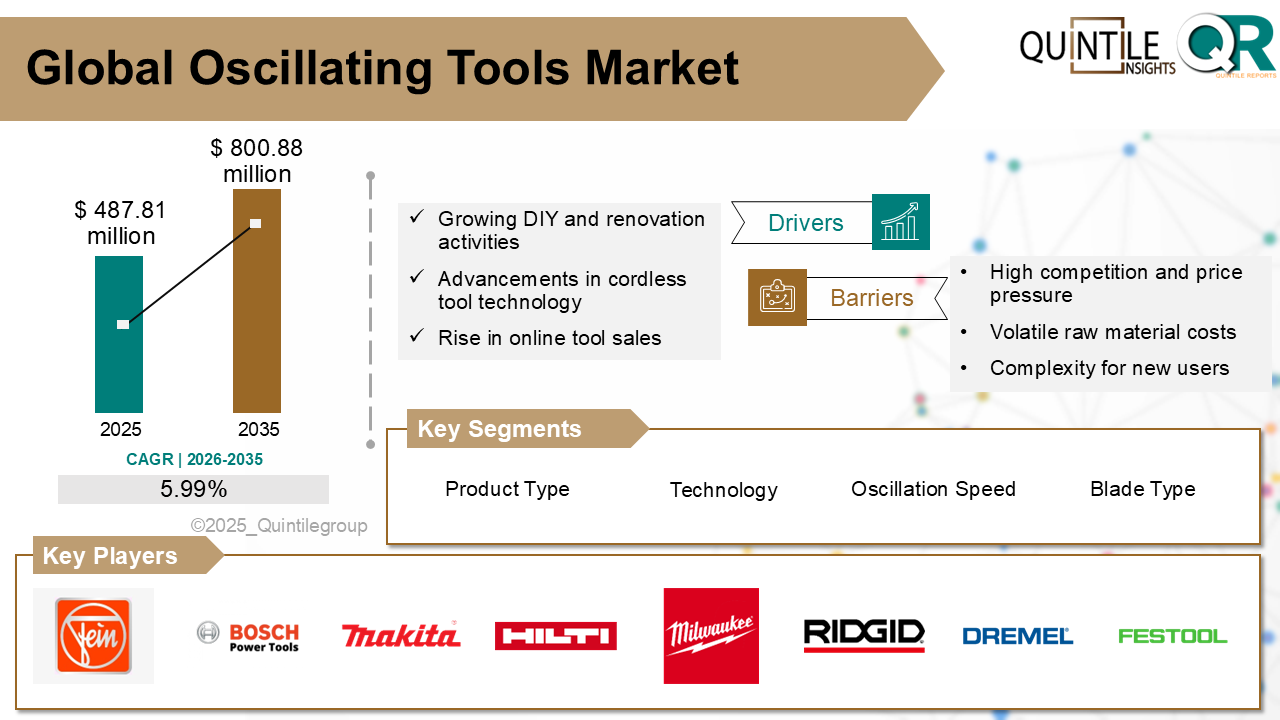
The Global Oscillating Tools Market was valued at USD 487.81 million in 2025 and is projected to reach USD 800.88 million by 2035, expanding at a robust CAGR of 5.99% during the forecast period from 2026 to 2035. The Oscillating Tools market report delivers a comprehensive industry assessment by analyzing macroeconomic conditions, technological advancements, regulatory frameworks, and evolving consumer behavior to provide a clear outlook on future growth potential.
With 2025 as the base year, the Oscillating Tools market is experiencing steady expansion driven by continuous innovation, rising demand across end-use industries, and rapid technological progress. Market participants are increasingly optimizing their go-to-market (GTM) strategies to capitalize on emerging opportunities and adapt to shifting competitive dynamics.
Looking ahead to 2035, the market is expected to maintain strong growth momentum, supported by sustained investments in research and development, strategic partnerships, and mergers and acquisitions. Companies that focus on innovation, agile GTM execution, and alignment with evolving customer needs are well positioned to achieve long-term success. The report provides in-depth insights into key market drivers, restraints, opportunities, and challenges across segments, regions, and countries, supported by robust qualitative and quantitative analysis spanning 2017 to 2035.
The oscillating tools market refers to the global industry for multifunctional handheld power tools also called oscillating multi-tools that execute rapid back-and-forth (oscillating) motion rather than full rotations. These tools accept interchangeable heads and attachments (saw blades, sanding pads, scrapers, grinding bits) and are used for precise cutting, sanding, scraping, grout removal, and polishing across materials like wood, drywall, metal, and tile.
This market includes both corded and cordless models and targets a diverse user base from DIY homeowners to professional contractors and industrial workshops. Segmentation typically covers power source (corded vs. cordless), amperage and oscillation speed capabilities, distribution channels (retail, e-commerce), and end-use sectors (residential, commercial, industrial). Leading manufacturers such as Black & Decker, Bosch, DEWALT, FEIN, and Makita populate the space, which is driven by the tools versatility, compact design, and suitability for confined or precision applications
The increasing popularity of DIY and home improvement activities is the major driver in the oscillating tools market. Homeowners are increasingly taking on renovation and maintenance projects and finding these versatile tools ideal for precise tasks like cutting, sanding, scraping, and polishing
The expansion of construction and renovation sectors, particularly in North America, Europe, and Asia-Pacific, is further fuelling demand. Growth in residential and commercial infrastructure projects drives professional usage of oscillating tools in trades like woodworking, plumbing, and finishing.
Advances in battery technology and cordless design are accelerating adoption. Improvements in lithium-ion batteries have enhanced runtime, reduced charging times, and made cordless multi-tools more portable and user-friendly.
The rise of e-commerce and digital distribution channels is boosting market visibility and accessibility. Online platforms have made a wide variety of brands and models more readily available to both professionals and DIY users, increasing sales.
The growing focus on technological innovation, ergonomics, and smart features is enhancing appeal. Manufacturers are incorporating brushless motors, IoT-connected features, ergonomic designs, and eco-friendly components to meet evolving user demands.
The high cost of advanced oscillating tools is a significant barrier to broader market penetration. Although professional-grade tools offer powerful performance and durability, their premium pricing often deters price-sensitive buyers especially in developing regions where budget constraints are tighter.
The intense competition and price pressure within a saturated market further restrain growth. With numerous brands and low-cost alternatives emerging, profit margins are under constant threat. Inexperienced consumers may gravitate toward cheaper, unbranded tools, weakening brand loyalty and complicating pricing strategies.
The technical complexity and user learning curve of oscillating tools present adoption challenges. Novice users often find advanced models complicated, requiring education on speed settings, blade changes, and safe usage. Without adequate training or intuitive design, this complexity reduces appeal to DIY customers.
Supply chain disruptions and raw material volatility hinder steady production and pricing stability. Fluctuations in steel and electronic component availabilityexacerbated by geopolitical issues and logistical bottlenecks lead to cost inflation and inventory delays, limiting consistent product supply.
North America is the leader in the oscillating tools segment, driven by a strong DIY culture, rising disposable incomes, and a mature online retail ecosystem. Over 50% of U.S. households report using oscillating tools for home improvement, while e-commerce contributes around 40% of total sales. High consumer awareness of tool versatility, combined with manufacturers integrating smart and cordless features, bolsters market growth.
Europes market is robust with key demand stemming from renovation projects, energy-efficient construction, and historic building preservation. Countries like Germany, the UK, and France prioritize ergonomic, low-noise, and eco-friendly oscillating tools. Professional contractors account for roughly 25% of demand as EU eco-design regulations drive adoption of advanced, premium products.
Asia-Pacific is the fastest-growing region due to rapid urbanization, industrial development, and a rise in DIY culture. China, India, and Japan together make up about 25% of global sales. Affordable cordless tools with extended battery lives are especially popular among homeowners. Ongoing infrastructure projects and local manufacturing yield competitive pricing and wide product availability.
Latin Americas market is expanding steadily, led by Brazil, Mexico, and Argentina. Increased urban development and renovation activities are driving demand, especially among contractors. Local partnerships with international brands help provide reliable, cost-effective oscillating tools suited for the price-sensitive market.
The Middle East & Africa region is seeing gradual growth in oscillating tool adoption, primarily in construction, real estate, and maintenance projects in countries like UAE, Saudi Arabia, South Africa, and Nigeria. Economic diversification and infrastructure investments support demand, with manufacturers targeting the market through distributor partnerships.
The surge in e-commerce and DIY culture across the U.S. has significantly broadened demand for versatile oscillating tools. In 2023, the U.S. market is driven largely by homeowners and contractors seeking tools capable of handling diverse renovation tasks efficiently.
The widespread availability of online tutorials, video guides, and community support has empowered consumers to use oscillating tools for home improvement projects ranging from cutting and sanding to grout removal and plunge cuts. Meanwhile, technological advancements like lithium-ion battery integration have enhanced cordless tool performance, helping meet growing user expectations for portability and convenience. These trends are reshaping the U.S. tool landscape, making oscillating multi-tools essential for modern DIY and pro workflows.
Germanys robust construction sector spending around 143 billion in 2021 and a growing DIY movement (with nearly 40% of residents engaging in home projects) are major catalysts for the oscillating tool market. These versatile tools are especially valued for renovation, fitting, and precision tasks in both professional and residential settings
As a result, major manufacturers like Fein (inventor of the oscillating multitool), Bosch, and Einhell are integrating advanced functionalities into their product lines. Features such as brushless motors, lithium-ion batteries, IoT connectivity, and reduced vibration cater to both contractors and DIY enthusiasts by enhancing tool durability, precision, and user comfort. These innovations are enabling sustained market growth and positioning Germany as a leading hub for oscillating tool advancement in Europe
Japans growing DIY movement particularly among urban home owners has led to increased demand for compact, multipurpose oscillating tools for home renovations, crafts, and repairs. These space-saving tools are ideal for small living spaces and versatile tasks like furniture assembly and wall cutting.
At the same time, major manufacturers such as Makita, Bosch, and Panasonic are driving sales with advanced cordless oscillating tools powered by lithium-ion batteries. These tools offer enhanced portability, longer runtime, and ergonomic designs meeting the needs of both professionals and hobbyists. The integration of IoT connectivity and smart features further boosts their appeal, solidifying Japan's role in the global oscillating tool market.
The Oscillating Tools market is highly competitive and innovation-driven, with leading manufacturers like Bosch, DeWalt (Stanley Black & Decker), Makita, Fein, Milwaukee, and Black & Decker pushing advancements in cordless platforms, improved battery technologies, brushless motors, Starlock interfaces, and digital controls. These innovations support precision, versatility, and performance across cutting, sanding, scraping, and polishing applications.
This innovation-led landscape fosters competition around R&D investment, regulatory compliance, and speed to market. Companies are launching new high-performance cordless models such as Makitas XGT TM001G and expanding universal blade compatibility (e.g., Dremels True Fit blades) to accelerate adoption and differentiation.
Price competitiveness remains crucial, particularly as cordless tools gain popularity. While premium brands leverage scale and innovation, mid-tier and entry-level manufacturers offer competitively priced or rental/leasing options especially in emerging markets. This strategy caters to price-sensitive DIY customers and smaller professional buyers.
The market is becoming more fragmented regionally and by specialization. North America and Europe dominate in volume and innovation, fuelled by a strong DIY culture and construction activity. Asia-Pacific is the fastest-growing region, driven by urbanization and e-commerce expansion in China, India, and Southeast Asia. Niche manufacturers are also emerging with localized features and price positioning.
Competition increasingly focuses on service ecosystems and sustainability. Brands are bundling tools with educational resources, warranty support, e-commerce services, and sustainability initiatives such as recyclable accessories and biodegradable packaging. Connected tools with IoT electronics, predictive maintenance, and online support portals are further enhancing user experience and brand loyalty
Key players in the market are Bosch Power Tools, Stanley Black & Decker (DeWalt, Craftsman), Fein Power Tools Inc., Makita Corporation, Hilti Corporation, Milwaukee Tool (Techtronic Industries), Ridgid (Emerson Electric Co.), Ryobi Tools (Techtronic Industries), Dremel (Bosch), Festool GmbH, WORX (Positec Group), Metabo HPT (Koki Holdings), Skil Power Tools, Genesis Power Tools and Chicago Electric (Harbor Freight).
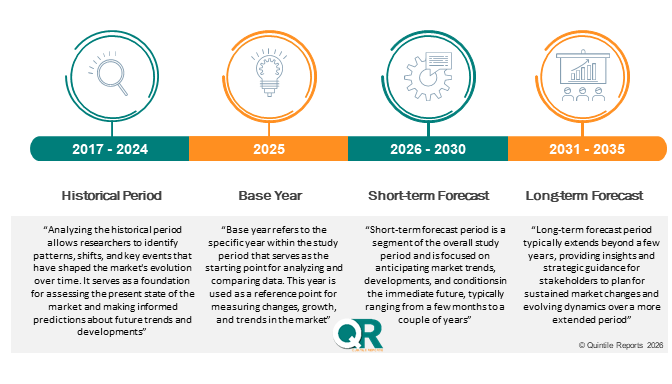
Our team of experienced researchers has meticulously gathered and analyzed data to deliver a thorough examination of market dynamics, competitive landscape, and emerging technologies. With a focus on delivering actionable intelligence, this report aims to empower decision-makers with the information needed to make informed choices and stay ahead of the competition. Whether you are a seasoned industry player or a new entrant, our market research report serves as a strategic tool to navigate the complexities of the market, aiding in successful business planning and growth strategies.
This chapter of our Oscillating Tools market report provides an in-depth examination of the factors shaping the industry landscape. This section typically encompasses several key elements to offer a comprehensive understanding of the industry landscape such as market drivers & restraints analysis, market opportunities & trend analysis, market size & growth analysis, competitive analysis, SWOT analysis, business environment tools such as Porter's five forces & PESTEL analysis, Ansoff Matrix analysis, penetration & growth prospect analysis, regulatory framework & reimbursement scenario analysis, impact of macro & micro economic factors analysis such as Covid-19 impact, GDP growth, market inflation, U.S.- China trade war, Russia-Ukraine war impact, and supply chain analysis.
The segment analysis chapter of Oscillating Tools market report is a critical section that delves into a detailed examination of the market's various segments. Segmentation involves dividing the market into distinct categories based on certain criteria to better understand and address the diverse needs of consumers. This chapter typically follows the introduction and provides a more granular view of the market, offering valuable insights for businesses and stakeholders. The components of the chapter lude segment definitions to understand the inclusions and exclusions of the study, assumptions, market size estimates and growth trend analysis of each segment, qualitative analysis of the segment, technological advancements, market penetration rate, market adoption rate, market share examination by each segment, segment growth drivers and restraint barriers, consumer behaviour and challenge analysis.
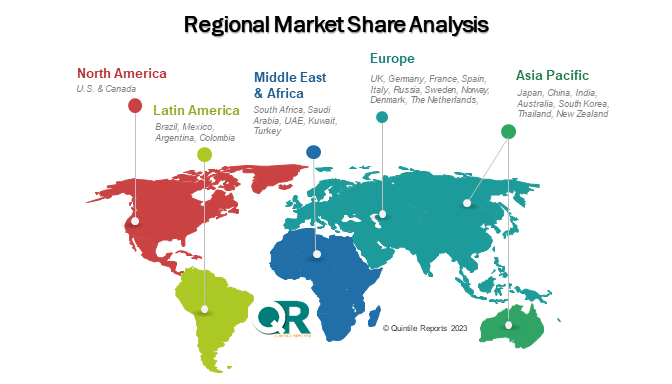
The chapter in Oscillating Tools market research report is a pivotal section that examines and predicts the market dynamics and trends specific to different geographical regions. This chapter is crucial for businesses and stakeholders seeking a comprehensive understanding of how the market behaves across various locations, enabling them to tailor strategies and make informed decisions based on regional variations. The regional analysis chapter of our Oscillating Tools market report is classified into regions & country-level. The chapter consists of North America (U.S., Canada), Europe (UK, Germany, France, Italy, Spain, Russia, Sweden, Denmark, Norway, Rest of Europe), Asia Pacific (Japan, China, India, Australia, South Korea, Thailand, Rest of Asia Pacific), Latin America (Brazil, Mexico, Argentina, Colombia, Rest of Latin America), Middle East & Africa (South Africa, Saudi Arabia, UAE, Kuwait, Rest of Middle East & Africa).
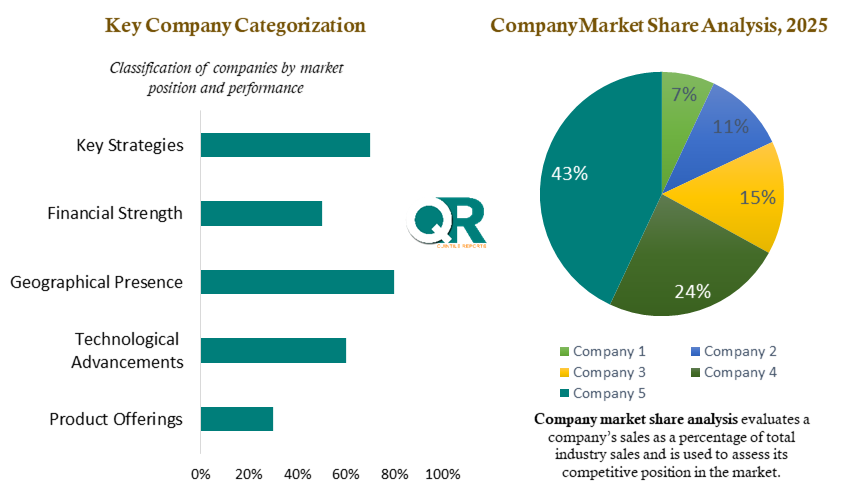
This section of a Oscillating Tools market report is a crucial segment that provides a comprehensive overview of the competitive landscape within the market. This section is vital for businesses, investors, and stakeholders seeking insights into key players, their market positioning, strengths, weaknesses, strategies, and potential impacts on the overall market dynamics. The chapter includes research methodology used to analyse the market competition, list of key players operating in the market, detailed company profile section which includes company overview, business verticals, financial performance, product/services benchmarking, geographical presence, and strategic initiatives.
| Report Scope | Details |
| Report Version | 2026 |
| Growth Rate | CAGR of 5.99 from 2026 to 2035 |
| Base Year | 2025 |
| Actual Estimates / Historical Data | 2017 - 2024 |
| Forecast Period | 2026 - 2035 |
| Quantitative Units | Revenue in USD million/billion & CAGR from 2026 to 2035 |
| Country Scope | North America (U.S., Canada), Europe (UK, Germany, France, Italy, Spain, Russia, Sweden, Denmark, Norway, Rest of Europe), Asia Pacific (Japan, China, India, Australia, South Korea, Thailand, Rest of Asia Pacific), Latin America (Brazil, Mexico, Argentina, Colombia, Rest of Latin America), Middle East & Africa (South Africa, Saudi Arabia, UAE, Kuwait, Rest of Middle East & Africa). |
| The Segment Covered by Product Type & Technology |
|
| The Segment Covered by Power & Amperage |
|
| Companies Covered |
|
| Report Coverage | Revenue forecast, company share, competitive landscape, growth factors, and trends |
| Free Customization Scope (Equivalent to 5 Analyst Working Days) | If you need specific information, which is not currently within the scope of the report, we will provide it to you as a part of the customization |

Statistics for the 2025 Oscillating Tools market share, size, and revenue growth rate were created by Quintile Report™. Oscillating Tools analysis includes a market forecast outlook for 2035 and a historical overview. Get a free PDF sample of this market analysis, please get in touch with our principal analyst at sales@quintilereports.com
List of Tables
Table 1 List of Abbreviation and acronyms
Table 2 List of Sources
Table 3 North America Global Oscillating Tools Market, by Segment Analysis, (USD Million) 2017-2035
Table 4 North America Global Oscillating Tools Market, by Region, (USD Million) 2017-2035
Table 5 U.S. Global Oscillating Tools Market, by Segment Analysis, (USD Million) 2017-2035
Table 6 Canada Global Oscillating Tools Market, by Segment Analysis, (USD Million) 2017-2035
Table 7 Europe Global Oscillating Tools Market, by Segment Analysis, (USD Million) 2017-2035
Table 8 Europe Global Oscillating Tools Market, by Region, (USD Million) 2017-2035
Table 9 Germany Global Oscillating Tools Market, by Segment Analysis, (USD Million) 2017-2035
Table 10 U.K. Global Oscillating Tools Market, by Segment Analysis, (USD Million) 2017-2035
Table 11 France Global Oscillating Tools Market, by Segment Analysis, (USD Million) 2017-2035
Table 12 Italy Global Oscillating Tools Market, by Segment Analysis, (USD Million) 2017-2035
Table 13 Spain Global Oscillating Tools Market, by Segment Analysis, (USD Million) 2017-2035
Table 14 Sweden Global Oscillating Tools Market, by Segment Analysis, (USD Million) 2017-2035
Table 15 Denmark Global Oscillating Tools Market, by Segment Analysis, (USD Million) 2017-2035
Table 16 Norway Global Oscillating Tools Market, by Segment Analysis, (USD Million) 2017-2035
Table 17 The Netherlands Global Oscillating Tools Market, by Segment Analysis, (USD Million) 2017-2035
Table 18 Russia Global Oscillating Tools Market, by Segment Analysis, (USD Million) 2017-2035
Table 19 Asia Pacific Global Oscillating Tools Market, by Segment Analysis, (USD Million) 2017-2035
Table 20 Asia Pacific Global Oscillating Tools Market, by Region, (USD Million) 2017-2035
Table 21 China Global Oscillating Tools Market, by Segment Analysis, (USD Million) 2017-2035
Table 22 Japan Global Oscillating Tools Market, by Segment Analysis, (USD Million) 2017-2035
Table 23 India Global Oscillating Tools Market, by Segment Analysis, (USD Million) 2017-2035
Table 24 Australia Global Oscillating Tools Market, by Segment Analysis, (USD Million) 2017-2035
Table 25 South Korea Global Oscillating Tools Market, by Segment Analysis, (USD Million) 2017-2035
Table 26 Thailand Global Oscillating Tools Market, by Segment Analysis, (USD Million) 2017-2035
Table 27 Latin America Global Oscillating Tools Market, by Segment Analysis, (USD Million) 2017-2035
Table 28 Latin America Global Oscillating Tools Market, by Region, (USD Million) 2017-2035
Table 29 Brazil Global Oscillating Tools Market, by Segment Analysis, (USD Million) 2017-2035
Table 30 Mexico Global Oscillating Tools Market, by Segment Analysis, (USD Million) 2017-2035
Table 31 Argentina Global Oscillating Tools Market, by Segment Analysis, (USD Million) 2017-2035
Table 32 Middle East and Africa Global Oscillating Tools Market, by Segment Analysis, (USD Million) 2017-2035
Table 33 Middle East and Africa Global Oscillating Tools Market, by Region, (USD Million) 2017-2035
Table 34 South Africa Global Oscillating Tools Market, by Segment Analysis, (USD Million) 2017-2035
Table 35 Saudi Arabia Global Oscillating Tools Market, by Segment Analysis, (USD Million) 2017-2035
Table 36 UAE Global Oscillating Tools Market, by Segment Analysis, (USD Million) 2017-2035
Table 37 Kuwait Global Oscillating Tools Market, by Segment Analysis, (USD Million) 2017-2035
Table 38 Turkey Global Oscillating Tools Market, by Segment Analysis, (USD Million) 2017-2035
Fig.1 Market research process
Fig.2 Market research approaches
Fig.3 Global Oscillating Tools Market: market scenario
Fig.4 Global Oscillating Tools Market competitive outlook
Fig.5 Global Oscillating Tools Market driver analysis
Fig.6 Global Oscillating Tools Market restraint analysis
Fig.7 Global Oscillating Tools Market opportunity analysis
Fig.8 Global Oscillating Tools Market trends analysis
Fig.9 Global Oscillating Tools Market: Segment Analysis (Based on the scope)
Fig.10 Global Oscillating Tools Market: regional analysis
Fig.11 Global market shares and leading market players
Fig.12 North America market share and leading players
Fig.13 Europe market share and leading players
Fig.14 Asia Pacific market share and leading players
Fig.15 Latin America market share and leading players
Fig.16 Middle East & Africa market share and leading players
Fig.17 North America, by country
Fig.18 North America
Fig.19 North America market estimates and forecast, 2017-2035
Fig.20 U.S.
Fig.21 Canada
Fig.22 Europe
Fig.23 Europe market estimates and forecast, 2017-2035
Fig.24 U.K.
Fig.25 Germany
Fig.26 France
Fig.27 Italy
Fig.28 Spain
Fig.29 Sweden
Fig.30 Denmark
Fig.31 Norway
Fig.32 The Netherlands
Fig.33 Russia
Fig.34 Asia Pacific
Fig.35 Asia Pacific market estimates and forecast, 2017-2035
Fig.36 China
Fig.37 Japan
Fig.38 India
Fig.39 Australia
Fig.40 South Korea
Fig.41 Thailand
Fig.42 Latin America
Fig.43 Latin America market estimates and forecast, 2017-2035
Fig.44 Brazil
Fig.45 Mexico
Fig.46 Argentina
Fig.47 Colombia
Fig.48 Middle East and Africa
Fig.49 Middle East and Africa market estimates and forecast, 2017-2035
Fig.50 Saudi Arabia
Fig.51 South Africa
Fig.52 UAE
Fig.53 Kuwait
Fig.54 Turkey
The Global Oscillating Tools Market was valued at USD 487.81 million in 2025 and is projected to reach USD 800.88 million by 2035, expanding at a robust CAGR of 5.99% during the forecast period from 2026 to 2035. The Oscillating Tools market report delivers a comprehensive industry assessment by analyzing macroeconomic conditions, technological advancements, regulatory frameworks, and evolving consumer behavior to provide a clear outlook on future growth potential.
With 2025 as the base year, the Oscillating Tools market is experiencing steady expansion driven by continuous innovation, rising demand across end-use industries, and rapid technological progress. Market participants are increasingly optimizing their go-to-market (GTM) strategies to capitalize on emerging opportunities and adapt to shifting competitive dynamics.
Looking ahead to 2035, the market is expected to maintain strong growth momentum, supported by sustained investments in research and development, strategic partnerships, and mergers and acquisitions. Companies that focus on innovation, agile GTM execution, and alignment with evolving customer needs are well positioned to achieve long-term success. The report provides in-depth insights into key market drivers, restraints, opportunities, and challenges across segments, regions, and countries, supported by robust qualitative and quantitative analysis spanning 2017 to 2035.
The oscillating tools market refers to the global industry for multifunctional handheld power tools also called oscillating multi-tools that execute rapid back-and-forth (oscillating) motion rather than full rotations. These tools accept interchangeable heads and attachments (saw blades, sanding pads, scrapers, grinding bits) and are used for precise cutting, sanding, scraping, grout removal, and polishing across materials like wood, drywall, metal, and tile.
This market includes both corded and cordless models and targets a diverse user base from DIY homeowners to professional contractors and industrial workshops. Segmentation typically covers power source (corded vs. cordless), amperage and oscillation speed capabilities, distribution channels (retail, e-commerce), and end-use sectors (residential, commercial, industrial). Leading manufacturers such as Black & Decker, Bosch, DEWALT, FEIN, and Makita populate the space, which is driven by the tools versatility, compact design, and suitability for confined or precision applications
The increasing popularity of DIY and home improvement activities is the major driver in the oscillating tools market. Homeowners are increasingly taking on renovation and maintenance projects and finding these versatile tools ideal for precise tasks like cutting, sanding, scraping, and polishing
The expansion of construction and renovation sectors, particularly in North America, Europe, and Asia-Pacific, is further fuelling demand. Growth in residential and commercial infrastructure projects drives professional usage of oscillating tools in trades like woodworking, plumbing, and finishing.
Advances in battery technology and cordless design are accelerating adoption. Improvements in lithium-ion batteries have enhanced runtime, reduced charging times, and made cordless multi-tools more portable and user-friendly.
The rise of e-commerce and digital distribution channels is boosting market visibility and accessibility. Online platforms have made a wide variety of brands and models more readily available to both professionals and DIY users, increasing sales.
The growing focus on technological innovation, ergonomics, and smart features is enhancing appeal. Manufacturers are incorporating brushless motors, IoT-connected features, ergonomic designs, and eco-friendly components to meet evolving user demands.
The high cost of advanced oscillating tools is a significant barrier to broader market penetration. Although professional-grade tools offer powerful performance and durability, their premium pricing often deters price-sensitive buyers especially in developing regions where budget constraints are tighter.
The intense competition and price pressure within a saturated market further restrain growth. With numerous brands and low-cost alternatives emerging, profit margins are under constant threat. Inexperienced consumers may gravitate toward cheaper, unbranded tools, weakening brand loyalty and complicating pricing strategies.
The technical complexity and user learning curve of oscillating tools present adoption challenges. Novice users often find advanced models complicated, requiring education on speed settings, blade changes, and safe usage. Without adequate training or intuitive design, this complexity reduces appeal to DIY customers.
Supply chain disruptions and raw material volatility hinder steady production and pricing stability. Fluctuations in steel and electronic component availabilityexacerbated by geopolitical issues and logistical bottlenecks lead to cost inflation and inventory delays, limiting consistent product supply.
North America is the leader in the oscillating tools segment, driven by a strong DIY culture, rising disposable incomes, and a mature online retail ecosystem. Over 50% of U.S. households report using oscillating tools for home improvement, while e-commerce contributes around 40% of total sales. High consumer awareness of tool versatility, combined with manufacturers integrating smart and cordless features, bolsters market growth.
Europes market is robust with key demand stemming from renovation projects, energy-efficient construction, and historic building preservation. Countries like Germany, the UK, and France prioritize ergonomic, low-noise, and eco-friendly oscillating tools. Professional contractors account for roughly 25% of demand as EU eco-design regulations drive adoption of advanced, premium products.
Asia-Pacific is the fastest-growing region due to rapid urbanization, industrial development, and a rise in DIY culture. China, India, and Japan together make up about 25% of global sales. Affordable cordless tools with extended battery lives are especially popular among homeowners. Ongoing infrastructure projects and local manufacturing yield competitive pricing and wide product availability.
Latin Americas market is expanding steadily, led by Brazil, Mexico, and Argentina. Increased urban development and renovation activities are driving demand, especially among contractors. Local partnerships with international brands help provide reliable, cost-effective oscillating tools suited for the price-sensitive market.
The Middle East & Africa region is seeing gradual growth in oscillating tool adoption, primarily in construction, real estate, and maintenance projects in countries like UAE, Saudi Arabia, South Africa, and Nigeria. Economic diversification and infrastructure investments support demand, with manufacturers targeting the market through distributor partnerships.
The surge in e-commerce and DIY culture across the U.S. has significantly broadened demand for versatile oscillating tools. In 2023, the U.S. market is driven largely by homeowners and contractors seeking tools capable of handling diverse renovation tasks efficiently.
The widespread availability of online tutorials, video guides, and community support has empowered consumers to use oscillating tools for home improvement projects ranging from cutting and sanding to grout removal and plunge cuts. Meanwhile, technological advancements like lithium-ion battery integration have enhanced cordless tool performance, helping meet growing user expectations for portability and convenience. These trends are reshaping the U.S. tool landscape, making oscillating multi-tools essential for modern DIY and pro workflows.
Germanys robust construction sector spending around 143 billion in 2021 and a growing DIY movement (with nearly 40% of residents engaging in home projects) are major catalysts for the oscillating tool market. These versatile tools are especially valued for renovation, fitting, and precision tasks in both professional and residential settings
As a result, major manufacturers like Fein (inventor of the oscillating multitool), Bosch, and Einhell are integrating advanced functionalities into their product lines. Features such as brushless motors, lithium-ion batteries, IoT connectivity, and reduced vibration cater to both contractors and DIY enthusiasts by enhancing tool durability, precision, and user comfort. These innovations are enabling sustained market growth and positioning Germany as a leading hub for oscillating tool advancement in Europe
Japans growing DIY movement particularly among urban home owners has led to increased demand for compact, multipurpose oscillating tools for home renovations, crafts, and repairs. These space-saving tools are ideal for small living spaces and versatile tasks like furniture assembly and wall cutting.
At the same time, major manufacturers such as Makita, Bosch, and Panasonic are driving sales with advanced cordless oscillating tools powered by lithium-ion batteries. These tools offer enhanced portability, longer runtime, and ergonomic designs meeting the needs of both professionals and hobbyists. The integration of IoT connectivity and smart features further boosts their appeal, solidifying Japan's role in the global oscillating tool market.
The Oscillating Tools market is highly competitive and innovation-driven, with leading manufacturers like Bosch, DeWalt (Stanley Black & Decker), Makita, Fein, Milwaukee, and Black & Decker pushing advancements in cordless platforms, improved battery technologies, brushless motors, Starlock interfaces, and digital controls. These innovations support precision, versatility, and performance across cutting, sanding, scraping, and polishing applications.
This innovation-led landscape fosters competition around R&D investment, regulatory compliance, and speed to market. Companies are launching new high-performance cordless models such as Makitas XGT TM001G and expanding universal blade compatibility (e.g., Dremels True Fit blades) to accelerate adoption and differentiation.
Price competitiveness remains crucial, particularly as cordless tools gain popularity. While premium brands leverage scale and innovation, mid-tier and entry-level manufacturers offer competitively priced or rental/leasing options especially in emerging markets. This strategy caters to price-sensitive DIY customers and smaller professional buyers.
The market is becoming more fragmented regionally and by specialization. North America and Europe dominate in volume and innovation, fuelled by a strong DIY culture and construction activity. Asia-Pacific is the fastest-growing region, driven by urbanization and e-commerce expansion in China, India, and Southeast Asia. Niche manufacturers are also emerging with localized features and price positioning.
Competition increasingly focuses on service ecosystems and sustainability. Brands are bundling tools with educational resources, warranty support, e-commerce services, and sustainability initiatives such as recyclable accessories and biodegradable packaging. Connected tools with IoT electronics, predictive maintenance, and online support portals are further enhancing user experience and brand loyalty
Key players in the market are Bosch Power Tools, Stanley Black & Decker (DeWalt, Craftsman), Fein Power Tools Inc., Makita Corporation, Hilti Corporation, Milwaukee Tool (Techtronic Industries), Ridgid (Emerson Electric Co.), Ryobi Tools (Techtronic Industries), Dremel (Bosch), Festool GmbH, WORX (Positec Group), Metabo HPT (Koki Holdings), Skil Power Tools, Genesis Power Tools and Chicago Electric (Harbor Freight).
Our team of experienced researchers has meticulously gathered and analyzed data to deliver a thorough examination of market dynamics, competitive landscape, and emerging technologies. With a focus on delivering actionable intelligence, this report aims to empower decision-makers with the information needed to make informed choices and stay ahead of the competition. Whether you are a seasoned industry player or a new entrant, our market research report serves as a strategic tool to navigate the complexities of the market, aiding in successful business planning and growth strategies.
This chapter of our Oscillating Tools market report provides an in-depth examination of the factors shaping the industry landscape. This section typically encompasses several key elements to offer a comprehensive understanding of the industry landscape such as market drivers & restraints analysis, market opportunities & trend analysis, market size & growth analysis, competitive analysis, SWOT analysis, business environment tools such as Porter's five forces & PESTEL analysis, Ansoff Matrix analysis, penetration & growth prospect analysis, regulatory framework & reimbursement scenario analysis, impact of macro & micro economic factors analysis such as Covid-19 impact, GDP growth, market inflation, U.S.- China trade war, Russia-Ukraine war impact, and supply chain analysis.
The segment analysis chapter of Oscillating Tools market report is a critical section that delves into a detailed examination of the market's various segments. Segmentation involves dividing the market into distinct categories based on certain criteria to better understand and address the diverse needs of consumers. This chapter typically follows the introduction and provides a more granular view of the market, offering valuable insights for businesses and stakeholders. The components of the chapter lude segment definitions to understand the inclusions and exclusions of the study, assumptions, market size estimates and growth trend analysis of each segment, qualitative analysis of the segment, technological advancements, market penetration rate, market adoption rate, market share examination by each segment, segment growth drivers and restraint barriers, consumer behaviour and challenge analysis.
The chapter in Oscillating Tools market research report is a pivotal section that examines and predicts the market dynamics and trends specific to different geographical regions. This chapter is crucial for businesses and stakeholders seeking a comprehensive understanding of how the market behaves across various locations, enabling them to tailor strategies and make informed decisions based on regional variations. The regional analysis chapter of our Oscillating Tools market report is classified into regions & country-level. The chapter consists of North America (U.S., Canada), Europe (UK, Germany, France, Italy, Spain, Russia, Sweden, Denmark, Norway, Rest of Europe), Asia Pacific (Japan, China, India, Australia, South Korea, Thailand, Rest of Asia Pacific), Latin America (Brazil, Mexico, Argentina, Colombia, Rest of Latin America), Middle East & Africa (South Africa, Saudi Arabia, UAE, Kuwait, Rest of Middle East & Africa).
This section of a Oscillating Tools market report is a crucial segment that provides a comprehensive overview of the competitive landscape within the market. This section is vital for businesses, investors, and stakeholders seeking insights into key players, their market positioning, strengths, weaknesses, strategies, and potential impacts on the overall market dynamics. The chapter includes research methodology used to analyse the market competition, list of key players operating in the market, detailed company profile section which includes company overview, business verticals, financial performance, product/services benchmarking, geographical presence, and strategic initiatives.
| Report Scope | Details |
| Report Version | 2026 |
| Growth Rate | CAGR of 5.99 from 2026 to 2035 |
| Base Year | 2025 |
| Actual Estimates / Historical Data | 2017 - 2024 |
| Forecast Period | 2026 - 2035 |
| Quantitative Units | Revenue in USD million/billion & CAGR from 2026 to 2035 |
| Country Scope | North America (U.S., Canada), Europe (UK, Germany, France, Italy, Spain, Russia, Sweden, Denmark, Norway, Rest of Europe), Asia Pacific (Japan, China, India, Australia, South Korea, Thailand, Rest of Asia Pacific), Latin America (Brazil, Mexico, Argentina, Colombia, Rest of Latin America), Middle East & Africa (South Africa, Saudi Arabia, UAE, Kuwait, Rest of Middle East & Africa). |
| The Segment Covered by Product Type & Technology |
|
| The Segment Covered by Power & Amperage |
|
| Companies Covered |
|
| Report Coverage | Revenue forecast, company share, competitive landscape, growth factors, and trends |
| Free Customization Scope (Equivalent to 5 Analyst Working Days) | If you need specific information, which is not currently within the scope of the report, we will provide it to you as a part of the customization |
Statistics for the 2025 Oscillating Tools market share, size, and revenue growth rate were created by Quintile Report™. Oscillating Tools analysis includes a market forecast outlook for 2035 and a historical overview. Get a free PDF sample of this market analysis, please get in touch with our principal analyst at sales@quintilereports.com
Table 1 List of Abbreviation and acronyms
Table 2 List of Sources
Table 3 North America Global Oscillating Tools Market, by Segment Analysis, (USD Million) 2017-2035
Table 4 North America Global Oscillating Tools Market, by Region, (USD Million) 2017-2035
Table 5 U.S. Global Oscillating Tools Market, by Segment Analysis, (USD Million) 2017-2035
Table 6 Canada Global Oscillating Tools Market, by Segment Analysis, (USD Million) 2017-2035
Table 7 Europe Global Oscillating Tools Market, by Segment Analysis, (USD Million) 2017-2035
Table 8 Europe Global Oscillating Tools Market, by Region, (USD Million) 2017-2035
Table 9 Germany Global Oscillating Tools Market, by Segment Analysis, (USD Million) 2017-2035
Table 10 U.K. Global Oscillating Tools Market, by Segment Analysis, (USD Million) 2017-2035
Table 11 France Global Oscillating Tools Market, by Segment Analysis, (USD Million) 2017-2035
Table 12 Italy Global Oscillating Tools Market, by Segment Analysis, (USD Million) 2017-2035
Table 13 Spain Global Oscillating Tools Market, by Segment Analysis, (USD Million) 2017-2035
Table 14 Sweden Global Oscillating Tools Market, by Segment Analysis, (USD Million) 2017-2035
Table 15 Denmark Global Oscillating Tools Market, by Segment Analysis, (USD Million) 2017-2035
Table 16 Norway Global Oscillating Tools Market, by Segment Analysis, (USD Million) 2017-2035
Table 17 The Netherlands Global Oscillating Tools Market, by Segment Analysis, (USD Million) 2017-2035
Table 18 Russia Global Oscillating Tools Market, by Segment Analysis, (USD Million) 2017-2035
Table 19 Asia Pacific Global Oscillating Tools Market, by Segment Analysis, (USD Million) 2017-2035
Table 20 Asia Pacific Global Oscillating Tools Market, by Region, (USD Million) 2017-2035
Table 21 China Global Oscillating Tools Market, by Segment Analysis, (USD Million) 2017-2035
Table 22 Japan Global Oscillating Tools Market, by Segment Analysis, (USD Million) 2017-2035
Table 23 India Global Oscillating Tools Market, by Segment Analysis, (USD Million) 2017-2035
Table 24 Australia Global Oscillating Tools Market, by Segment Analysis, (USD Million) 2017-2035
Table 25 South Korea Global Oscillating Tools Market, by Segment Analysis, (USD Million) 2017-2035
Table 26 Thailand Global Oscillating Tools Market, by Segment Analysis, (USD Million) 2017-2035
Table 27 Latin America Global Oscillating Tools Market, by Segment Analysis, (USD Million) 2017-2035
Table 28 Latin America Global Oscillating Tools Market, by Region, (USD Million) 2017-2035
Table 29 Brazil Global Oscillating Tools Market, by Segment Analysis, (USD Million) 2017-2035
Table 30 Mexico Global Oscillating Tools Market, by Segment Analysis, (USD Million) 2017-2035
Table 31 Argentina Global Oscillating Tools Market, by Segment Analysis, (USD Million) 2017-2035
Table 32 Middle East and Africa Global Oscillating Tools Market, by Segment Analysis, (USD Million) 2017-2035
Table 33 Middle East and Africa Global Oscillating Tools Market, by Region, (USD Million) 2017-2035
Table 34 South Africa Global Oscillating Tools Market, by Segment Analysis, (USD Million) 2017-2035
Table 35 Saudi Arabia Global Oscillating Tools Market, by Segment Analysis, (USD Million) 2017-2035
Table 36 UAE Global Oscillating Tools Market, by Segment Analysis, (USD Million) 2017-2035
Table 37 Kuwait Global Oscillating Tools Market, by Segment Analysis, (USD Million) 2017-2035
Table 38 Turkey Global Oscillating Tools Market, by Segment Analysis, (USD Million) 2017-2035
Fig.1 Market research process
Fig.2 Market research approaches
Fig.3 Global Oscillating Tools Market: market scenario
Fig.4 Global Oscillating Tools Market competitive outlook
Fig.5 Global Oscillating Tools Market driver analysis
Fig.6 Global Oscillating Tools Market restraint analysis
Fig.7 Global Oscillating Tools Market opportunity analysis
Fig.8 Global Oscillating Tools Market trends analysis
Fig.9 Global Oscillating Tools Market: Segment Analysis (Based on the scope)
Fig.10 Global Oscillating Tools Market: regional analysis
Fig.11 Global market shares and leading market players
Fig.12 North America market share and leading players
Fig.13 Europe market share and leading players
Fig.14 Asia Pacific market share and leading players
Fig.15 Latin America market share and leading players
Fig.16 Middle East & Africa market share and leading players
Fig.17 North America, by country
Fig.18 North America
Fig.19 North America market estimates and forecast, 2017-2035
Fig.20 U.S.
Fig.21 Canada
Fig.22 Europe
Fig.23 Europe market estimates and forecast, 2017-2035
Fig.24 U.K.
Fig.25 Germany
Fig.26 France
Fig.27 Italy
Fig.28 Spain
Fig.29 Sweden
Fig.30 Denmark
Fig.31 Norway
Fig.32 The Netherlands
Fig.33 Russia
Fig.34 Asia Pacific
Fig.35 Asia Pacific market estimates and forecast, 2017-2035
Fig.36 China
Fig.37 Japan
Fig.38 India
Fig.39 Australia
Fig.40 South Korea
Fig.41 Thailand
Fig.42 Latin America
Fig.43 Latin America market estimates and forecast, 2017-2035
Fig.44 Brazil
Fig.45 Mexico
Fig.46 Argentina
Fig.47 Colombia
Fig.48 Middle East and Africa
Fig.49 Middle East and Africa market estimates and forecast, 2017-2035
Fig.50 Saudi Arabia
Fig.51 South Africa
Fig.52 UAE
Fig.53 Kuwait
Fig.54 Turkey

A license granted to one user. Rules or conditions might be applied for e.g. the use of electric files (PDFs) or printings, depending on product.
A license granted to multiple users.
A license granted to a single business site/establishment.
A license granted to all employees within organisation access to the product.
Immediate / Within 24-48 hours - Working days
Online Payments with PayPal and CCavenue
You can order a report by picking any of the payment methods which is bank wire or online payment through any Debit/Credit card or PayPal.
Hard Copy
Report OverviewThe Global Self-Loading Concrete Mixer Market was valued at USD 12.46 billion in 2025
Read MoreReport OverviewThe Global Marine Turbochargers Market was valued at USD 762.32 million in 2025 and i
Read MoreReport OverviewThe Global Drone Services Market was valued at USD 10.18 billion in 2025 and is proje
Read More U.S. : +1-201-772-7734