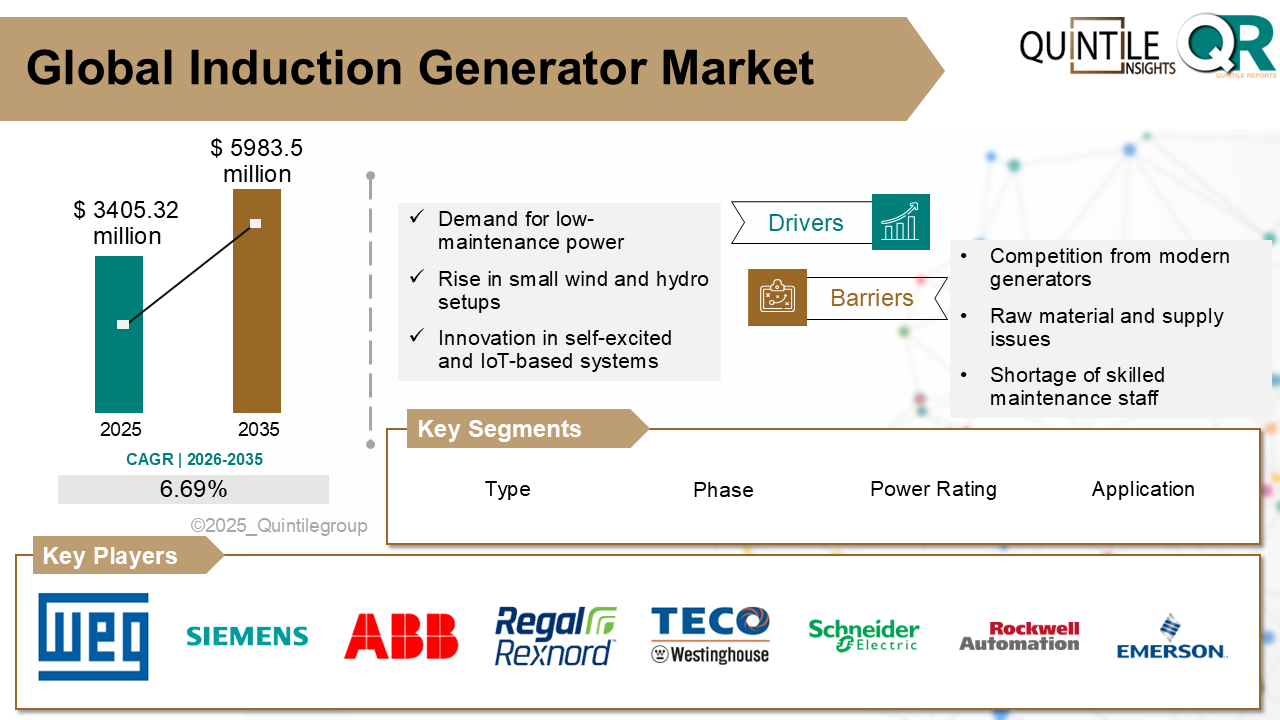
The Global Induction Generator Market was valued at USD 3405.32 million in 2025 and is projected to reach USD 5983.5 million by 2035, expanding at a robust CAGR of 6.69% during the forecast period from 2026 to 2035. The Induction Generator market report delivers a comprehensive industry assessment by analyzing macroeconomic conditions, technological advancements, regulatory frameworks, and evolving consumer behavior to provide a clear outlook on future growth potential.
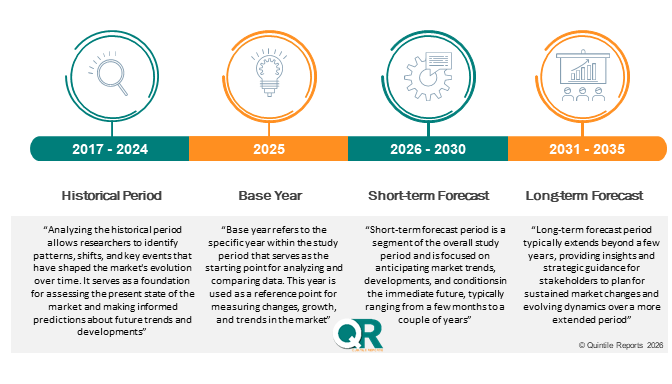
With 2025 as the base year, the Induction Generator market is experiencing steady expansion driven by continuous innovation, rising demand across end-use industries, and rapid technological progress. Market participants are increasingly optimizing their go-to-market (GTM) strategies to capitalize on emerging opportunities and adapt to shifting competitive dynamics.
Looking ahead to 2035, the market is expected to maintain strong growth momentum, supported by sustained investments in research and development, strategic partnerships, and mergers and acquisitions. Companies that focus on innovation, agile GTM execution, and alignment with evolving customer needs are well positioned to achieve long-term success. The report provides in-depth insights into key market drivers, restraints, opportunities, and challenges across segments, regions, and countries, supported by robust qualitative and quantitative analysis spanning 2017 to 2035.
The induction generator market comprises the global industry that manufactures and distributes induction generators alternating-current (AC) machines that generate electricity when their rotors are driven above synchronous speed via mechanical energy. Often used in renewable energy applications like wind turbines, micro-hydro stations, and gas-pressure energy recovery systems, these generators are prized for their mechanical simplicity, ruggedness, and ability to operate efficiently under varying speed conditions.
This market covers the full product ecosystem, including high- and medium-voltage induction generator units, rotor winding systems, excitation components (capacitor banks or grid-supplied reactive power), and peripheral accessories, deployed across sectors such as renewable energy, industrial backup power, microgrids, and off-grid electrification. The market is supported by trends in renewable energy expansion particularly in wind and hydropower advancements in connected and doubly-fed generator configurations, and demand for low-maintenance, distributed power generation solutions in regions like Asia-Pacific, North America, and Africa.
The global shift toward renewable energy sources, especially wind and small-scale hydropower, is the primary catalyst driving demand for induction generators. Their adaptability to variable-speed operations makes them essential in renewable installations.
The rising need for decentralized and off-grid power solutions particularly in rural electrification, remote industrial sites, and backup power systems is further fuelling adoption. Induction generators offer ruggedness, low maintenance, and simplicity, making them ideal for these scenarios.
Technological innovation, including advancements in doubly-fed systems, rotor/stator design, digital monitoring, IoT, and AI-powered diagnostics, is enhancing efficiency, reliability, and ease of maintenance.
Favourable government policies, subsidies, and regulatory support for clean energy adoption are encouraging the deployment of induction generators in renewable and hybrid setups aligning with global carbon-reduction objectives.
Robust infrastructure and capacity growth in emerging markets particularly in Asia-Pacific, Latin America, and Africa is expanding the market. Rising electrification efforts, renewable projects, and microgrid deployment are boosting uptake in these regions.
The high initial cost and lifecycle expenditure of induction generators is a primary challenge. While they are generally more affordable than synchronous systems, high-quality units especially those incorporating variable-speed drives or advanced controls come with significant upfront and maintenance costs. This is particularly restrictive for small-scale projects and developing regions where budgets are limited.
The technical complexities of grid integration and power-quality management also restrain broader adoption. Induction generators can cause voltage fluctuations and consume reactive power, necessitating extra equipment for power factor correction and regulation. This integration effort, along with the need for specialized design expertise, increases both system complexity and total cost.
Raw material volatility and supply chain disruptions further limit market growth. Key components such as copper windings, stator laminations, and electrical steel saw sharp price hikes and supply delays due to geopolitical tensions and logistical bottlenecks. Additionally, incoming tariffs on critical parts are prompting regional reshoring but that brings higher upfront investment and potential production delays.
Strong competition from alternative generator technologies like permanent magnet synchronous generators and battery storage solutions poses significant restraint. These substitutes often offer higher efficiency, better compactness, and simplified grid integration. As renewable and hybrid power systems evolve, buyers increasingly favour these options over traditional induction-based systems.
North America remains a strong market for induction generators, driven by significant investments in renewable energy especially wind and small hydropower installations. Demand is further supported by U.S. Department of Energy incentives targeting microgrid and distributed power systems. Tariff-driven shifts have led to increased domestic manufacturing and facility expansion in the Midwest and Southeast. Businesses and utilities are showing interest in smart-grid ready generators enhanced with AI diagnostics and IoT connectivity to ensure grid stability and backup power.
Europe maintains a solid demand for induction generators, largely fuelled by its focus on renewable energy, particularly offshore and onshore wind projects in countries like Germany, Denmark, and Spain. Replacement or repowering initiatives for aging wind farms, coupled with smart-grid integration efforts, continue to support market expansion. Regulatory emphasis on grid conformity and reactive power management ensures ongoing demand for advanced generator technologies.
Asia-Pacific is the fastest-growing region in the induction generator market. Rapid industrial and infrastructure expansion in China and India, coupled with widespread adoption of renewable solutions, drive strong uptake. Australia, Japan, South Korea, and Southeast Asia are also advancing boosted by modernization plans in rural and mining sectors. Local manufacturing of scalable, cost-efficient generator models tailored for variable renewable integration reinforces regional growth.
Latin America is experiencing steady growth in induction generator use, thanks to proactive rural electrification and diversified renewable energy portfolios hydro, wind, and solar. Countries like Brazil, Mexico, and Argentina are adopting decentralized power systems to address grid limitations. Industry analyses also project a tripling of renewable capacity by 2050, further increasing demand for induction generators.
The Middle East & Africa region is steadily expanding into induction generators, utilizing them primarily in variable-speed generator applications across wind farms and remote power infrastructure. Gulf states such as Saudi Arabia, the UAE, and select African countries are deploying generation systems that integrate induction technology with renewable and oil & gas operations. The region is also adopting predictive maintenance smart features and generator systems tailored for grid resilience.
The rapid growth of renewable energy projects particularly wind power has made induction generators, especially doubly-fed induction generators (DFIGs), a preferred solution across the United States. These generators offer flexibility in variable wind conditions, allowing efficient energy conversion without requiring constant grid synchronization. Their ability to regulate voltage and frequency has become crucial in supporting grid stability, especially in regions like Texas and the Midwest, where wind energy penetration is high.
Further driving adoption is the U.S. government's push for grid modernization under the Infrastructure Investment and Jobs Act. This includes investments in smart inverters and energy storage systems that complement induction generator-based systems. Utility companies favour these generators for their lower maintenance costs, fault-ride-through capabilities, and adaptability to both large-scale and distributed wind applications making them an essential component in the countrys renewable energy strategy.
Germanys nationwide push toward renewable energy under the Renewable Energy Sources Act (EEG), which mandates expanding wind and solar power comprising over 52 % of electricity in 2023 has significantly increased the deployment of induction generators, especially doubly-fed induction units in wind turbines and hybrid renewable systems.
This demand is reinforced by regulatory emphasis on grid stability and reactive power support: DFIG-based induction generators are essential for maintaining voltage quality and frequency responsiveness amid fluctuating renewable inputs. Local R&D and incentives under Germanys Industry 4.0 and clean energy policies are catalysing smart, IoT-enabled induction generator installations within decentralized energy projects, rural microgrids, and prosumer applications.
Japan's aggressive renewable energy targets aiming for 3638% of electricity from renewables by 2030 and up to 50% by 2040 have significantly increased deployment of induction generators (especially doubly-fed induction generators, DFIGs) in wind farms.
This renewable push is supported by legislative reforms like the shift from FIT to FIP schemes and grid upgrades (e.g., expanded transmission capacity and HVDC connections), enabling higher integration of variable renewables. Induction generators offer vital grid stability, voltage control, and fault-ride through capability amid greater renewable penetration cementing their role in Japan's clean energy strategy,
The Induction Generator market is highly competitive and innovation-driven, with manufacturers focusing on enhanced efficiency, compact designs, and integration with renewables like wind, hydro, and hybrid systems. Companies are embedding smart sensors, IoT connectivity, AI-powered predictive maintenance, and modular setups in generators especially for small wind and micro-hydro applications.
This innovation landscape fosters competition through R&D strength, regulatory compliance, and speed to deployment. Firms are forming strategic partnerships such as ABBs acquisition of Gamesa Electrics power electronics business and investing in next-gen tech like self-excited and doubly-fed induction generators (DFIGs), which boost grid compatibility and performance. Compliance with emerging sustainability regulations and sustainable manufacturing practices are becoming crucial strategic differentiators.
Price competitiveness plays a pivotal role, especially in emerging markets and off-grid applications. Global leaders (e.g., ABB, Siemens, GE, Schneider) leverage scale and supply chain efficiencies, while mid-tier and regional vendors offer simplified, entry-level designs tailored to local cost structures. Leasing and rental models are also gaining ground, enabling customers to access technology with lower capital investment.
The market is gradually fragmenting with the growth of regional and niche firms, driven by demand in Asia-Pacific, Latin America, and Africa. Asia-Pacific is currently the fastest-growing region, supported by energy policies and infrastructure upgrades in China and India. Companies are tailoring offerings by application such as high-voltage units for utility-scale wind and micro-hydro systems, and mobile generators for off-grid power.
Competition extends to ecosystem services and user experience. Providers bundle hardware with digital tools like cloud monitoring, real-time diagnostics, remote support, and integration with smart grids or hybrid systems. Adoption of eco-friendly materials and recyclability is also rising, aligning with circular economy goals
Key players in the market are Siemens AG, ABB Ltd., GE Vernova (General Electric), WEG Electric Corp., Regal Rexnord Corporation, TECO-Westinghouse Motor Company, Schneider Electric, Rockwell Automation, Inc., Emerson Electric Co., Leroy-Somer (Nidec Group), Kirloskar Electric Company, Bharat Heavy Electricals Limited (BHEL), CG Power and Industrial Solutions Ltd., Toshiba Corporation and Hyundai Electric & Energy Systems Co., Ltd.
Our team of experienced researchers has meticulously gathered and analyzed data to deliver a thorough examination of market dynamics, competitive landscape, and emerging technologies. With a focus on delivering actionable intelligence, this report aims to empower decision-makers with the information needed to make informed choices and stay ahead of the competition. Whether you are a seasoned industry player or a new entrant, our market research report serves as a strategic tool to navigate the complexities of the market, aiding in successful business planning and growth strategies.
This chapter of our Induction Generator market report provides an in-depth examination of the factors shaping the industry landscape. This section typically encompasses several key elements to offer a comprehensive understanding of the industry landscape such as market drivers & restraints analysis, market opportunities & trend analysis, market size & growth analysis, competitive analysis, SWOT analysis, business environment tools such as Porter's five forces & PESTEL analysis, Ansoff Matrix analysis, penetration & growth prospect analysis, regulatory framework & reimbursement scenario analysis, impact of macro & micro economic factors analysis such as Covid-19 impact, GDP growth, market inflation, U.S.- China trade war, Russia-Ukraine war impact, and supply chain analysis.
The segment analysis chapter of Induction Generator market report is a critical section that delves into a detailed examination of the market's various segments. Segmentation involves dividing the market into distinct categories based on certain criteria to better understand and address the diverse needs of consumers. This chapter typically follows the introduction and provides a more granular view of the market, offering valuable insights for businesses and stakeholders. The components of the chapter lude segment definitions to understand the inclusions and exclusions of the study, assumptions, market size estimates and growth trend analysis of each segment, qualitative analysis of the segment, technological advancements, market penetration rate, market adoption rate, market share examination by each segment, segment growth drivers and restraint barriers, consumer behaviour and challenge analysis.
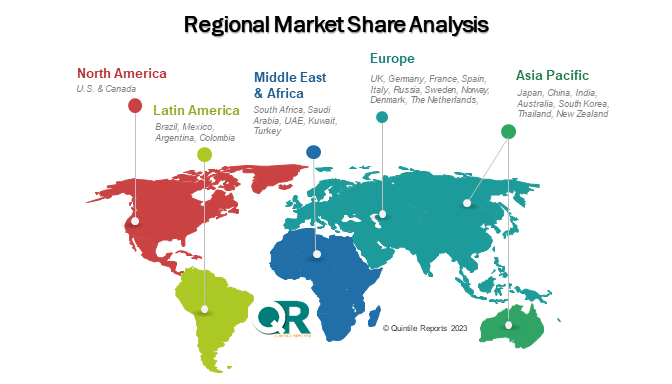
The chapter in Induction Generator market research report is a pivotal section that examines and predicts the market dynamics and trends specific to different geographical regions. This chapter is crucial for businesses and stakeholders seeking a comprehensive understanding of how the market behaves across various locations, enabling them to tailor strategies and make informed decisions based on regional variations. The regional analysis chapter of our Induction Generator market report is classified into regions & country-level. The chapter consists of North America (U.S., Canada), Europe (UK, Germany, France, Italy, Spain, Russia, Sweden, Denmark, Norway, Rest of Europe), Asia Pacific (Japan, China, India, Australia, South Korea, Thailand, Rest of Asia Pacific), Latin America (Brazil, Mexico, Argentina, Colombia, Rest of Latin America), Middle East & Africa (South Africa, Saudi Arabia, UAE, Kuwait, Rest of Middle East & Africa).
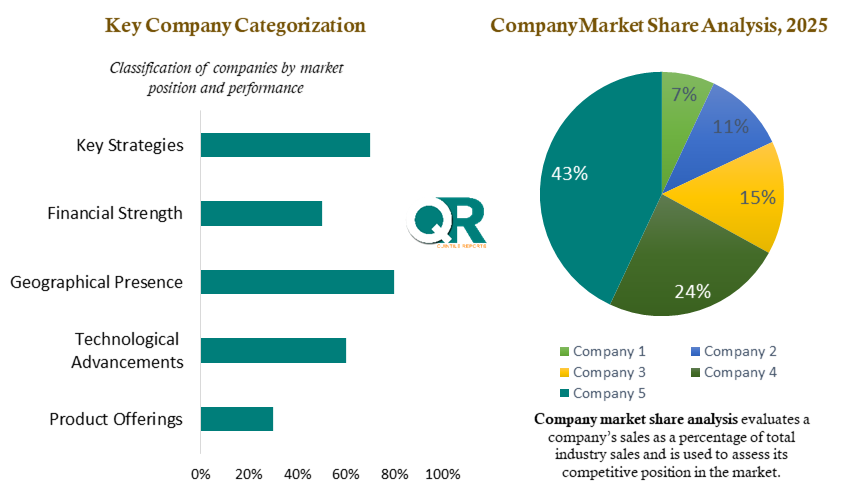
This section of a Induction Generator market report is a crucial segment that provides a comprehensive overview of the competitive landscape within the market. This section is vital for businesses, investors, and stakeholders seeking insights into key players, their market positioning, strengths, weaknesses, strategies, and potential impacts on the overall market dynamics. The chapter includes research methodology used to analyse the market competition, list of key players operating in the market, detailed company profile section which includes company overview, business verticals, financial performance, product/services benchmarking, geographical presence, and strategic initiatives.
| Report Scope | Details |
| Report Version | 2026 |
| Growth Rate | CAGR of 6.69 from 2026 to 2035 |
| Base Year | 2025 |
| Actual Estimates / Historical Data | 2017 - 2024 |
| Forecast Period | 2026 - 2035 |
| Quantitative Units | Revenue in USD million/billion & CAGR from 2026 to 2035 |
| Country Scope | North America (U.S., Canada), Europe (UK, Germany, France, Italy, Spain, Russia, Sweden, Denmark, Norway, Rest of Europe), Asia Pacific (Japan, China, India, Australia, South Korea, Thailand, Rest of Asia Pacific), Latin America (Brazil, Mexico, Argentina, Colombia, Rest of Latin America), Middle East & Africa (South Africa, Saudi Arabia, UAE, Kuwait, Rest of Middle East & Africa). |
| The Segment Covered by Type & Phase |
|
| The Segment Covered by Power Rating |
|
| Companies Covered |
|
| Report Coverage | Revenue forecast, company share, competitive landscape, growth factors, and trends |
| Free Customization Scope (Equivalent to 5 Analyst Working Days) | If you need specific information, which is not currently within the scope of the report, we will provide it to you as a part of the customization |

Statistics for the 2025 Induction Generator market share, size, and revenue growth rate were created by Quintile Report™. Induction Generator analysis includes a market forecast outlook for 2035 and a historical overview. Get a free PDF sample of this market analysis, please get in touch with our principal analyst at sales@quintilereports.com
List of Tables
Table 1 List of Abbreviation and acronyms
Table 2 List of Sources
Table 3 North America Global Induction Generator Market, by Segment Analysis, (USD Million) 2017-2035
Table 4 North America Global Induction Generator Market, by Region, (USD Million) 2017-2035
Table 5 U.S. Global Induction Generator Market, by Segment Analysis, (USD Million) 2017-2035
Table 6 Canada Global Induction Generator Market, by Segment Analysis, (USD Million) 2017-2035
Table 7 Europe Global Induction Generator Market, by Segment Analysis, (USD Million) 2017-2035
Table 8 Europe Global Induction Generator Market, by Region, (USD Million) 2017-2035
Table 9 Germany Global Induction Generator Market, by Segment Analysis, (USD Million) 2017-2035
Table 10 U.K. Global Induction Generator Market, by Segment Analysis, (USD Million) 2017-2035
Table 11 France Global Induction Generator Market, by Segment Analysis, (USD Million) 2017-2035
Table 12 Italy Global Induction Generator Market, by Segment Analysis, (USD Million) 2017-2035
Table 13 Spain Global Induction Generator Market, by Segment Analysis, (USD Million) 2017-2035
Table 14 Sweden Global Induction Generator Market, by Segment Analysis, (USD Million) 2017-2035
Table 15 Denmark Global Induction Generator Market, by Segment Analysis, (USD Million) 2017-2035
Table 16 Norway Global Induction Generator Market, by Segment Analysis, (USD Million) 2017-2035
Table 17 The Netherlands Global Induction Generator Market, by Segment Analysis, (USD Million) 2017-2035
Table 18 Russia Global Induction Generator Market, by Segment Analysis, (USD Million) 2017-2035
Table 19 Asia Pacific Global Induction Generator Market, by Segment Analysis, (USD Million) 2017-2035
Table 20 Asia Pacific Global Induction Generator Market, by Region, (USD Million) 2017-2035
Table 21 China Global Induction Generator Market, by Segment Analysis, (USD Million) 2017-2035
Table 22 Japan Global Induction Generator Market, by Segment Analysis, (USD Million) 2017-2035
Table 23 India Global Induction Generator Market, by Segment Analysis, (USD Million) 2017-2035
Table 24 Australia Global Induction Generator Market, by Segment Analysis, (USD Million) 2017-2035
Table 25 South Korea Global Induction Generator Market, by Segment Analysis, (USD Million) 2017-2035
Table 26 Thailand Global Induction Generator Market, by Segment Analysis, (USD Million) 2017-2035
Table 27 Latin America Global Induction Generator Market, by Segment Analysis, (USD Million) 2017-2035
Table 28 Latin America Global Induction Generator Market, by Region, (USD Million) 2017-2035
Table 29 Brazil Global Induction Generator Market, by Segment Analysis, (USD Million) 2017-2035
Table 30 Mexico Global Induction Generator Market, by Segment Analysis, (USD Million) 2017-2035
Table 31 Argentina Global Induction Generator Market, by Segment Analysis, (USD Million) 2017-2035
Table 32 Middle East and Africa Global Induction Generator Market, by Segment Analysis, (USD Million) 2017-2035
Table 33 Middle East and Africa Global Induction Generator Market, by Region, (USD Million) 2017-2035
Table 34 South Africa Global Induction Generator Market, by Segment Analysis, (USD Million) 2017-2035
Table 35 Saudi Arabia Global Induction Generator Market, by Segment Analysis, (USD Million) 2017-2035
Table 36 UAE Global Induction Generator Market, by Segment Analysis, (USD Million) 2017-2035
Table 37 Kuwait Global Induction Generator Market, by Segment Analysis, (USD Million) 2017-2035
Table 38 Turkey Global Induction Generator Market, by Segment Analysis, (USD Million) 2017-2035
Fig.1 Market research process
Fig.2 Market research approaches
Fig.3 Global Induction Generator Market: market scenario
Fig.4 Global Induction Generator Market competitive outlook
Fig.5 Global Induction Generator Market driver analysis
Fig.6 Global Induction Generator Market restraint analysis
Fig.7 Global Induction Generator Market opportunity analysis
Fig.8 Global Induction Generator Market trends analysis
Fig.9 Global Induction Generator Market: Segment Analysis (Based on the scope)
Fig.10 Global Induction Generator Market: regional analysis
Fig.11 Global market shares and leading market players
Fig.12 North America market share and leading players
Fig.13 Europe market share and leading players
Fig.14 Asia Pacific market share and leading players
Fig.15 Latin America market share and leading players
Fig.16 Middle East & Africa market share and leading players
Fig.17 North America, by country
Fig.18 North America
Fig.19 North America market estimates and forecast, 2017-2035
Fig.20 U.S.
Fig.21 Canada
Fig.22 Europe
Fig.23 Europe market estimates and forecast, 2017-2035
Fig.24 U.K.
Fig.25 Germany
Fig.26 France
Fig.27 Italy
Fig.28 Spain
Fig.29 Sweden
Fig.30 Denmark
Fig.31 Norway
Fig.32 The Netherlands
Fig.33 Russia
Fig.34 Asia Pacific
Fig.35 Asia Pacific market estimates and forecast, 2017-2035
Fig.36 China
Fig.37 Japan
Fig.38 India
Fig.39 Australia
Fig.40 South Korea
Fig.41 Thailand
Fig.42 Latin America
Fig.43 Latin America market estimates and forecast, 2017-2035
Fig.44 Brazil
Fig.45 Mexico
Fig.46 Argentina
Fig.47 Colombia
Fig.48 Middle East and Africa
Fig.49 Middle East and Africa market estimates and forecast, 2017-2035
Fig.50 Saudi Arabia
Fig.51 South Africa
Fig.52 UAE
Fig.53 Kuwait
Fig.54 Turkey
The Global Induction Generator Market was valued at USD 3405.32 million in 2025 and is projected to reach USD 5983.5 million by 2035, expanding at a robust CAGR of 6.69% during the forecast period from 2026 to 2035. The Induction Generator market report delivers a comprehensive industry assessment by analyzing macroeconomic conditions, technological advancements, regulatory frameworks, and evolving consumer behavior to provide a clear outlook on future growth potential.
With 2025 as the base year, the Induction Generator market is experiencing steady expansion driven by continuous innovation, rising demand across end-use industries, and rapid technological progress. Market participants are increasingly optimizing their go-to-market (GTM) strategies to capitalize on emerging opportunities and adapt to shifting competitive dynamics.
Looking ahead to 2035, the market is expected to maintain strong growth momentum, supported by sustained investments in research and development, strategic partnerships, and mergers and acquisitions. Companies that focus on innovation, agile GTM execution, and alignment with evolving customer needs are well positioned to achieve long-term success. The report provides in-depth insights into key market drivers, restraints, opportunities, and challenges across segments, regions, and countries, supported by robust qualitative and quantitative analysis spanning 2017 to 2035.
The induction generator market comprises the global industry that manufactures and distributes induction generators alternating-current (AC) machines that generate electricity when their rotors are driven above synchronous speed via mechanical energy. Often used in renewable energy applications like wind turbines, micro-hydro stations, and gas-pressure energy recovery systems, these generators are prized for their mechanical simplicity, ruggedness, and ability to operate efficiently under varying speed conditions.
This market covers the full product ecosystem, including high- and medium-voltage induction generator units, rotor winding systems, excitation components (capacitor banks or grid-supplied reactive power), and peripheral accessories, deployed across sectors such as renewable energy, industrial backup power, microgrids, and off-grid electrification. The market is supported by trends in renewable energy expansion particularly in wind and hydropower advancements in connected and doubly-fed generator configurations, and demand for low-maintenance, distributed power generation solutions in regions like Asia-Pacific, North America, and Africa.
The global shift toward renewable energy sources, especially wind and small-scale hydropower, is the primary catalyst driving demand for induction generators. Their adaptability to variable-speed operations makes them essential in renewable installations.
The rising need for decentralized and off-grid power solutions particularly in rural electrification, remote industrial sites, and backup power systems is further fuelling adoption. Induction generators offer ruggedness, low maintenance, and simplicity, making them ideal for these scenarios.
Technological innovation, including advancements in doubly-fed systems, rotor/stator design, digital monitoring, IoT, and AI-powered diagnostics, is enhancing efficiency, reliability, and ease of maintenance.
Favourable government policies, subsidies, and regulatory support for clean energy adoption are encouraging the deployment of induction generators in renewable and hybrid setups aligning with global carbon-reduction objectives.
Robust infrastructure and capacity growth in emerging markets particularly in Asia-Pacific, Latin America, and Africa is expanding the market. Rising electrification efforts, renewable projects, and microgrid deployment are boosting uptake in these regions.
The high initial cost and lifecycle expenditure of induction generators is a primary challenge. While they are generally more affordable than synchronous systems, high-quality units especially those incorporating variable-speed drives or advanced controls come with significant upfront and maintenance costs. This is particularly restrictive for small-scale projects and developing regions where budgets are limited.
The technical complexities of grid integration and power-quality management also restrain broader adoption. Induction generators can cause voltage fluctuations and consume reactive power, necessitating extra equipment for power factor correction and regulation. This integration effort, along with the need for specialized design expertise, increases both system complexity and total cost.
Raw material volatility and supply chain disruptions further limit market growth. Key components such as copper windings, stator laminations, and electrical steel saw sharp price hikes and supply delays due to geopolitical tensions and logistical bottlenecks. Additionally, incoming tariffs on critical parts are prompting regional reshoring but that brings higher upfront investment and potential production delays.
Strong competition from alternative generator technologies like permanent magnet synchronous generators and battery storage solutions poses significant restraint. These substitutes often offer higher efficiency, better compactness, and simplified grid integration. As renewable and hybrid power systems evolve, buyers increasingly favour these options over traditional induction-based systems.
North America remains a strong market for induction generators, driven by significant investments in renewable energy especially wind and small hydropower installations. Demand is further supported by U.S. Department of Energy incentives targeting microgrid and distributed power systems. Tariff-driven shifts have led to increased domestic manufacturing and facility expansion in the Midwest and Southeast. Businesses and utilities are showing interest in smart-grid ready generators enhanced with AI diagnostics and IoT connectivity to ensure grid stability and backup power.
Europe maintains a solid demand for induction generators, largely fuelled by its focus on renewable energy, particularly offshore and onshore wind projects in countries like Germany, Denmark, and Spain. Replacement or repowering initiatives for aging wind farms, coupled with smart-grid integration efforts, continue to support market expansion. Regulatory emphasis on grid conformity and reactive power management ensures ongoing demand for advanced generator technologies.
Asia-Pacific is the fastest-growing region in the induction generator market. Rapid industrial and infrastructure expansion in China and India, coupled with widespread adoption of renewable solutions, drive strong uptake. Australia, Japan, South Korea, and Southeast Asia are also advancing boosted by modernization plans in rural and mining sectors. Local manufacturing of scalable, cost-efficient generator models tailored for variable renewable integration reinforces regional growth.
Latin America is experiencing steady growth in induction generator use, thanks to proactive rural electrification and diversified renewable energy portfolios hydro, wind, and solar. Countries like Brazil, Mexico, and Argentina are adopting decentralized power systems to address grid limitations. Industry analyses also project a tripling of renewable capacity by 2050, further increasing demand for induction generators.
The Middle East & Africa region is steadily expanding into induction generators, utilizing them primarily in variable-speed generator applications across wind farms and remote power infrastructure. Gulf states such as Saudi Arabia, the UAE, and select African countries are deploying generation systems that integrate induction technology with renewable and oil & gas operations. The region is also adopting predictive maintenance smart features and generator systems tailored for grid resilience.
The rapid growth of renewable energy projects particularly wind power has made induction generators, especially doubly-fed induction generators (DFIGs), a preferred solution across the United States. These generators offer flexibility in variable wind conditions, allowing efficient energy conversion without requiring constant grid synchronization. Their ability to regulate voltage and frequency has become crucial in supporting grid stability, especially in regions like Texas and the Midwest, where wind energy penetration is high.
Further driving adoption is the U.S. government's push for grid modernization under the Infrastructure Investment and Jobs Act. This includes investments in smart inverters and energy storage systems that complement induction generator-based systems. Utility companies favour these generators for their lower maintenance costs, fault-ride-through capabilities, and adaptability to both large-scale and distributed wind applications making them an essential component in the countrys renewable energy strategy.
Germanys nationwide push toward renewable energy under the Renewable Energy Sources Act (EEG), which mandates expanding wind and solar power comprising over 52 % of electricity in 2023 has significantly increased the deployment of induction generators, especially doubly-fed induction units in wind turbines and hybrid renewable systems.
This demand is reinforced by regulatory emphasis on grid stability and reactive power support: DFIG-based induction generators are essential for maintaining voltage quality and frequency responsiveness amid fluctuating renewable inputs. Local R&D and incentives under Germanys Industry 4.0 and clean energy policies are catalysing smart, IoT-enabled induction generator installations within decentralized energy projects, rural microgrids, and prosumer applications.
Japan's aggressive renewable energy targets aiming for 3638% of electricity from renewables by 2030 and up to 50% by 2040 have significantly increased deployment of induction generators (especially doubly-fed induction generators, DFIGs) in wind farms.
This renewable push is supported by legislative reforms like the shift from FIT to FIP schemes and grid upgrades (e.g., expanded transmission capacity and HVDC connections), enabling higher integration of variable renewables. Induction generators offer vital grid stability, voltage control, and fault-ride through capability amid greater renewable penetration cementing their role in Japan's clean energy strategy,
The Induction Generator market is highly competitive and innovation-driven, with manufacturers focusing on enhanced efficiency, compact designs, and integration with renewables like wind, hydro, and hybrid systems. Companies are embedding smart sensors, IoT connectivity, AI-powered predictive maintenance, and modular setups in generators especially for small wind and micro-hydro applications.
This innovation landscape fosters competition through R&D strength, regulatory compliance, and speed to deployment. Firms are forming strategic partnerships such as ABBs acquisition of Gamesa Electrics power electronics business and investing in next-gen tech like self-excited and doubly-fed induction generators (DFIGs), which boost grid compatibility and performance. Compliance with emerging sustainability regulations and sustainable manufacturing practices are becoming crucial strategic differentiators.
Price competitiveness plays a pivotal role, especially in emerging markets and off-grid applications. Global leaders (e.g., ABB, Siemens, GE, Schneider) leverage scale and supply chain efficiencies, while mid-tier and regional vendors offer simplified, entry-level designs tailored to local cost structures. Leasing and rental models are also gaining ground, enabling customers to access technology with lower capital investment.
The market is gradually fragmenting with the growth of regional and niche firms, driven by demand in Asia-Pacific, Latin America, and Africa. Asia-Pacific is currently the fastest-growing region, supported by energy policies and infrastructure upgrades in China and India. Companies are tailoring offerings by application such as high-voltage units for utility-scale wind and micro-hydro systems, and mobile generators for off-grid power.
Competition extends to ecosystem services and user experience. Providers bundle hardware with digital tools like cloud monitoring, real-time diagnostics, remote support, and integration with smart grids or hybrid systems. Adoption of eco-friendly materials and recyclability is also rising, aligning with circular economy goals
Key players in the market are Siemens AG, ABB Ltd., GE Vernova (General Electric), WEG Electric Corp., Regal Rexnord Corporation, TECO-Westinghouse Motor Company, Schneider Electric, Rockwell Automation, Inc., Emerson Electric Co., Leroy-Somer (Nidec Group), Kirloskar Electric Company, Bharat Heavy Electricals Limited (BHEL), CG Power and Industrial Solutions Ltd., Toshiba Corporation and Hyundai Electric & Energy Systems Co., Ltd.
Our team of experienced researchers has meticulously gathered and analyzed data to deliver a thorough examination of market dynamics, competitive landscape, and emerging technologies. With a focus on delivering actionable intelligence, this report aims to empower decision-makers with the information needed to make informed choices and stay ahead of the competition. Whether you are a seasoned industry player or a new entrant, our market research report serves as a strategic tool to navigate the complexities of the market, aiding in successful business planning and growth strategies.
This chapter of our Induction Generator market report provides an in-depth examination of the factors shaping the industry landscape. This section typically encompasses several key elements to offer a comprehensive understanding of the industry landscape such as market drivers & restraints analysis, market opportunities & trend analysis, market size & growth analysis, competitive analysis, SWOT analysis, business environment tools such as Porter's five forces & PESTEL analysis, Ansoff Matrix analysis, penetration & growth prospect analysis, regulatory framework & reimbursement scenario analysis, impact of macro & micro economic factors analysis such as Covid-19 impact, GDP growth, market inflation, U.S.- China trade war, Russia-Ukraine war impact, and supply chain analysis.
The segment analysis chapter of Induction Generator market report is a critical section that delves into a detailed examination of the market's various segments. Segmentation involves dividing the market into distinct categories based on certain criteria to better understand and address the diverse needs of consumers. This chapter typically follows the introduction and provides a more granular view of the market, offering valuable insights for businesses and stakeholders. The components of the chapter lude segment definitions to understand the inclusions and exclusions of the study, assumptions, market size estimates and growth trend analysis of each segment, qualitative analysis of the segment, technological advancements, market penetration rate, market adoption rate, market share examination by each segment, segment growth drivers and restraint barriers, consumer behaviour and challenge analysis.
The chapter in Induction Generator market research report is a pivotal section that examines and predicts the market dynamics and trends specific to different geographical regions. This chapter is crucial for businesses and stakeholders seeking a comprehensive understanding of how the market behaves across various locations, enabling them to tailor strategies and make informed decisions based on regional variations. The regional analysis chapter of our Induction Generator market report is classified into regions & country-level. The chapter consists of North America (U.S., Canada), Europe (UK, Germany, France, Italy, Spain, Russia, Sweden, Denmark, Norway, Rest of Europe), Asia Pacific (Japan, China, India, Australia, South Korea, Thailand, Rest of Asia Pacific), Latin America (Brazil, Mexico, Argentina, Colombia, Rest of Latin America), Middle East & Africa (South Africa, Saudi Arabia, UAE, Kuwait, Rest of Middle East & Africa).
This section of a Induction Generator market report is a crucial segment that provides a comprehensive overview of the competitive landscape within the market. This section is vital for businesses, investors, and stakeholders seeking insights into key players, their market positioning, strengths, weaknesses, strategies, and potential impacts on the overall market dynamics. The chapter includes research methodology used to analyse the market competition, list of key players operating in the market, detailed company profile section which includes company overview, business verticals, financial performance, product/services benchmarking, geographical presence, and strategic initiatives.
| Report Scope | Details |
| Report Version | 2026 |
| Growth Rate | CAGR of 6.69 from 2026 to 2035 |
| Base Year | 2025 |
| Actual Estimates / Historical Data | 2017 - 2024 |
| Forecast Period | 2026 - 2035 |
| Quantitative Units | Revenue in USD million/billion & CAGR from 2026 to 2035 |
| Country Scope | North America (U.S., Canada), Europe (UK, Germany, France, Italy, Spain, Russia, Sweden, Denmark, Norway, Rest of Europe), Asia Pacific (Japan, China, India, Australia, South Korea, Thailand, Rest of Asia Pacific), Latin America (Brazil, Mexico, Argentina, Colombia, Rest of Latin America), Middle East & Africa (South Africa, Saudi Arabia, UAE, Kuwait, Rest of Middle East & Africa). |
| The Segment Covered by Type & Phase |
|
| The Segment Covered by Power Rating |
|
| Companies Covered |
|
| Report Coverage | Revenue forecast, company share, competitive landscape, growth factors, and trends |
| Free Customization Scope (Equivalent to 5 Analyst Working Days) | If you need specific information, which is not currently within the scope of the report, we will provide it to you as a part of the customization |
Statistics for the 2025 Induction Generator market share, size, and revenue growth rate were created by Quintile Report™. Induction Generator analysis includes a market forecast outlook for 2035 and a historical overview. Get a free PDF sample of this market analysis, please get in touch with our principal analyst at sales@quintilereports.com
Table 1 List of Abbreviation and acronyms
Table 2 List of Sources
Table 3 North America Global Induction Generator Market, by Segment Analysis, (USD Million) 2017-2035
Table 4 North America Global Induction Generator Market, by Region, (USD Million) 2017-2035
Table 5 U.S. Global Induction Generator Market, by Segment Analysis, (USD Million) 2017-2035
Table 6 Canada Global Induction Generator Market, by Segment Analysis, (USD Million) 2017-2035
Table 7 Europe Global Induction Generator Market, by Segment Analysis, (USD Million) 2017-2035
Table 8 Europe Global Induction Generator Market, by Region, (USD Million) 2017-2035
Table 9 Germany Global Induction Generator Market, by Segment Analysis, (USD Million) 2017-2035
Table 10 U.K. Global Induction Generator Market, by Segment Analysis, (USD Million) 2017-2035
Table 11 France Global Induction Generator Market, by Segment Analysis, (USD Million) 2017-2035
Table 12 Italy Global Induction Generator Market, by Segment Analysis, (USD Million) 2017-2035
Table 13 Spain Global Induction Generator Market, by Segment Analysis, (USD Million) 2017-2035
Table 14 Sweden Global Induction Generator Market, by Segment Analysis, (USD Million) 2017-2035
Table 15 Denmark Global Induction Generator Market, by Segment Analysis, (USD Million) 2017-2035
Table 16 Norway Global Induction Generator Market, by Segment Analysis, (USD Million) 2017-2035
Table 17 The Netherlands Global Induction Generator Market, by Segment Analysis, (USD Million) 2017-2035
Table 18 Russia Global Induction Generator Market, by Segment Analysis, (USD Million) 2017-2035
Table 19 Asia Pacific Global Induction Generator Market, by Segment Analysis, (USD Million) 2017-2035
Table 20 Asia Pacific Global Induction Generator Market, by Region, (USD Million) 2017-2035
Table 21 China Global Induction Generator Market, by Segment Analysis, (USD Million) 2017-2035
Table 22 Japan Global Induction Generator Market, by Segment Analysis, (USD Million) 2017-2035
Table 23 India Global Induction Generator Market, by Segment Analysis, (USD Million) 2017-2035
Table 24 Australia Global Induction Generator Market, by Segment Analysis, (USD Million) 2017-2035
Table 25 South Korea Global Induction Generator Market, by Segment Analysis, (USD Million) 2017-2035
Table 26 Thailand Global Induction Generator Market, by Segment Analysis, (USD Million) 2017-2035
Table 27 Latin America Global Induction Generator Market, by Segment Analysis, (USD Million) 2017-2035
Table 28 Latin America Global Induction Generator Market, by Region, (USD Million) 2017-2035
Table 29 Brazil Global Induction Generator Market, by Segment Analysis, (USD Million) 2017-2035
Table 30 Mexico Global Induction Generator Market, by Segment Analysis, (USD Million) 2017-2035
Table 31 Argentina Global Induction Generator Market, by Segment Analysis, (USD Million) 2017-2035
Table 32 Middle East and Africa Global Induction Generator Market, by Segment Analysis, (USD Million) 2017-2035
Table 33 Middle East and Africa Global Induction Generator Market, by Region, (USD Million) 2017-2035
Table 34 South Africa Global Induction Generator Market, by Segment Analysis, (USD Million) 2017-2035
Table 35 Saudi Arabia Global Induction Generator Market, by Segment Analysis, (USD Million) 2017-2035
Table 36 UAE Global Induction Generator Market, by Segment Analysis, (USD Million) 2017-2035
Table 37 Kuwait Global Induction Generator Market, by Segment Analysis, (USD Million) 2017-2035
Table 38 Turkey Global Induction Generator Market, by Segment Analysis, (USD Million) 2017-2035
Fig.1 Market research process
Fig.2 Market research approaches
Fig.3 Global Induction Generator Market: market scenario
Fig.4 Global Induction Generator Market competitive outlook
Fig.5 Global Induction Generator Market driver analysis
Fig.6 Global Induction Generator Market restraint analysis
Fig.7 Global Induction Generator Market opportunity analysis
Fig.8 Global Induction Generator Market trends analysis
Fig.9 Global Induction Generator Market: Segment Analysis (Based on the scope)
Fig.10 Global Induction Generator Market: regional analysis
Fig.11 Global market shares and leading market players
Fig.12 North America market share and leading players
Fig.13 Europe market share and leading players
Fig.14 Asia Pacific market share and leading players
Fig.15 Latin America market share and leading players
Fig.16 Middle East & Africa market share and leading players
Fig.17 North America, by country
Fig.18 North America
Fig.19 North America market estimates and forecast, 2017-2035
Fig.20 U.S.
Fig.21 Canada
Fig.22 Europe
Fig.23 Europe market estimates and forecast, 2017-2035
Fig.24 U.K.
Fig.25 Germany
Fig.26 France
Fig.27 Italy
Fig.28 Spain
Fig.29 Sweden
Fig.30 Denmark
Fig.31 Norway
Fig.32 The Netherlands
Fig.33 Russia
Fig.34 Asia Pacific
Fig.35 Asia Pacific market estimates and forecast, 2017-2035
Fig.36 China
Fig.37 Japan
Fig.38 India
Fig.39 Australia
Fig.40 South Korea
Fig.41 Thailand
Fig.42 Latin America
Fig.43 Latin America market estimates and forecast, 2017-2035
Fig.44 Brazil
Fig.45 Mexico
Fig.46 Argentina
Fig.47 Colombia
Fig.48 Middle East and Africa
Fig.49 Middle East and Africa market estimates and forecast, 2017-2035
Fig.50 Saudi Arabia
Fig.51 South Africa
Fig.52 UAE
Fig.53 Kuwait
Fig.54 Turkey

A license granted to one user. Rules or conditions might be applied for e.g. the use of electric files (PDFs) or printings, depending on product.
A license granted to multiple users.
A license granted to a single business site/establishment.
A license granted to all employees within organisation access to the product.
Immediate / Within 24-48 hours - Working days
Online Payments with PayPal and CCavenue
You can order a report by picking any of the payment methods which is bank wire or online payment through any Debit/Credit card or PayPal.
Hard Copy
Report OverviewThe Global Self-Loading Concrete Mixer Market was valued at USD 12.46 billion in 2025
Read MoreReport OverviewThe Global Marine Turbochargers Market was valued at USD 762.32 million in 2025 and i
Read MoreReport OverviewThe Global Drone Services Market was valued at USD 10.18 billion in 2025 and is proje
Read More U.S. : +1-201-772-7734