The Global Marine Turbochargers Market was valued at USD 762.32 million in 2025 and is projected to reach USD 1402.5 million by 2035, expanding at a robust CAGR of 7.19% during the forecast period from 2026 to 2035. The Marine Turbochargers market report delivers a comprehensive industry assessment by analyzing macroeconomic conditions, technological advancements, regulatory frameworks, and evolving consumer behavior to provide a clear outlook on future growth potential.
With 2025 as the base year, the Marine Turbochargers market is experiencing steady expansion driven by continuous innovation, rising demand across end-use industries, and rapid technological progress. Market participants are increasingly optimizing their go-to-market (GTM) strategies to capitalize on emerging opportunities and adapt to shifting competitive dynamics.
Looking ahead to 2035, the market is expected to maintain strong growth momentum, supported by sustained investments in research and development, strategic partnerships, and mergers and acquisitions. Companies that focus on innovation, agile GTM execution, and alignment with evolving customer needs are well positioned to achieve long-term success. The report provides in-depth insights into key market drivers, restraints, opportunities, and challenges across segments, regions, and countries, supported by robust qualitative and quantitative analysis spanning 2017 to 2035.
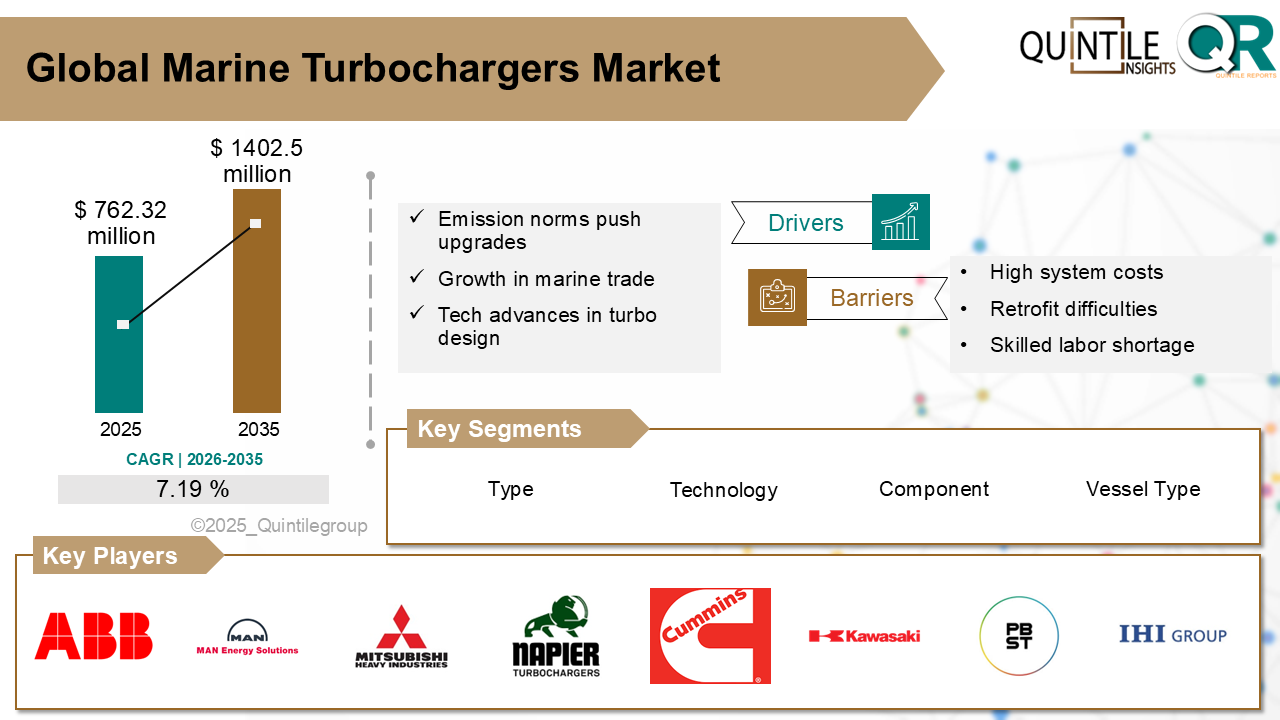
The marine turbochargers market refers to the global and regional market for turbocharging systems specifically designed for marine engines used in vessels such as cargo ships, tankers, container ships, naval vessels, and offshore support ships. Marine turbochargers enhance engine performance by forcing more air into the combustion chamber, resulting in increased power output, improved fuel efficiency, and reduced emissions. These systems are critical for both two-stroke and four-stroke diesel or gas engines operating in demanding maritime environments.
Traditionally focused on fuel economy and engine performance, the market is now increasingly influenced by environmental regulations such as IMO Tier III standards, pushing demand for high-efficiency, low-emission turbocharging solutions. Technological innovations, including variable geometry turbochargers (VGTs), hybrid turbo systems, and advanced materials for higher thermal tolerance, are shaping product development. The marine turbochargers market serves engine manufacturers, shipbuilders, and fleet operators, with both OEM installations and aftermarket retrofits contributing to demand.
The driver of growth for marine turbochargers is the greater focus on fuel efficiency and lower emissions in shipping. Turbochargers greatly enhance engine performance as they raise air inlet pressure, which in turn boosts combustion efficiency and lowers fuel consumption. As a significant percentage of shipping costs are attributed to fuel, shipping companies are investing more in turbocharging units to optimise performance as well as stay in conformity with global maritime rules.
The second major driver is the imposition of stricter environmental standards by international and regional agencies. Mandate regulations on sulfur oxide (SO) and nitrogen oxide (NO) emissions, especially in Emission Control Areas (ECAs), have prompted the use of high-efficiency engine technologies. Turbocharging allows marine engines to comply with such changing standards without sacrificing operational power and reliability, most notably in bulk carriers, tankers, and container ships.
Additionally, increasing worldwide maritime commerce and newbuilding orders are driving demand. With increasing worldwide seaborne trade, shipowners and shipyards are ordering state-of-the-art, high-powered engines with tight turbocharging systems. Even in the retrofit market, vessels are being retrofitted with more efficient turbochargers to stay competitive, to achieve emission regulations, and to meet rules.
The move toward dual-fuel and LNG-fueled engines is another principal driver. These new fuels demand high-precision combustion control as well as pressure management, both of which are supplied by turbocharging. With the increasing desire for cleaner propulsion, turbocharger engineering is well-positioned to support hybrid, dual-fuel, and electric boost-powered engines as well.
Lastly, the technological advancements and digital monitoring are driving design improvements that are increasing reliability, maintenance effectiveness, and overall performance. Technologies such as variable geometry turbochargers (VGTs), condition monitoring systems built into them, and predictive maintenance analytics are making turbochargers smarter and more economical throughout their lifecycle, which is creating more market demand.
Marine turbochargers are high-technology devices that demand precise production and strong materials that are capable of withstanding harsh sea conditions. Their purchase entails heavy capital investment, especially on dual-fuel or high-performance turbochargers installed on bulky ships. In addition, regular overhaulingnormally required by maritime regulationcould be prohibitively expensive due to the need for expertise and authorised spares, thus total life cycle costs could be a weighty financial factor.
Turbochargers experience high pressure and heat, which result in wear and tear of components such as bearing deterioration, fouling, or oil leakage. Maintenance is unavoidable but complicated, involving experienced technicians and diagnostic tools not necessarily available onboard or at smaller docks. Failure or delay in maintenance may result in vessel downtime, route disruption, and further operating loss for shipping companies.
Global decarbonization has put more pressure on ship operators to comply with IMO Tier III and EEDI regulations demanding low-NOx turbocharger technologies and lower-emission burning fuels. But installing compliant turbochargers on older engines or coupling them with hybrid propulsion is too expensive, engineer-intensive, and perhaps performance-sacrificing. This regulator drive has slowed replacement cycles and caused customers to hesitate before reinvesting.
The marine turbocharger market is characterised by a broad variety of ship, engine configurations and operating conditions that restrict standardisation. Customising the turbocharger to a particular ship-engine combination raises the manufacturing lead times and inventory complexity levels.
The maintenance and production of marine turbochargers require specialized marine engineering skills, of which there is not a large number available across the world. The shortage is further fueled by an aging workforce within the shipping industry and the decline in new engineering graduates who are joining the industry. The shortage of technical capacity affects the quality of service, raises the cost of training, and retards the uptake of newer turbocharger systems, especially in new maritime economies.
North America has a strong market share, fueled by huge retrofit and upgrade schemes to improve fuel efficiency and comply with environmental regulations. Shipowners in the United States and Canada are increasingly swapping out old, weary turbochargers with state-of-the-art single, dual, or variable-geometry units with digital performance monitoring and predictive diagnosis.
The European market is marked by robust German, Norwegian, Dutch, and UK shipbuilding and stringent emissions control under the IMO and EU regimes. The region calls for the integration of high-efficiency VGTs, hybrid turbocharger packages, and smart systems to enable sustainable shipping.
Asia-Pacific dominates the world marine turbocharger market on the strength of shipbuilding supremacy in China, Japan, and South Korea. Demand is supported by a surge in new ship orders and retrofits, coupled with government-sponsored green shipping initiatives. Domestic manufacturers also increase production of green turbo systems to meet expanding domestic demand.
Latin American markets are slowly opening up due to fleet modernisation programs and increasing maritime trade in Brazil, Mexico, and elsewhere. Shipowners and operators are spending increasingly on sophisticated turbocharging technologies to optimise the efficiency of ships and align with international standards.
In the Middle East & Africa, port expansion, offshore infrastructure development, and upgrading the fleet are top markets predominantly within North African and Gulf nations. Operators are adopting axial and VGT turbochargers as they prioritise fuel savings and durability in harsh operating conditions.
The United States leads the market demand for marine turbochargers, fueled primarily by stringent emission reduction policies and the upgrade of its defence and commercial naval fleets with new ones. Among the prominent drivers is the demand for cleaner engine propulsion systems due to compliance with the U.S. Environmental Protection Agency (EPA) Tier 4 standards and the International Maritime Organisation's MARPOL Annexe VI regulations, which both mandate a serious reduction in NOx and SOx emissions by ships that traverse seas in the U.S.
Shipowners and fleet operators in major ports such as Houston, Los Angeles, and New York increasingly retrofit ships with high-tech turbocharging equipment to make engines more efficient, lower fuel expenses, and comply with new regulatory standards. Turbochargers enable ships to be driven under lower emissions while equaling or possibly exceeding power, ideally suited for tugboats, patrol boats, and cargo ships sailing under rigorous local environmental regulations.
In addition to this, the U.S. Navy and U.S. Coast Guard are making anchor investments in next-generation marine engines that are dependent upon high-output turbochargers for increased power and fuel efficiency in long-term operations. Foreign suppliers and domestic manufacturers are reacting to this with low-maintenance, hybrid-compatible, and high-density turbocharger solutions, further cementing the U.S. as a major market for high-performance marine power systems.
Germany is a strong market leader in the European marine turbochargers market, founded on its robust maritime engineering background and strong drive toward low-emission propulsion technology. Awaiting International Maritime Organization (IMO) hardening MARPOL Annex VI regulations, and the European Union's FuelEU Maritime initiative, German shipowners and shipbuilders are driving aggressively to fit fleets with turbocharged engines to improve fuel efficiency and meet sulfur and NOx reduction limits.
Ports like Hamburg, Bremerhaven, and Kiel are experiencing growing retrofit activity, especially for merchant ships, ferries, and coastal box ships. Sea-going turbochargers are allowing such ships to run on lower fuel consumption rates, greater power density, and compatibility with LNG or hybrid fuels. This makes Germany a focal point for retrofitting and an innovation centre for cleaner marine propulsion units in Northern Europe.
Japan's marine turbochargers market is mainly driven by the nation's keen adherence to international maritime emission legislation to curb sulfur oxides (SOx), nitrogen oxides (NOx), and greenhouse gas emissions from ships. As one of the world's leading shipbuilding centres and sea-trading nations, Japan followed the IMO 2020 regulation closely and subsequent decarbonization plans closely, compelling shipowners and engine makers to replace propulsion units with efficient turbochargers to comply with changing requirements.
Marine turbochargers enable lower fuel use and improved burning quality, both critical to achieving these mandates. Japanese industry leaders such as Mitsubishi Heavy Industries and IHI Corporation are developing turbocharger technologies that enable dual-fuel engines, LNG-powered propulsion, and exhaust gas recirculation systems. Along with enabling the reduction of emissions by the large cargo and container vessels, these technologies also provide a performance improvement to coastal vessels plying within Japan's domestic ECAs.
The trend is reinforced by Japan's leadership in alternative maritime propulsion innovation and green shipbuilding, backed by government support in the form of the "Green Innovation Fund." Shipbuilding and fleet renewal are propelling long-term demand for small, durable, and electronically controlled turbochargers. As Japan aims to reach carbon neutrality in shipping by 2050, marine turbochargers continue to be an essential component of cleaner, more efficient seaborne transportation.
The global marine turbocharger industry is significantly driven by the continuous need for fuel efficiency in shipping business. Shipowners and manufacturers of engines are placing priorities on turbocharging systems that facilitate optimal combustion and engine performance via non-optimized fuel input.
Turbochargers enable marine engines to capture otherwise wasted exhaust energy and form an improved power cycle. This emphasis on efficiency becomes critically relevant for large cargo ships on long voyages, naval vessels, and other high-use fleets, where even modest improvements in efficiency result in substantial operating cost savings over the long term.
The producers are hence finding it challenging to design progressive turbocharger systems that minimise engine load, enhance maintenance schedules, and maximise power-to-weight ratios. Developments have a propensity towards limiting mechanical losses, maximising turbine responsiveness, and accommodating multiple engine speeds. Additionally, the transition towards dual-fuel and slow-speed marine engines has led to the need for the creation of adaptive turbocharger solutions that still continue to provide efficiency under diverse operating profiles.
Firms providing flexibility in the modularity and integration of upgrade solutions are winning strategic share because shipowners desire their investment to be long-term as well as meet performance targets.
Finally, fuel efficiency is not just a cost factorit is a fundamental differentiator in an environment characterised by environmental pressures, operating constraints, and increasing fuel volatility. Players that position their product portfolio around this driver are most likely to gain market share as shipowners seek to future-proof fleets. Turbocharger suppliers that deliver real-world improvements in engine efficiency, at no detriment to reliability or serviceability, are in a position to own contract pipelines in commercial and naval maritime sectors.
In December 2024, Rolls-Royce Power Systems upgraded its marine turbocharger lineup, introducing models tailored for alternative fuels and improved energy efficiency. Enhancements include variable-geometry and digital monitoring systems aimed at predictive maintenance and compliance with stricter emissions standards.
In December 2024, Accelleron (formerly ABB Turbocharging) announced plans to release next-generation axial turbochargers by 2025, optimized for net-zero marine fuels (e.g., green ammonia, methanol, hydrogen). These units target low- and medium-speed engines in both marine and stationary power application.
In January 2025, MAN Energy Solutions (recently rebranded Everllence) introduced the TCP series turbochargers under its PBST brand. The series delivers high-efficiency performance across a broad power range and supports dual-fuel and LNG-capable marine engines.
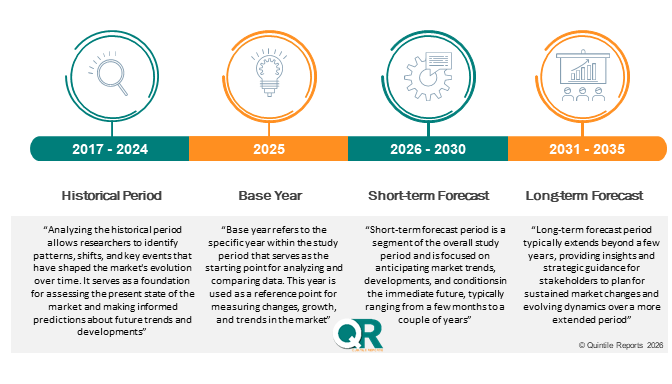
Our team of experienced researchers has meticulously gathered and analyzed data to deliver a thorough examination of market dynamics, competitive landscape, and emerging technologies. With a focus on delivering actionable intelligence, this report aims to empower decision-makers with the information needed to make informed choices and stay ahead of the competition. Whether you are a seasoned industry player or a new entrant, our market research report serves as a strategic tool to navigate the complexities of the market, aiding in successful business planning and growth strategies.
This chapter of our Marine Turbochargers market report provides an in-depth examination of the factors shaping the industry landscape. This section typically encompasses several key elements to offer a comprehensive understanding of the industry landscape such as market drivers & restraints analysis, market opportunities & trend analysis, market size & growth analysis, competitive analysis, SWOT analysis, business environment tools such as Porter's five forces & PESTEL analysis, Ansoff Matrix analysis, penetration & growth prospect analysis, regulatory framework & reimbursement scenario analysis, impact of macro & micro economic factors analysis such as Covid-19 impact, GDP growth, market inflation, U.S.- China trade war, Russia-Ukraine war impact, and supply chain analysis.
The segment analysis chapter of Marine Turbochargers market report is a critical section that delves into a detailed examination of the market's various segments. Segmentation involves dividing the market into distinct categories based on certain criteria to better understand and address the diverse needs of consumers. This chapter typically follows the introduction and provides a more granular view of the market, offering valuable insights for businesses and stakeholders. The components of the chapter lude segment definitions to understand the inclusions and exclusions of the study, assumptions, market size estimates and growth trend analysis of each segment, qualitative analysis of the segment, technological advancements, market penetration rate, market adoption rate, market share examination by each segment, segment growth drivers and restraint barriers, consumer behaviour and challenge analysis.
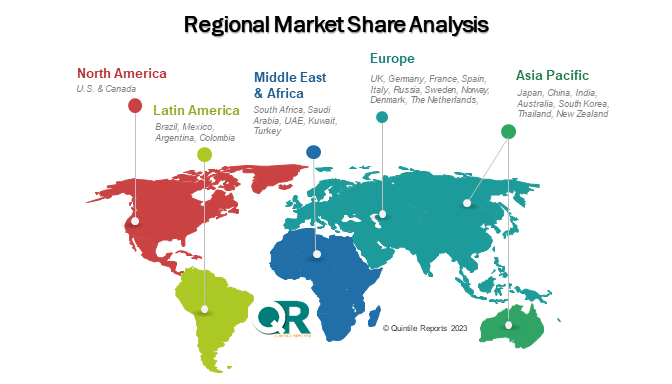
The chapter in Marine Turbochargers market research report is a pivotal section that examines and predicts the market dynamics and trends specific to different geographical regions. This chapter is crucial for businesses and stakeholders seeking a comprehensive understanding of how the market behaves across various locations, enabling them to tailor strategies and make informed decisions based on regional variations. The regional analysis chapter of our Marine Turbochargers market report is classified into regions & country-level. The chapter consists of North America (U.S., Canada), Europe (UK, Germany, France, Italy, Spain, Russia, Sweden, Denmark, Norway, Rest of Europe), Asia Pacific (Japan, China, India, Australia, South Korea, Thailand, Rest of Asia Pacific), Latin America (Brazil, Mexico, Argentina, Colombia, Rest of Latin America), Middle East & Africa (South Africa, Saudi Arabia, UAE, Kuwait, Rest of Middle East & Africa).
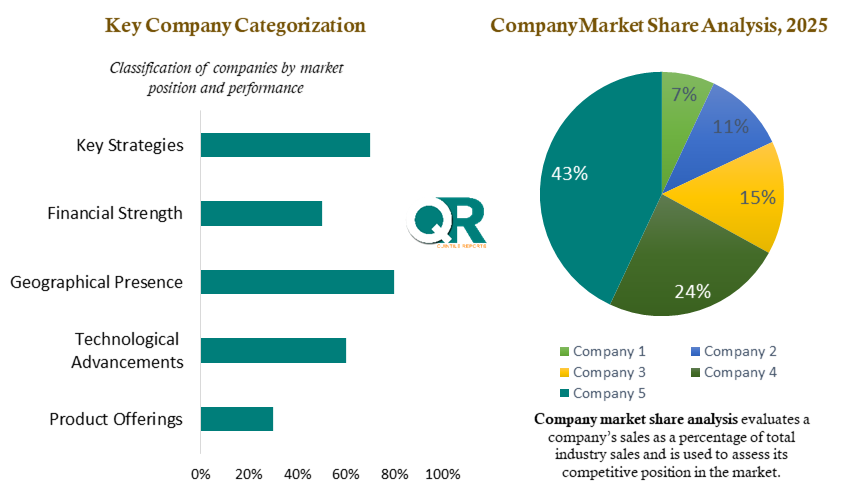
This section of a Marine Turbochargers market report is a crucial segment that provides a comprehensive overview of the competitive landscape within the market. This section is vital for businesses, investors, and stakeholders seeking insights into key players, their market positioning, strengths, weaknesses, strategies, and potential impacts on the overall market dynamics. The chapter includes research methodology used to analyse the market competition, list of key players operating in the market, detailed company profile section which includes company overview, business verticals, financial performance, product/services benchmarking, geographical presence, and strategic initiatives.
| Report Scope | Details |
| Report Version | 2026 |
| Growth Rate | CAGR of 7.19 from 2026 to 2035 |
| Base Year | 2025 |
| Actual Estimates / Historical Data | 2017 - 2024 |
| Forecast Period | 2026 - 2035 |
| Quantitative Units | Revenue in USD million/billion & CAGR from 2026 to 2035 |
| Country Scope | North America (U.S., Canada), Europe (UK, Germany, France, Italy, Spain, Russia, Sweden, Denmark, Norway, Rest of Europe), Asia Pacific (Japan, China, India, Australia, South Korea, Thailand, Rest of Asia Pacific), Latin America (Brazil, Mexico, Argentina, Colombia, Rest of Latin America), Middle East & Africa (South Africa, Saudi Arabia, UAE, Kuwait, Rest of Middle East & Africa). |
| The Segment Covered by Type & Technology |
|
| The Segment Covered by Component |
|
| Companies Covered |
|
| Report Coverage | Revenue forecast, company share, competitive landscape, growth factors, and trends |
| Free Customization Scope (Equivalent to 5 Analyst Working Days) | If you need specific information, which is not currently within the scope of the report, we will provide it to you as a part of the customization |

Statistics for the 2025 Marine Turbochargers market share, size, and revenue growth rate were created by Quintile Report™. Marine Turbochargers analysis includes a market forecast outlook for 2035 and a historical overview. Get a free PDF sample of this market analysis, please get in touch with our principal analyst at sales@quintilereports.com
List of Tables
Table 1 List of Abbreviation and acronyms
Table 2 List of Sources
Table 3 North America Global Marine Turbochargers Market, by Segment Analysis, (USD Million) 2017-2035
Table 4 North America Global Marine Turbochargers Market, by Region, (USD Million) 2017-2035
Table 5 U.S. Global Marine Turbochargers Market, by Segment Analysis, (USD Million) 2017-2035
Table 6 Canada Global Marine Turbochargers Market, by Segment Analysis, (USD Million) 2017-2035
Table 7 Europe Global Marine Turbochargers Market, by Segment Analysis, (USD Million) 2017-2035
Table 8 Europe Global Marine Turbochargers Market, by Region, (USD Million) 2017-2035
Table 9 Germany Global Marine Turbochargers Market, by Segment Analysis, (USD Million) 2017-2035
Table 10 U.K. Global Marine Turbochargers Market, by Segment Analysis, (USD Million) 2017-2035
Table 11 France Global Marine Turbochargers Market, by Segment Analysis, (USD Million) 2017-2035
Table 12 Italy Global Marine Turbochargers Market, by Segment Analysis, (USD Million) 2017-2035
Table 13 Spain Global Marine Turbochargers Market, by Segment Analysis, (USD Million) 2017-2035
Table 14 Sweden Global Marine Turbochargers Market, by Segment Analysis, (USD Million) 2017-2035
Table 15 Denmark Global Marine Turbochargers Market, by Segment Analysis, (USD Million) 2017-2035
Table 16 Norway Global Marine Turbochargers Market, by Segment Analysis, (USD Million) 2017-2035
Table 17 The Netherlands Global Marine Turbochargers Market, by Segment Analysis, (USD Million) 2017-2035
Table 18 Russia Global Marine Turbochargers Market, by Segment Analysis, (USD Million) 2017-2035
Table 19 Asia Pacific Global Marine Turbochargers Market, by Segment Analysis, (USD Million) 2017-2035
Table 20 Asia Pacific Global Marine Turbochargers Market, by Region, (USD Million) 2017-2035
Table 21 China Global Marine Turbochargers Market, by Segment Analysis, (USD Million) 2017-2035
Table 22 Japan Global Marine Turbochargers Market, by Segment Analysis, (USD Million) 2017-2035
Table 23 India Global Marine Turbochargers Market, by Segment Analysis, (USD Million) 2017-2035
Table 24 Australia Global Marine Turbochargers Market, by Segment Analysis, (USD Million) 2017-2035
Table 25 South Korea Global Marine Turbochargers Market, by Segment Analysis, (USD Million) 2017-2035
Table 26 Thailand Global Marine Turbochargers Market, by Segment Analysis, (USD Million) 2017-2035
Table 27 Latin America Global Marine Turbochargers Market, by Segment Analysis, (USD Million) 2017-2035
Table 28 Latin America Global Marine Turbochargers Market, by Region, (USD Million) 2017-2035
Table 29 Brazil Global Marine Turbochargers Market, by Segment Analysis, (USD Million) 2017-2035
Table 30 Mexico Global Marine Turbochargers Market, by Segment Analysis, (USD Million) 2017-2035
Table 31 Argentina Global Marine Turbochargers Market, by Segment Analysis, (USD Million) 2017-2035
Table 32 Middle East and Africa Global Marine Turbochargers Market, by Segment Analysis, (USD Million) 2017-2035
Table 33 Middle East and Africa Global Marine Turbochargers Market, by Region, (USD Million) 2017-2035
Table 34 South Africa Global Marine Turbochargers Market, by Segment Analysis, (USD Million) 2017-2035
Table 35 Saudi Arabia Global Marine Turbochargers Market, by Segment Analysis, (USD Million) 2017-2035
Table 36 UAE Global Marine Turbochargers Market, by Segment Analysis, (USD Million) 2017-2035
Table 37 Kuwait Global Marine Turbochargers Market, by Segment Analysis, (USD Million) 2017-2035
Table 38 Turkey Global Marine Turbochargers Market, by Segment Analysis, (USD Million) 2017-2035
Fig.1 Market research process
Fig.2 Market research approaches
Fig.3 Global Marine Turbochargers Market: market scenario
Fig.4 Global Marine Turbochargers Market competitive outlook
Fig.5 Global Marine Turbochargers Market driver analysis
Fig.6 Global Marine Turbochargers Market restraint analysis
Fig.7 Global Marine Turbochargers Market opportunity analysis
Fig.8 Global Marine Turbochargers Market trends analysis
Fig.9 Global Marine Turbochargers Market: Segment Analysis (Based on the scope)
Fig.10 Global Marine Turbochargers Market: regional analysis
Fig.11 Global market shares and leading market players
Fig.12 North America market share and leading players
Fig.13 Europe market share and leading players
Fig.14 Asia Pacific market share and leading players
Fig.15 Latin America market share and leading players
Fig.16 Middle East & Africa market share and leading players
Fig.17 North America, by country
Fig.18 North America
Fig.19 North America market estimates and forecast, 2017-2035
Fig.20 U.S.
Fig.21 Canada
Fig.22 Europe
Fig.23 Europe market estimates and forecast, 2017-2035
Fig.24 U.K.
Fig.25 Germany
Fig.26 France
Fig.27 Italy
Fig.28 Spain
Fig.29 Sweden
Fig.30 Denmark
Fig.31 Norway
Fig.32 The Netherlands
Fig.33 Russia
Fig.34 Asia Pacific
Fig.35 Asia Pacific market estimates and forecast, 2017-2035
Fig.36 China
Fig.37 Japan
Fig.38 India
Fig.39 Australia
Fig.40 South Korea
Fig.41 Thailand
Fig.42 Latin America
Fig.43 Latin America market estimates and forecast, 2017-2035
Fig.44 Brazil
Fig.45 Mexico
Fig.46 Argentina
Fig.47 Colombia
Fig.48 Middle East and Africa
Fig.49 Middle East and Africa market estimates and forecast, 2017-2035
Fig.50 Saudi Arabia
Fig.51 South Africa
Fig.52 UAE
Fig.53 Kuwait
Fig.54 Turkey
The Global Marine Turbochargers Market was valued at USD 762.32 million in 2025 and is projected to reach USD 1402.5 million by 2035, expanding at a robust CAGR of 7.19% during the forecast period from 2026 to 2035. The Marine Turbochargers market report delivers a comprehensive industry assessment by analyzing macroeconomic conditions, technological advancements, regulatory frameworks, and evolving consumer behavior to provide a clear outlook on future growth potential.
With 2025 as the base year, the Marine Turbochargers market is experiencing steady expansion driven by continuous innovation, rising demand across end-use industries, and rapid technological progress. Market participants are increasingly optimizing their go-to-market (GTM) strategies to capitalize on emerging opportunities and adapt to shifting competitive dynamics.
Looking ahead to 2035, the market is expected to maintain strong growth momentum, supported by sustained investments in research and development, strategic partnerships, and mergers and acquisitions. Companies that focus on innovation, agile GTM execution, and alignment with evolving customer needs are well positioned to achieve long-term success. The report provides in-depth insights into key market drivers, restraints, opportunities, and challenges across segments, regions, and countries, supported by robust qualitative and quantitative analysis spanning 2017 to 2035.
The marine turbochargers market refers to the global and regional market for turbocharging systems specifically designed for marine engines used in vessels such as cargo ships, tankers, container ships, naval vessels, and offshore support ships. Marine turbochargers enhance engine performance by forcing more air into the combustion chamber, resulting in increased power output, improved fuel efficiency, and reduced emissions. These systems are critical for both two-stroke and four-stroke diesel or gas engines operating in demanding maritime environments.
Traditionally focused on fuel economy and engine performance, the market is now increasingly influenced by environmental regulations such as IMO Tier III standards, pushing demand for high-efficiency, low-emission turbocharging solutions. Technological innovations, including variable geometry turbochargers (VGTs), hybrid turbo systems, and advanced materials for higher thermal tolerance, are shaping product development. The marine turbochargers market serves engine manufacturers, shipbuilders, and fleet operators, with both OEM installations and aftermarket retrofits contributing to demand.
The driver of growth for marine turbochargers is the greater focus on fuel efficiency and lower emissions in shipping. Turbochargers greatly enhance engine performance as they raise air inlet pressure, which in turn boosts combustion efficiency and lowers fuel consumption. As a significant percentage of shipping costs are attributed to fuel, shipping companies are investing more in turbocharging units to optimise performance as well as stay in conformity with global maritime rules.
The second major driver is the imposition of stricter environmental standards by international and regional agencies. Mandate regulations on sulfur oxide (SO) and nitrogen oxide (NO) emissions, especially in Emission Control Areas (ECAs), have prompted the use of high-efficiency engine technologies. Turbocharging allows marine engines to comply with such changing standards without sacrificing operational power and reliability, most notably in bulk carriers, tankers, and container ships.
Additionally, increasing worldwide maritime commerce and newbuilding orders are driving demand. With increasing worldwide seaborne trade, shipowners and shipyards are ordering state-of-the-art, high-powered engines with tight turbocharging systems. Even in the retrofit market, vessels are being retrofitted with more efficient turbochargers to stay competitive, to achieve emission regulations, and to meet rules.
The move toward dual-fuel and LNG-fueled engines is another principal driver. These new fuels demand high-precision combustion control as well as pressure management, both of which are supplied by turbocharging. With the increasing desire for cleaner propulsion, turbocharger engineering is well-positioned to support hybrid, dual-fuel, and electric boost-powered engines as well.
Lastly, the technological advancements and digital monitoring are driving design improvements that are increasing reliability, maintenance effectiveness, and overall performance. Technologies such as variable geometry turbochargers (VGTs), condition monitoring systems built into them, and predictive maintenance analytics are making turbochargers smarter and more economical throughout their lifecycle, which is creating more market demand.
Marine turbochargers are high-technology devices that demand precise production and strong materials that are capable of withstanding harsh sea conditions. Their purchase entails heavy capital investment, especially on dual-fuel or high-performance turbochargers installed on bulky ships. In addition, regular overhaulingnormally required by maritime regulationcould be prohibitively expensive due to the need for expertise and authorised spares, thus total life cycle costs could be a weighty financial factor.
Turbochargers experience high pressure and heat, which result in wear and tear of components such as bearing deterioration, fouling, or oil leakage. Maintenance is unavoidable but complicated, involving experienced technicians and diagnostic tools not necessarily available onboard or at smaller docks. Failure or delay in maintenance may result in vessel downtime, route disruption, and further operating loss for shipping companies.
Global decarbonization has put more pressure on ship operators to comply with IMO Tier III and EEDI regulations demanding low-NOx turbocharger technologies and lower-emission burning fuels. But installing compliant turbochargers on older engines or coupling them with hybrid propulsion is too expensive, engineer-intensive, and perhaps performance-sacrificing. This regulator drive has slowed replacement cycles and caused customers to hesitate before reinvesting.
The marine turbocharger market is characterised by a broad variety of ship, engine configurations and operating conditions that restrict standardisation. Customising the turbocharger to a particular ship-engine combination raises the manufacturing lead times and inventory complexity levels.
The maintenance and production of marine turbochargers require specialized marine engineering skills, of which there is not a large number available across the world. The shortage is further fueled by an aging workforce within the shipping industry and the decline in new engineering graduates who are joining the industry. The shortage of technical capacity affects the quality of service, raises the cost of training, and retards the uptake of newer turbocharger systems, especially in new maritime economies.
North America has a strong market share, fueled by huge retrofit and upgrade schemes to improve fuel efficiency and comply with environmental regulations. Shipowners in the United States and Canada are increasingly swapping out old, weary turbochargers with state-of-the-art single, dual, or variable-geometry units with digital performance monitoring and predictive diagnosis.
The European market is marked by robust German, Norwegian, Dutch, and UK shipbuilding and stringent emissions control under the IMO and EU regimes. The region calls for the integration of high-efficiency VGTs, hybrid turbocharger packages, and smart systems to enable sustainable shipping.
Asia-Pacific dominates the world marine turbocharger market on the strength of shipbuilding supremacy in China, Japan, and South Korea. Demand is supported by a surge in new ship orders and retrofits, coupled with government-sponsored green shipping initiatives. Domestic manufacturers also increase production of green turbo systems to meet expanding domestic demand.
Latin American markets are slowly opening up due to fleet modernisation programs and increasing maritime trade in Brazil, Mexico, and elsewhere. Shipowners and operators are spending increasingly on sophisticated turbocharging technologies to optimise the efficiency of ships and align with international standards.
In the Middle East & Africa, port expansion, offshore infrastructure development, and upgrading the fleet are top markets predominantly within North African and Gulf nations. Operators are adopting axial and VGT turbochargers as they prioritise fuel savings and durability in harsh operating conditions.
The United States leads the market demand for marine turbochargers, fueled primarily by stringent emission reduction policies and the upgrade of its defence and commercial naval fleets with new ones. Among the prominent drivers is the demand for cleaner engine propulsion systems due to compliance with the U.S. Environmental Protection Agency (EPA) Tier 4 standards and the International Maritime Organisation's MARPOL Annexe VI regulations, which both mandate a serious reduction in NOx and SOx emissions by ships that traverse seas in the U.S.
Shipowners and fleet operators in major ports such as Houston, Los Angeles, and New York increasingly retrofit ships with high-tech turbocharging equipment to make engines more efficient, lower fuel expenses, and comply with new regulatory standards. Turbochargers enable ships to be driven under lower emissions while equaling or possibly exceeding power, ideally suited for tugboats, patrol boats, and cargo ships sailing under rigorous local environmental regulations.
In addition to this, the U.S. Navy and U.S. Coast Guard are making anchor investments in next-generation marine engines that are dependent upon high-output turbochargers for increased power and fuel efficiency in long-term operations. Foreign suppliers and domestic manufacturers are reacting to this with low-maintenance, hybrid-compatible, and high-density turbocharger solutions, further cementing the U.S. as a major market for high-performance marine power systems.
Germany is a strong market leader in the European marine turbochargers market, founded on its robust maritime engineering background and strong drive toward low-emission propulsion technology. Awaiting International Maritime Organization (IMO) hardening MARPOL Annex VI regulations, and the European Union's FuelEU Maritime initiative, German shipowners and shipbuilders are driving aggressively to fit fleets with turbocharged engines to improve fuel efficiency and meet sulfur and NOx reduction limits.
Ports like Hamburg, Bremerhaven, and Kiel are experiencing growing retrofit activity, especially for merchant ships, ferries, and coastal box ships. Sea-going turbochargers are allowing such ships to run on lower fuel consumption rates, greater power density, and compatibility with LNG or hybrid fuels. This makes Germany a focal point for retrofitting and an innovation centre for cleaner marine propulsion units in Northern Europe.
Japan's marine turbochargers market is mainly driven by the nation's keen adherence to international maritime emission legislation to curb sulfur oxides (SOx), nitrogen oxides (NOx), and greenhouse gas emissions from ships. As one of the world's leading shipbuilding centres and sea-trading nations, Japan followed the IMO 2020 regulation closely and subsequent decarbonization plans closely, compelling shipowners and engine makers to replace propulsion units with efficient turbochargers to comply with changing requirements.
Marine turbochargers enable lower fuel use and improved burning quality, both critical to achieving these mandates. Japanese industry leaders such as Mitsubishi Heavy Industries and IHI Corporation are developing turbocharger technologies that enable dual-fuel engines, LNG-powered propulsion, and exhaust gas recirculation systems. Along with enabling the reduction of emissions by the large cargo and container vessels, these technologies also provide a performance improvement to coastal vessels plying within Japan's domestic ECAs.
The trend is reinforced by Japan's leadership in alternative maritime propulsion innovation and green shipbuilding, backed by government support in the form of the "Green Innovation Fund." Shipbuilding and fleet renewal are propelling long-term demand for small, durable, and electronically controlled turbochargers. As Japan aims to reach carbon neutrality in shipping by 2050, marine turbochargers continue to be an essential component of cleaner, more efficient seaborne transportation.
The global marine turbocharger industry is significantly driven by the continuous need for fuel efficiency in shipping business. Shipowners and manufacturers of engines are placing priorities on turbocharging systems that facilitate optimal combustion and engine performance via non-optimized fuel input.
Turbochargers enable marine engines to capture otherwise wasted exhaust energy and form an improved power cycle. This emphasis on efficiency becomes critically relevant for large cargo ships on long voyages, naval vessels, and other high-use fleets, where even modest improvements in efficiency result in substantial operating cost savings over the long term.
The producers are hence finding it challenging to design progressive turbocharger systems that minimise engine load, enhance maintenance schedules, and maximise power-to-weight ratios. Developments have a propensity towards limiting mechanical losses, maximising turbine responsiveness, and accommodating multiple engine speeds. Additionally, the transition towards dual-fuel and slow-speed marine engines has led to the need for the creation of adaptive turbocharger solutions that still continue to provide efficiency under diverse operating profiles.
Firms providing flexibility in the modularity and integration of upgrade solutions are winning strategic share because shipowners desire their investment to be long-term as well as meet performance targets.
Finally, fuel efficiency is not just a cost factorit is a fundamental differentiator in an environment characterised by environmental pressures, operating constraints, and increasing fuel volatility. Players that position their product portfolio around this driver are most likely to gain market share as shipowners seek to future-proof fleets. Turbocharger suppliers that deliver real-world improvements in engine efficiency, at no detriment to reliability or serviceability, are in a position to own contract pipelines in commercial and naval maritime sectors.
In December 2024, Rolls-Royce Power Systems upgraded its marine turbocharger lineup, introducing models tailored for alternative fuels and improved energy efficiency. Enhancements include variable-geometry and digital monitoring systems aimed at predictive maintenance and compliance with stricter emissions standards.
In December 2024, Accelleron (formerly ABB Turbocharging) announced plans to release next-generation axial turbochargers by 2025, optimized for net-zero marine fuels (e.g., green ammonia, methanol, hydrogen). These units target low- and medium-speed engines in both marine and stationary power application.
In January 2025, MAN Energy Solutions (recently rebranded Everllence) introduced the TCP series turbochargers under its PBST brand. The series delivers high-efficiency performance across a broad power range and supports dual-fuel and LNG-capable marine engines.
Our team of experienced researchers has meticulously gathered and analyzed data to deliver a thorough examination of market dynamics, competitive landscape, and emerging technologies. With a focus on delivering actionable intelligence, this report aims to empower decision-makers with the information needed to make informed choices and stay ahead of the competition. Whether you are a seasoned industry player or a new entrant, our market research report serves as a strategic tool to navigate the complexities of the market, aiding in successful business planning and growth strategies.
This chapter of our Marine Turbochargers market report provides an in-depth examination of the factors shaping the industry landscape. This section typically encompasses several key elements to offer a comprehensive understanding of the industry landscape such as market drivers & restraints analysis, market opportunities & trend analysis, market size & growth analysis, competitive analysis, SWOT analysis, business environment tools such as Porter's five forces & PESTEL analysis, Ansoff Matrix analysis, penetration & growth prospect analysis, regulatory framework & reimbursement scenario analysis, impact of macro & micro economic factors analysis such as Covid-19 impact, GDP growth, market inflation, U.S.- China trade war, Russia-Ukraine war impact, and supply chain analysis.
The segment analysis chapter of Marine Turbochargers market report is a critical section that delves into a detailed examination of the market's various segments. Segmentation involves dividing the market into distinct categories based on certain criteria to better understand and address the diverse needs of consumers. This chapter typically follows the introduction and provides a more granular view of the market, offering valuable insights for businesses and stakeholders. The components of the chapter lude segment definitions to understand the inclusions and exclusions of the study, assumptions, market size estimates and growth trend analysis of each segment, qualitative analysis of the segment, technological advancements, market penetration rate, market adoption rate, market share examination by each segment, segment growth drivers and restraint barriers, consumer behaviour and challenge analysis.
The chapter in Marine Turbochargers market research report is a pivotal section that examines and predicts the market dynamics and trends specific to different geographical regions. This chapter is crucial for businesses and stakeholders seeking a comprehensive understanding of how the market behaves across various locations, enabling them to tailor strategies and make informed decisions based on regional variations. The regional analysis chapter of our Marine Turbochargers market report is classified into regions & country-level. The chapter consists of North America (U.S., Canada), Europe (UK, Germany, France, Italy, Spain, Russia, Sweden, Denmark, Norway, Rest of Europe), Asia Pacific (Japan, China, India, Australia, South Korea, Thailand, Rest of Asia Pacific), Latin America (Brazil, Mexico, Argentina, Colombia, Rest of Latin America), Middle East & Africa (South Africa, Saudi Arabia, UAE, Kuwait, Rest of Middle East & Africa).
This section of a Marine Turbochargers market report is a crucial segment that provides a comprehensive overview of the competitive landscape within the market. This section is vital for businesses, investors, and stakeholders seeking insights into key players, their market positioning, strengths, weaknesses, strategies, and potential impacts on the overall market dynamics. The chapter includes research methodology used to analyse the market competition, list of key players operating in the market, detailed company profile section which includes company overview, business verticals, financial performance, product/services benchmarking, geographical presence, and strategic initiatives.
| Report Scope | Details |
| Report Version | 2026 |
| Growth Rate | CAGR of 7.19 from 2026 to 2035 |
| Base Year | 2025 |
| Actual Estimates / Historical Data | 2017 - 2024 |
| Forecast Period | 2026 - 2035 |
| Quantitative Units | Revenue in USD million/billion & CAGR from 2026 to 2035 |
| Country Scope | North America (U.S., Canada), Europe (UK, Germany, France, Italy, Spain, Russia, Sweden, Denmark, Norway, Rest of Europe), Asia Pacific (Japan, China, India, Australia, South Korea, Thailand, Rest of Asia Pacific), Latin America (Brazil, Mexico, Argentina, Colombia, Rest of Latin America), Middle East & Africa (South Africa, Saudi Arabia, UAE, Kuwait, Rest of Middle East & Africa). |
| The Segment Covered by Type & Technology |
|
| The Segment Covered by Component |
|
| Companies Covered |
|
| Report Coverage | Revenue forecast, company share, competitive landscape, growth factors, and trends |
| Free Customization Scope (Equivalent to 5 Analyst Working Days) | If you need specific information, which is not currently within the scope of the report, we will provide it to you as a part of the customization |
Statistics for the 2025 Marine Turbochargers market share, size, and revenue growth rate were created by Quintile Report™. Marine Turbochargers analysis includes a market forecast outlook for 2035 and a historical overview. Get a free PDF sample of this market analysis, please get in touch with our principal analyst at sales@quintilereports.com
Table 1 List of Abbreviation and acronyms
Table 2 List of Sources
Table 3 North America Global Marine Turbochargers Market, by Segment Analysis, (USD Million) 2017-2035
Table 4 North America Global Marine Turbochargers Market, by Region, (USD Million) 2017-2035
Table 5 U.S. Global Marine Turbochargers Market, by Segment Analysis, (USD Million) 2017-2035
Table 6 Canada Global Marine Turbochargers Market, by Segment Analysis, (USD Million) 2017-2035
Table 7 Europe Global Marine Turbochargers Market, by Segment Analysis, (USD Million) 2017-2035
Table 8 Europe Global Marine Turbochargers Market, by Region, (USD Million) 2017-2035
Table 9 Germany Global Marine Turbochargers Market, by Segment Analysis, (USD Million) 2017-2035
Table 10 U.K. Global Marine Turbochargers Market, by Segment Analysis, (USD Million) 2017-2035
Table 11 France Global Marine Turbochargers Market, by Segment Analysis, (USD Million) 2017-2035
Table 12 Italy Global Marine Turbochargers Market, by Segment Analysis, (USD Million) 2017-2035
Table 13 Spain Global Marine Turbochargers Market, by Segment Analysis, (USD Million) 2017-2035
Table 14 Sweden Global Marine Turbochargers Market, by Segment Analysis, (USD Million) 2017-2035
Table 15 Denmark Global Marine Turbochargers Market, by Segment Analysis, (USD Million) 2017-2035
Table 16 Norway Global Marine Turbochargers Market, by Segment Analysis, (USD Million) 2017-2035
Table 17 The Netherlands Global Marine Turbochargers Market, by Segment Analysis, (USD Million) 2017-2035
Table 18 Russia Global Marine Turbochargers Market, by Segment Analysis, (USD Million) 2017-2035
Table 19 Asia Pacific Global Marine Turbochargers Market, by Segment Analysis, (USD Million) 2017-2035
Table 20 Asia Pacific Global Marine Turbochargers Market, by Region, (USD Million) 2017-2035
Table 21 China Global Marine Turbochargers Market, by Segment Analysis, (USD Million) 2017-2035
Table 22 Japan Global Marine Turbochargers Market, by Segment Analysis, (USD Million) 2017-2035
Table 23 India Global Marine Turbochargers Market, by Segment Analysis, (USD Million) 2017-2035
Table 24 Australia Global Marine Turbochargers Market, by Segment Analysis, (USD Million) 2017-2035
Table 25 South Korea Global Marine Turbochargers Market, by Segment Analysis, (USD Million) 2017-2035
Table 26 Thailand Global Marine Turbochargers Market, by Segment Analysis, (USD Million) 2017-2035
Table 27 Latin America Global Marine Turbochargers Market, by Segment Analysis, (USD Million) 2017-2035
Table 28 Latin America Global Marine Turbochargers Market, by Region, (USD Million) 2017-2035
Table 29 Brazil Global Marine Turbochargers Market, by Segment Analysis, (USD Million) 2017-2035
Table 30 Mexico Global Marine Turbochargers Market, by Segment Analysis, (USD Million) 2017-2035
Table 31 Argentina Global Marine Turbochargers Market, by Segment Analysis, (USD Million) 2017-2035
Table 32 Middle East and Africa Global Marine Turbochargers Market, by Segment Analysis, (USD Million) 2017-2035
Table 33 Middle East and Africa Global Marine Turbochargers Market, by Region, (USD Million) 2017-2035
Table 34 South Africa Global Marine Turbochargers Market, by Segment Analysis, (USD Million) 2017-2035
Table 35 Saudi Arabia Global Marine Turbochargers Market, by Segment Analysis, (USD Million) 2017-2035
Table 36 UAE Global Marine Turbochargers Market, by Segment Analysis, (USD Million) 2017-2035
Table 37 Kuwait Global Marine Turbochargers Market, by Segment Analysis, (USD Million) 2017-2035
Table 38 Turkey Global Marine Turbochargers Market, by Segment Analysis, (USD Million) 2017-2035
Fig.1 Market research process
Fig.2 Market research approaches
Fig.3 Global Marine Turbochargers Market: market scenario
Fig.4 Global Marine Turbochargers Market competitive outlook
Fig.5 Global Marine Turbochargers Market driver analysis
Fig.6 Global Marine Turbochargers Market restraint analysis
Fig.7 Global Marine Turbochargers Market opportunity analysis
Fig.8 Global Marine Turbochargers Market trends analysis
Fig.9 Global Marine Turbochargers Market: Segment Analysis (Based on the scope)
Fig.10 Global Marine Turbochargers Market: regional analysis
Fig.11 Global market shares and leading market players
Fig.12 North America market share and leading players
Fig.13 Europe market share and leading players
Fig.14 Asia Pacific market share and leading players
Fig.15 Latin America market share and leading players
Fig.16 Middle East & Africa market share and leading players
Fig.17 North America, by country
Fig.18 North America
Fig.19 North America market estimates and forecast, 2017-2035
Fig.20 U.S.
Fig.21 Canada
Fig.22 Europe
Fig.23 Europe market estimates and forecast, 2017-2035
Fig.24 U.K.
Fig.25 Germany
Fig.26 France
Fig.27 Italy
Fig.28 Spain
Fig.29 Sweden
Fig.30 Denmark
Fig.31 Norway
Fig.32 The Netherlands
Fig.33 Russia
Fig.34 Asia Pacific
Fig.35 Asia Pacific market estimates and forecast, 2017-2035
Fig.36 China
Fig.37 Japan
Fig.38 India
Fig.39 Australia
Fig.40 South Korea
Fig.41 Thailand
Fig.42 Latin America
Fig.43 Latin America market estimates and forecast, 2017-2035
Fig.44 Brazil
Fig.45 Mexico
Fig.46 Argentina
Fig.47 Colombia
Fig.48 Middle East and Africa
Fig.49 Middle East and Africa market estimates and forecast, 2017-2035
Fig.50 Saudi Arabia
Fig.51 South Africa
Fig.52 UAE
Fig.53 Kuwait
Fig.54 Turkey

A license granted to one user. Rules or conditions might be applied for e.g. the use of electric files (PDFs) or printings, depending on product.
A license granted to multiple users.
A license granted to a single business site/establishment.
A license granted to all employees within organisation access to the product.
Immediate / Within 24-48 hours - Working days
Online Payments with PayPal and CCavenue
You can order a report by picking any of the payment methods which is bank wire or online payment through any Debit/Credit card or PayPal.
Hard Copy
 U.S. : +1-201-772-7734