The global Zootechnical Feed Additives Market was valued at USD 14.10 billion in 2025 and is projected to reach USD 25.5 billion by 2035, growing at a CAGR of 7.65%. Growth is driven by increasing demand for high-quality animal nutrition, improved feed efficiency, and rising adoption of sustainable and antibiotic-free livestock solutions.
For livestock producers, zootechnical feed additives offer measurable benefits such as improved feed conversion ratios, reduced production costs, and enhanced animal health outcomes, making them a critical component of modern animal nutrition strategies.
Zootechnical feed additives such as enzymes, probiotics, and phytogenics enhance feed conversion, improve gut health, and reduce environmental impact across livestock systems.
Market growth is strongly influenced by rising demand for antibiotic-free livestock production, increasing feed cost optimization strategies, and regulatory pressure to reduce environmental emissions from animal farming.
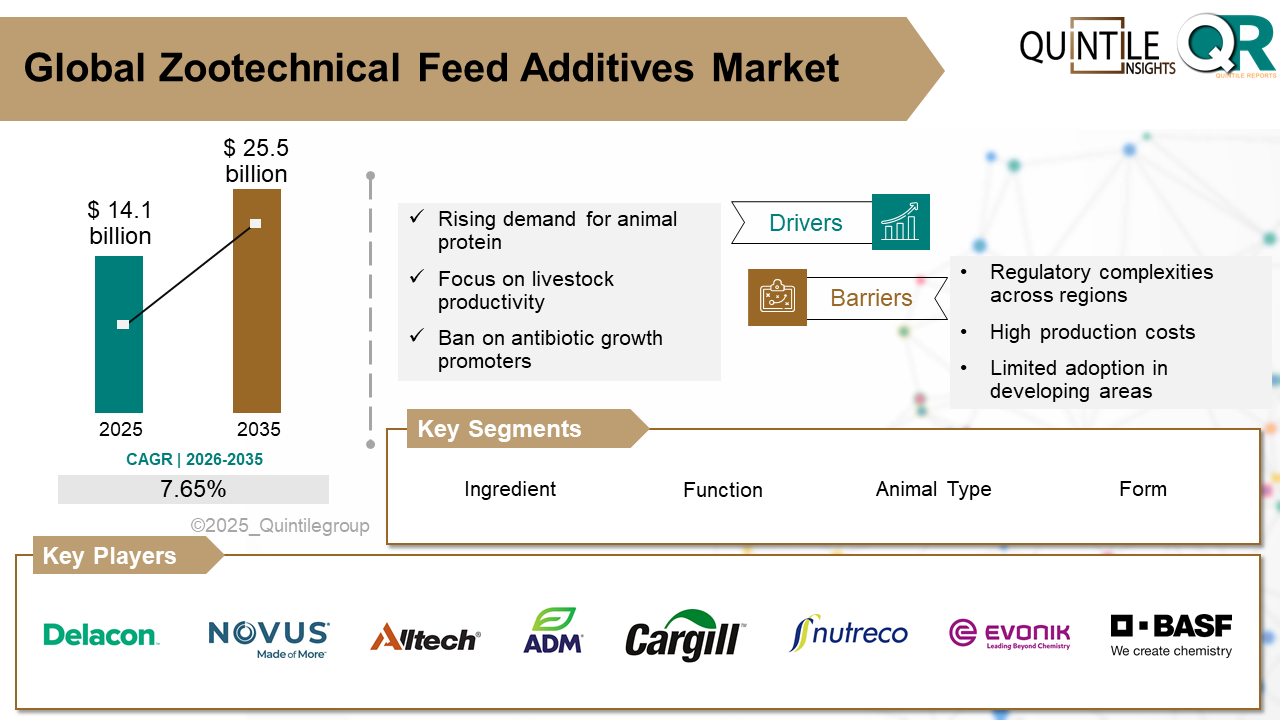
The zootechnical feed additives market covers a specialized category of animal feed additives developed to directly improve animal performance and/or deliver measurable environmental benefits. These additives act by enhancing feed digestibility, improving nutrient utilization, strengthening resilience to stress, and reducing waste outputs such as nitrogen and methane. Their role has become increasingly strategic as livestock systems face pressure to produce more protein with fewer resources, aligning closely with sustainability frameworks such as the EU’s Farm to Fork Strategy.
From a commercial standpoint, zootechnical additives offer unique incentives for developers. Under EU Regulation (EC) No 1831/2003, approvals are holder-specific and valid for 10 years, granting temporary exclusivity and protected revenue streams. Additionally, efficacy data generated for one species can, in certain cases, be leveraged for authorization in others—reducing marginal regulatory costs. However, the pathway to approval remains highly data-intensive, time-consuming, and capital-heavy, creating high entry barriers and favoring established players.
The market is being propelled by a combination of economic, regulatory, and sustainability-driven forces reshaping global animal production.
Despite strong demand fundamentals, structural and regulatory barriers continue to constrain market expansion.
A performance-driven market focused on cost efficiency and productivity. Adoption is accelerating as producers seek antibiotic alternatives and precision nutrition tools.
The most regulated yet innovation-intensive region. EU sustainability mandates and antibiotic bans make zootechnical additives a core pillar of modern feed strategies.
The fastest-growing demand region. Expanding livestock populations and rising protein consumption are driving interest in additives that improve efficiency and reduce losses.
Growth is export-driven. Countries like Brazil and Argentina are adopting zootechnical additives to meet international sustainability and performance benchmarks.
An emerging opportunity zone. Modernization of poultry and dairy systems is gradually increasing awareness of feed efficiency solutions.
The U.S. is a global leader in adoption, driven by large-scale livestock operations and strong R&D ecosystems. With feed efficiency gains directly linked to profitability, zootechnical additives are increasingly embedded in commercial feed programs. Regulatory oversight by the FDA ensures safety while allowing innovation, positioning the U.S. as a testing ground for next-generation performance additives.
Germany acts as a benchmark market within the EU, combining strict animal welfare rules with sustainability mandates. Under Regulation (EC) No 1831/2003, many microorganisms—including bacteria and yeasts—are classified as zootechnical additives. German producers favor additives that demonstrate quantifiable emission reductions and nutrient efficiency gains, reinforcing the country’s role as an EU innovation hub.
Japan’s market prioritizes precision and premium performance. Small-scale but highly efficient livestock systems create demand for high-value additives such as enzymes, acidifiers, and stress-mitigation compounds. Strict safety standards slow entry but enhance long-term trust and product credibility.
The zootechnical feed additives market is moderately fragmented but innovation-concentrated. Competitive strength hinges on regulatory approvals, scientific validation, and the ability to demonstrate statistically significant performance or environmental outcomes.
EU regulatory exclusivity creates temporary monopolies, rewarding first movers and discouraging imitation. As a result, competition centers on R&D depth, trial design, and regulatory expertise rather than pricing alone.
Products offering multi-functional benefits—such as improved digestibility combined with emission reduction—achieve faster adoption. Companies capable of reusing datasets across species gain a structural advantage by shortening development cycles and lowering marginal costs.
Key players include Delacon Biotechnik GmbH, Novus International, Alltech Inc., Archer Daniels Midland Company (ADM), Cargill (Diamond V), Nutreco N.V., Evonik Industries AG, BASF SE, DSM Animal Nutrition (incl. Novozymes), Kemin Industries, Chr. Hansen Holding A/S, Phibro Animal Health Corporation, Phytobiotics, Aves Pro, Blue Star Adisseo, and other players.
July 2025: The European Union approved BAFASAL, the first bacteriophage-based zootechnical feed additive for poultry, following EFSA evaluation—marking a breakthrough in non-antibiotic pathogen control.
June 2024: aXichem AB launched aXiphen in Brazil after approval as a zootechnical additive. A large-scale trial covering 1.6 million broilers demonstrated a 14% production efficiency gain and reduced salmonella prevalence—highlighting the strong ROI potential of next-generation zootechnical solutions.
The report provides in-depth analysis of market size, growth trends, competitive landscape, and regional outlook. It highlights key drivers such as feed efficiency improvements, sustainability regulations, and increasing demand for antibiotic-free livestock production.
This section provides an in-depth examination of the factors shaping the zootechnical feed additives market, including analysis of market drivers and restraints, emerging opportunities, growth trends, competitive dynamics, and key analytical frameworks such as SWOT, Porter’s Five Forces, and PESTEL analysis.
The segment analysis chapter of the zootechnical feed additives market report is a critical section that delves into a detailed examination of the market's various segments. Segmentation involves dividing the market into distinct categories based on certain criteria to better understand and address the diverse needs of consumers. This chapter typically follows the introduction and provides a more granular view of the market, offering valuable insights for businesses and stakeholders. The components of the chapter include segment definitions to understand the inclusions and exclusions of the study, assumptions, market size estimates and growth trend analysis of each segment, qualitative analysis of the segment, technological advancements, market penetration rate, market adoption rate, market share examination by each segment, segment growth drivers and restraint barriers, consumer behaviour and challenge analysis.
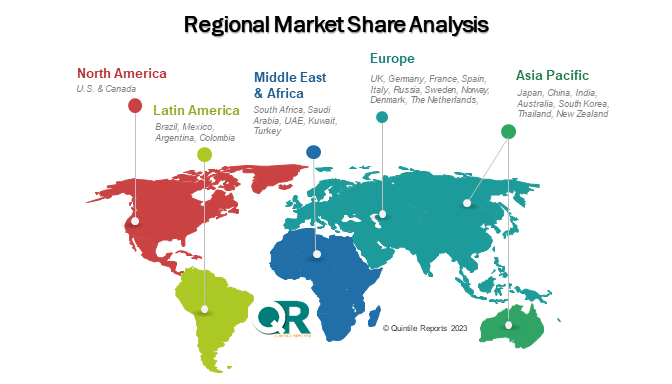
The chapter in zootechnical feed additives market research report is a pivotal section that examines and predicts the market dynamics and trends specific to different geographical regions. This chapter is crucial for businesses and stakeholders seeking a comprehensive understanding of how the market behaves across various locations, enabling them to tailor strategies and make informed decisions based on regional variations. The regional analysis chapter of our zootechnical feed additives market report is classified into regions & country-level. The chapter consists of North America (U.S., Canada), Europe (UK, Germany, France, Italy, Spain, Russia, Sweden, Denmark, Norway, Rest of Europe), Asia Pacific (Japan, China, India, Australia, South Korea, Thailand, Rest of Asia Pacific), Latin America (Brazil, Mexico, Argentina, Colombia, Rest of Latin America), Middle East & Africa (South Africa, Saudi Arabia, UAE, Kuwait, Rest of Middle East & Africa).
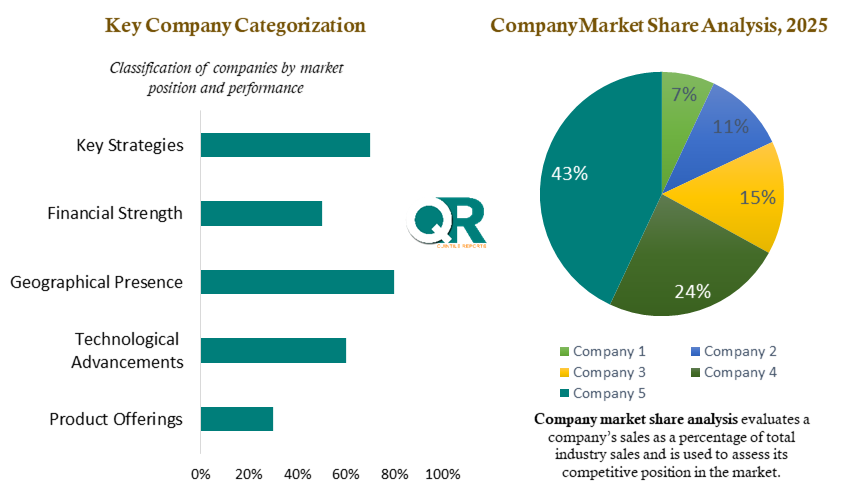
This section of a zootechnical feed additives market report is a crucial segment that provides a comprehensive overview of the competitive landscape within the market. This section is vital for businesses, investors, and stakeholders seeking insights into key players, their market positioning, strengths, weaknesses, strategies, and potential impacts on the overall market dynamics. The chapter includes research methodology used to analyse the market competition, list of key players operating in the market, detailed company profile section which includes company overview, business verticals, financial performance, product/services benchmarking, geographical presence, and strategic initiatives.
Quintile Reports has segmented the zootechnical feed additives market into the following segments:
| Report Scope | Details |
| Report Version | 2026 |
| Growth Rate | CAGR of 7.65 from 2026 to 2035 |
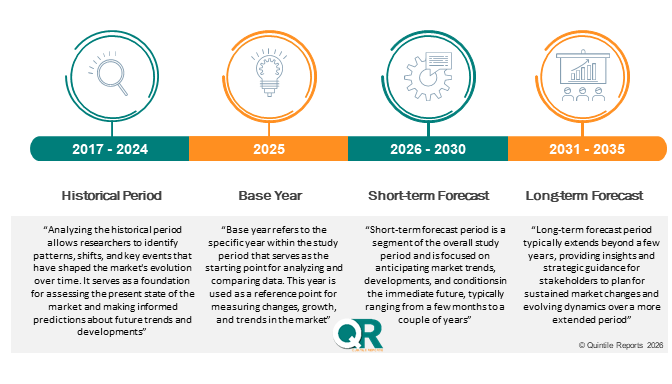
| Base Year | 2025 |
| Actual Estimates / Historical Data | 2017 - 2024 |
| Forecast Period | 2026 - 2035 |
| Quantitative Units | Revenue in USD million/billion & CAGR from 2026 to 2035 |
| Country Scope | North America (U.S., Canada), Europe (UK, Germany, France, Italy, Spain, Russia, Sweden, Denmark, Norway, Rest of Europe), Asia Pacific (Japan, China, India, Australia, South Korea, Thailand, Rest of Asia Pacific), Latin America (Brazil, Mexico, Argentina, Colombia, Rest of Latin America), Middle East & Africa (South Africa, Saudi Arabia, UAE, Kuwait, Rest of Middle East & Africa). |
| The Segment Covered by Ingredient Type |
|
| The Segment Covered by Function / Claim |
|
| Companies Covered |
|
| Report Coverage | Revenue forecast, company share, competitive landscape, growth factors, and trends |
| Free Customization Scope (Equivalent to 5 Analyst Working Days) | If you need specific information, which is not currently within the scope of the report, we will provide it to you as a part of the customization |

Statistics for the 2025 zootechnical feed additives market share, size, and revenue growth rate were created by Quintile Report™. The analysis includes a market forecast outlook for 2035 and a historical overview. Get a free PDF sample of this market analysis, please get in touch with our principal analyst at sales@quintilereports.com
The market is projected to grow at a CAGR of 7.65% between 2026 and 2035.
They are used to improve feed efficiency, enhance animal health, and reduce environmental impact in livestock production.
List of Tables
Table 1 List of Abbreviation and acronyms
Table 2 List of Sources
Table 3 North America Global Zootechnical Feed Additives Market, by Segment Analysis, (USD Million) 2017-2035
Table 4 North America Global Zootechnical Feed Additives Market, by Region, (USD Million) 2017-2035
Table 5 U.S. Global Zootechnical Feed Additives Market, by Segment Analysis, (USD Million) 2017-2035
Table 6 Canada Global Zootechnical Feed Additives Market, by Segment Analysis, (USD Million) 2017-2035
Table 7 Europe Global Zootechnical Feed Additives Market, by Segment Analysis, (USD Million) 2017-2035
Table 8 Europe Global Zootechnical Feed Additives Market, by Region, (USD Million) 2017-2035
Table 9 Germany Global Zootechnical Feed Additives Market, by Segment Analysis, (USD Million) 2017-2035
Table 10 U.K. Global Zootechnical Feed Additives Market, by Segment Analysis, (USD Million) 2017-2035
Table 11 France Global Zootechnical Feed Additives Market, by Segment Analysis, (USD Million) 2017-2035
Table 12 Italy Global Zootechnical Feed Additives Market, by Segment Analysis, (USD Million) 2017-2035
Table 13 Spain Global Zootechnical Feed Additives Market, by Segment Analysis, (USD Million) 2017-2035
Table 14 Sweden Global Zootechnical Feed Additives Market, by Segment Analysis, (USD Million) 2017-2035
Table 15 Denmark Global Zootechnical Feed Additives Market, by Segment Analysis, (USD Million) 2017-2035
Table 16 Norway Global Zootechnical Feed Additives Market, by Segment Analysis, (USD Million) 2017-2035
Table 17 The Netherlands Global Zootechnical Feed Additives Market, by Segment Analysis, (USD Million) 2017-2035
Table 18 Russia Global Zootechnical Feed Additives Market, by Segment Analysis, (USD Million) 2017-2035
Table 19 Asia Pacific Global Zootechnical Feed Additives Market, by Segment Analysis, (USD Million) 2017-2035
Table 20 Asia Pacific Global Zootechnical Feed Additives Market, by Region, (USD Million) 2017-2035
Table 21 China Global Zootechnical Feed Additives Market, by Segment Analysis, (USD Million) 2017-2035
Table 22 Japan Global Zootechnical Feed Additives Market, by Segment Analysis, (USD Million) 2017-2035
Table 23 India Global Zootechnical Feed Additives Market, by Segment Analysis, (USD Million) 2017-2035
Table 24 Australia Global Zootechnical Feed Additives Market, by Segment Analysis, (USD Million) 2017-2035
Table 25 South Korea Global Zootechnical Feed Additives Market, by Segment Analysis, (USD Million) 2017-2035
Table 26 Thailand Global Zootechnical Feed Additives Market, by Segment Analysis, (USD Million) 2017-2035
Table 27 Latin America Global Zootechnical Feed Additives Market, by Segment Analysis, (USD Million) 2017-2035
Table 28 Latin America Global Zootechnical Feed Additives Market, by Region, (USD Million) 2017-2035
Table 29 Brazil Global Zootechnical Feed Additives Market, by Segment Analysis, (USD Million) 2017-2035
Table 30 Mexico Global Zootechnical Feed Additives Market, by Segment Analysis, (USD Million) 2017-2035
Table 31 Argentina Global Zootechnical Feed Additives Market, by Segment Analysis, (USD Million) 2017-2035
Table 32 Middle East and Africa Global Zootechnical Feed Additives Market, by Segment Analysis, (USD Million) 2017-2035
Table 33 Middle East and Africa Global Zootechnical Feed Additives Market, by Region, (USD Million) 2017-2035
Table 34 South Africa Global Zootechnical Feed Additives Market, by Segment Analysis, (USD Million) 2017-2035
Table 35 Saudi Arabia Global Zootechnical Feed Additives Market, by Segment Analysis, (USD Million) 2017-2035
Table 36 UAE Global Zootechnical Feed Additives Market, by Segment Analysis, (USD Million) 2017-2035
Table 37 Kuwait Global Zootechnical Feed Additives Market, by Segment Analysis, (USD Million) 2017-2035
Table 38 Turkey Global Zootechnical Feed Additives Market, by Segment Analysis, (USD Million) 2017-2035
Fig.1 Market research process
Fig.2 Market research approaches
Fig.3 Global Zootechnical Feed Additives Market: market scenario
Fig.4 Global Zootechnical Feed Additives Market competitive outlook
Fig.5 Global Zootechnical Feed Additives Market driver analysis
Fig.6 Global Zootechnical Feed Additives Market restraint analysis
Fig.7 Global Zootechnical Feed Additives Market opportunity analysis
Fig.8 Global Zootechnical Feed Additives Market trends analysis
Fig.9 Global Zootechnical Feed Additives Market: Segment Analysis (Based on the scope)
Fig.10 Global Zootechnical Feed Additives Market: regional analysis
Fig.11 Global market shares and leading market players
Fig.12 North America market share and leading players
Fig.13 Europe market share and leading players
Fig.14 Asia Pacific market share and leading players
Fig.15 Latin America market share and leading players
Fig.16 Middle East & Africa market share and leading players
Fig.17 North America, by country
Fig.18 North America
Fig.19 North America market estimates and forecast, 2017-2035
Fig.20 U.S.
Fig.21 Canada
Fig.22 Europe
Fig.23 Europe market estimates and forecast, 2017-2035
Fig.24 U.K.
Fig.25 Germany
Fig.26 France
Fig.27 Italy
Fig.28 Spain
Fig.29 Sweden
Fig.30 Denmark
Fig.31 Norway
Fig.32 The Netherlands
Fig.33 Russia
Fig.34 Asia Pacific
Fig.35 Asia Pacific market estimates and forecast, 2017-2035
Fig.36 China
Fig.37 Japan
Fig.38 India
Fig.39 Australia
Fig.40 South Korea
Fig.41 Thailand
Fig.42 Latin America
Fig.43 Latin America market estimates and forecast, 2017-2035
Fig.44 Brazil
Fig.45 Mexico
Fig.46 Argentina
Fig.47 Colombia
Fig.48 Middle East and Africa
Fig.49 Middle East and Africa market estimates and forecast, 2017-2035
Fig.50 Saudi Arabia
Fig.51 South Africa
Fig.52 UAE
Fig.53 Kuwait
Fig.54 Turkey
List of Tables
Table 1 List of Abbreviation and acronyms
Table 2 List of Sources
Table 3 North America Global Zootechnical Feed Additives Market, by Segment Analysis, (USD Million) 2017-2035
Table 4 North America Global Zootechnical Feed Additives Market, by Region, (USD Million) 2017-2035
Table 5 U.S. Global Zootechnical Feed Additives Market, by Segment Analysis, (USD Million) 2017-2035
Table 6 Canada Global Zootechnical Feed Additives Market, by Segment Analysis, (USD Million) 2017-2035
Table 7 Europe Global Zootechnical Feed Additives Market, by Segment Analysis, (USD Million) 2017-2035
Table 8 Europe Global Zootechnical Feed Additives Market, by Region, (USD Million) 2017-2035
Table 9 Germany Global Zootechnical Feed Additives Market, by Segment Analysis, (USD Million) 2017-2035
Table 10 U.K. Global Zootechnical Feed Additives Market, by Segment Analysis, (USD Million) 2017-2035
Table 11 France Global Zootechnical Feed Additives Market, by Segment Analysis, (USD Million) 2017-2035
Table 12 Italy Global Zootechnical Feed Additives Market, by Segment Analysis, (USD Million) 2017-2035
Table 13 Spain Global Zootechnical Feed Additives Market, by Segment Analysis, (USD Million) 2017-2035
Table 14 Sweden Global Zootechnical Feed Additives Market, by Segment Analysis, (USD Million) 2017-2035
Table 15 Denmark Global Zootechnical Feed Additives Market, by Segment Analysis, (USD Million) 2017-2035
Table 16 Norway Global Zootechnical Feed Additives Market, by Segment Analysis, (USD Million) 2017-2035
Table 17 The Netherlands Global Zootechnical Feed Additives Market, by Segment Analysis, (USD Million) 2017-2035
Table 18 Russia Global Zootechnical Feed Additives Market, by Segment Analysis, (USD Million) 2017-2035
Table 19 Asia Pacific Global Zootechnical Feed Additives Market, by Segment Analysis, (USD Million) 2017-2035
Table 20 Asia Pacific Global Zootechnical Feed Additives Market, by Region, (USD Million) 2017-2035
Table 21 China Global Zootechnical Feed Additives Market, by Segment Analysis, (USD Million) 2017-2035
Table 22 Japan Global Zootechnical Feed Additives Market, by Segment Analysis, (USD Million) 2017-2035
Table 23 India Global Zootechnical Feed Additives Market, by Segment Analysis, (USD Million) 2017-2035
Table 24 Australia Global Zootechnical Feed Additives Market, by Segment Analysis, (USD Million) 2017-2035
Table 25 South Korea Global Zootechnical Feed Additives Market, by Segment Analysis, (USD Million) 2017-2035
Table 26 Thailand Global Zootechnical Feed Additives Market, by Segment Analysis, (USD Million) 2017-2035
Table 27 Latin America Global Zootechnical Feed Additives Market, by Segment Analysis, (USD Million) 2017-2035
Table 28 Latin America Global Zootechnical Feed Additives Market, by Region, (USD Million) 2017-2035
Table 29 Brazil Global Zootechnical Feed Additives Market, by Segment Analysis, (USD Million) 2017-2035
Table 30 Mexico Global Zootechnical Feed Additives Market, by Segment Analysis, (USD Million) 2017-2035
Table 31 Argentina Global Zootechnical Feed Additives Market, by Segment Analysis, (USD Million) 2017-2035
Table 32 Middle East and Africa Global Zootechnical Feed Additives Market, by Segment Analysis, (USD Million) 2017-2035
Table 33 Middle East and Africa Global Zootechnical Feed Additives Market, by Region, (USD Million) 2017-2035
Table 34 South Africa Global Zootechnical Feed Additives Market, by Segment Analysis, (USD Million) 2017-2035
Table 35 Saudi Arabia Global Zootechnical Feed Additives Market, by Segment Analysis, (USD Million) 2017-2035
Table 36 UAE Global Zootechnical Feed Additives Market, by Segment Analysis, (USD Million) 2017-2035
Table 37 Kuwait Global Zootechnical Feed Additives Market, by Segment Analysis, (USD Million) 2017-2035
Table 38 Turkey Global Zootechnical Feed Additives Market, by Segment Analysis, (USD Million) 2017-2035
Fig.1 Market research process
Fig.2 Market research approaches
Fig.3 Global Zootechnical Feed Additives Market: market scenario
Fig.4 Global Zootechnical Feed Additives Market competitive outlook
Fig.5 Global Zootechnical Feed Additives Market driver analysis
Fig.6 Global Zootechnical Feed Additives Market restraint analysis
Fig.7 Global Zootechnical Feed Additives Market opportunity analysis
Fig.8 Global Zootechnical Feed Additives Market trends analysis
Fig.9 Global Zootechnical Feed Additives Market: Segment Analysis (Based on the scope)
Fig.10 Global Zootechnical Feed Additives Market: regional analysis
Fig.11 Global market shares and leading market players
Fig.12 North America market share and leading players
Fig.13 Europe market share and leading players
Fig.14 Asia Pacific market share and leading players
Fig.15 Latin America market share and leading players
Fig.16 Middle East & Africa market share and leading players
Fig.17 North America, by country
Fig.18 North America
Fig.19 North America market estimates and forecast, 2017-2035
Fig.20 U.S.
Fig.21 Canada
Fig.22 Europe
Fig.23 Europe market estimates and forecast, 2017-2035
Fig.24 U.K.
Fig.25 Germany
Fig.26 France
Fig.27 Italy
Fig.28 Spain
Fig.29 Sweden
Fig.30 Denmark
Fig.31 Norway
Fig.32 The Netherlands
Fig.33 Russia
Fig.34 Asia Pacific
Fig.35 Asia Pacific market estimates and forecast, 2017-2035
Fig.36 China
Fig.37 Japan
Fig.38 India
Fig.39 Australia
Fig.40 South Korea
Fig.41 Thailand
Fig.42 Latin America
Fig.43 Latin America market estimates and forecast, 2017-2035
Fig.44 Brazil
Fig.45 Mexico
Fig.46 Argentina
Fig.47 Colombia
Fig.48 Middle East and Africa
Fig.49 Middle East and Africa market estimates and forecast, 2017-2035
Fig.50 Saudi Arabia
Fig.51 South Africa
Fig.52 UAE
Fig.53 Kuwait
Fig.54 Turkey
The global Zootechnical Feed Additives Market was valued at USD 14.10 billion in 2025 and is projected to reach USD 25.5 billion by 2035, growing at a CAGR of 7.65%. Growth is driven by increasing demand for high-quality animal nutrition, improved feed efficiency, and rising adoption of sustainable and antibiotic-free livestock solutions.
For livestock producers, zootechnical feed additives offer measurable benefits such as improved feed conversion ratios, reduced production costs, and enhanced animal health outcomes, making them a critical component of modern animal nutrition strategies.
Zootechnical feed additives such as enzymes, probiotics, and phytogenics enhance feed conversion, improve gut health, and reduce environmental impact across livestock systems.
Market growth is strongly influenced by rising demand for antibiotic-free livestock production, increasing feed cost optimization strategies, and regulatory pressure to reduce environmental emissions from animal farming.
The zootechnical feed additives market covers a specialized category of animal feed additives developed to directly improve animal performance and/or deliver measurable environmental benefits. These additives act by enhancing feed digestibility, improving nutrient utilization, strengthening resilience to stress, and reducing waste outputs such as nitrogen and methane. Their role has become increasingly strategic as livestock systems face pressure to produce more protein with fewer resources, aligning closely with sustainability frameworks such as the EU’s Farm to Fork Strategy.
From a commercial standpoint, zootechnical additives offer unique incentives for developers. Under EU Regulation (EC) No 1831/2003, approvals are holder-specific and valid for 10 years, granting temporary exclusivity and protected revenue streams. Additionally, efficacy data generated for one species can, in certain cases, be leveraged for authorization in others—reducing marginal regulatory costs. However, the pathway to approval remains highly data-intensive, time-consuming, and capital-heavy, creating high entry barriers and favoring established players.
The market is being propelled by a combination of economic, regulatory, and sustainability-driven forces reshaping global animal production.
Despite strong demand fundamentals, structural and regulatory barriers continue to constrain market expansion.
A performance-driven market focused on cost efficiency and productivity. Adoption is accelerating as producers seek antibiotic alternatives and precision nutrition tools.
The most regulated yet innovation-intensive region. EU sustainability mandates and antibiotic bans make zootechnical additives a core pillar of modern feed strategies.
The fastest-growing demand region. Expanding livestock populations and rising protein consumption are driving interest in additives that improve efficiency and reduce losses.
Growth is export-driven. Countries like Brazil and Argentina are adopting zootechnical additives to meet international sustainability and performance benchmarks.
An emerging opportunity zone. Modernization of poultry and dairy systems is gradually increasing awareness of feed efficiency solutions.
The U.S. is a global leader in adoption, driven by large-scale livestock operations and strong R&D ecosystems. With feed efficiency gains directly linked to profitability, zootechnical additives are increasingly embedded in commercial feed programs. Regulatory oversight by the FDA ensures safety while allowing innovation, positioning the U.S. as a testing ground for next-generation performance additives.
Germany acts as a benchmark market within the EU, combining strict animal welfare rules with sustainability mandates. Under Regulation (EC) No 1831/2003, many microorganisms—including bacteria and yeasts—are classified as zootechnical additives. German producers favor additives that demonstrate quantifiable emission reductions and nutrient efficiency gains, reinforcing the country’s role as an EU innovation hub.
Japan’s market prioritizes precision and premium performance. Small-scale but highly efficient livestock systems create demand for high-value additives such as enzymes, acidifiers, and stress-mitigation compounds. Strict safety standards slow entry but enhance long-term trust and product credibility.
The zootechnical feed additives market is moderately fragmented but innovation-concentrated. Competitive strength hinges on regulatory approvals, scientific validation, and the ability to demonstrate statistically significant performance or environmental outcomes.
EU regulatory exclusivity creates temporary monopolies, rewarding first movers and discouraging imitation. As a result, competition centers on R&D depth, trial design, and regulatory expertise rather than pricing alone.
Products offering multi-functional benefits—such as improved digestibility combined with emission reduction—achieve faster adoption. Companies capable of reusing datasets across species gain a structural advantage by shortening development cycles and lowering marginal costs.
Key players include Delacon Biotechnik GmbH, Novus International, Alltech Inc., Archer Daniels Midland Company (ADM), Cargill (Diamond V), Nutreco N.V., Evonik Industries AG, BASF SE, DSM Animal Nutrition (incl. Novozymes), Kemin Industries, Chr. Hansen Holding A/S, Phibro Animal Health Corporation, Phytobiotics, Aves Pro, Blue Star Adisseo, and other players.
July 2025: The European Union approved BAFASAL, the first bacteriophage-based zootechnical feed additive for poultry, following EFSA evaluation—marking a breakthrough in non-antibiotic pathogen control.
June 2024: aXichem AB launched aXiphen in Brazil after approval as a zootechnical additive. A large-scale trial covering 1.6 million broilers demonstrated a 14% production efficiency gain and reduced salmonella prevalence—highlighting the strong ROI potential of next-generation zootechnical solutions.
The report provides in-depth analysis of market size, growth trends, competitive landscape, and regional outlook. It highlights key drivers such as feed efficiency improvements, sustainability regulations, and increasing demand for antibiotic-free livestock production.
This section provides an in-depth examination of the factors shaping the zootechnical feed additives market, including analysis of market drivers and restraints, emerging opportunities, growth trends, competitive dynamics, and key analytical frameworks such as SWOT, Porter’s Five Forces, and PESTEL analysis.
The segment analysis chapter of the zootechnical feed additives market report is a critical section that delves into a detailed examination of the market's various segments. Segmentation involves dividing the market into distinct categories based on certain criteria to better understand and address the diverse needs of consumers. This chapter typically follows the introduction and provides a more granular view of the market, offering valuable insights for businesses and stakeholders. The components of the chapter include segment definitions to understand the inclusions and exclusions of the study, assumptions, market size estimates and growth trend analysis of each segment, qualitative analysis of the segment, technological advancements, market penetration rate, market adoption rate, market share examination by each segment, segment growth drivers and restraint barriers, consumer behaviour and challenge analysis.
The chapter in zootechnical feed additives market research report is a pivotal section that examines and predicts the market dynamics and trends specific to different geographical regions. This chapter is crucial for businesses and stakeholders seeking a comprehensive understanding of how the market behaves across various locations, enabling them to tailor strategies and make informed decisions based on regional variations. The regional analysis chapter of our zootechnical feed additives market report is classified into regions & country-level. The chapter consists of North America (U.S., Canada), Europe (UK, Germany, France, Italy, Spain, Russia, Sweden, Denmark, Norway, Rest of Europe), Asia Pacific (Japan, China, India, Australia, South Korea, Thailand, Rest of Asia Pacific), Latin America (Brazil, Mexico, Argentina, Colombia, Rest of Latin America), Middle East & Africa (South Africa, Saudi Arabia, UAE, Kuwait, Rest of Middle East & Africa).
This section of a zootechnical feed additives market report is a crucial segment that provides a comprehensive overview of the competitive landscape within the market. This section is vital for businesses, investors, and stakeholders seeking insights into key players, their market positioning, strengths, weaknesses, strategies, and potential impacts on the overall market dynamics. The chapter includes research methodology used to analyse the market competition, list of key players operating in the market, detailed company profile section which includes company overview, business verticals, financial performance, product/services benchmarking, geographical presence, and strategic initiatives.
Quintile Reports has segmented the zootechnical feed additives market into the following segments:
| Report Scope | Details |
| Report Version | 2026 |
| Growth Rate | CAGR of 7.65 from 2026 to 2035 |
| Base Year | 2025 |
| Actual Estimates / Historical Data | 2017 - 2024 |
| Forecast Period | 2026 - 2035 |
| Quantitative Units | Revenue in USD million/billion & CAGR from 2026 to 2035 |
| Country Scope | North America (U.S., Canada), Europe (UK, Germany, France, Italy, Spain, Russia, Sweden, Denmark, Norway, Rest of Europe), Asia Pacific (Japan, China, India, Australia, South Korea, Thailand, Rest of Asia Pacific), Latin America (Brazil, Mexico, Argentina, Colombia, Rest of Latin America), Middle East & Africa (South Africa, Saudi Arabia, UAE, Kuwait, Rest of Middle East & Africa). |
| The Segment Covered by Ingredient Type |
|
| The Segment Covered by Function / Claim |
|
| Companies Covered |
|
| Report Coverage | Revenue forecast, company share, competitive landscape, growth factors, and trends |
| Free Customization Scope (Equivalent to 5 Analyst Working Days) | If you need specific information, which is not currently within the scope of the report, we will provide it to you as a part of the customization |
Statistics for the 2025 zootechnical feed additives market share, size, and revenue growth rate were created by Quintile Report™. The analysis includes a market forecast outlook for 2035 and a historical overview. Get a free PDF sample of this market analysis, please get in touch with our principal analyst at sales@quintilereports.com
The market is projected to grow at a CAGR of 7.65% between 2026 and 2035.
They are used to improve feed efficiency, enhance animal health, and reduce environmental impact in livestock production.
Table 1 List of Abbreviation and acronyms
Table 2 List of Sources
Table 3 North America Global Zootechnical Feed Additives Market, by Segment Analysis, (USD Million) 2017-2035
Table 4 North America Global Zootechnical Feed Additives Market, by Region, (USD Million) 2017-2035
Table 5 U.S. Global Zootechnical Feed Additives Market, by Segment Analysis, (USD Million) 2017-2035
Table 6 Canada Global Zootechnical Feed Additives Market, by Segment Analysis, (USD Million) 2017-2035
Table 7 Europe Global Zootechnical Feed Additives Market, by Segment Analysis, (USD Million) 2017-2035
Table 8 Europe Global Zootechnical Feed Additives Market, by Region, (USD Million) 2017-2035
Table 9 Germany Global Zootechnical Feed Additives Market, by Segment Analysis, (USD Million) 2017-2035
Table 10 U.K. Global Zootechnical Feed Additives Market, by Segment Analysis, (USD Million) 2017-2035
Table 11 France Global Zootechnical Feed Additives Market, by Segment Analysis, (USD Million) 2017-2035
Table 12 Italy Global Zootechnical Feed Additives Market, by Segment Analysis, (USD Million) 2017-2035
Table 13 Spain Global Zootechnical Feed Additives Market, by Segment Analysis, (USD Million) 2017-2035
Table 14 Sweden Global Zootechnical Feed Additives Market, by Segment Analysis, (USD Million) 2017-2035
Table 15 Denmark Global Zootechnical Feed Additives Market, by Segment Analysis, (USD Million) 2017-2035
Table 16 Norway Global Zootechnical Feed Additives Market, by Segment Analysis, (USD Million) 2017-2035
Table 17 The Netherlands Global Zootechnical Feed Additives Market, by Segment Analysis, (USD Million) 2017-2035
Table 18 Russia Global Zootechnical Feed Additives Market, by Segment Analysis, (USD Million) 2017-2035
Table 19 Asia Pacific Global Zootechnical Feed Additives Market, by Segment Analysis, (USD Million) 2017-2035
Table 20 Asia Pacific Global Zootechnical Feed Additives Market, by Region, (USD Million) 2017-2035
Table 21 China Global Zootechnical Feed Additives Market, by Segment Analysis, (USD Million) 2017-2035
Table 22 Japan Global Zootechnical Feed Additives Market, by Segment Analysis, (USD Million) 2017-2035
Table 23 India Global Zootechnical Feed Additives Market, by Segment Analysis, (USD Million) 2017-2035
Table 24 Australia Global Zootechnical Feed Additives Market, by Segment Analysis, (USD Million) 2017-2035
Table 25 South Korea Global Zootechnical Feed Additives Market, by Segment Analysis, (USD Million) 2017-2035
Table 26 Thailand Global Zootechnical Feed Additives Market, by Segment Analysis, (USD Million) 2017-2035
Table 27 Latin America Global Zootechnical Feed Additives Market, by Segment Analysis, (USD Million) 2017-2035
Table 28 Latin America Global Zootechnical Feed Additives Market, by Region, (USD Million) 2017-2035
Table 29 Brazil Global Zootechnical Feed Additives Market, by Segment Analysis, (USD Million) 2017-2035
Table 30 Mexico Global Zootechnical Feed Additives Market, by Segment Analysis, (USD Million) 2017-2035
Table 31 Argentina Global Zootechnical Feed Additives Market, by Segment Analysis, (USD Million) 2017-2035
Table 32 Middle East and Africa Global Zootechnical Feed Additives Market, by Segment Analysis, (USD Million) 2017-2035
Table 33 Middle East and Africa Global Zootechnical Feed Additives Market, by Region, (USD Million) 2017-2035
Table 34 South Africa Global Zootechnical Feed Additives Market, by Segment Analysis, (USD Million) 2017-2035
Table 35 Saudi Arabia Global Zootechnical Feed Additives Market, by Segment Analysis, (USD Million) 2017-2035
Table 36 UAE Global Zootechnical Feed Additives Market, by Segment Analysis, (USD Million) 2017-2035
Table 37 Kuwait Global Zootechnical Feed Additives Market, by Segment Analysis, (USD Million) 2017-2035
Table 38 Turkey Global Zootechnical Feed Additives Market, by Segment Analysis, (USD Million) 2017-2035
Fig.1 Market research process
Fig.2 Market research approaches
Fig.3 Global Zootechnical Feed Additives Market: market scenario
Fig.4 Global Zootechnical Feed Additives Market competitive outlook
Fig.5 Global Zootechnical Feed Additives Market driver analysis
Fig.6 Global Zootechnical Feed Additives Market restraint analysis
Fig.7 Global Zootechnical Feed Additives Market opportunity analysis
Fig.8 Global Zootechnical Feed Additives Market trends analysis
Fig.9 Global Zootechnical Feed Additives Market: Segment Analysis (Based on the scope)
Fig.10 Global Zootechnical Feed Additives Market: regional analysis
Fig.11 Global market shares and leading market players
Fig.12 North America market share and leading players
Fig.13 Europe market share and leading players
Fig.14 Asia Pacific market share and leading players
Fig.15 Latin America market share and leading players
Fig.16 Middle East & Africa market share and leading players
Fig.17 North America, by country
Fig.18 North America
Fig.19 North America market estimates and forecast, 2017-2035
Fig.20 U.S.
Fig.21 Canada
Fig.22 Europe
Fig.23 Europe market estimates and forecast, 2017-2035
Fig.24 U.K.
Fig.25 Germany
Fig.26 France
Fig.27 Italy
Fig.28 Spain
Fig.29 Sweden
Fig.30 Denmark
Fig.31 Norway
Fig.32 The Netherlands
Fig.33 Russia
Fig.34 Asia Pacific
Fig.35 Asia Pacific market estimates and forecast, 2017-2035
Fig.36 China
Fig.37 Japan
Fig.38 India
Fig.39 Australia
Fig.40 South Korea
Fig.41 Thailand
Fig.42 Latin America
Fig.43 Latin America market estimates and forecast, 2017-2035
Fig.44 Brazil
Fig.45 Mexico
Fig.46 Argentina
Fig.47 Colombia
Fig.48 Middle East and Africa
Fig.49 Middle East and Africa market estimates and forecast, 2017-2035
Fig.50 Saudi Arabia
Fig.51 South Africa
Fig.52 UAE
Fig.53 Kuwait
Fig.54 Turkey
Table 1 List of Abbreviation and acronyms
Table 2 List of Sources
Table 3 North America Global Zootechnical Feed Additives Market, by Segment Analysis, (USD Million) 2017-2035
Table 4 North America Global Zootechnical Feed Additives Market, by Region, (USD Million) 2017-2035
Table 5 U.S. Global Zootechnical Feed Additives Market, by Segment Analysis, (USD Million) 2017-2035
Table 6 Canada Global Zootechnical Feed Additives Market, by Segment Analysis, (USD Million) 2017-2035
Table 7 Europe Global Zootechnical Feed Additives Market, by Segment Analysis, (USD Million) 2017-2035
Table 8 Europe Global Zootechnical Feed Additives Market, by Region, (USD Million) 2017-2035
Table 9 Germany Global Zootechnical Feed Additives Market, by Segment Analysis, (USD Million) 2017-2035
Table 10 U.K. Global Zootechnical Feed Additives Market, by Segment Analysis, (USD Million) 2017-2035
Table 11 France Global Zootechnical Feed Additives Market, by Segment Analysis, (USD Million) 2017-2035
Table 12 Italy Global Zootechnical Feed Additives Market, by Segment Analysis, (USD Million) 2017-2035
Table 13 Spain Global Zootechnical Feed Additives Market, by Segment Analysis, (USD Million) 2017-2035
Table 14 Sweden Global Zootechnical Feed Additives Market, by Segment Analysis, (USD Million) 2017-2035
Table 15 Denmark Global Zootechnical Feed Additives Market, by Segment Analysis, (USD Million) 2017-2035
Table 16 Norway Global Zootechnical Feed Additives Market, by Segment Analysis, (USD Million) 2017-2035
Table 17 The Netherlands Global Zootechnical Feed Additives Market, by Segment Analysis, (USD Million) 2017-2035
Table 18 Russia Global Zootechnical Feed Additives Market, by Segment Analysis, (USD Million) 2017-2035
Table 19 Asia Pacific Global Zootechnical Feed Additives Market, by Segment Analysis, (USD Million) 2017-2035
Table 20 Asia Pacific Global Zootechnical Feed Additives Market, by Region, (USD Million) 2017-2035
Table 21 China Global Zootechnical Feed Additives Market, by Segment Analysis, (USD Million) 2017-2035
Table 22 Japan Global Zootechnical Feed Additives Market, by Segment Analysis, (USD Million) 2017-2035
Table 23 India Global Zootechnical Feed Additives Market, by Segment Analysis, (USD Million) 2017-2035
Table 24 Australia Global Zootechnical Feed Additives Market, by Segment Analysis, (USD Million) 2017-2035
Table 25 South Korea Global Zootechnical Feed Additives Market, by Segment Analysis, (USD Million) 2017-2035
Table 26 Thailand Global Zootechnical Feed Additives Market, by Segment Analysis, (USD Million) 2017-2035
Table 27 Latin America Global Zootechnical Feed Additives Market, by Segment Analysis, (USD Million) 2017-2035
Table 28 Latin America Global Zootechnical Feed Additives Market, by Region, (USD Million) 2017-2035
Table 29 Brazil Global Zootechnical Feed Additives Market, by Segment Analysis, (USD Million) 2017-2035
Table 30 Mexico Global Zootechnical Feed Additives Market, by Segment Analysis, (USD Million) 2017-2035
Table 31 Argentina Global Zootechnical Feed Additives Market, by Segment Analysis, (USD Million) 2017-2035
Table 32 Middle East and Africa Global Zootechnical Feed Additives Market, by Segment Analysis, (USD Million) 2017-2035
Table 33 Middle East and Africa Global Zootechnical Feed Additives Market, by Region, (USD Million) 2017-2035
Table 34 South Africa Global Zootechnical Feed Additives Market, by Segment Analysis, (USD Million) 2017-2035
Table 35 Saudi Arabia Global Zootechnical Feed Additives Market, by Segment Analysis, (USD Million) 2017-2035
Table 36 UAE Global Zootechnical Feed Additives Market, by Segment Analysis, (USD Million) 2017-2035
Table 37 Kuwait Global Zootechnical Feed Additives Market, by Segment Analysis, (USD Million) 2017-2035
Table 38 Turkey Global Zootechnical Feed Additives Market, by Segment Analysis, (USD Million) 2017-2035
Fig.1 Market research process
Fig.2 Market research approaches
Fig.3 Global Zootechnical Feed Additives Market: market scenario
Fig.4 Global Zootechnical Feed Additives Market competitive outlook
Fig.5 Global Zootechnical Feed Additives Market driver analysis
Fig.6 Global Zootechnical Feed Additives Market restraint analysis
Fig.7 Global Zootechnical Feed Additives Market opportunity analysis
Fig.8 Global Zootechnical Feed Additives Market trends analysis
Fig.9 Global Zootechnical Feed Additives Market: Segment Analysis (Based on the scope)
Fig.10 Global Zootechnical Feed Additives Market: regional analysis
Fig.11 Global market shares and leading market players
Fig.12 North America market share and leading players
Fig.13 Europe market share and leading players
Fig.14 Asia Pacific market share and leading players
Fig.15 Latin America market share and leading players
Fig.16 Middle East & Africa market share and leading players
Fig.17 North America, by country
Fig.18 North America
Fig.19 North America market estimates and forecast, 2017-2035
Fig.20 U.S.
Fig.21 Canada
Fig.22 Europe
Fig.23 Europe market estimates and forecast, 2017-2035
Fig.24 U.K.
Fig.25 Germany
Fig.26 France
Fig.27 Italy
Fig.28 Spain
Fig.29 Sweden
Fig.30 Denmark
Fig.31 Norway
Fig.32 The Netherlands
Fig.33 Russia
Fig.34 Asia Pacific
Fig.35 Asia Pacific market estimates and forecast, 2017-2035
Fig.36 China
Fig.37 Japan
Fig.38 India
Fig.39 Australia
Fig.40 South Korea
Fig.41 Thailand
Fig.42 Latin America
Fig.43 Latin America market estimates and forecast, 2017-2035
Fig.44 Brazil
Fig.45 Mexico
Fig.46 Argentina
Fig.47 Colombia
Fig.48 Middle East and Africa
Fig.49 Middle East and Africa market estimates and forecast, 2017-2035
Fig.50 Saudi Arabia
Fig.51 South Africa
Fig.52 UAE
Fig.53 Kuwait
Fig.54 Turkey

A license granted to one user. Rules or conditions might be applied for e.g. the use of electric files (PDFs) or printings, depending on product.
A license granted to multiple users.
A license granted to a single business site/establishment.
A license granted to all employees within organisation access to the product.
Immediate / Within 24-48 hours - Working days
Online Payments with PayPal and CCavenue
You can order a report by picking any of the payment methods which is bank wire or online payment through any Debit/Credit card or PayPal.
Hard Copy
Live Fish Carrier Overview The Global Live Fish Carrier Market was valued at USD 3702.32 million in
Read MoreReport Descriptions: The Global Non-GMO Flour Market was estimated at USD 72.87 billion in 2025 and
Read MoreReport Descriptions: The Global Mineral Ingredients Market was estimated at USD 8.12 billion in 2025
Read More U.S. : +91-626-560-6898