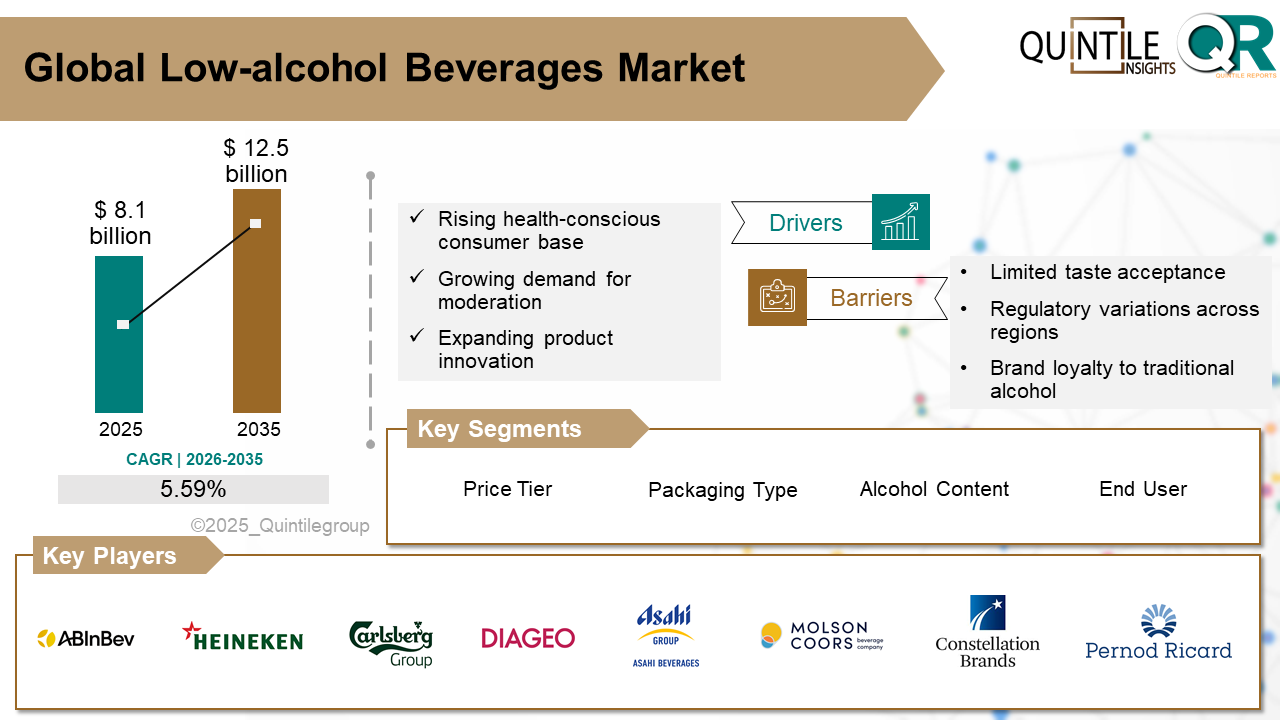
The Global Low-alcohol Beverages Market was estimated at USD 8.1 billion in 2025 and is projected to reach USD 12.5 billion by 2035, growing at a robust CAGR of 5.59% during the forecast period from 2026 to 2035. The Low-alcohol Beverages market report provides a comprehensive industry assessment, analyzing economic conditions, technological advancements, regulatory frameworks, and evolving consumer behavior to deliver a clear view of future growth potential.
With 2025 as the base year, the Low-alcohol Beverages market is witnessing steady expansion driven by innovation, rising consumer demand, and rapid technological progress. Companies are increasingly refining their go-to-market (GTM) strategies to capture emerging opportunities and respond to shifting market dynamics.
Looking ahead to 2035, the market is expected to sustain its growth momentum, supported by continuous R&D investments, strategic partnerships, and mergers and acquisitions. Businesses that prioritize innovation, agile GTM strategies, and alignment with consumer needs are likely to achieve long-term success. The report delivers detailed insights into key drivers, restraints, opportunities, and challenges across segments, regions, and countries, supported by qualitative and quantitative analysis covering the period from 2017 to 2035.
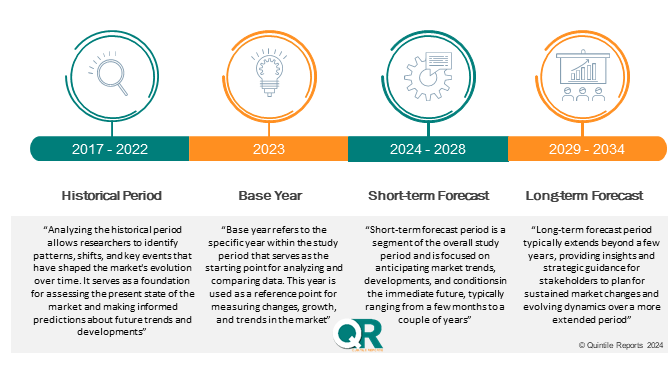
Historical Analysis (2017–2024): Reviews past market trends, performance metrics, and growth patterns to identify factors shaping current and future market behavior.
Forecast and Projections (2026–2035): Provides forward-looking market estimates, highlighting growth opportunities, emerging trends, and regional developments.
Compound Annual Growth Rate (CAGR): Presents a clear CAGR calculation for 2026–2035, enabling stakeholders to evaluate market growth potential over the forecast period.
Low-alcohol Beverages Market
The low-alcohol beverages market refers to the global and regional market for beverages designed to replicate traditional alcoholic drinks like beer, wine, cider, or spirits, but with significantly reduced alcohol content. These products aim to maintain the familiar taste, appearance, and drinking experience of their full-strength counterparts. Often sold in similar packaging and advertised in comparable ways, low alcohol options have become increasingly appealing due to advancements in flavor and formulation. As a result, consumers now have access to a wider range of better-tasting low alcohol beverages than ever before.
The popularity of low alcohol drinks is growing, with one in four UK adults who consume alcohol trying a low or alcohol-free option in 2021. Drinkaware research indicates that regular consumers of these products have noticed an improvement in taste, while those unfamiliar with them often hold outdated or negative assumptions. Many are pleasantly surprised after giving them a try. For individuals looking to reduce their alcohol intake, switching to low alcohol drinks can help lower overall consumption provided they replace, rather than supplement, existing drinking habits.
What are the drivers of low-alcohol beverages market?Growing health consciousness among consumers has led to increased demand for low alcohol beverages. People are more aware of the risks associated with excessive alcohol consumption, such as liver disease and other chronic health conditions, and are actively seeking alternatives that align with wellness-oriented lifestyles.
The rise of moderation movements like "Dry January" and "Sober October" is encouraging occasional drinkers to opt for low or no alcohol options. These cultural shifts have normalized reduced alcohol consumption and contributed to mainstream acceptance of low alcohol products.
Advancements in production technology have significantly improved the taste and variety of low alcohol drinks. Innovations in brewing and distillation allow manufacturers to create beverages that closely mimic the sensory profile of traditional alcoholic drinks, increasing their appeal.
Younger consumers, especially Millennials and Gen Z, are showing a growing preference for products that support mindful drinking. This demographic values experiences over intoxication and often seeks out beverages that support socializing without compromising health.
The expansion of retail and hospitality channels offering low alcohol options is boosting visibility and accessibility. Supermarkets, bars, and restaurants increasingly stock a variety of these products, making them more convenient to purchase and try.
What are the challenges and restraining factors of low-alcohol beverages market?Despite improvements in taste, some consumers still perceive low alcohol drinks as inferior to regular alcoholic beverages. This stigma can hinder adoption, especially among traditional drinkers who prioritize the flavor and strength of standard options.
Regulatory inconsistencies across countries regarding labeling and classification of low alcohol drinks pose a challenge for global manufacturers. Varying definitions and alcohol limits can create confusion and compliance burdens in international markets.
The premium pricing of some low alcohol products acts as a barrier to widespread adoption. Consumers may hesitate to pay the same or more for a drink that contains less alcohol, especially when budget is a key consideration.
Marketing low alcohol products without alienating regular drinkers requires a delicate balance. Positioning them as both healthy and enjoyable can be complex, particularly in markets where alcohol culture remains deeply rooted.
What are the regional trends of low-alcohol beverages market?In North America, the low alcohol beverage market is expanding steadily, driven by health-conscious millennials and Gen Z consumers. The U.S. and Canada are seeing increased product offerings in retail and on-premise channels, especially in urban areas where wellness trends are strong.
Europe remains the largest and most mature market for low alcohol beverages. Countries like the UK, Germany, and Spain are at the forefront, with well-established demand supported by public health campaigns and a cultural shift toward mindful drinking.
In Asia-Pacific, rapid urbanization and a rising middle class are fueling growth in low alcohol drinks, particularly in Japan, Australia, and South Korea. Younger consumers and professionals are showing interest in these products as part of healthier lifestyle choices.
Latin America is emerging as a promising region, with Brazil and Mexico showing early signs of interest. While still niche, increasing awareness of alcohol-related health risks is opening the market to new entrants and product innovation.
In the Middle East and Africa, growth is relatively slow due to cultural and religious norms limiting alcohol consumption.
Country-Wise Outlook:U.S. Low-Alcohol Market Grows with Health-Conscious Consumers:In the United States, the low alcohol beverage market is being shaped by shifting consumer attitudes toward health and moderation. A growing number of Americans are reducing their alcohol intake due to concerns about wellness, fitness, and mental clarity, which has opened space for low ABV beers, wines, and ready-to-drink cocktails. Brands are focusing on transparency, clean labeling, and functional benefits like low calories or added botanicals to appeal to the health-aware demographic. The low and no alcohol segment is just starting to gain momentum in the U.S., with many scale brewers extending their core brands into the space.
The U.S. market is also benefiting from strong retail distribution and e-commerce channels that allow innovative startups and craft producers to reach niche audiences. Urban areas, particularly on the coasts, have become hotspots for product experimentation and consumption. Social media campaigns and influencer partnerships have helped normalize the consumption of low alcohol beverages among younger adults, especially millennials and Gen Z.
Germany Leads in Non-Alcoholic Beer Innovation:Germany has long been a leader in beer innovation, and its adoption of low alcohol beverages reflects this heritage. The country hosts a wide range of low alcohol and non-alcoholic beers, which are well integrated into mainstream retail and hospitality channels. Consumer preferences in Germany are shifting, especially among younger and health-conscious demographics seeking alternatives with lower ABV. Similar to the UK’s definition, many German low-alcohol beers hover around 0.5% ABV, aligning with broader European labeling practices for "alkoholfrei" products. German breweries also export low-alcohol beers extensively, showing increasing global demand for the category.
However, there is no single harmonized standard across the EU for what constitutes "low alcohol", unlike the UK which defines it as up to 1.2% ABV. While many German products stay below 0.5% ABV, there are also “light” beers in the 2–3% ABV range, akin to the UK’s “reduced alcohol” category. Consumer awareness of units of alcohol and health guidelines is rising, partly influenced by public health frameworks like those in the UK, which recommend no more than 14 units per week.
Japan's Youth Drive Rapid Low-ABV Adoption:Japan’s low-alcohol beverage market is undergoing rapid transformation, driven by shifting consumer preferences and heightened health consciousness. More than half of Japanese consumers aged 25–34 and nearly half of those aged 18–24 now report consuming low- or zero-alcohol drinks. This behavioral shift reflects a broader movement away from traditional drinking patterns, as younger generations increasingly prioritize wellness and moderation. Government initiatives have also supported this trend, with Japan’s Ministry of Health promoting responsible consumption guidelines aimed at reducing long-term health risks associated with alcohol.
To meet the growing demand, major Japanese beverage companies are actively expanding their low-alcohol portfolios. For example, Kirin Brewery launched Kirin Hanayoi in September 2024, a 3% ABV ready-to-drink beverage that blends soju, carbonated water, and juice. This marked Kirin's first product under 3% ABV in nearly a decade, with a target to sell 20 million units by year-end. Meanwhile, Asahi Breweries has committed to capping future releases below 8% ABV and aims to increase sales of products with 3.5% ABV or less by 2025. These efforts illustrate how moderation and mindful consumption are reshaping Japan’s alcoholic beverage landscape.
Competitive Analysis:The low-alcohol beverages market is witnessing heightened competition as more producers respond to shifting consumer demand for healthier drinking options. Brands are diversifying their product portfolios by launching low- and no-alcohol versions of popular beverages, aiming to retain existing customers while attracting new, health-conscious consumers. Strong branding and broad availability remain key competitive advantages.
Taste and quality have become critical differentiators. Companies are investing in research and innovation to improve flavor profiles, as earlier concerns over taste discouraged adoption. By enhancing production methods and incorporating natural ingredients, many new products now meet consumer expectations for both taste and experience, raising the bar for competitors.
Smaller players, including startups and craft producers, are gaining ground by offering unique formulations, clean-label products, or functional benefits. While these entrants often lack scale, their ability to connect with niche audiences through authenticity and innovation has carved out new sub-segments within the market.
Sales channels are also shaping competition. Increased reliance on online platforms, direct-to-consumer sales, and partnerships with retailers and hospitality venues have created more opportunities for market penetration. Brands that align their marketing strategies with wellness, moderation, and lifestyle values tend to perform better across both digital and traditional retail environments.
Regulatory developments and changing social norms continue to reshape competitive dynamics. Lower-alcohol labeling allowances and national health guidelines are encouraging product innovation.
Recent Development:In January 2025, new low- and no-alcohol products including a chocolate cherry stout, a barrel-aged aperitivo, and an espresso martini-style drink were launched to meet rising demand for mindful drinking. These launches reflect growing consumer interest in flavorful, lower-ABV options.
In November 2024, Utopian Brewing introduced its first alcohol-free beer, the AF Pilsner, with an ABV of 0.5%. This launch marked a significant entry into the low-alcohol beer segment for the Devonshire-based brewery. The AF Pilsner was developed using traditional brewing techniques cold fermentation with lager yeast without employing expensive alcohol-removal technologies. The company emphasized its commitment to quality and authenticity, highlighting that the process took nearly a year and multiple pilot runs to achieve the desired taste and mouthfeel.
Our team of experienced researchers has meticulously gathered and analyzed data to deliver a thorough examination of market dynamics, competitive landscape, and emerging technologies. With a focus on delivering actionable intelligence, this report aims to empower decision-makers with the information needed to make informed choices and stay ahead of the competition. Whether you are a seasoned industry player or a new entrant, our market research report serves as a strategic tool to navigate the complexities of the market, aiding in successful business planning and growth strategies.
This chapter of our Low-alcohol Beverages market report provides an in-depth examination of the factors shaping the industry landscape. This section typically encompasses several key elements to offer a comprehensive understanding of the industry landscape such as market drivers & restraints analysis, market opportunities & trend analysis, market size & growth analysis, competitive analysis, SWOT analysis, business environment tools such as Porter's five forces & PESTEL analysis, Ansoff Matrix analysis, penetration & growth prospect analysis, regulatory framework & reimbursement scenario analysis, impact of macro & micro economic factors analysis such as Covid-19 impact, GDP growth, market inflation, U.S.- China trade war, Russia-Ukraine war impact, and supply chain analysis.
The segment analysis chapter of Low-alcohol Beverages market report is a critical section that delves into a detailed examination of the market's various segments. Segmentation involves dividing the market into distinct categories based on certain criteria to better understand and address the diverse needs of consumers. This chapter typically follows the introduction and provides a more granular view of the market, offering valuable insights for businesses and stakeholders. The components of the chapter lude segment definitions to understand the inclusions and exclusions of the study, assumptions, market size estimates and growth trend analysis of each segment, qualitative analysis of the segment, technological advancements, market penetration rate, market adoption rate, market share examination by each segment, segment growth drivers and restraint barriers, consumer behaviour and challenge analysis.
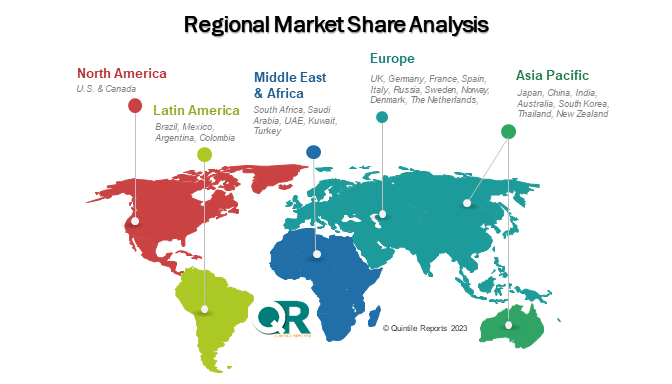
The chapter in Low-alcohol Beverages market research report is a pivotal section that examines and predicts the market dynamics and trends specific to different geographical regions. This chapter is crucial for businesses and stakeholders seeking a comprehensive understanding of how the market behaves across various locations, enabling them to tailor strategies and make informed decisions based on regional variations. The regional analysis chapter of our Low-alcohol Beverages market report is classified into regions & country-level. The chapter consists of North America (U.S., Canada), Europe (UK, Germany, France, Italy, Spain, Russia, Sweden, Denmark, Norway, Rest of Europe), Asia Pacific (Japan, China, India, Australia, South Korea, Thailand, Rest of Asia Pacific), Latin America (Brazil, Mexico, Argentina, Colombia, Rest of Latin America), Middle East & Africa (South Africa, Saudi Arabia, UAE, Kuwait, Rest of Middle East & Africa).
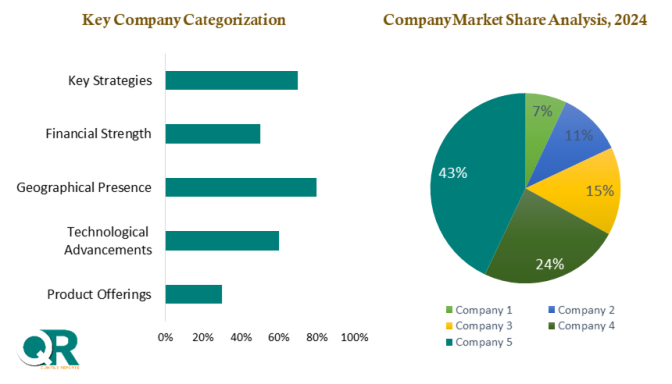
This section of a Low-alcohol Beverages market report is a crucial segment that provides a comprehensive overview of the competitive landscape within the market. This section is vital for businesses, investors, and stakeholders seeking insights into key players, their market positioning, strengths, weaknesses, strategies, and potential impacts on the overall market dynamics. The chapter includes research methodology used to analyse the market competition, list of key players operating in the market, detailed company profile section which includes company overview, business verticals, financial performance, product/services benchmarking, geographical presence, and strategic initiatives.
| Report Scope | Details |
| Report Version | 2026 |
| Growth Rate | CAGR of 5.59 from 2026 to 2035 |
| Base year | 2025 |
| Actual estimates/Historical data | 2017 - 2024 |
| Forecast period | 2026 - 2035 |
| Quantitative units | Revenue in USD million/billion & CAGR from 2026 to 2035 |
| Country scope | North America (U.S., Canada), Europe (UK, Germany, France, Italy, Spain, Russia, Sweden, Denmark, Norway, Rest of Europe), Asia Pacific (Japan, China, India, Australia, South Korea, Thailand, Rest of Asia Pacific), Latin America (Brazil, Mexico, Argentina, Colombia, Rest of Latin America), Middle East & Africa (South Africa, Saudi Arabia, UAE, Kuwait, Rest of Middle East & Africa). |
| The Segment covered by Product Type & Alcohol Content |
|
| The Segment covered by Price Tier |
|
| Companies covered |
|
| Report coverage | Revenue forecast, company share, competitive landscape, growth factors, and trends |
| Free customization scope (equivalent to 5 analyst working days) | If you need specific information, which is not currently within the scope of the report, we will provide it to you as a part of the customization |

Statistics for the 2025 Low-alcohol Beverages market share, size, and revenue growth rate were created by Quintile Report™. Low-alcohol Beverages analysis includes a market forecast outlook for 2035 and a historical overview. Get a free PDF sample of this market analysis, please get in touch with our principal analyst at sales@quintilereports.com
List of Tables
Table 1 List of Abbreviation and acronyms
Table 2 List of Sources
Table 3 North America Global Low-alcohol Beverages Market, by Segment Analysis, (USD Million) 2017-2035
Table 4 North America Global Low-alcohol Beverages Market, by Region, (USD Million) 2017-2035
Table 5 U.S. Global Low-alcohol Beverages Market, by Segment Analysis, (USD Million) 2017-2035
Table 6 Canada Global Low-alcohol Beverages Market, by Segment Analysis, (USD Million) 2017-2035
Table 7 Europe Global Low-alcohol Beverages Market, by Segment Analysis, (USD Million) 2017-2035
Table 8 Europe Global Low-alcohol Beverages Market, by Region, (USD Million) 2017-2035
Table 9 Germany Global Low-alcohol Beverages Market, by Segment Analysis, (USD Million) 2017-2035
Table 10 U.K. Global Low-alcohol Beverages Market, by Segment Analysis, (USD Million) 2017-2035
Table 11 France Global Low-alcohol Beverages Market, by Segment Analysis, (USD Million) 2017-2035
Table 12 Italy Global Low-alcohol Beverages Market, by Segment Analysis, (USD Million) 2017-2035
Table 13 Spain Global Low-alcohol Beverages Market, by Segment Analysis, (USD Million) 2017-2035
Table 14 Sweden Global Low-alcohol Beverages Market, by Segment Analysis, (USD Million) 2017-2035
Table 15 Denmark Global Low-alcohol Beverages Market, by Segment Analysis, (USD Million) 2017-2035
Table 16 Norway Global Low-alcohol Beverages Market, by Segment Analysis, (USD Million) 2017-2035
Table 17 The Netherlands Global Low-alcohol Beverages Market, by Segment Analysis, (USD Million) 2017-2035
Table 18 Russia Global Low-alcohol Beverages Market, by Segment Analysis, (USD Million) 2017-2035
Table 19 Asia Pacific Global Low-alcohol Beverages Market, by Segment Analysis, (USD Million) 2017-2035
Table 20 Asia Pacific Global Low-alcohol Beverages Market, by Region, (USD Million) 2017-2035
Table 21 China Global Low-alcohol Beverages Market, by Segment Analysis, (USD Million) 2017-2035
Table 22 Japan Global Low-alcohol Beverages Market, by Segment Analysis, (USD Million) 2017-2035
Table 23 India Global Low-alcohol Beverages Market, by Segment Analysis, (USD Million) 2017-2035
Table 24 Australia Global Low-alcohol Beverages Market, by Segment Analysis, (USD Million) 2017-2035
Table 25 South Korea Global Low-alcohol Beverages Market, by Segment Analysis, (USD Million) 2017-2035
Table 26 Thailand Global Low-alcohol Beverages Market, by Segment Analysis, (USD Million) 2017-2035
Table 27 Latin America Global Low-alcohol Beverages Market, by Segment Analysis, (USD Million) 2017-2035
Table 28 Latin America Global Low-alcohol Beverages Market, by Region, (USD Million) 2017-2035
Table 29 Brazil Global Low-alcohol Beverages Market, by Segment Analysis, (USD Million) 2017-2035
Table 30 Mexico Global Low-alcohol Beverages Market, by Segment Analysis, (USD Million) 2017-2035
Table 31 Argentina Global Low-alcohol Beverages Market, by Segment Analysis, (USD Million) 2017-2035
Table 32 Middle East and Africa Global Low-alcohol Beverages Market, by Segment Analysis, (USD Million) 2017-2035
Table 33 Middle East and Africa Global Low-alcohol Beverages Market, by Region, (USD Million) 2017-2035
Table 34 South Africa Global Low-alcohol Beverages Market, by Segment Analysis, (USD Million) 2017-2035
Table 35 Saudi Arabia Global Low-alcohol Beverages Market, by Segment Analysis, (USD Million) 2017-2035
Table 36 UAE Global Low-alcohol Beverages Market, by Segment Analysis, (USD Million) 2017-2035
Table 37 Kuwait Global Low-alcohol Beverages Market, by Segment Analysis, (USD Million) 2017-2035
Table 38 Turkey Global Low-alcohol Beverages Market, by Segment Analysis, (USD Million) 2017-2035
Fig.1 Market research process
Fig.2 Market research approaches
Fig.3 Global Low-alcohol Beverages Market: market scenario
Fig.4 Global Low-alcohol Beverages Market competitive outlook
Fig.5 Global Low-alcohol Beverages Market driver analysis
Fig.6 Global Low-alcohol Beverages Market restraint analysis
Fig.7 Global Low-alcohol Beverages Market opportunity analysis
Fig.8 Global Low-alcohol Beverages Market trends analysis
Fig.9 Global Low-alcohol Beverages Market: Segment Analysis (Based on the scope)
Fig.10 Global Low-alcohol Beverages Market: regional analysis
Fig.11 Global market shares and leading market players
Fig.12 North America market share and leading players
Fig.13 Europe market share and leading players
Fig.14 Asia Pacific market share and leading players
Fig.15 Latin America market share and leading players
Fig.16 Middle East & Africa market share and leading players
Fig.17 North America, by country
Fig.18 North America
Fig.19 North America market estimates and forecast, 2017-2035
Fig.20 U.S.
Fig.21 Canada
Fig.22 Europe
Fig.23 Europe market estimates and forecast, 2017-2035
Fig.24 U.K.
Fig.25 Germany
Fig.26 France
Fig.27 Italy
Fig.28 Spain
Fig.29 Sweden
Fig.30 Denmark
Fig.31 Norway
Fig.32 The Netherlands
Fig.33 Russia
Fig.34 Asia Pacific
Fig.35 Asia Pacific market estimates and forecast, 2017-2035
Fig.36 China
Fig.37 Japan
Fig.38 India
Fig.39 Australia
Fig.40 South Korea
Fig.41 Thailand
Fig.42 Latin America
Fig.43 Latin America market estimates and forecast, 2017-2035
Fig.44 Brazil
Fig.45 Mexico
Fig.46 Argentina
Fig.47 Colombia
Fig.48 Middle East and Africa
Fig.49 Middle East and Africa market estimates and forecast, 2017-2035
Fig.50 Saudi Arabia
Fig.51 South Africa
Fig.52 UAE
Fig.53 Kuwait
Fig.54 Turkey
List of Tables
Table 1 List of Abbreviation and acronyms
Table 2 List of Sources
Table 3 North America Global Low-alcohol Beverages Market, by Segment Analysis, (USD Million) 2017-2035
Table 4 North America Global Low-alcohol Beverages Market, by Region, (USD Million) 2017-2035
Table 5 U.S. Global Low-alcohol Beverages Market, by Segment Analysis, (USD Million) 2017-2035
Table 6 Canada Global Low-alcohol Beverages Market, by Segment Analysis, (USD Million) 2017-2035
Table 7 Europe Global Low-alcohol Beverages Market, by Segment Analysis, (USD Million) 2017-2035
Table 8 Europe Global Low-alcohol Beverages Market, by Region, (USD Million) 2017-2035
Table 9 Germany Global Low-alcohol Beverages Market, by Segment Analysis, (USD Million) 2017-2035
Table 10 U.K. Global Low-alcohol Beverages Market, by Segment Analysis, (USD Million) 2017-2035
Table 11 France Global Low-alcohol Beverages Market, by Segment Analysis, (USD Million) 2017-2035
Table 12 Italy Global Low-alcohol Beverages Market, by Segment Analysis, (USD Million) 2017-2035
Table 13 Spain Global Low-alcohol Beverages Market, by Segment Analysis, (USD Million) 2017-2035
Table 14 Sweden Global Low-alcohol Beverages Market, by Segment Analysis, (USD Million) 2017-2035
Table 15 Denmark Global Low-alcohol Beverages Market, by Segment Analysis, (USD Million) 2017-2035
Table 16 Norway Global Low-alcohol Beverages Market, by Segment Analysis, (USD Million) 2017-2035
Table 17 The Netherlands Global Low-alcohol Beverages Market, by Segment Analysis, (USD Million) 2017-2035
Table 18 Russia Global Low-alcohol Beverages Market, by Segment Analysis, (USD Million) 2017-2035
Table 19 Asia Pacific Global Low-alcohol Beverages Market, by Segment Analysis, (USD Million) 2017-2035
Table 20 Asia Pacific Global Low-alcohol Beverages Market, by Region, (USD Million) 2017-2035
Table 21 China Global Low-alcohol Beverages Market, by Segment Analysis, (USD Million) 2017-2035
Table 22 Japan Global Low-alcohol Beverages Market, by Segment Analysis, (USD Million) 2017-2035
Table 23 India Global Low-alcohol Beverages Market, by Segment Analysis, (USD Million) 2017-2035
Table 24 Australia Global Low-alcohol Beverages Market, by Segment Analysis, (USD Million) 2017-2035
Table 25 South Korea Global Low-alcohol Beverages Market, by Segment Analysis, (USD Million) 2017-2035
Table 26 Thailand Global Low-alcohol Beverages Market, by Segment Analysis, (USD Million) 2017-2035
Table 27 Latin America Global Low-alcohol Beverages Market, by Segment Analysis, (USD Million) 2017-2035
Table 28 Latin America Global Low-alcohol Beverages Market, by Region, (USD Million) 2017-2035
Table 29 Brazil Global Low-alcohol Beverages Market, by Segment Analysis, (USD Million) 2017-2035
Table 30 Mexico Global Low-alcohol Beverages Market, by Segment Analysis, (USD Million) 2017-2035
Table 31 Argentina Global Low-alcohol Beverages Market, by Segment Analysis, (USD Million) 2017-2035
Table 32 Middle East and Africa Global Low-alcohol Beverages Market, by Segment Analysis, (USD Million) 2017-2035
Table 33 Middle East and Africa Global Low-alcohol Beverages Market, by Region, (USD Million) 2017-2035
Table 34 South Africa Global Low-alcohol Beverages Market, by Segment Analysis, (USD Million) 2017-2035
Table 35 Saudi Arabia Global Low-alcohol Beverages Market, by Segment Analysis, (USD Million) 2017-2035
Table 36 UAE Global Low-alcohol Beverages Market, by Segment Analysis, (USD Million) 2017-2035
Table 37 Kuwait Global Low-alcohol Beverages Market, by Segment Analysis, (USD Million) 2017-2035
Table 38 Turkey Global Low-alcohol Beverages Market, by Segment Analysis, (USD Million) 2017-2035
Fig.1 Market research process
Fig.2 Market research approaches
Fig.3 Global Low-alcohol Beverages Market: market scenario
Fig.4 Global Low-alcohol Beverages Market competitive outlook
Fig.5 Global Low-alcohol Beverages Market driver analysis
Fig.6 Global Low-alcohol Beverages Market restraint analysis
Fig.7 Global Low-alcohol Beverages Market opportunity analysis
Fig.8 Global Low-alcohol Beverages Market trends analysis
Fig.9 Global Low-alcohol Beverages Market: Segment Analysis (Based on the scope)
Fig.10 Global Low-alcohol Beverages Market: regional analysis
Fig.11 Global market shares and leading market players
Fig.12 North America market share and leading players
Fig.13 Europe market share and leading players
Fig.14 Asia Pacific market share and leading players
Fig.15 Latin America market share and leading players
Fig.16 Middle East & Africa market share and leading players
Fig.17 North America, by country
Fig.18 North America
Fig.19 North America market estimates and forecast, 2017-2035
Fig.20 U.S.
Fig.21 Canada
Fig.22 Europe
Fig.23 Europe market estimates and forecast, 2017-2035
Fig.24 U.K.
Fig.25 Germany
Fig.26 France
Fig.27 Italy
Fig.28 Spain
Fig.29 Sweden
Fig.30 Denmark
Fig.31 Norway
Fig.32 The Netherlands
Fig.33 Russia
Fig.34 Asia Pacific
Fig.35 Asia Pacific market estimates and forecast, 2017-2035
Fig.36 China
Fig.37 Japan
Fig.38 India
Fig.39 Australia
Fig.40 South Korea
Fig.41 Thailand
Fig.42 Latin America
Fig.43 Latin America market estimates and forecast, 2017-2035
Fig.44 Brazil
Fig.45 Mexico
Fig.46 Argentina
Fig.47 Colombia
Fig.48 Middle East and Africa
Fig.49 Middle East and Africa market estimates and forecast, 2017-2035
Fig.50 Saudi Arabia
Fig.51 South Africa
Fig.52 UAE
Fig.53 Kuwait
Fig.54 Turkey
The Global Low-alcohol Beverages Market was estimated at USD 8.1 billion in 2025 and is projected to reach USD 12.5 billion by 2035, growing at a robust CAGR of 5.59% during the forecast period from 2026 to 2035. The Low-alcohol Beverages market report provides a comprehensive industry assessment, analyzing economic conditions, technological advancements, regulatory frameworks, and evolving consumer behavior to deliver a clear view of future growth potential.
With 2025 as the base year, the Low-alcohol Beverages market is witnessing steady expansion driven by innovation, rising consumer demand, and rapid technological progress. Companies are increasingly refining their go-to-market (GTM) strategies to capture emerging opportunities and respond to shifting market dynamics.
Looking ahead to 2035, the market is expected to sustain its growth momentum, supported by continuous R&D investments, strategic partnerships, and mergers and acquisitions. Businesses that prioritize innovation, agile GTM strategies, and alignment with consumer needs are likely to achieve long-term success. The report delivers detailed insights into key drivers, restraints, opportunities, and challenges across segments, regions, and countries, supported by qualitative and quantitative analysis covering the period from 2017 to 2035.
Historical Analysis (2017–2024): Reviews past market trends, performance metrics, and growth patterns to identify factors shaping current and future market behavior.
Forecast and Projections (2026–2035): Provides forward-looking market estimates, highlighting growth opportunities, emerging trends, and regional developments.
Compound Annual Growth Rate (CAGR): Presents a clear CAGR calculation for 2026–2035, enabling stakeholders to evaluate market growth potential over the forecast period.
Low-alcohol Beverages Market
The low-alcohol beverages market refers to the global and regional market for beverages designed to replicate traditional alcoholic drinks like beer, wine, cider, or spirits, but with significantly reduced alcohol content. These products aim to maintain the familiar taste, appearance, and drinking experience of their full-strength counterparts. Often sold in similar packaging and advertised in comparable ways, low alcohol options have become increasingly appealing due to advancements in flavor and formulation. As a result, consumers now have access to a wider range of better-tasting low alcohol beverages than ever before.
The popularity of low alcohol drinks is growing, with one in four UK adults who consume alcohol trying a low or alcohol-free option in 2021. Drinkaware research indicates that regular consumers of these products have noticed an improvement in taste, while those unfamiliar with them often hold outdated or negative assumptions. Many are pleasantly surprised after giving them a try. For individuals looking to reduce their alcohol intake, switching to low alcohol drinks can help lower overall consumption provided they replace, rather than supplement, existing drinking habits.
What are the drivers of low-alcohol beverages market?Growing health consciousness among consumers has led to increased demand for low alcohol beverages. People are more aware of the risks associated with excessive alcohol consumption, such as liver disease and other chronic health conditions, and are actively seeking alternatives that align with wellness-oriented lifestyles.
The rise of moderation movements like "Dry January" and "Sober October" is encouraging occasional drinkers to opt for low or no alcohol options. These cultural shifts have normalized reduced alcohol consumption and contributed to mainstream acceptance of low alcohol products.
Advancements in production technology have significantly improved the taste and variety of low alcohol drinks. Innovations in brewing and distillation allow manufacturers to create beverages that closely mimic the sensory profile of traditional alcoholic drinks, increasing their appeal.
Younger consumers, especially Millennials and Gen Z, are showing a growing preference for products that support mindful drinking. This demographic values experiences over intoxication and often seeks out beverages that support socializing without compromising health.
The expansion of retail and hospitality channels offering low alcohol options is boosting visibility and accessibility. Supermarkets, bars, and restaurants increasingly stock a variety of these products, making them more convenient to purchase and try.
What are the challenges and restraining factors of low-alcohol beverages market?Despite improvements in taste, some consumers still perceive low alcohol drinks as inferior to regular alcoholic beverages. This stigma can hinder adoption, especially among traditional drinkers who prioritize the flavor and strength of standard options.
Regulatory inconsistencies across countries regarding labeling and classification of low alcohol drinks pose a challenge for global manufacturers. Varying definitions and alcohol limits can create confusion and compliance burdens in international markets.
The premium pricing of some low alcohol products acts as a barrier to widespread adoption. Consumers may hesitate to pay the same or more for a drink that contains less alcohol, especially when budget is a key consideration.
Marketing low alcohol products without alienating regular drinkers requires a delicate balance. Positioning them as both healthy and enjoyable can be complex, particularly in markets where alcohol culture remains deeply rooted.
What are the regional trends of low-alcohol beverages market?In North America, the low alcohol beverage market is expanding steadily, driven by health-conscious millennials and Gen Z consumers. The U.S. and Canada are seeing increased product offerings in retail and on-premise channels, especially in urban areas where wellness trends are strong.
Europe remains the largest and most mature market for low alcohol beverages. Countries like the UK, Germany, and Spain are at the forefront, with well-established demand supported by public health campaigns and a cultural shift toward mindful drinking.
In Asia-Pacific, rapid urbanization and a rising middle class are fueling growth in low alcohol drinks, particularly in Japan, Australia, and South Korea. Younger consumers and professionals are showing interest in these products as part of healthier lifestyle choices.
Latin America is emerging as a promising region, with Brazil and Mexico showing early signs of interest. While still niche, increasing awareness of alcohol-related health risks is opening the market to new entrants and product innovation.
In the Middle East and Africa, growth is relatively slow due to cultural and religious norms limiting alcohol consumption.
Country-Wise Outlook:U.S. Low-Alcohol Market Grows with Health-Conscious Consumers:In the United States, the low alcohol beverage market is being shaped by shifting consumer attitudes toward health and moderation. A growing number of Americans are reducing their alcohol intake due to concerns about wellness, fitness, and mental clarity, which has opened space for low ABV beers, wines, and ready-to-drink cocktails. Brands are focusing on transparency, clean labeling, and functional benefits like low calories or added botanicals to appeal to the health-aware demographic. The low and no alcohol segment is just starting to gain momentum in the U.S., with many scale brewers extending their core brands into the space.
The U.S. market is also benefiting from strong retail distribution and e-commerce channels that allow innovative startups and craft producers to reach niche audiences. Urban areas, particularly on the coasts, have become hotspots for product experimentation and consumption. Social media campaigns and influencer partnerships have helped normalize the consumption of low alcohol beverages among younger adults, especially millennials and Gen Z.
Germany Leads in Non-Alcoholic Beer Innovation:Germany has long been a leader in beer innovation, and its adoption of low alcohol beverages reflects this heritage. The country hosts a wide range of low alcohol and non-alcoholic beers, which are well integrated into mainstream retail and hospitality channels. Consumer preferences in Germany are shifting, especially among younger and health-conscious demographics seeking alternatives with lower ABV. Similar to the UK’s definition, many German low-alcohol beers hover around 0.5% ABV, aligning with broader European labeling practices for "alkoholfrei" products. German breweries also export low-alcohol beers extensively, showing increasing global demand for the category.
However, there is no single harmonized standard across the EU for what constitutes "low alcohol", unlike the UK which defines it as up to 1.2% ABV. While many German products stay below 0.5% ABV, there are also “light” beers in the 2–3% ABV range, akin to the UK’s “reduced alcohol” category. Consumer awareness of units of alcohol and health guidelines is rising, partly influenced by public health frameworks like those in the UK, which recommend no more than 14 units per week.
Japan's Youth Drive Rapid Low-ABV Adoption:Japan’s low-alcohol beverage market is undergoing rapid transformation, driven by shifting consumer preferences and heightened health consciousness. More than half of Japanese consumers aged 25–34 and nearly half of those aged 18–24 now report consuming low- or zero-alcohol drinks. This behavioral shift reflects a broader movement away from traditional drinking patterns, as younger generations increasingly prioritize wellness and moderation. Government initiatives have also supported this trend, with Japan’s Ministry of Health promoting responsible consumption guidelines aimed at reducing long-term health risks associated with alcohol.
To meet the growing demand, major Japanese beverage companies are actively expanding their low-alcohol portfolios. For example, Kirin Brewery launched Kirin Hanayoi in September 2024, a 3% ABV ready-to-drink beverage that blends soju, carbonated water, and juice. This marked Kirin's first product under 3% ABV in nearly a decade, with a target to sell 20 million units by year-end. Meanwhile, Asahi Breweries has committed to capping future releases below 8% ABV and aims to increase sales of products with 3.5% ABV or less by 2025. These efforts illustrate how moderation and mindful consumption are reshaping Japan’s alcoholic beverage landscape.
Competitive Analysis:The low-alcohol beverages market is witnessing heightened competition as more producers respond to shifting consumer demand for healthier drinking options. Brands are diversifying their product portfolios by launching low- and no-alcohol versions of popular beverages, aiming to retain existing customers while attracting new, health-conscious consumers. Strong branding and broad availability remain key competitive advantages.
Taste and quality have become critical differentiators. Companies are investing in research and innovation to improve flavor profiles, as earlier concerns over taste discouraged adoption. By enhancing production methods and incorporating natural ingredients, many new products now meet consumer expectations for both taste and experience, raising the bar for competitors.
Smaller players, including startups and craft producers, are gaining ground by offering unique formulations, clean-label products, or functional benefits. While these entrants often lack scale, their ability to connect with niche audiences through authenticity and innovation has carved out new sub-segments within the market.
Sales channels are also shaping competition. Increased reliance on online platforms, direct-to-consumer sales, and partnerships with retailers and hospitality venues have created more opportunities for market penetration. Brands that align their marketing strategies with wellness, moderation, and lifestyle values tend to perform better across both digital and traditional retail environments.
Regulatory developments and changing social norms continue to reshape competitive dynamics. Lower-alcohol labeling allowances and national health guidelines are encouraging product innovation.
Recent Development:In January 2025, new low- and no-alcohol products including a chocolate cherry stout, a barrel-aged aperitivo, and an espresso martini-style drink were launched to meet rising demand for mindful drinking. These launches reflect growing consumer interest in flavorful, lower-ABV options.
In November 2024, Utopian Brewing introduced its first alcohol-free beer, the AF Pilsner, with an ABV of 0.5%. This launch marked a significant entry into the low-alcohol beer segment for the Devonshire-based brewery. The AF Pilsner was developed using traditional brewing techniques cold fermentation with lager yeast without employing expensive alcohol-removal technologies. The company emphasized its commitment to quality and authenticity, highlighting that the process took nearly a year and multiple pilot runs to achieve the desired taste and mouthfeel.
Our team of experienced researchers has meticulously gathered and analyzed data to deliver a thorough examination of market dynamics, competitive landscape, and emerging technologies. With a focus on delivering actionable intelligence, this report aims to empower decision-makers with the information needed to make informed choices and stay ahead of the competition. Whether you are a seasoned industry player or a new entrant, our market research report serves as a strategic tool to navigate the complexities of the market, aiding in successful business planning and growth strategies.
This chapter of our Low-alcohol Beverages market report provides an in-depth examination of the factors shaping the industry landscape. This section typically encompasses several key elements to offer a comprehensive understanding of the industry landscape such as market drivers & restraints analysis, market opportunities & trend analysis, market size & growth analysis, competitive analysis, SWOT analysis, business environment tools such as Porter's five forces & PESTEL analysis, Ansoff Matrix analysis, penetration & growth prospect analysis, regulatory framework & reimbursement scenario analysis, impact of macro & micro economic factors analysis such as Covid-19 impact, GDP growth, market inflation, U.S.- China trade war, Russia-Ukraine war impact, and supply chain analysis.
The segment analysis chapter of Low-alcohol Beverages market report is a critical section that delves into a detailed examination of the market's various segments. Segmentation involves dividing the market into distinct categories based on certain criteria to better understand and address the diverse needs of consumers. This chapter typically follows the introduction and provides a more granular view of the market, offering valuable insights for businesses and stakeholders. The components of the chapter lude segment definitions to understand the inclusions and exclusions of the study, assumptions, market size estimates and growth trend analysis of each segment, qualitative analysis of the segment, technological advancements, market penetration rate, market adoption rate, market share examination by each segment, segment growth drivers and restraint barriers, consumer behaviour and challenge analysis.
The chapter in Low-alcohol Beverages market research report is a pivotal section that examines and predicts the market dynamics and trends specific to different geographical regions. This chapter is crucial for businesses and stakeholders seeking a comprehensive understanding of how the market behaves across various locations, enabling them to tailor strategies and make informed decisions based on regional variations. The regional analysis chapter of our Low-alcohol Beverages market report is classified into regions & country-level. The chapter consists of North America (U.S., Canada), Europe (UK, Germany, France, Italy, Spain, Russia, Sweden, Denmark, Norway, Rest of Europe), Asia Pacific (Japan, China, India, Australia, South Korea, Thailand, Rest of Asia Pacific), Latin America (Brazil, Mexico, Argentina, Colombia, Rest of Latin America), Middle East & Africa (South Africa, Saudi Arabia, UAE, Kuwait, Rest of Middle East & Africa).
This section of a Low-alcohol Beverages market report is a crucial segment that provides a comprehensive overview of the competitive landscape within the market. This section is vital for businesses, investors, and stakeholders seeking insights into key players, their market positioning, strengths, weaknesses, strategies, and potential impacts on the overall market dynamics. The chapter includes research methodology used to analyse the market competition, list of key players operating in the market, detailed company profile section which includes company overview, business verticals, financial performance, product/services benchmarking, geographical presence, and strategic initiatives.
| Report Scope | Details |
| Report Version | 2026 |
| Growth Rate | CAGR of 5.59 from 2026 to 2035 |
| Base year | 2025 |
| Actual estimates/Historical data | 2017 - 2024 |
| Forecast period | 2026 - 2035 |
| Quantitative units | Revenue in USD million/billion & CAGR from 2026 to 2035 |
| Country scope | North America (U.S., Canada), Europe (UK, Germany, France, Italy, Spain, Russia, Sweden, Denmark, Norway, Rest of Europe), Asia Pacific (Japan, China, India, Australia, South Korea, Thailand, Rest of Asia Pacific), Latin America (Brazil, Mexico, Argentina, Colombia, Rest of Latin America), Middle East & Africa (South Africa, Saudi Arabia, UAE, Kuwait, Rest of Middle East & Africa). |
| The Segment covered by Product Type & Alcohol Content |
|
| The Segment covered by Price Tier |
|
| Companies covered |
|
| Report coverage | Revenue forecast, company share, competitive landscape, growth factors, and trends |
| Free customization scope (equivalent to 5 analyst working days) | If you need specific information, which is not currently within the scope of the report, we will provide it to you as a part of the customization |
Statistics for the 2025 Low-alcohol Beverages market share, size, and revenue growth rate were created by Quintile Report™. Low-alcohol Beverages analysis includes a market forecast outlook for 2035 and a historical overview. Get a free PDF sample of this market analysis, please get in touch with our principal analyst at sales@quintilereports.com
Table 1 List of Abbreviation and acronyms
Table 2 List of Sources
Table 3 North America Global Low-alcohol Beverages Market, by Segment Analysis, (USD Million) 2017-2035
Table 4 North America Global Low-alcohol Beverages Market, by Region, (USD Million) 2017-2035
Table 5 U.S. Global Low-alcohol Beverages Market, by Segment Analysis, (USD Million) 2017-2035
Table 6 Canada Global Low-alcohol Beverages Market, by Segment Analysis, (USD Million) 2017-2035
Table 7 Europe Global Low-alcohol Beverages Market, by Segment Analysis, (USD Million) 2017-2035
Table 8 Europe Global Low-alcohol Beverages Market, by Region, (USD Million) 2017-2035
Table 9 Germany Global Low-alcohol Beverages Market, by Segment Analysis, (USD Million) 2017-2035
Table 10 U.K. Global Low-alcohol Beverages Market, by Segment Analysis, (USD Million) 2017-2035
Table 11 France Global Low-alcohol Beverages Market, by Segment Analysis, (USD Million) 2017-2035
Table 12 Italy Global Low-alcohol Beverages Market, by Segment Analysis, (USD Million) 2017-2035
Table 13 Spain Global Low-alcohol Beverages Market, by Segment Analysis, (USD Million) 2017-2035
Table 14 Sweden Global Low-alcohol Beverages Market, by Segment Analysis, (USD Million) 2017-2035
Table 15 Denmark Global Low-alcohol Beverages Market, by Segment Analysis, (USD Million) 2017-2035
Table 16 Norway Global Low-alcohol Beverages Market, by Segment Analysis, (USD Million) 2017-2035
Table 17 The Netherlands Global Low-alcohol Beverages Market, by Segment Analysis, (USD Million) 2017-2035
Table 18 Russia Global Low-alcohol Beverages Market, by Segment Analysis, (USD Million) 2017-2035
Table 19 Asia Pacific Global Low-alcohol Beverages Market, by Segment Analysis, (USD Million) 2017-2035
Table 20 Asia Pacific Global Low-alcohol Beverages Market, by Region, (USD Million) 2017-2035
Table 21 China Global Low-alcohol Beverages Market, by Segment Analysis, (USD Million) 2017-2035
Table 22 Japan Global Low-alcohol Beverages Market, by Segment Analysis, (USD Million) 2017-2035
Table 23 India Global Low-alcohol Beverages Market, by Segment Analysis, (USD Million) 2017-2035
Table 24 Australia Global Low-alcohol Beverages Market, by Segment Analysis, (USD Million) 2017-2035
Table 25 South Korea Global Low-alcohol Beverages Market, by Segment Analysis, (USD Million) 2017-2035
Table 26 Thailand Global Low-alcohol Beverages Market, by Segment Analysis, (USD Million) 2017-2035
Table 27 Latin America Global Low-alcohol Beverages Market, by Segment Analysis, (USD Million) 2017-2035
Table 28 Latin America Global Low-alcohol Beverages Market, by Region, (USD Million) 2017-2035
Table 29 Brazil Global Low-alcohol Beverages Market, by Segment Analysis, (USD Million) 2017-2035
Table 30 Mexico Global Low-alcohol Beverages Market, by Segment Analysis, (USD Million) 2017-2035
Table 31 Argentina Global Low-alcohol Beverages Market, by Segment Analysis, (USD Million) 2017-2035
Table 32 Middle East and Africa Global Low-alcohol Beverages Market, by Segment Analysis, (USD Million) 2017-2035
Table 33 Middle East and Africa Global Low-alcohol Beverages Market, by Region, (USD Million) 2017-2035
Table 34 South Africa Global Low-alcohol Beverages Market, by Segment Analysis, (USD Million) 2017-2035
Table 35 Saudi Arabia Global Low-alcohol Beverages Market, by Segment Analysis, (USD Million) 2017-2035
Table 36 UAE Global Low-alcohol Beverages Market, by Segment Analysis, (USD Million) 2017-2035
Table 37 Kuwait Global Low-alcohol Beverages Market, by Segment Analysis, (USD Million) 2017-2035
Table 38 Turkey Global Low-alcohol Beverages Market, by Segment Analysis, (USD Million) 2017-2035
Fig.1 Market research process
Fig.2 Market research approaches
Fig.3 Global Low-alcohol Beverages Market: market scenario
Fig.4 Global Low-alcohol Beverages Market competitive outlook
Fig.5 Global Low-alcohol Beverages Market driver analysis
Fig.6 Global Low-alcohol Beverages Market restraint analysis
Fig.7 Global Low-alcohol Beverages Market opportunity analysis
Fig.8 Global Low-alcohol Beverages Market trends analysis
Fig.9 Global Low-alcohol Beverages Market: Segment Analysis (Based on the scope)
Fig.10 Global Low-alcohol Beverages Market: regional analysis
Fig.11 Global market shares and leading market players
Fig.12 North America market share and leading players
Fig.13 Europe market share and leading players
Fig.14 Asia Pacific market share and leading players
Fig.15 Latin America market share and leading players
Fig.16 Middle East & Africa market share and leading players
Fig.17 North America, by country
Fig.18 North America
Fig.19 North America market estimates and forecast, 2017-2035
Fig.20 U.S.
Fig.21 Canada
Fig.22 Europe
Fig.23 Europe market estimates and forecast, 2017-2035
Fig.24 U.K.
Fig.25 Germany
Fig.26 France
Fig.27 Italy
Fig.28 Spain
Fig.29 Sweden
Fig.30 Denmark
Fig.31 Norway
Fig.32 The Netherlands
Fig.33 Russia
Fig.34 Asia Pacific
Fig.35 Asia Pacific market estimates and forecast, 2017-2035
Fig.36 China
Fig.37 Japan
Fig.38 India
Fig.39 Australia
Fig.40 South Korea
Fig.41 Thailand
Fig.42 Latin America
Fig.43 Latin America market estimates and forecast, 2017-2035
Fig.44 Brazil
Fig.45 Mexico
Fig.46 Argentina
Fig.47 Colombia
Fig.48 Middle East and Africa
Fig.49 Middle East and Africa market estimates and forecast, 2017-2035
Fig.50 Saudi Arabia
Fig.51 South Africa
Fig.52 UAE
Fig.53 Kuwait
Fig.54 Turkey
Table 1 List of Abbreviation and acronyms
Table 2 List of Sources
Table 3 North America Global Low-alcohol Beverages Market, by Segment Analysis, (USD Million) 2017-2035
Table 4 North America Global Low-alcohol Beverages Market, by Region, (USD Million) 2017-2035
Table 5 U.S. Global Low-alcohol Beverages Market, by Segment Analysis, (USD Million) 2017-2035
Table 6 Canada Global Low-alcohol Beverages Market, by Segment Analysis, (USD Million) 2017-2035
Table 7 Europe Global Low-alcohol Beverages Market, by Segment Analysis, (USD Million) 2017-2035
Table 8 Europe Global Low-alcohol Beverages Market, by Region, (USD Million) 2017-2035
Table 9 Germany Global Low-alcohol Beverages Market, by Segment Analysis, (USD Million) 2017-2035
Table 10 U.K. Global Low-alcohol Beverages Market, by Segment Analysis, (USD Million) 2017-2035
Table 11 France Global Low-alcohol Beverages Market, by Segment Analysis, (USD Million) 2017-2035
Table 12 Italy Global Low-alcohol Beverages Market, by Segment Analysis, (USD Million) 2017-2035
Table 13 Spain Global Low-alcohol Beverages Market, by Segment Analysis, (USD Million) 2017-2035
Table 14 Sweden Global Low-alcohol Beverages Market, by Segment Analysis, (USD Million) 2017-2035
Table 15 Denmark Global Low-alcohol Beverages Market, by Segment Analysis, (USD Million) 2017-2035
Table 16 Norway Global Low-alcohol Beverages Market, by Segment Analysis, (USD Million) 2017-2035
Table 17 The Netherlands Global Low-alcohol Beverages Market, by Segment Analysis, (USD Million) 2017-2035
Table 18 Russia Global Low-alcohol Beverages Market, by Segment Analysis, (USD Million) 2017-2035
Table 19 Asia Pacific Global Low-alcohol Beverages Market, by Segment Analysis, (USD Million) 2017-2035
Table 20 Asia Pacific Global Low-alcohol Beverages Market, by Region, (USD Million) 2017-2035
Table 21 China Global Low-alcohol Beverages Market, by Segment Analysis, (USD Million) 2017-2035
Table 22 Japan Global Low-alcohol Beverages Market, by Segment Analysis, (USD Million) 2017-2035
Table 23 India Global Low-alcohol Beverages Market, by Segment Analysis, (USD Million) 2017-2035
Table 24 Australia Global Low-alcohol Beverages Market, by Segment Analysis, (USD Million) 2017-2035
Table 25 South Korea Global Low-alcohol Beverages Market, by Segment Analysis, (USD Million) 2017-2035
Table 26 Thailand Global Low-alcohol Beverages Market, by Segment Analysis, (USD Million) 2017-2035
Table 27 Latin America Global Low-alcohol Beverages Market, by Segment Analysis, (USD Million) 2017-2035
Table 28 Latin America Global Low-alcohol Beverages Market, by Region, (USD Million) 2017-2035
Table 29 Brazil Global Low-alcohol Beverages Market, by Segment Analysis, (USD Million) 2017-2035
Table 30 Mexico Global Low-alcohol Beverages Market, by Segment Analysis, (USD Million) 2017-2035
Table 31 Argentina Global Low-alcohol Beverages Market, by Segment Analysis, (USD Million) 2017-2035
Table 32 Middle East and Africa Global Low-alcohol Beverages Market, by Segment Analysis, (USD Million) 2017-2035
Table 33 Middle East and Africa Global Low-alcohol Beverages Market, by Region, (USD Million) 2017-2035
Table 34 South Africa Global Low-alcohol Beverages Market, by Segment Analysis, (USD Million) 2017-2035
Table 35 Saudi Arabia Global Low-alcohol Beverages Market, by Segment Analysis, (USD Million) 2017-2035
Table 36 UAE Global Low-alcohol Beverages Market, by Segment Analysis, (USD Million) 2017-2035
Table 37 Kuwait Global Low-alcohol Beverages Market, by Segment Analysis, (USD Million) 2017-2035
Table 38 Turkey Global Low-alcohol Beverages Market, by Segment Analysis, (USD Million) 2017-2035
Fig.1 Market research process
Fig.2 Market research approaches
Fig.3 Global Low-alcohol Beverages Market: market scenario
Fig.4 Global Low-alcohol Beverages Market competitive outlook
Fig.5 Global Low-alcohol Beverages Market driver analysis
Fig.6 Global Low-alcohol Beverages Market restraint analysis
Fig.7 Global Low-alcohol Beverages Market opportunity analysis
Fig.8 Global Low-alcohol Beverages Market trends analysis
Fig.9 Global Low-alcohol Beverages Market: Segment Analysis (Based on the scope)
Fig.10 Global Low-alcohol Beverages Market: regional analysis
Fig.11 Global market shares and leading market players
Fig.12 North America market share and leading players
Fig.13 Europe market share and leading players
Fig.14 Asia Pacific market share and leading players
Fig.15 Latin America market share and leading players
Fig.16 Middle East & Africa market share and leading players
Fig.17 North America, by country
Fig.18 North America
Fig.19 North America market estimates and forecast, 2017-2035
Fig.20 U.S.
Fig.21 Canada
Fig.22 Europe
Fig.23 Europe market estimates and forecast, 2017-2035
Fig.24 U.K.
Fig.25 Germany
Fig.26 France
Fig.27 Italy
Fig.28 Spain
Fig.29 Sweden
Fig.30 Denmark
Fig.31 Norway
Fig.32 The Netherlands
Fig.33 Russia
Fig.34 Asia Pacific
Fig.35 Asia Pacific market estimates and forecast, 2017-2035
Fig.36 China
Fig.37 Japan
Fig.38 India
Fig.39 Australia
Fig.40 South Korea
Fig.41 Thailand
Fig.42 Latin America
Fig.43 Latin America market estimates and forecast, 2017-2035
Fig.44 Brazil
Fig.45 Mexico
Fig.46 Argentina
Fig.47 Colombia
Fig.48 Middle East and Africa
Fig.49 Middle East and Africa market estimates and forecast, 2017-2035
Fig.50 Saudi Arabia
Fig.51 South Africa
Fig.52 UAE
Fig.53 Kuwait
Fig.54 Turkey

A license granted to one user. Rules or conditions might be applied for e.g. the use of electric files (PDFs) or printings, depending on product.
A license granted to multiple users.
A license granted to a single business site/establishment.
A license granted to all employees within organisation access to the product.
Immediate / Within 24-48 hours - Working days
Online Payments with PayPal and CCavenue
You can order a report by picking any of the payment methods which is bank wire or online payment through any Debit/Credit card or PayPal.
Hard Copy
Live Fish Carrier Overview The Global Live Fish Carrier Market was valued at USD 3702.32 million in
Read MoreReport Descriptions: The Global Non-GMO Flour Market was estimated at USD 72.87 billion in 2025 and
Read MoreReport Descriptions: The Global Mineral Ingredients Market was estimated at USD 8.12 billion in 2025
Read More U.S. : +91-626-560-6898