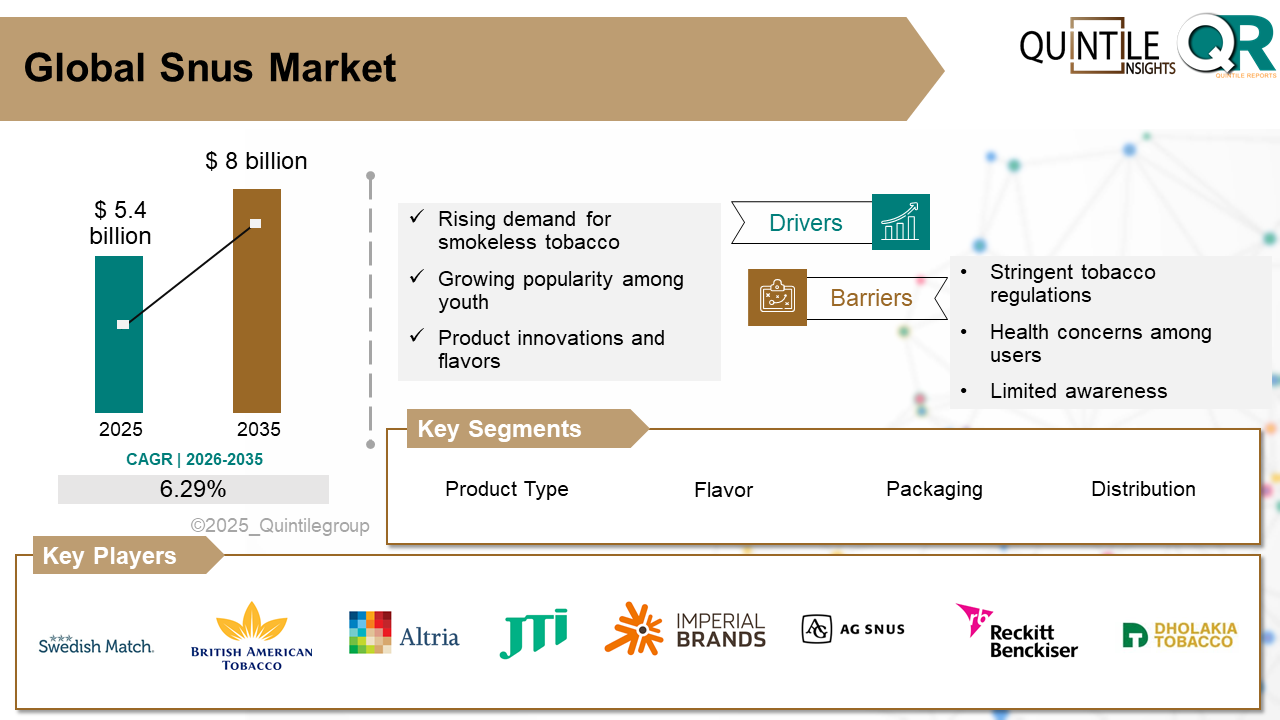
The Global Snus Market was estimated at USD 5.4 Billion in 2025 and is projected to reach USD 8 Billion by 2035, reflecting a strong CAGR of 6.29% over the forecast period from 2026 to 2035. The Snus market report delivers a comprehensive overview of the industry, extending beyond traditional analysis. It examines key market dynamics, including economic shifts, technological advancements, regulatory developments, and changing consumer behavior. The report also highlights the projected Compound Annual Growth Rate (CAGR), offering a clear understanding of future market growth.
The Snus market is experiencing dynamic expansion, with 2025 as the base year. Recent data indicates notable growth driven by innovation, rising consumer demand, and rapid technological progress. Companies are refining their go-to-market (GTM) strategies to capitalize on emerging opportunities and adapt to evolving market conditions.
Looking ahead, the Snus market is expected to maintain its upward trajectory through 2035, supported by continuous R&D investments, strategic collaborations, and mergers and acquisitions. Organizations that adapt their GTM strategies, innovate, and align with shifting consumer needs are positioned for long-term success. The Snus market report provides an in-depth analysis of current conditions and valuable insights into key drivers, challenges, and opportunities shaping the industry over the next decade. It covers market dynamics across segments, regions, and countries, integrating both qualitative and quantitative data from 2017 to 2035.
Historical Analysis (2017-2024): The report reviews market trends, performance indicators, and growth patterns from 2017 to 2024, helping identify historical factors that influence present and future dynamics.
Forecast and Projections (2026-2035): Building on historical insights, the report presents market forecasts and growth expectations from 2026 to 2035, highlighting key trends, opportunities, and challenges across various regions and segments.
Compound Annual Growth Rate (CAGR): The report provides a clear calculation of the CAGR for 2026 to 2035, enabling stakeholders to assess expected growth and market potential during the forecast period.
Snus Market
The snus market refers to the global and regional market for smokeless, powdered form of tobacco that can be used loose or in a pouch. It originated in Sweden in the 17th century and differs from traditional snuff, which is inhaled nasally. Instead, snus is consumed orally by placing it between the gum and the cheek or upper lip, allowing nicotine to be absorbed through the oral mucosa.
Typically made of air-dried ground tobacco, water, salt, flavoring, and taste additives, snus is steam-pasteurized and usually wrapped in an organic cellulose pouch. While it is similar to nicotine pouches in terms of usage, the key difference is that nicotine pouches do not contain tobacco.
What are the drivers of snus marketThe growing preference for smokeless tobacco alternatives among consumers is a key driver of the snus market. As awareness about the harmful effects of smoking increases, more individuals are turning to products like snus, which do not involve combustion and are perceived as a less harmful nicotine delivery method.
The expansion of modern trade channels and e-commerce platforms has made snus products more accessible to a broader consumer base. Online sales, in particular, allow consumers to discreetly purchase products and access a wider variety of flavors and strengths, boosting overall market demand.
Product innovation is significantly driving the market. Manufacturers are introducing snus in varied flavors, moisture levels, and portion sizes to appeal to diverse consumer preferences. This innovation not only enhances user experience but also attracts new users, especially in non-traditional markets.
Supportive regulatory frameworks in certain countries, especially in parts of Europe like Sweden, have facilitated the legal availability and marketing of snus. This regulatory environment has allowed companies to build brand trust and expand distribution without facing the restrictions imposed on other tobacco products.
Increasing consumer interest in harm reduction products is influencing tobacco users to switch from cigarettes to products like snus. Backed by some scientific findings suggesting that snus may pose fewer health risks than smoking, consumers are viewing it as a viable alternative, which is supporting market growth.
What are the challenges and restraining factors of snus marketOne major challenge facing the snus market is regulatory disparity across regions. While snus is legal and widely accepted in countries like Sweden, it remains banned in most of the European Union, limiting its international market expansion and posing hurdles for global manufacturers.
Public health concerns and ongoing debates about the safety of snus continue to affect consumer perception and acceptance. Although snus is considered less harmful than smoking by some studies, health authorities in many countries remain cautious, and this skepticism can slow down adoption.
The rising popularity of nicotine pouches, which contain no tobacco, presents direct competition to traditional snus. These pouches are often perceived as cleaner and more modern alternatives, drawing away potential consumers and fragmenting the market.
What are the regional trends of snus marketIn North America, the snus market is gradually gaining traction, particularly in the United States, where rising awareness of tobacco harm reduction and innovation in flavored products are drawing adult consumers. However, the market still faces resistance from regulatory scrutiny and public health campaigns discouraging all nicotine products.
Europe continues to be the most mature and established market for snus, with Sweden leading in both consumption and regulatory acceptance. The widespread use of snus in Scandinavia has supported consistent demand, though sales remain constrained elsewhere in the EU due to a longstanding ban, except for Sweden which secured an exemption upon joining the Union.
In the Asia-Pacific region, the snus market is still in its early stages, with limited awareness and accessibility. However, growing interest in alternative nicotine products and a large population of tobacco users present long-term opportunities for market entry, particularly in countries exploring harm reduction policies.
Latin America has shown modest growth in snus adoption, primarily through niche markets and online distribution. Consumer exposure to western tobacco alternatives is increasing, but the dominance of traditional tobacco products and limited regulatory clarity present challenges for rapid expansion.
In the Middle East and Africa, the market for snus remains nascent, with very limited availability and low consumer familiarity. However, growing urbanization and exposure to international product trends may gradually create opportunities, especially in Gulf countries with high rates of tobacco use and shifting consumer preferences.
Country-Wise Outlook:U.S. Snus Gains Traction as Harm Reduction Option:In the United States, the snus market has experienced moderate growth driven by increasing demand for smokeless alternatives and a gradual shift toward tobacco harm reduction strategies. Although not as mainstream as in Scandinavia, major tobacco companies have introduced snus offerings to cater to adult consumers looking for discreet nicotine options. However, regulatory pressures from the FDA and anti-tobacco advocacy groups continue to restrict aggressive market expansion, especially around flavored variants and advertising.
Consumer education remains a key hurdle in the U.S., where many individuals are still unfamiliar with the product's benefits compared to combustible tobacco. Nevertheless, increased retail availability and product innovation such as mint or wintergreen flavors are supporting awareness among adult nicotine users. Snus is increasingly positioned as a niche product, appealing to a small but loyal base interested in alternatives to smoking and vaping.
Germany's Snus Market Limited by EU Regulations:In Germany, snus remains largely restricted due to EU regulations banning its sale outside Sweden. Despite this, there is growing underground interest and rising curiosity among adult consumers, especially those exploring harm reduction strategies. Some consumers import snus privately or turn to legal nicotine pouches, which mimic the snus experience without violating EU tobacco regulations.
The regulatory environment in Germany presents a significant barrier to market penetration, but shifting public health discussions and comparative risk assessments could influence future policy directions. If regulatory conditions were to loosen, Germany could emerge as a strong growth market due to its sizable adult smoker population and increasing demand for less harmful alternatives.
Japan Favors Alternative Nicotine Products Over Snus:In Japan, traditional snus has limited presence due to both cultural preferences and regulatory restrictions on oral tobacco products. The market instead favors heat-not-burn tobacco and nicotine alternatives, which have gained mainstream acceptance. Japanese consumers tend to prefer high-tech, clean delivery formats, making adoption of snus slow and niche at best.
However, Japans openness to innovation and premium wellness-focused products may offer long-term potential for modernized, tobacco-free snus variants. With strong consumer interest in reduced-risk nicotine options, there is a possibility for market penetration if snus products can be adapted to align with domestic preferences and legal frameworks.
Competitive Analysis:The snus market is moderately fragmented, with a mix of multinational tobacco giants and smaller regional players competing through branding, flavor innovation, and distribution strategies. Large companies leverage existing retail infrastructure and brand loyalty to maintain dominance, while niche players differentiate through product variety and exclusivity.
Flavor diversification has become a central theme in competition, as companies increasingly offer a range of mint, fruit, and caffeine-infused varieties to appeal to different user preferences. This trend is particularly strong among younger adult consumers seeking alternatives to traditional tobacco flavors, creating space for startups and niche brands to gain visibility.
Product format and packaging innovation also contribute to competitive advantage. Custom pouch sizes, slim packaging, and visually appealing can designs are being used to differentiate products and enhance user convenience. Companies that offer customized branding for private-label partners are also seeing increased interest from retail chains and specialty shops.
Regulatory adaptability is another key competitive factor. Firms that can navigate diverse global regulatory landscapes such as Sweden's permissive stance versus the EU ban outside Sweden are better positioned to expand across regions. This includes offering tobacco-free nicotine pouches that mimic snus experience in legally restricted countries.
Digital marketing, influencer partnerships, and online retail have further intensified competition. With many traditional tobacco advertising channels restricted, firms that invest in compliant yet engaging digital outreach are better able to connect with adult consumers and build brand awareness, especially in underdeveloped or emerging snus markets.
Key players in the market are:Swedish Match, British American Tobacco p.l.c., Altria Group, Inc., JT International AG, Imperial Brands, AG Snus, Reckitt Benckiser, Dholakia Tobacco PVT. LTD, GN Tobacco Sweden AB, Japan Tobacco Inc., Philip Morris International, Skruf Snus AB, Mac Baren Tobacco Company, Kurbits Snus AB, Burger Shne Sweden AB, and other players.
Recent Development:In April 2024, Unteka launched the Miami Snus brand, introducing a new range of snus products with innovative flavor profiles including fruit, mint, classic tobacco, and caffeine-infused variants. Developed through extensive R&D, the brand offers personalized flavor development and customizable packaging for business partners, combining product innovation with tailored branding solutions to enhance consumer engagement.
In May 2024, Scandinavian Tobacco Group UK launched its XQS nicotine pouches in the UK, marking its entry into the next-generation nicotine category. Developed in Sweden, the range features four flavors Tropical, Blueberry Mint, Cool Ice, and Arctic Freeze and comes in smaller pouches with fully recyclable cans.

Our team of experienced researchers has meticulously gathered and analyzed data to deliver a thorough examination of market dynamics, competitive landscape, and emerging technologies. With a focus on delivering actionable intelligence, this report aims to empower decision-makers with the information needed to make informed choices and stay ahead of the competition. Whether you are a seasoned industry player or a new entrant, our market research report serves as a strategic tool to navigate the complexities of the market, aiding in successful business planning and growth strategies.
This chapter of our Snus market report provides an in-depth examination of the factors shaping the industry landscape. This section typically encompasses several key elements to offer a comprehensive understanding of the industry landscape such as market drivers & restraints analysis, market opportunities & trend analysis, market size & growth analysis, competitive analysis, SWOT analysis, business environment tools such as Porter's five forces & PESTEL analysis, Ansoff Matrix analysis, penetration & growth prospect analysis, regulatory framework & reimbursement scenario analysis, impact of macro & micro economic factors analysis such as Covid-19 impact, GDP growth, market inflation, U.S.- China trade war, Russia-Ukraine war impact, and supply chain analysis.
The segment analysis chapter of Snus market report is a critical section that delves into a detailed examination of the market's various segments. Segmentation involves dividing the market into distinct categories based on certain criteria to better understand and address the diverse needs of consumers. This chapter typically follows the introduction and provides a more granular view of the market, offering valuable insights for businesses and stakeholders. The components of the chapter lude segment definitions to understand the inclusions and exclusions of the study, assumptions, market size estimates and growth trend analysis of each segment, qualitative analysis of the segment, technological advancements, market penetration rate, market adoption rate, market share examination by each segment, segment growth drivers and restraint barriers, consumer behaviour and challenge analysis.
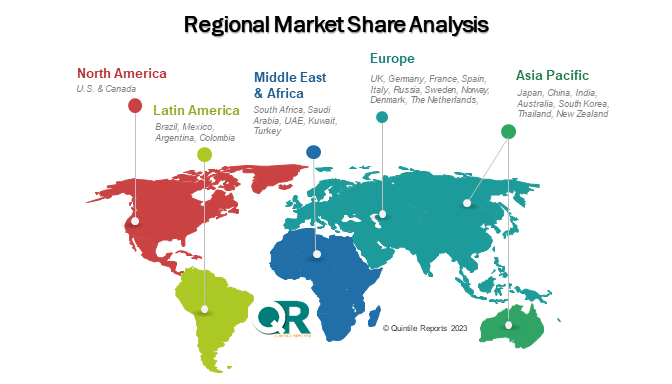
The chapter in Snus market research report is a pivotal section that examines and predicts the market dynamics and trends specific to different geographical regions. This chapter is crucial for businesses and stakeholders seeking a comprehensive understanding of how the market behaves across various locations, enabling them to tailor strategies and make informed decisions based on regional variations. The regional analysis chapter of our Snus market report is classified into regions & country-level. The chapter consists of North America (U.S., Canada), Europe (UK, Germany, France, Italy, Spain, Russia, Sweden, Denmark, Norway, Rest of Europe), Asia Pacific (Japan, China, India, Australia, South Korea, Thailand, Rest of Asia Pacific), Latin America (Brazil, Mexico, Argentina, Colombia, Rest of Latin America), Middle East & Africa (South Africa, Saudi Arabia, UAE, Kuwait, Rest of Middle East & Africa).
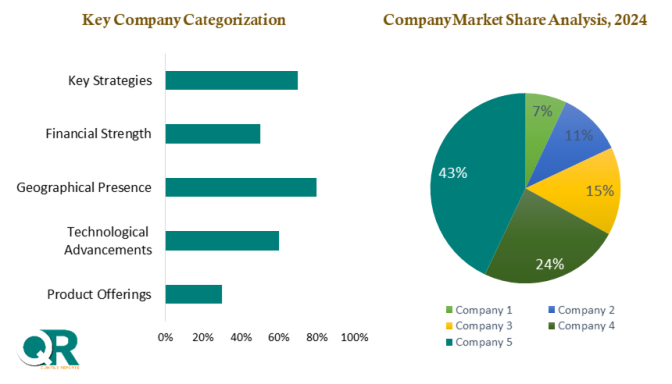
This section of a Snus market report is a crucial segment that provides a comprehensive overview of the competitive landscape within the market. This section is vital for businesses, investors, and stakeholders seeking insights into key players, their market positioning, strengths, weaknesses, strategies, and potential impacts on the overall market dynamics. The chapter includes research methodology used to analyse the market competition, list of key players operating in the market, detailed company profile section which includes company overview, business verticals, financial performance, product/services benchmarking, geographical presence, and strategic initiatives.
| Report Scope | Details |
| Report Version | 2026 |
| Growth Rate | CAGR of 6.29 from 2026 to 2035 |
| Base year | 2025 |
| Actual estimates/Historical data | 2017 - 2024 |
| Forecast period | 2026 - 2035 |
| Quantitative units | Revenue in USD million/billion & CAGR from 2026 to 2035 |
| Country scope | North America (U.S., Canada), Europe (UK, Germany, France, Italy, Spain, Russia, Sweden, Denmark, Norway, Rest of Europe), Asia Pacific (Japan, China, India, Australia, South Korea, Thailand, Rest of Asia Pacific), Latin America (Brazil, Mexico, Argentina, Colombia, Rest of Latin America), Middle East & Africa (South Africa, Saudi Arabia, UAE, Kuwait, Rest of Middle East & Africa). |
| The Segment covered by Product Type |
|
| The Segment covered by Flavor |
|
| Companies covered |
|
| Report coverage | Revenue forecast, company share, competitive landscape, growth factors, and trends |
| Free customization scope (equivalent to 5 analyst working days) | If you need specific information, which is not currently within the scope of the report, we will provide it to you as a part of the customization |

Statistics for the 2025 Snus market share, size, and revenue growth rate were created by Quintile Report™. Snus analysis includes a market forecast outlook for 2035 and a historical overview. Get a free PDF sample of this market analysis, please get in touch with our principal analyst at sales@quintilereports.com
List of Tables
Table 1 List of Abbreviation and acronyms
Table 2 List of Sources
Table 3 North America Global Snus Market, by Segment Analysis, (USD Million) 2017-2035
Table 4 North America Global Snus Market, by Region, (USD Million) 2017-2035
Table 5 U.S. Global Snus Market, by Segment Analysis, (USD Million) 2017-2035
Table 6 Canada Global Snus Market, by Segment Analysis, (USD Million) 2017-2035
Table 7 Europe Global Snus Market, by Segment Analysis, (USD Million) 2017-2035
Table 8 Europe Global Snus Market, by Region, (USD Million) 2017-2035
Table 9 Germany Global Snus Market, by Segment Analysis, (USD Million) 2017-2035
Table 10 U.K. Global Snus Market, by Segment Analysis, (USD Million) 2017-2035
Table 11 France Global Snus Market, by Segment Analysis, (USD Million) 2017-2035
Table 12 Italy Global Snus Market, by Segment Analysis, (USD Million) 2017-2035
Table 13 Spain Global Snus Market, by Segment Analysis, (USD Million) 2017-2035
Table 14 Sweden Global Snus Market, by Segment Analysis, (USD Million) 2017-2035
Table 15 Denmark Global Snus Market, by Segment Analysis, (USD Million) 2017-2035
Table 16 Norway Global Snus Market, by Segment Analysis, (USD Million) 2017-2035
Table 17 The Netherlands Global Snus Market, by Segment Analysis, (USD Million) 2017-2035
Table 18 Russia Global Snus Market, by Segment Analysis, (USD Million) 2017-2035
Table 19 Asia Pacific Global Snus Market, by Segment Analysis, (USD Million) 2017-2035
Table 20 Asia Pacific Global Snus Market, by Region, (USD Million) 2017-2035
Table 21 China Global Snus Market, by Segment Analysis, (USD Million) 2017-2035
Table 22 Japan Global Snus Market, by Segment Analysis, (USD Million) 2017-2035
Table 23 India Global Snus Market, by Segment Analysis, (USD Million) 2017-2035
Table 24 Australia Global Snus Market, by Segment Analysis, (USD Million) 2017-2035
Table 25 South Korea Global Snus Market, by Segment Analysis, (USD Million) 2017-2035
Table 26 Thailand Global Snus Market, by Segment Analysis, (USD Million) 2017-2035
Table 27 Latin America Global Snus Market, by Segment Analysis, (USD Million) 2017-2035
Table 28 Latin America Global Snus Market, by Region, (USD Million) 2017-2035
Table 29 Brazil Global Snus Market, by Segment Analysis, (USD Million) 2017-2035
Table 30 Mexico Global Snus Market, by Segment Analysis, (USD Million) 2017-2035
Table 31 Argentina Global Snus Market, by Segment Analysis, (USD Million) 2017-2035
Table 32 Middle East and Africa Global Snus Market, by Segment Analysis, (USD Million) 2017-2035
Table 33 Middle East and Africa Global Snus Market, by Region, (USD Million) 2017-2035
Table 34 South Africa Global Snus Market, by Segment Analysis, (USD Million) 2017-2035
Table 35 Saudi Arabia Global Snus Market, by Segment Analysis, (USD Million) 2017-2035
Table 36 UAE Global Snus Market, by Segment Analysis, (USD Million) 2017-2035
Table 37 Kuwait Global Snus Market, by Segment Analysis, (USD Million) 2017-2035
Table 38 Turkey Global Snus Market, by Segment Analysis, (USD Million) 2017-2035
Fig.1 Market research process
Fig.2 Market research approaches
Fig.3 Global Snus Market: market scenario
Fig.4 Global Snus Market competitive outlook
Fig.5 Global Snus Market driver analysis
Fig.6 Global Snus Market restraint analysis
Fig.7 Global Snus Market opportunity analysis
Fig.8 Global Snus Market trends analysis
Fig.9 Global Snus Market: Segment Analysis (Based on the scope)
Fig.10 Global Snus Market: regional analysis
Fig.11 Global market shares and leading market players
Fig.12 North America market share and leading players
Fig.13 Europe market share and leading players
Fig.14 Asia Pacific market share and leading players
Fig.15 Latin America market share and leading players
Fig.16 Middle East & Africa market share and leading players
Fig.17 North America, by country
Fig.18 North America
Fig.19 North America market estimates and forecast, 2017-2035
Fig.20 U.S.
Fig.21 Canada
Fig.22 Europe
Fig.23 Europe market estimates and forecast, 2017-2035
Fig.24 U.K.
Fig.25 Germany
Fig.26 France
Fig.27 Italy
Fig.28 Spain
Fig.29 Sweden
Fig.30 Denmark
Fig.31 Norway
Fig.32 The Netherlands
Fig.33 Russia
Fig.34 Asia Pacific
Fig.35 Asia Pacific market estimates and forecast, 2017-2035
Fig.36 China
Fig.37 Japan
Fig.38 India
Fig.39 Australia
Fig.40 South Korea
Fig.41 Thailand
Fig.42 Latin America
Fig.43 Latin America market estimates and forecast, 2017-2035
Fig.44 Brazil
Fig.45 Mexico
Fig.46 Argentina
Fig.47 Colombia
Fig.48 Middle East and Africa
Fig.49 Middle East and Africa market estimates and forecast, 2017-2035
Fig.50 Saudi Arabia
Fig.51 South Africa
Fig.52 UAE
Fig.53 Kuwait
Fig.54 Turkey
The Global Snus Market was estimated at USD 5.4 Billion in 2025 and is projected to reach USD 8 Billion by 2035, reflecting a strong CAGR of 6.29% over the forecast period from 2026 to 2035. The Snus market report delivers a comprehensive overview of the industry, extending beyond traditional analysis. It examines key market dynamics, including economic shifts, technological advancements, regulatory developments, and changing consumer behavior. The report also highlights the projected Compound Annual Growth Rate (CAGR), offering a clear understanding of future market growth.
The Snus market is experiencing dynamic expansion, with 2025 as the base year. Recent data indicates notable growth driven by innovation, rising consumer demand, and rapid technological progress. Companies are refining their go-to-market (GTM) strategies to capitalize on emerging opportunities and adapt to evolving market conditions.
Looking ahead, the Snus market is expected to maintain its upward trajectory through 2035, supported by continuous R&D investments, strategic collaborations, and mergers and acquisitions. Organizations that adapt their GTM strategies, innovate, and align with shifting consumer needs are positioned for long-term success. The Snus market report provides an in-depth analysis of current conditions and valuable insights into key drivers, challenges, and opportunities shaping the industry over the next decade. It covers market dynamics across segments, regions, and countries, integrating both qualitative and quantitative data from 2017 to 2035.
Historical Analysis (2017-2024): The report reviews market trends, performance indicators, and growth patterns from 2017 to 2024, helping identify historical factors that influence present and future dynamics.
Forecast and Projections (2026-2035): Building on historical insights, the report presents market forecasts and growth expectations from 2026 to 2035, highlighting key trends, opportunities, and challenges across various regions and segments.
Compound Annual Growth Rate (CAGR): The report provides a clear calculation of the CAGR for 2026 to 2035, enabling stakeholders to assess expected growth and market potential during the forecast period.
Snus Market
The snus market refers to the global and regional market for smokeless, powdered form of tobacco that can be used loose or in a pouch. It originated in Sweden in the 17th century and differs from traditional snuff, which is inhaled nasally. Instead, snus is consumed orally by placing it between the gum and the cheek or upper lip, allowing nicotine to be absorbed through the oral mucosa.
Typically made of air-dried ground tobacco, water, salt, flavoring, and taste additives, snus is steam-pasteurized and usually wrapped in an organic cellulose pouch. While it is similar to nicotine pouches in terms of usage, the key difference is that nicotine pouches do not contain tobacco.
What are the drivers of snus marketThe growing preference for smokeless tobacco alternatives among consumers is a key driver of the snus market. As awareness about the harmful effects of smoking increases, more individuals are turning to products like snus, which do not involve combustion and are perceived as a less harmful nicotine delivery method.
The expansion of modern trade channels and e-commerce platforms has made snus products more accessible to a broader consumer base. Online sales, in particular, allow consumers to discreetly purchase products and access a wider variety of flavors and strengths, boosting overall market demand.
Product innovation is significantly driving the market. Manufacturers are introducing snus in varied flavors, moisture levels, and portion sizes to appeal to diverse consumer preferences. This innovation not only enhances user experience but also attracts new users, especially in non-traditional markets.
Supportive regulatory frameworks in certain countries, especially in parts of Europe like Sweden, have facilitated the legal availability and marketing of snus. This regulatory environment has allowed companies to build brand trust and expand distribution without facing the restrictions imposed on other tobacco products.
Increasing consumer interest in harm reduction products is influencing tobacco users to switch from cigarettes to products like snus. Backed by some scientific findings suggesting that snus may pose fewer health risks than smoking, consumers are viewing it as a viable alternative, which is supporting market growth.
What are the challenges and restraining factors of snus marketOne major challenge facing the snus market is regulatory disparity across regions. While snus is legal and widely accepted in countries like Sweden, it remains banned in most of the European Union, limiting its international market expansion and posing hurdles for global manufacturers.
Public health concerns and ongoing debates about the safety of snus continue to affect consumer perception and acceptance. Although snus is considered less harmful than smoking by some studies, health authorities in many countries remain cautious, and this skepticism can slow down adoption.
The rising popularity of nicotine pouches, which contain no tobacco, presents direct competition to traditional snus. These pouches are often perceived as cleaner and more modern alternatives, drawing away potential consumers and fragmenting the market.
What are the regional trends of snus marketIn North America, the snus market is gradually gaining traction, particularly in the United States, where rising awareness of tobacco harm reduction and innovation in flavored products are drawing adult consumers. However, the market still faces resistance from regulatory scrutiny and public health campaigns discouraging all nicotine products.
Europe continues to be the most mature and established market for snus, with Sweden leading in both consumption and regulatory acceptance. The widespread use of snus in Scandinavia has supported consistent demand, though sales remain constrained elsewhere in the EU due to a longstanding ban, except for Sweden which secured an exemption upon joining the Union.
In the Asia-Pacific region, the snus market is still in its early stages, with limited awareness and accessibility. However, growing interest in alternative nicotine products and a large population of tobacco users present long-term opportunities for market entry, particularly in countries exploring harm reduction policies.
Latin America has shown modest growth in snus adoption, primarily through niche markets and online distribution. Consumer exposure to western tobacco alternatives is increasing, but the dominance of traditional tobacco products and limited regulatory clarity present challenges for rapid expansion.
In the Middle East and Africa, the market for snus remains nascent, with very limited availability and low consumer familiarity. However, growing urbanization and exposure to international product trends may gradually create opportunities, especially in Gulf countries with high rates of tobacco use and shifting consumer preferences.
Country-Wise Outlook:U.S. Snus Gains Traction as Harm Reduction Option:In the United States, the snus market has experienced moderate growth driven by increasing demand for smokeless alternatives and a gradual shift toward tobacco harm reduction strategies. Although not as mainstream as in Scandinavia, major tobacco companies have introduced snus offerings to cater to adult consumers looking for discreet nicotine options. However, regulatory pressures from the FDA and anti-tobacco advocacy groups continue to restrict aggressive market expansion, especially around flavored variants and advertising.
Consumer education remains a key hurdle in the U.S., where many individuals are still unfamiliar with the product's benefits compared to combustible tobacco. Nevertheless, increased retail availability and product innovation such as mint or wintergreen flavors are supporting awareness among adult nicotine users. Snus is increasingly positioned as a niche product, appealing to a small but loyal base interested in alternatives to smoking and vaping.
Germany's Snus Market Limited by EU Regulations:In Germany, snus remains largely restricted due to EU regulations banning its sale outside Sweden. Despite this, there is growing underground interest and rising curiosity among adult consumers, especially those exploring harm reduction strategies. Some consumers import snus privately or turn to legal nicotine pouches, which mimic the snus experience without violating EU tobacco regulations.
The regulatory environment in Germany presents a significant barrier to market penetration, but shifting public health discussions and comparative risk assessments could influence future policy directions. If regulatory conditions were to loosen, Germany could emerge as a strong growth market due to its sizable adult smoker population and increasing demand for less harmful alternatives.
Japan Favors Alternative Nicotine Products Over Snus:In Japan, traditional snus has limited presence due to both cultural preferences and regulatory restrictions on oral tobacco products. The market instead favors heat-not-burn tobacco and nicotine alternatives, which have gained mainstream acceptance. Japanese consumers tend to prefer high-tech, clean delivery formats, making adoption of snus slow and niche at best.
However, Japans openness to innovation and premium wellness-focused products may offer long-term potential for modernized, tobacco-free snus variants. With strong consumer interest in reduced-risk nicotine options, there is a possibility for market penetration if snus products can be adapted to align with domestic preferences and legal frameworks.
Competitive Analysis:The snus market is moderately fragmented, with a mix of multinational tobacco giants and smaller regional players competing through branding, flavor innovation, and distribution strategies. Large companies leverage existing retail infrastructure and brand loyalty to maintain dominance, while niche players differentiate through product variety and exclusivity.
Flavor diversification has become a central theme in competition, as companies increasingly offer a range of mint, fruit, and caffeine-infused varieties to appeal to different user preferences. This trend is particularly strong among younger adult consumers seeking alternatives to traditional tobacco flavors, creating space for startups and niche brands to gain visibility.
Product format and packaging innovation also contribute to competitive advantage. Custom pouch sizes, slim packaging, and visually appealing can designs are being used to differentiate products and enhance user convenience. Companies that offer customized branding for private-label partners are also seeing increased interest from retail chains and specialty shops.
Regulatory adaptability is another key competitive factor. Firms that can navigate diverse global regulatory landscapes such as Sweden's permissive stance versus the EU ban outside Sweden are better positioned to expand across regions. This includes offering tobacco-free nicotine pouches that mimic snus experience in legally restricted countries.
Digital marketing, influencer partnerships, and online retail have further intensified competition. With many traditional tobacco advertising channels restricted, firms that invest in compliant yet engaging digital outreach are better able to connect with adult consumers and build brand awareness, especially in underdeveloped or emerging snus markets.
Key players in the market are:Swedish Match, British American Tobacco p.l.c., Altria Group, Inc., JT International AG, Imperial Brands, AG Snus, Reckitt Benckiser, Dholakia Tobacco PVT. LTD, GN Tobacco Sweden AB, Japan Tobacco Inc., Philip Morris International, Skruf Snus AB, Mac Baren Tobacco Company, Kurbits Snus AB, Burger Shne Sweden AB, and other players.
Recent Development:In April 2024, Unteka launched the Miami Snus brand, introducing a new range of snus products with innovative flavor profiles including fruit, mint, classic tobacco, and caffeine-infused variants. Developed through extensive R&D, the brand offers personalized flavor development and customizable packaging for business partners, combining product innovation with tailored branding solutions to enhance consumer engagement.
In May 2024, Scandinavian Tobacco Group UK launched its XQS nicotine pouches in the UK, marking its entry into the next-generation nicotine category. Developed in Sweden, the range features four flavors Tropical, Blueberry Mint, Cool Ice, and Arctic Freeze and comes in smaller pouches with fully recyclable cans.
Our team of experienced researchers has meticulously gathered and analyzed data to deliver a thorough examination of market dynamics, competitive landscape, and emerging technologies. With a focus on delivering actionable intelligence, this report aims to empower decision-makers with the information needed to make informed choices and stay ahead of the competition. Whether you are a seasoned industry player or a new entrant, our market research report serves as a strategic tool to navigate the complexities of the market, aiding in successful business planning and growth strategies.
This chapter of our Snus market report provides an in-depth examination of the factors shaping the industry landscape. This section typically encompasses several key elements to offer a comprehensive understanding of the industry landscape such as market drivers & restraints analysis, market opportunities & trend analysis, market size & growth analysis, competitive analysis, SWOT analysis, business environment tools such as Porter's five forces & PESTEL analysis, Ansoff Matrix analysis, penetration & growth prospect analysis, regulatory framework & reimbursement scenario analysis, impact of macro & micro economic factors analysis such as Covid-19 impact, GDP growth, market inflation, U.S.- China trade war, Russia-Ukraine war impact, and supply chain analysis.
The segment analysis chapter of Snus market report is a critical section that delves into a detailed examination of the market's various segments. Segmentation involves dividing the market into distinct categories based on certain criteria to better understand and address the diverse needs of consumers. This chapter typically follows the introduction and provides a more granular view of the market, offering valuable insights for businesses and stakeholders. The components of the chapter lude segment definitions to understand the inclusions and exclusions of the study, assumptions, market size estimates and growth trend analysis of each segment, qualitative analysis of the segment, technological advancements, market penetration rate, market adoption rate, market share examination by each segment, segment growth drivers and restraint barriers, consumer behaviour and challenge analysis.
The chapter in Snus market research report is a pivotal section that examines and predicts the market dynamics and trends specific to different geographical regions. This chapter is crucial for businesses and stakeholders seeking a comprehensive understanding of how the market behaves across various locations, enabling them to tailor strategies and make informed decisions based on regional variations. The regional analysis chapter of our Snus market report is classified into regions & country-level. The chapter consists of North America (U.S., Canada), Europe (UK, Germany, France, Italy, Spain, Russia, Sweden, Denmark, Norway, Rest of Europe), Asia Pacific (Japan, China, India, Australia, South Korea, Thailand, Rest of Asia Pacific), Latin America (Brazil, Mexico, Argentina, Colombia, Rest of Latin America), Middle East & Africa (South Africa, Saudi Arabia, UAE, Kuwait, Rest of Middle East & Africa).
This section of a Snus market report is a crucial segment that provides a comprehensive overview of the competitive landscape within the market. This section is vital for businesses, investors, and stakeholders seeking insights into key players, their market positioning, strengths, weaknesses, strategies, and potential impacts on the overall market dynamics. The chapter includes research methodology used to analyse the market competition, list of key players operating in the market, detailed company profile section which includes company overview, business verticals, financial performance, product/services benchmarking, geographical presence, and strategic initiatives.
| Report Scope | Details |
| Report Version | 2026 |
| Growth Rate | CAGR of 6.29 from 2026 to 2035 |
| Base year | 2025 |
| Actual estimates/Historical data | 2017 - 2024 |
| Forecast period | 2026 - 2035 |
| Quantitative units | Revenue in USD million/billion & CAGR from 2026 to 2035 |
| Country scope | North America (U.S., Canada), Europe (UK, Germany, France, Italy, Spain, Russia, Sweden, Denmark, Norway, Rest of Europe), Asia Pacific (Japan, China, India, Australia, South Korea, Thailand, Rest of Asia Pacific), Latin America (Brazil, Mexico, Argentina, Colombia, Rest of Latin America), Middle East & Africa (South Africa, Saudi Arabia, UAE, Kuwait, Rest of Middle East & Africa). |
| The Segment covered by Product Type |
|
| The Segment covered by Flavor |
|
| Companies covered |
|
| Report coverage | Revenue forecast, company share, competitive landscape, growth factors, and trends |
| Free customization scope (equivalent to 5 analyst working days) | If you need specific information, which is not currently within the scope of the report, we will provide it to you as a part of the customization |
Statistics for the 2025 Snus market share, size, and revenue growth rate were created by Quintile Report™. Snus analysis includes a market forecast outlook for 2035 and a historical overview. Get a free PDF sample of this market analysis, please get in touch with our principal analyst at sales@quintilereports.com
Table 1 List of Abbreviation and acronyms
Table 2 List of Sources
Table 3 North America Global Snus Market, by Segment Analysis, (USD Million) 2017-2035
Table 4 North America Global Snus Market, by Region, (USD Million) 2017-2035
Table 5 U.S. Global Snus Market, by Segment Analysis, (USD Million) 2017-2035
Table 6 Canada Global Snus Market, by Segment Analysis, (USD Million) 2017-2035
Table 7 Europe Global Snus Market, by Segment Analysis, (USD Million) 2017-2035
Table 8 Europe Global Snus Market, by Region, (USD Million) 2017-2035
Table 9 Germany Global Snus Market, by Segment Analysis, (USD Million) 2017-2035
Table 10 U.K. Global Snus Market, by Segment Analysis, (USD Million) 2017-2035
Table 11 France Global Snus Market, by Segment Analysis, (USD Million) 2017-2035
Table 12 Italy Global Snus Market, by Segment Analysis, (USD Million) 2017-2035
Table 13 Spain Global Snus Market, by Segment Analysis, (USD Million) 2017-2035
Table 14 Sweden Global Snus Market, by Segment Analysis, (USD Million) 2017-2035
Table 15 Denmark Global Snus Market, by Segment Analysis, (USD Million) 2017-2035
Table 16 Norway Global Snus Market, by Segment Analysis, (USD Million) 2017-2035
Table 17 The Netherlands Global Snus Market, by Segment Analysis, (USD Million) 2017-2035
Table 18 Russia Global Snus Market, by Segment Analysis, (USD Million) 2017-2035
Table 19 Asia Pacific Global Snus Market, by Segment Analysis, (USD Million) 2017-2035
Table 20 Asia Pacific Global Snus Market, by Region, (USD Million) 2017-2035
Table 21 China Global Snus Market, by Segment Analysis, (USD Million) 2017-2035
Table 22 Japan Global Snus Market, by Segment Analysis, (USD Million) 2017-2035
Table 23 India Global Snus Market, by Segment Analysis, (USD Million) 2017-2035
Table 24 Australia Global Snus Market, by Segment Analysis, (USD Million) 2017-2035
Table 25 South Korea Global Snus Market, by Segment Analysis, (USD Million) 2017-2035
Table 26 Thailand Global Snus Market, by Segment Analysis, (USD Million) 2017-2035
Table 27 Latin America Global Snus Market, by Segment Analysis, (USD Million) 2017-2035
Table 28 Latin America Global Snus Market, by Region, (USD Million) 2017-2035
Table 29 Brazil Global Snus Market, by Segment Analysis, (USD Million) 2017-2035
Table 30 Mexico Global Snus Market, by Segment Analysis, (USD Million) 2017-2035
Table 31 Argentina Global Snus Market, by Segment Analysis, (USD Million) 2017-2035
Table 32 Middle East and Africa Global Snus Market, by Segment Analysis, (USD Million) 2017-2035
Table 33 Middle East and Africa Global Snus Market, by Region, (USD Million) 2017-2035
Table 34 South Africa Global Snus Market, by Segment Analysis, (USD Million) 2017-2035
Table 35 Saudi Arabia Global Snus Market, by Segment Analysis, (USD Million) 2017-2035
Table 36 UAE Global Snus Market, by Segment Analysis, (USD Million) 2017-2035
Table 37 Kuwait Global Snus Market, by Segment Analysis, (USD Million) 2017-2035
Table 38 Turkey Global Snus Market, by Segment Analysis, (USD Million) 2017-2035
Fig.1 Market research process
Fig.2 Market research approaches
Fig.3 Global Snus Market: market scenario
Fig.4 Global Snus Market competitive outlook
Fig.5 Global Snus Market driver analysis
Fig.6 Global Snus Market restraint analysis
Fig.7 Global Snus Market opportunity analysis
Fig.8 Global Snus Market trends analysis
Fig.9 Global Snus Market: Segment Analysis (Based on the scope)
Fig.10 Global Snus Market: regional analysis
Fig.11 Global market shares and leading market players
Fig.12 North America market share and leading players
Fig.13 Europe market share and leading players
Fig.14 Asia Pacific market share and leading players
Fig.15 Latin America market share and leading players
Fig.16 Middle East & Africa market share and leading players
Fig.17 North America, by country
Fig.18 North America
Fig.19 North America market estimates and forecast, 2017-2035
Fig.20 U.S.
Fig.21 Canada
Fig.22 Europe
Fig.23 Europe market estimates and forecast, 2017-2035
Fig.24 U.K.
Fig.25 Germany
Fig.26 France
Fig.27 Italy
Fig.28 Spain
Fig.29 Sweden
Fig.30 Denmark
Fig.31 Norway
Fig.32 The Netherlands
Fig.33 Russia
Fig.34 Asia Pacific
Fig.35 Asia Pacific market estimates and forecast, 2017-2035
Fig.36 China
Fig.37 Japan
Fig.38 India
Fig.39 Australia
Fig.40 South Korea
Fig.41 Thailand
Fig.42 Latin America
Fig.43 Latin America market estimates and forecast, 2017-2035
Fig.44 Brazil
Fig.45 Mexico
Fig.46 Argentina
Fig.47 Colombia
Fig.48 Middle East and Africa
Fig.49 Middle East and Africa market estimates and forecast, 2017-2035
Fig.50 Saudi Arabia
Fig.51 South Africa
Fig.52 UAE
Fig.53 Kuwait
Fig.54 Turkey

A license granted to one user. Rules or conditions might be applied for e.g. the use of electric files (PDFs) or printings, depending on product.
A license granted to multiple users.
A license granted to a single business site/establishment.
A license granted to all employees within organisation access to the product.
Immediate / Within 24-48 hours - Working days
Online Payments with PayPal and CCavenue
You can order a report by picking any of the payment methods which is bank wire or online payment through any Debit/Credit card or PayPal.
Hard Copy
Report Descriptions: The Global Non-GMO Flour Market was estimated at USD 72.87 billion in 2025 and
Read MoreReport Descriptions: The Global Mineral Ingredients Market was estimated at USD 8.12 billion in 2025
Read MoreReport Descriptions: The Global Feeding Distiller Dried Grains with Solubles (DGDS) Market was estim
Read More U.S. : +1-201-772-7734