A giant white dome has appeared over a construction site in Jinan, China, creating a scene that looks more like a futuristic movie set than a conventional building project.
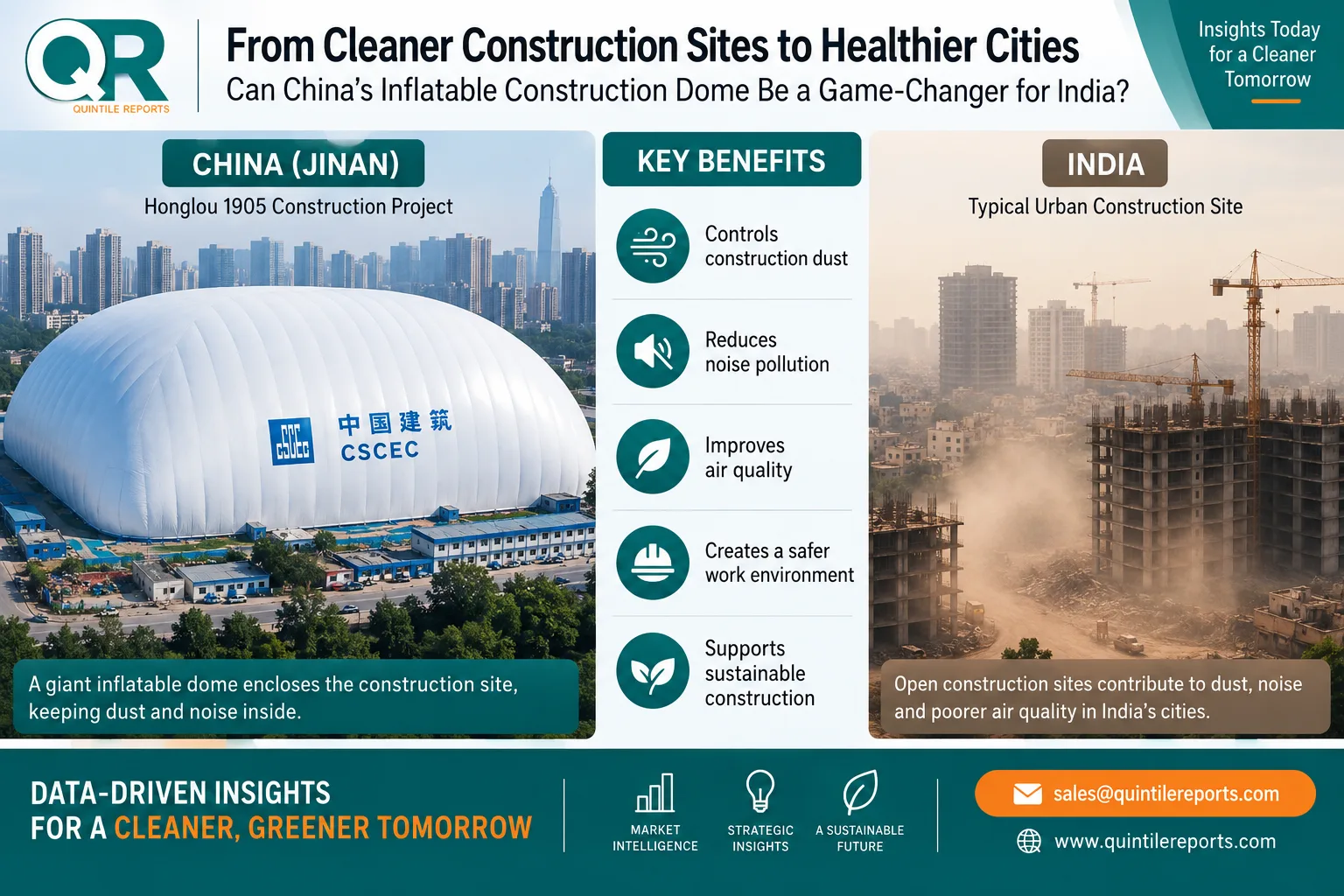
The enormous inflatable structure covers an active construction site in the city's Licheng district. But the unusual engineering experiment has little to do with appearance.
It is designed to keep dust, noise and other construction impacts contained.
And for a country like India, where construction is expanding rapidly while many cities continue to struggle with particulate pollution, the technology raises a bigger question:
Could putting construction sites inside giant inflatable enclosures help reduce pollution in Indian cities?
The answer is not as simple as putting a giant "bubble" over every project. But China's experiment offers an intriguing idea worth examining.
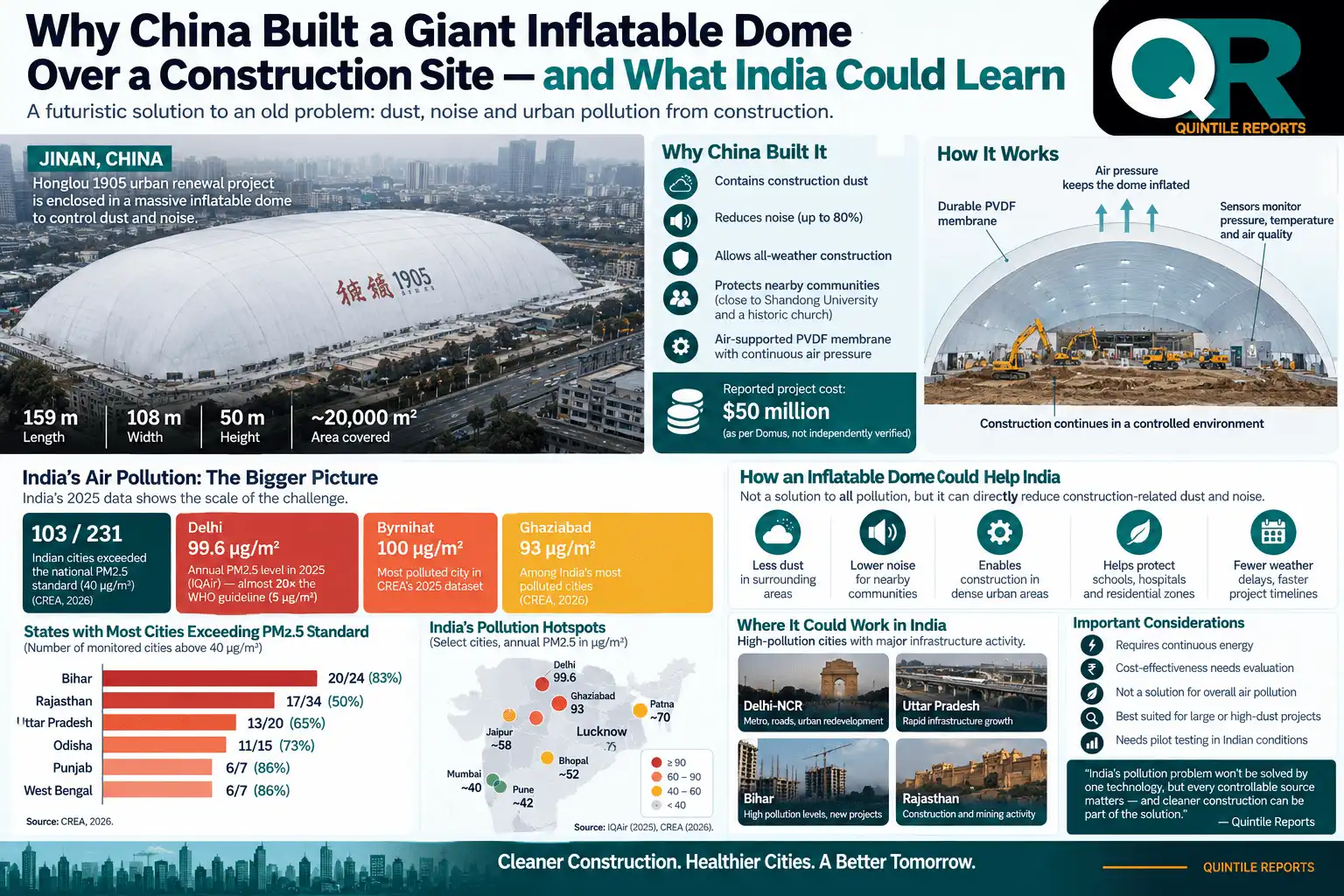
The structure has been installed over the Honglou 1905 urban renewal project in Jinan, a major redevelopment project in a densely populated part of the city.
The dome is approximately 159 metres long, 108 metres wide and 50 metres high, enclosing an area of nearly 20,000 square metres.
That is roughly the size of several football fields under one enormous membrane.
The project is located close to Shandong University and a historic church, meaning construction activity is taking place near existing buildings and communities. That makes controlling dust and noise particularly important.
Rather than relying solely on conventional construction barriers, the project essentially puts the working environment under one enormous roof.
Except the roof is inflatable.
The structure uses an air-supported membrane system.
Instead of relying on a conventional network of steel columns and beams to support a roof, large fans maintain air pressure inside the enclosure. That pressure keeps the membrane inflated and creates a large, unobstructed working area underneath.
The structure reportedly uses a PVDF membrane, a high-performance material known for its durability and resistance to weather and chemicals.
Sensors and ventilation systems help regulate conditions inside the enclosure, while additional measures can be used to control dust generated by construction activity.
The result is essentially a temporary controlled environment around a construction site.
And that is where the idea becomes interesting.
Construction creates an unavoidable combination of dust, machinery noise, vehicle movement and debris.
Usually, the approach is to control these impacts after they are generated.
Water is sprayed to suppress dust.
Barriers are installed around the perimeter.
Equipment is fitted with noise controls.
Trucks are covered.
But the Jinan project takes a different approach:
Instead of controlling the construction site only from the outside, enclose the entire work area.
According to reports from the project, the structure is designed to significantly reduce the amount of construction dust escaping into the surrounding environment and can reduce construction noise by around 80%. These are project-related claims rather than independent measurements applicable to every construction site.
The enclosure can also provide protection from rain and other adverse weather, potentially allowing construction activity to continue under more controlled conditions.
The project has attracted international attention partly because of its reported cost.
Architecture publication Domus reported a $50 million figure in connection with the development. However, that figure should be treated as a reported project figure rather than an independently verified cost of the inflatable dome itself.
That distinction matters.
The technology is interesting regardless of the exact price tag, but its future use elsewhere will ultimately depend on economics.
A construction enclosure that costs more to install and operate than the pollution and disruption it prevents would have limited commercial appeal.
The real test is therefore not simply whether the dome works.
It is whether the benefits justify the cost.
Quite a lot.
India is undergoing an enormous construction and infrastructure expansion.
Metro systems, highways, airports, industrial facilities, housing projects and urban redevelopment are transforming cities across the country.
At the same time, many Indian cities face serious particulate pollution.
The Government of India identifies construction and demolition activities, road and open-area dust, vehicles, industrial emissions, biomass burning and waste burning among the sources contributing to air pollution.
That does not mean construction is responsible for India's entire pollution problem.
It isn't.
But construction dust is one source that can potentially be addressed directly at the worksite.
And that makes China's experiment particularly relevant.
The scale of India's particulate pollution is significant.
A 2026 analysis by the Centre for Research on Energy and Clean Air (CREA) found that 103 of 231 Indian cities with sufficient PM2.5 data exceeded India's annual national standard of 40 µg/m³.
The analysis identified Byrnihat, Delhi and Ghaziabad among the most polluted cities in its dataset, with annual PM2.5 concentrations of approximately 100, 96 and 93 µg/m³, respectively.
The problem is particularly visible across several northern states.
According to the same assessment:
These numbers do not mean construction caused those pollution levels. Air pollution in these regions comes from multiple sources, including transport, industry, household fuel use, dust, agricultural burning and regional pollution movement.
But they highlight why every controllable source matters.
If India were to test large inflatable construction enclosures, Delhi-NCR would be one of the most logical places to start.
Delhi and surrounding cities combine dense populations with extensive infrastructure and real-estate construction.
Metro expansion, road projects, commercial developments and redevelopment projects frequently take place alongside residential areas and busy transport corridors.
Delhi recorded an annual PM2.5 concentration of approximately 99.6 µg/m³ in 2025, according to IQAir's data - almost 20 times the WHO annual guideline of 5 µg/m³.
Ghaziabad, meanwhile, was recorded at approximately 93 µg/m³ in CREA's 2026 assessment.
A dome obviously cannot solve Delhi's air pollution.
It cannot stop vehicle emissions.
It cannot eliminate industrial pollution.
It cannot prevent crop-residue burning.
And it cannot control pollution blowing in from neighbouring regions.
But it could potentially address pollution generated within a particular construction site.
That is a much more realistic proposition.
Uttar Pradesh has some of India's most polluted urban areas and is simultaneously experiencing rapid infrastructure development.
The CREA analysis found that 13 of 20 monitored cities in Uttar Pradesh exceeded the national annual PM2.5 standard.
Cities in the Delhi-NCR region, including Ghaziabad and other rapidly developing urban centres, could therefore provide potential test locations for stronger construction-dust containment.
Bihar presents another interesting case.
20 of 24 monitored cities in the state exceeded India's annual PM2.5 standard in the CREA assessment.
Here too, the solution cannot simply be “cover construction sites.”
But for particularly dusty projects - especially large excavation, demolition and earthmoving operations - additional containment could potentially complement existing pollution-control measures.
Rajasthan's environment presents a different challenge.
Dry conditions and extensive construction, excavation and infrastructure activity can make dust management particularly difficult.
CREA found that 17 of 34 monitored cities in Rajasthan exceeded India's annual PM2.5 standard.
For large projects involving significant earth movement, a controlled enclosure could theoretically reduce the amount of dust escaping directly from the worksite.
Again, the technology would not solve regional air pollution.
But it could potentially reduce one local source.
The idea is not restricted to northern India.
Maharashtra contains some of India's largest construction markets, particularly Mumbai and Pune, where major projects are often built in densely populated environments.
A satellite-based assessment by CREA found that 14 districts in Maharashtra exceeded India's national annual PM2.5 standard, despite the state's overall population-weighted average being below the national standard.
That is an important lesson.
State-level averages can hide local pollution hotspots.
For a major construction project located next to a school, hospital, residential complex or heavily trafficked road, local dust and noise can matter even when the wider state-level pollution statistics look less severe.
This is probably the most important point.
China's technology should not be interpreted as a universal replacement for conventional construction pollution controls.
India could potentially use the concept selectively.
Large inflatable enclosures could be considered for:
Instead of enclosing an entire project for years, developers could potentially use the technology during the most dust-intensive phases of construction.
That could make the economics more attractive.
The dome is not a free environmental solution.
An air-supported structure requires continuous air pressure, meaning fans and ventilation systems need energy.
India would therefore need to examine the full environmental balance.
How much electricity does the enclosure consume?
How much dust does it actually prevent from escaping?
How much water does it save compared with conventional dust suppression?
How much noise does it reduce?
What is the lifespan of the membrane?
How expensive is installation and maintenance?
And ultimately:
Does the reduction in local pollution justify the energy and financial cost?
Those questions would need independent testing before the technology could be considered at scale.
The most interesting lesson from Jinan is not the dome itself.
It is the idea of treating a construction site as a controlled environmental zone.
Traditional construction often works on the principle of containing pollution around the edges.
China's approach attempts to contain the entire working environment.
That difference could become increasingly important as Indian cities grow denser.
The next generation of Indian infrastructure projects will increasingly be built alongside people who are already living, studying and working in the same space.
The challenge will therefore not simply be:
How quickly can we build?
It will also be:
How cleanly and quietly can we build?
It is too early to say.
The Jinan project is an interesting demonstration, not proof that giant inflatable construction enclosures are economically or environmentally superior everywhere.
India's climate, construction practices, energy costs, regulations and project economics are different.
But the concept deserves attention.
If independent testing shows that these structures can substantially reduce construction dust and noise without consuming excessive energy or adding prohibitive costs, India could have strong reasons to experiment with them in pollution-sensitive urban projects.
The technology would not solve India's air-pollution crisis.
No single construction technology could.
But India's pollution problem is ultimately a collection of many smaller problems - transport emissions, industrial pollution, open burning, agricultural burning, road dust and construction emissions among them.
Each source that can be reduced is another source removed from the atmosphere.
And that is why the enormous white dome in Jinan may matter beyond China.
It is not really a bubble over a construction site.
It is an experiment in whether cities can build the infrastructure they need while keeping more of the pollution inside the construction site - rather than allowing the surrounding population to breathe it.
A giant white dome has appeared over a construction site in Jinan, China, creating a scene that looks more like a futuristic movie set than a conventional building project.
The enormous inflatable structure covers an active construction site in the city's Licheng district. But the unusual engineering experiment has little to do with appearance.
It is designed to keep dust, noise and other construction impacts contained.
And for a country like India, where construction is expanding rapidly while many cities continue to struggle with particulate pollution, the technology raises a bigger question:
Could putting construction sites inside giant inflatable enclosures help reduce pollution in Indian cities?
The answer is not as simple as putting a giant "bubble" over every project. But China's experiment offers an intriguing idea worth examining.
The structure has been installed over the Honglou 1905 urban renewal project in Jinan, a major redevelopment project in a densely populated part of the city.
The dome is approximately 159 metres long, 108 metres wide and 50 metres high, enclosing an area of nearly 20,000 square metres.
That is roughly the size of several football fields under one enormous membrane.
The project is located close to Shandong University and a historic church, meaning construction activity is taking place near existing buildings and communities. That makes controlling dust and noise particularly important.
Rather than relying solely on conventional construction barriers, the project essentially puts the working environment under one enormous roof.
Except the roof is inflatable.
The structure uses an air-supported membrane system.
Instead of relying on a conventional network of steel columns and beams to support a roof, large fans maintain air pressure inside the enclosure. That pressure keeps the membrane inflated and creates a large, unobstructed working area underneath.
The structure reportedly uses a PVDF membrane, a high-performance material known for its durability and resistance to weather and chemicals.
Sensors and ventilation systems help regulate conditions inside the enclosure, while additional measures can be used to control dust generated by construction activity.
The result is essentially a temporary controlled environment around a construction site.
And that is where the idea becomes interesting.
Construction creates an unavoidable combination of dust, machinery noise, vehicle movement and debris.
Usually, the approach is to control these impacts after they are generated.
Water is sprayed to suppress dust.
Barriers are installed around the perimeter.
Equipment is fitted with noise controls.
Trucks are covered.
But the Jinan project takes a different approach:
Instead of controlling the construction site only from the outside, enclose the entire work area.
According to reports from the project, the structure is designed to significantly reduce the amount of construction dust escaping into the surrounding environment and can reduce construction noise by around 80%. These are project-related claims rather than independent measurements applicable to every construction site.
The enclosure can also provide protection from rain and other adverse weather, potentially allowing construction activity to continue under more controlled conditions.
The project has attracted international attention partly because of its reported cost.
Architecture publication Domus reported a $50 million figure in connection with the development. However, that figure should be treated as a reported project figure rather than an independently verified cost of the inflatable dome itself.
That distinction matters.
The technology is interesting regardless of the exact price tag, but its future use elsewhere will ultimately depend on economics.
A construction enclosure that costs more to install and operate than the pollution and disruption it prevents would have limited commercial appeal.
The real test is therefore not simply whether the dome works.
It is whether the benefits justify the cost.
Quite a lot.
India is undergoing an enormous construction and infrastructure expansion.
Metro systems, highways, airports, industrial facilities, housing projects and urban redevelopment are transforming cities across the country.
At the same time, many Indian cities face serious particulate pollution.
The Government of India identifies construction and demolition activities, road and open-area dust, vehicles, industrial emissions, biomass burning and waste burning among the sources contributing to air pollution.
That does not mean construction is responsible for India's entire pollution problem.
It isn't.
But construction dust is one source that can potentially be addressed directly at the worksite.
And that makes China's experiment particularly relevant.
The scale of India's particulate pollution is significant.
A 2026 analysis by the Centre for Research on Energy and Clean Air (CREA) found that 103 of 231 Indian cities with sufficient PM2.5 data exceeded India's annual national standard of 40 µg/m³.
The analysis identified Byrnihat, Delhi and Ghaziabad among the most polluted cities in its dataset, with annual PM2.5 concentrations of approximately 100, 96 and 93 µg/m³, respectively.
The problem is particularly visible across several northern states.
According to the same assessment:
These numbers do not mean construction caused those pollution levels. Air pollution in these regions comes from multiple sources, including transport, industry, household fuel use, dust, agricultural burning and regional pollution movement.
But they highlight why every controllable source matters.
If India were to test large inflatable construction enclosures, Delhi-NCR would be one of the most logical places to start.
Delhi and surrounding cities combine dense populations with extensive infrastructure and real-estate construction.
Metro expansion, road projects, commercial developments and redevelopment projects frequently take place alongside residential areas and busy transport corridors.
Delhi recorded an annual PM2.5 concentration of approximately 99.6 µg/m³ in 2025, according to IQAir's data - almost 20 times the WHO annual guideline of 5 µg/m³.
Ghaziabad, meanwhile, was recorded at approximately 93 µg/m³ in CREA's 2026 assessment.
A dome obviously cannot solve Delhi's air pollution.
It cannot stop vehicle emissions.
It cannot eliminate industrial pollution.
It cannot prevent crop-residue burning.
And it cannot control pollution blowing in from neighbouring regions.
But it could potentially address pollution generated within a particular construction site.
That is a much more realistic proposition.
Uttar Pradesh has some of India's most polluted urban areas and is simultaneously experiencing rapid infrastructure development.
The CREA analysis found that 13 of 20 monitored cities in Uttar Pradesh exceeded the national annual PM2.5 standard.
Cities in the Delhi-NCR region, including Ghaziabad and other rapidly developing urban centres, could therefore provide potential test locations for stronger construction-dust containment.
Bihar presents another interesting case.
20 of 24 monitored cities in the state exceeded India's annual PM2.5 standard in the CREA assessment.
Here too, the solution cannot simply be “cover construction sites.”
But for particularly dusty projects - especially large excavation, demolition and earthmoving operations - additional containment could potentially complement existing pollution-control measures.
Rajasthan's environment presents a different challenge.
Dry conditions and extensive construction, excavation and infrastructure activity can make dust management particularly difficult.
CREA found that 17 of 34 monitored cities in Rajasthan exceeded India's annual PM2.5 standard.
For large projects involving significant earth movement, a controlled enclosure could theoretically reduce the amount of dust escaping directly from the worksite.
Again, the technology would not solve regional air pollution.
But it could potentially reduce one local source.
The idea is not restricted to northern India.
Maharashtra contains some of India's largest construction markets, particularly Mumbai and Pune, where major projects are often built in densely populated environments.
A satellite-based assessment by CREA found that 14 districts in Maharashtra exceeded India's national annual PM2.5 standard, despite the state's overall population-weighted average being below the national standard.
That is an important lesson.
State-level averages can hide local pollution hotspots.
For a major construction project located next to a school, hospital, residential complex or heavily trafficked road, local dust and noise can matter even when the wider state-level pollution statistics look less severe.
This is probably the most important point.
China's technology should not be interpreted as a universal replacement for conventional construction pollution controls.
India could potentially use the concept selectively.
Large inflatable enclosures could be considered for:
Instead of enclosing an entire project for years, developers could potentially use the technology during the most dust-intensive phases of construction.
That could make the economics more attractive.
The dome is not a free environmental solution.
An air-supported structure requires continuous air pressure, meaning fans and ventilation systems need energy.
India would therefore need to examine the full environmental balance.
How much electricity does the enclosure consume?
How much dust does it actually prevent from escaping?
How much water does it save compared with conventional dust suppression?
How much noise does it reduce?
What is the lifespan of the membrane?
How expensive is installation and maintenance?
And ultimately:
Does the reduction in local pollution justify the energy and financial cost?
Those questions would need independent testing before the technology could be considered at scale.
The most interesting lesson from Jinan is not the dome itself.
It is the idea of treating a construction site as a controlled environmental zone.
Traditional construction often works on the principle of containing pollution around the edges.
China's approach attempts to contain the entire working environment.
That difference could become increasingly important as Indian cities grow denser.
The next generation of Indian infrastructure projects will increasingly be built alongside people who are already living, studying and working in the same space.
The challenge will therefore not simply be:
How quickly can we build?
It will also be:
How cleanly and quietly can we build?
It is too early to say.
The Jinan project is an interesting demonstration, not proof that giant inflatable construction enclosures are economically or environmentally superior everywhere.
India's climate, construction practices, energy costs, regulations and project economics are different.
But the concept deserves attention.
If independent testing shows that these structures can substantially reduce construction dust and noise without consuming excessive energy or adding prohibitive costs, India could have strong reasons to experiment with them in pollution-sensitive urban projects.
The technology would not solve India's air-pollution crisis.
No single construction technology could.
But India's pollution problem is ultimately a collection of many smaller problems - transport emissions, industrial pollution, open burning, agricultural burning, road dust and construction emissions among them.
Each source that can be reduced is another source removed from the atmosphere.
And that is why the enormous white dome in Jinan may matter beyond China.
It is not really a bubble over a construction site.
It is an experiment in whether cities can build the infrastructure they need while keeping more of the pollution inside the construction site - rather than allowing the surrounding population to breathe it.

A license granted to one user. Rules or conditions might be applied for e.g. the use of electric files (PDFs) or printings, depending on product.
A license granted to multiple users.
A license granted to a single business site/establishment.
A license granted to all employees within organisation access to the product.
Immediate / Within 24-48 hours - Working days
Online Payments with PayPal and CCavenue
You can order a report by picking any of the payment methods which is bank wire or online payment through any Debit/Credit card or PayPal.
Hard Copy