India, January, 2026 – Quintile Reports, a trusted authority in market intelligence and automation insights, has released its latest analysis on the Bin Picking System Market. This in-depth report examines the evolving role of robotic bin picking technologies defined by their use of 3D vision, AI, and robotics to identify and retrieve items in unstructured settings. As industries across logistics, manufacturing, and warehousing prioritize automation, bin picking systems are becoming essential components of next-generation smart factories and distribution centers.
The report highlights key factors driving market growth, including labor shortages, demand for faster order fulfillment, and advancements in AI-powered perception. It also addresses the integration challenges, cost barriers, and technical limitations impacting adoption. By analyzing current trends in automation readiness, scalability, and system reliability, the study offers actionable insights into how bin picking solutions are transforming operational efficiency and flexibility across industrial workflows.
The global bin picking system market is projected to grow at a compound annual growth rate (CAGR) of 13.48% between 2026 and 2035. Key growth drivers include labor shortages in repetitive tasks, rising e-commerce fulfillment demands, breakthroughs in AI-powered 3D vision for accurate object handling, the adoption of collaborative robots for flexible automation, and the shift toward fully autonomous "lights-out" manufacturing operations.
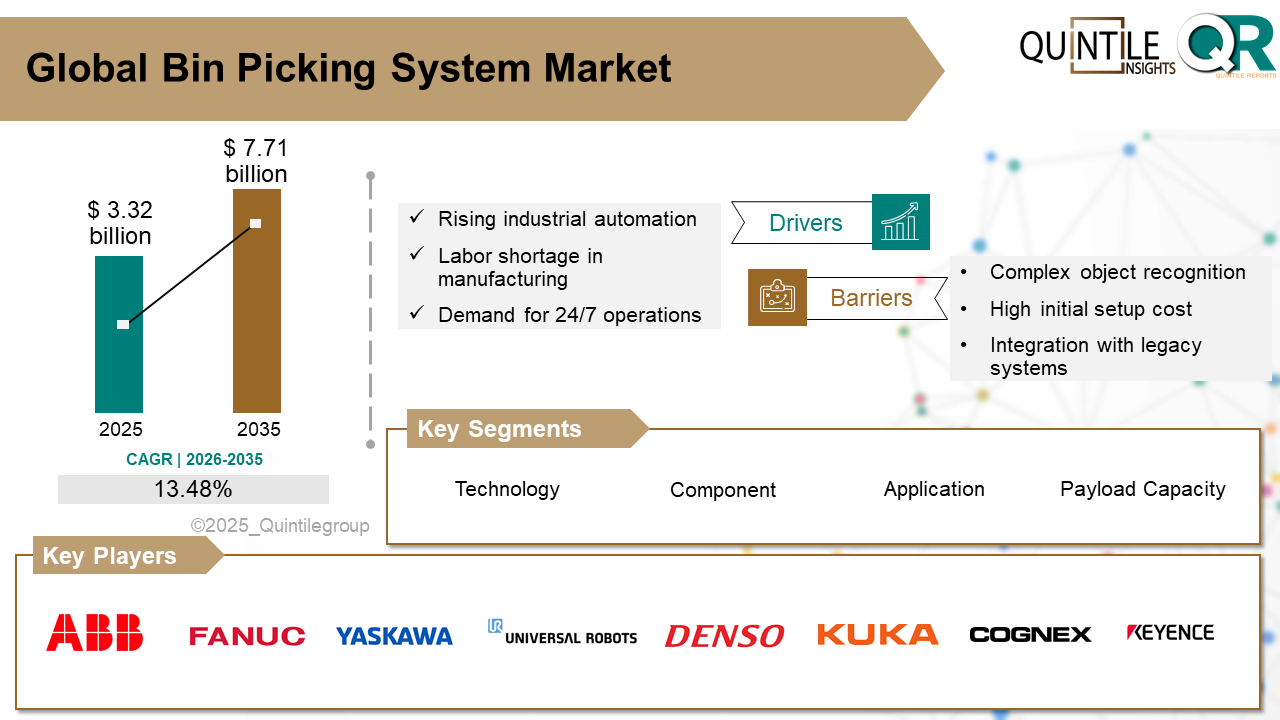
The report provides a detailed analysis of the competitive environment, profiling major companies such as ABB, FANUC Corporation, Yaskawa Electric Corporation, Universal Robots, DENSO Robotics, KUKA AG, Cognex Corporation, Keyence Corporation, Omron Corporation, and Kawasaki Robotics. These players dominate the bin picking system market through advanced robotics, AI-driven vision technology, and global deployment capabilities across industrial automation sectors.
Recent development in the bin picking system market includes a high-speed solution from Fizyr, Cognibotics, and Zivid achieving 2,000 picks per hour with 99.5% accuracy, and Comau’s MI.RA/OnePicker, an AI-powered system that autonomously handles mixed objects without CAD data, enhancing accuracy and reducing manual sorting in warehousing and e-commerce.
Bin-picking systems face key challenges such as distorted 3D data from reflective or transparent materials, visual occlusion from overlapping objects, and difficulties with irregular shapes that hinder accurate grasping. These systems also require complex integration with robots, cameras, software, and conveyors, demanding high technical expertise. High upfront costs and frequent reconfiguration needs can delay ROI, especially for SMEs with diverse product lines or low volumes.
The future of the bin picking system market is poised for strong growth as industries intensify efforts to automate labor-intensive tasks amid persistent workforce shortages and rising demand for operational efficiency. As AI-driven perception, high-speed 3D vision, and adaptive robotics mature, bin-picking solutions will become more accurate, scalable, and easier to deploy across sectors including logistics, electronics, and automotive.
Strategic recommendations for stakeholders include prioritizing modular system designs that allow flexible integration, investing in edge AI capabilities for faster decision-making, and collaborating with vendors offering robust post-deployment support. To maximize adoption, players should focus on lowering the total cost of ownership and developing low-code interfaces that enable configuration by non-specialists. Firms that align solutions with the shift toward lights-out, data-driven manufacturing environments will be best positioned for long-term success.
Quintile Reports, a part of Quintile Group, is a global market intelligence firm delivering actionable insights across industries including MedTech, Pharmaceuticals, Biotechnology, Consumer Goods, Automotive, Agriculture, Aerospace & Defense, Semiconductors, Energy & Power and Financial Services. With expert analysts and a presence across the U.S., UK, and APAC, we help businesses navigate market complexities, identify growth opportunities, and make informed decisions. At Quintile Reports, we turn data into strategy fueling innovation through trusted research and secure, in-depth analysis.
Sarah Singh (Chief Strategic Marketing)
Quintile Reports
Email:sales@quintilereports.com
India, January, 2026 – Quintile Reports, a trusted authority in market intelligence and automation insights, has released its latest analysis on the Bin Picking System Market. This in-depth report examines the evolving role of robotic bin picking technologies defined by their use of 3D vision, AI, and robotics to identify and retrieve items in unstructured settings. As industries across logistics, manufacturing, and warehousing prioritize automation, bin picking systems are becoming essential components of next-generation smart factories and distribution centers.
The report highlights key factors driving market growth, including labor shortages, demand for faster order fulfillment, and advancements in AI-powered perception. It also addresses the integration challenges, cost barriers, and technical limitations impacting adoption. By analyzing current trends in automation readiness, scalability, and system reliability, the study offers actionable insights into how bin picking solutions are transforming operational efficiency and flexibility across industrial workflows.
The global bin picking system market is projected to grow at a compound annual growth rate (CAGR) of 13.48% between 2026 and 2035. Key growth drivers include labor shortages in repetitive tasks, rising e-commerce fulfillment demands, breakthroughs in AI-powered 3D vision for accurate object handling, the adoption of collaborative robots for flexible automation, and the shift toward fully autonomous "lights-out" manufacturing operations.
The report provides a detailed analysis of the competitive environment, profiling major companies such as ABB, FANUC Corporation, Yaskawa Electric Corporation, Universal Robots, DENSO Robotics, KUKA AG, Cognex Corporation, Keyence Corporation, Omron Corporation, and Kawasaki Robotics. These players dominate the bin picking system market through advanced robotics, AI-driven vision technology, and global deployment capabilities across industrial automation sectors.
Recent development in the bin picking system market includes a high-speed solution from Fizyr, Cognibotics, and Zivid achieving 2,000 picks per hour with 99.5% accuracy, and Comau’s MI.RA/OnePicker, an AI-powered system that autonomously handles mixed objects without CAD data, enhancing accuracy and reducing manual sorting in warehousing and e-commerce.
Bin-picking systems face key challenges such as distorted 3D data from reflective or transparent materials, visual occlusion from overlapping objects, and difficulties with irregular shapes that hinder accurate grasping. These systems also require complex integration with robots, cameras, software, and conveyors, demanding high technical expertise. High upfront costs and frequent reconfiguration needs can delay ROI, especially for SMEs with diverse product lines or low volumes.
The future of the bin picking system market is poised for strong growth as industries intensify efforts to automate labor-intensive tasks amid persistent workforce shortages and rising demand for operational efficiency. As AI-driven perception, high-speed 3D vision, and adaptive robotics mature, bin-picking solutions will become more accurate, scalable, and easier to deploy across sectors including logistics, electronics, and automotive.
Strategic recommendations for stakeholders include prioritizing modular system designs that allow flexible integration, investing in edge AI capabilities for faster decision-making, and collaborating with vendors offering robust post-deployment support. To maximize adoption, players should focus on lowering the total cost of ownership and developing low-code interfaces that enable configuration by non-specialists. Firms that align solutions with the shift toward lights-out, data-driven manufacturing environments will be best positioned for long-term success.
Quintile Reports, a part of Quintile Group, is a global market intelligence firm delivering actionable insights across industries including MedTech, Pharmaceuticals, Biotechnology, Consumer Goods, Automotive, Agriculture, Aerospace & Defense, Semiconductors, Energy & Power and Financial Services. With expert analysts and a presence across the U.S., UK, and APAC, we help businesses navigate market complexities, identify growth opportunities, and make informed decisions. At Quintile Reports, we turn data into strategy fueling innovation through trusted research and secure, in-depth analysis.
Sarah Singh (Chief Strategic Marketing)
Quintile Reports
Email:sales@quintilereports.com

A license granted to one user. Rules or conditions might be applied for e.g. the use of electric files (PDFs) or printings, depending on product.
A license granted to multiple users.
A license granted to a single business site/establishment.
A license granted to all employees within organisation access to the product.
Immediate / Within 24-48 hours - Working days
Online Payments with PayPal and CCavenue
You can order a report by picking any of the payment methods which is bank wire or online payment through any Debit/Credit card or PayPal.
Hard Copy
 U.S. : +1-201-772-7734